Virginia's CC-1670 estate inventory, explained
Virginia requires an inventory of the estate on Form CC-1670, filed with the Commissioner of Accounts of the circuit court within four months after the fiduciary qualifies. Va. Code § 64.2-1308 accepts the form itself, a computer-generated facsimile, or any other clear format instead. In practice, Commissioners of Accounts expect the form's own shape, so confirm the exact requirement with your Commissioner before filing. Here is what the form asks for, part by part, and how to have every number ready.
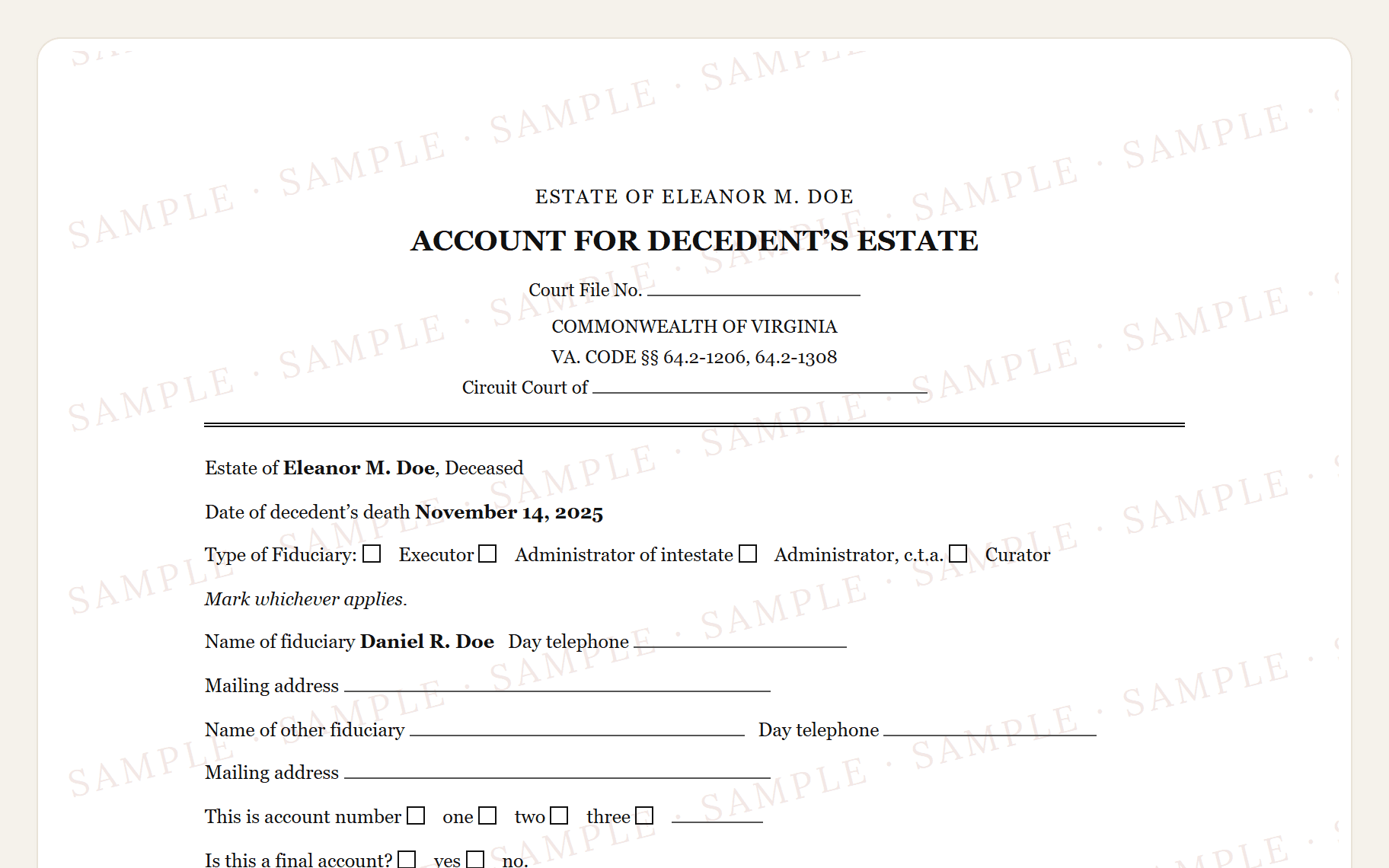
Section 1 of 5.What Form CC-1670 is, and who files it
Virginia probate follows Title 64.2, chiefly Chapter 12 (Commissioners of Accounts) and Chapter 13 (Inventories and Accounts). The fiduciary, whether an executor, administrator, or curator, files with the Commissioner of Accounts of the circuit court where the will was probated or the fiduciary qualified, not with a judge directly.
Va. Code § 64.2-1308 says an inventory filed under § 64.2-1300 may be made on the form provided by the clerk, a computer-generated facsimile, or any other clear format, so neither form is mandatory. The Commissioner of Accounts still expects the form's shape in practice: one circuit's own instructions state that CC-1670 is required unless the Commissioner approves otherwise in advance, so confirm the exact expectation with your estate's Commissioner before filing.
CC-1670, Inventory for Decedent's Estate, lists everything the fiduciary supervises at its fair market value on the date of death, with no deduction for a mortgage, loan, lien, or other claim against the property.
Section 2 of 5.When the inventory is due
Under Va. Code § 64.2-1300, the personal representative generally must file an inventory of the probate assets (the personal estate under their control, the decedent's interest in any multiple-party bank account, real estate over which they hold a power of sale, and any other real estate that is an estate asset) with the commissioner of accounts within 4 months after qualification, so calendar this filing right away; confirm the exact filing deadline with your attorney.
Within 30 days of qualification, or of the will's admission to probate, the fiduciary sends written notice to the surviving spouse, every heir at law, and every living, ascertained beneficiary (Va. Code § 64.2-508(A), (D)). An affidavit proving that notice was sent must then be recorded within four months; the Commissioner of Accounts will not approve a later settlement until that affidavit is recorded.
Section 3 of 5.What goes in it, part by part
CC-1670 has five parts, each its own Description of Property and Value table with its own total. Part 1 holds the decedent's personal estate under the fiduciary's supervision and control, everything that is not real property. Part 2 holds the decedent's interest in multiple-party bank and credit union accounts. Part 3 holds Virginia real estate over which the fiduciary has a power of sale. Part 4 holds the decedent's other Virginia real estate. Part 5 holds non-Virginia real estate.
Two totals print at the top of the form: the total of Parts 1 and 3 (the estate for bond) and the total of Parts 1, 3, and 4 (the estate for probate tax). Parts 2, 4, and 5 stay on the inventory for reporting and probate-tax purposes and never enter the account's own balance, unless a Part 4 property is later sold or handed over under the fiduciary's power, at which point exercising that power moves it into Part 3.
Section 4 of 5.From your records to the CC-1670 form
Recording is free for as long as the estate takes: every receipt and disbursement with its date and description, distributions per beneficiary, and a balance that checks itself as you go. ExecutorLedger builds Virginia-style documents from those records, an inventory shaped like CC-1670 and an account shaped like CC-1680, ready to transcribe if you end up filing them with your Commissioner of Accounts, sending copies to interested persons who request them, or handing them to your attorney. Neither is a court form, and your attorney should review them before anything is signed or filed. Usually less than one attorney hour, and typically reimbursable by the estate.
Section 5 of 5.Questions about the Virginia inventory
Does Virginia require the CC-1670 inventory and CC-1680 account?
No. Va. Code § 64.2-1308 accepts the form, a computer-generated facsimile, or any other clear format for an inventory filed under § 64.2-1300 or an account filed under § 64.2-1206. The Commissioner of Accounts overseeing a given estate can still expect the form's own shape as a matter of local practice, so confirm the exact expectation with your estate's Commissioner.
When is the Virginia inventory due?
Within four months after the date of qualification, at fair market value on the date of death, with no reduction for a mortgage, loan, or other lien (Va. Code § 64.2-1300(A), (D)). It is filed with the Commissioner of Accounts, not the court directly.
What is a Commissioner of Accounts?
A private attorney appointed by the circuit court in each Virginia jurisdiction to review fiduciaries' inventories and accounts under Va. Code Chapter 12, not a probate judge. The fiduciary qualifies before the circuit court or its clerk, then files the inventory and every account with that circuit's own Commissioner of Accounts for review.
The inventory is the first filing, not the last. The full Virginia guide covers the accounting that follows it, every deadline with its statute, what the executor is paid, and how estates close.
This page describes Virginia practice as our verified references state it; formats drift and estates differ, and none of this is legal advice. ExecutorLedger produces court-style documents for transcription. They are not official court forms. What your estate must file is a question for its attorney.