Virginia Estate Accounting: A Fiduciary's Guide
Virginia probate runs through the Commissioner of Accounts of the circuit court where the fiduciary qualified, a court-appointed local officer, not a probate judge or a surrogate's court. Virginia's Office of the Executive Secretary publishes two statewide forms, CC-1670 and CC-1680, but Va. Code § 64.2-1308 accepts the form, a computer-generated facsimile, or any other clear format instead. Here is what each document covers, the deadlines behind each, and how a Virginia estate closes.
Section 1 of 7.The two documents: the CC-1670 inventory and the CC-1680 account
Virginia probate follows Title 64.2, chiefly Chapter 12 (Commissioners of Accounts) and Chapter 13 (Inventories and Accounts). The fiduciary, whether an executor, administrator, or curator, files with the Commissioner of Accounts of the circuit court where the will was probated or the fiduciary qualified, not with a judge directly. Va. Code § 64.2-1308 says an inventory filed under § 64.2-1300 or an account filed under § 64.2-1206 "may be made on the form provided to the fiduciary by the clerk of the court, on a computer-generated facsimile of the appropriate form, or in any other clear format," so neither CC-1670 nor CC-1680 is a mandatory court form. The Commissioner of Accounts still expects the form's shape in practice: one circuit's own instructions state that CC-1670 and CC-1680 are required unless the Commissioner approves otherwise in advance, so confirm the exact expectation with your estate's Commissioner before filing.
CC-1670, "Inventory for Decedent's Estate," lists everything the fiduciary supervises at its fair market value on the date of death, with no deduction for a mortgage, loan, lien, or other claim against the property. It has five parts, each its own "DESCRIPTION OF PROPERTY" and "VALUE" table with its own total. Part 1 holds the decedent's personal estate under the fiduciary's supervision and control, everything that is not real property. Part 2 holds the decedent's interest in multiple-party bank and credit union accounts. Part 3 holds Virginia real estate over which the fiduciary has a power of sale. Part 4 holds the decedent's other Virginia real estate. Part 5 holds non-Virginia real estate. Two totals print at the top of the form: the total of Parts 1 and 3 (the estate for bond) and the total of Parts 1, 3, and 4 (the estate for probate tax).
CC-1680's own instructions answer a question the inventory alone cannot: which parts carry forward. Line 1 of the account, Beginning Assets, comes from Parts 1 and 3 of the inventory only, personal estate plus real estate the fiduciary can sell. Parts 2, 4, and 5 stay on the inventory for reporting and probate-tax purposes and never enter the account's own balance, unless a Part 4 property is later sold or handed over under the fiduciary's power, at which point exercising that power moves it into Part 3.
CC-1680, "Account for Decedent's Estate," is the fiduciary's periodic accounting: a first account covering the first 12 months, then an account every 12 months after, until the estate closes. One checkbox on the form itself, "Is this a final account? yes/no," covers both an interim account and the final account. There is no separate final-account form number.
Section 2 of 7.Virginia's deadlines, with the statute behind each
- Day 30 (about 1 month)Send written notice of probate to heirs and beneficiaries
Why
Under Va. Code §64.2-508, the personal representative generally must mail or deliver written notice of the qualification/probate to the surviving spouse, heirs at law, and beneficiaries within 30 days of qualification or admission of the will to probate, and then record an affidavit of that notice in the clerk's office within 4 months, so calendar the mailing right after you qualify; confirm exactly who must be notified and the affidavit deadline with your attorney. - Day 120 (about 4 months)File the probate inventory
Why
Under Va. Code §64.2-1300, the personal representative generally must file an inventory of the probate assets (the personal estate under their control, the decedent's interest in any multiple-party bank account, real estate over which they hold a power of sale, and any other real estate that is an estate asset) with the commissioner of accounts within 4 months after qualification, so calendar this filing right away; confirm the exact filing deadline with your attorney. - Day 180 (about 6 months)Creditor claims bar date (only if you publish notice)
Why
Under Va. Code §64.2-508.1, publishing notice to creditors is optional in Virginia, not automatic; if the personal representative chooses to publish (once a week for two consecutive weeks in a newspaper of general circulation) and mail notice to known creditors, claims are generally barred as of the later of 6 months after first publication or 90 days after the notice is mailed to that creditor, so this is anchored here to 6 months after qualification only as a conservative placeholder. The real clock starts on your actual publication date; confirm whether you're using this optional procedure and the exact bar date with your attorney. - Day 180 (about 6 months) · earliest possibleEarliest a distribution can be compelled
Why
Under Va. Code §64.2-554, a personal representative generally cannot be compelled to pay a legacy or distribute the estate until 6 months from the date of the order conferring authority on the first executor or administrator, and even then only after the distributee gives a refunding bond (unless the will says otherwise), so treat this as the earliest safe distribution date rather than a due date; confirm timing and whether a refunding bond is needed with your attorney. - Day 480 (about 16 months)First accounting due (then annually)
Why
Under Va. Code §64.2-1304, the personal representative generally must exhibit a first accounting (covering the first 12 months) before the commissioner of accounts within 16 months of qualification, and, once that account is settled, each following account is generally due within 4 months after the close of the next 12-month period, so treat this as a recurring status-report deadline until the estate closes; confirm your commissioner of accounts' exact due date, and whether a §64.2-1314 statement in lieu of settlement applies instead, with your attorney.
- Day 270 (about 9 months)Federal estate tax return (Form 706), if required
Why
Under IRC §6075, Form 706 is due 9 months after death, but only if the gross estate exceeds the federal exemption or the estate elects portability, and a 6-month extension may be available; confirm applicability and timing with your attorney.
The inventory is due within four months after the date of the order conferring authority, the qualification date, at fair market value on the date of death (Va. Code § 64.2-1300(A), (D)). It goes to the Commissioner of Accounts, not the court directly.
Read the full explanation
Within 30 days of qualification, or of the will's admission to probate, the fiduciary sends written notice to the surviving spouse, every heir at law, and every living, ascertained beneficiary (Va. Code § 64.2-508(A), (D)). An affidavit proving that notice was sent must then be recorded within four months (§ 64.2-508(F)); the Commissioner of Accounts will not approve a later settlement until that affidavit is recorded.
Publishing notice to creditors is optional in Virginia, not automatic (Va. Code § 64.2-508.1(B), "may publish"). If the fiduciary chooses to publish, once a week for two consecutive weeks, claims are barred as of the later of six months after first publication or 90 days after mailed notice to a known creditor (§ 64.2-508.1(C)(4)).
A fiduciary cannot be compelled to pay a legacy or distribute the estate until six months from the date of the order conferring authority on the first executor or administrator, and then only after the distributee gives a refunding bond, unless the will says otherwise (Va. Code § 64.2-554). After that, a court may instead order creditors to show cause and then order distribution on its own refunding-bond terms (§ 64.2-556).
The first account is due within 16 months of qualification, covering the first 12 months. Once that account is settled, each following account covers the next 12-month period and is due within four months after that period closes (Va. Code § 64.2-1304(A), (B)).
Once an account is filed, the Commissioner's report to the circuit court stands confirmed the day after 15 days have passed with no exceptions filed; any exceptions filed within that window are examined and resolved by the circuit court instead (Va. Code § 64.2-1212(A), (B)).
A federal estate tax return, Form 706, if the estate needs one, is due nine months after death (IRC section 6075), with a possible six-month extension. Confirm whether the estate needs one with your attorney.
Section 3 of 7.What Virginia pays a fiduciary
Virginia sets no statutory percentage for fiduciary compensation. Va. Code § 64.2-1208(A) directs the Commissioner of Accounts to allow "reasonable expenses" plus, except where otherwise provided, "a reasonable compensation in the form of a commission on receipts or otherwise," with no percentage, tier, or cap written into the statute itself.
The Judicial Council's Standing Committee on Commissioners of Accounts publishes a statewide Guidelines for Fiduciary Compensation that many Commissioners apply in practice: a one-time principal fee of 5 percent of the first $400,000 of the probate estate, 4 percent of the next $300,000, 3 percent of the next $300,000, and 2 percent over $1,000,000 (amounts over $10,000,000 by agreement with the Commissioner, with prior consultation required), plus a separate 5 percent of income receipts, not including capital gains, taken annually. Real estate counts toward the fee-bearing estate only if the fiduciary has the power to sell it and is instructed to sell it in the will, is asked to sell it by every affected beneficiary, must sell it to pay taxes or other charges, or determines the sale is clearly in the estate's best interest. The Guidelines describe themselves plainly as guidance, not a rate: "A guideline is a statement of policy or procedure; it is not a fiat. ... The guidelines are not intended as a substitute for the analytical work the Commissioner must do in determining the statutory 'reasonable compensation' for each case."
Missing a year's accounting carries a real cost. Va. Code § 64.2-1217 provides that a fiduciary who wholly fails to file a complete account for a year forfeits compensation, and any commission on money or property left out of that year's account, unless the Commissioner of Accounts allows it for good cause shown.
Section 4 of 7.How a Virginia estate closes
Virginia has not adopted the Uniform Probate Code, so there is no single verified closing statement the way some other states use. Most estates close by continuing to file accounts under Va. Code § 64.2-1304 every 12 months until the estate is fully distributed. Before distributing the residue, the fiduciary generally cannot act earlier than six months after the first executor or administrator qualified, and can require each beneficiary to sign a refunding bond, or in practice a receipt-and-refunding agreement, promising to return a proportionate share if a later-proved debt turns up (§ 64.2-554; a court can also order distribution on its own refunding-bond terms after calling creditors to show cause, § 64.2-556). Once the fiduciary files what will be the final account, the Commissioner of Accounts states, settles, and reports it to the circuit court (§ 64.2-1312); the report stands confirmed if no one files exceptions within 15 days, and the circuit court examines and resolves any timely exceptions instead (§ 64.2-1212(A), (B)).
A shorter route exists when every distributee of an intestate estate, or every residuary beneficiary under a will, is also a fiduciary of the estate. In lieu of filing a full CC-1680, that fiduciary can file a sworn statement in lieu of settlement (CC-1681) once six months have passed since qualification, every known debt and tax is paid, and the residue is already delivered (Va. Code § 64.2-1314). A residuary beneficiary's version needs an itemized, vouchered list showing every other bequest satisfied. If the statement cannot yet be filed by the usual account deadline, the fiduciary instead files an interim account, or a sworn notice of intent to file the statement later, repeated annually until the statement can be filed.
- Keep filing your accounts with the commissioner of accounts (Va. Code §64.2-1304) every 12 months until the estate is fully distributed. Virginia estates close through this ongoing accounting process rather than a single closing petition.
- Before distributing the residue, remember the personal representative generally cannot be compelled to distribute earlier than 6 months after the first personal representative qualified, and can require each beneficiary to sign a refunding bond (or, in practice, an informal receipt-and-refunding agreement) promising to return a proportionate share if a later-proved debt turns up (Va. Code §64.2-554; the court can also order distribution on its own refunding-bond terms after creditors are called to show cause, Va. Code §64.2-556).
- If every distributee, or every residuary beneficiary under the will, is also a personal representative of the estate, ask your attorney whether you can skip full account settlement and instead file a sworn 'statement in lieu of settlement' confirming all known charges are paid, at least 6 months have passed since qualification, and the residue has been delivered (Va. Code §64.2-1314).
- Otherwise, the commissioner of accounts states, settles, and reports your final account to the circuit court (Va. Code §64.2-1312); the report generally stands confirmed if no one files exceptions within 15 days, and any timely exceptions by a beneficiary or creditor are examined and resolved by the circuit court (Va. Code §64.2-1212) rather than closing administratively.
Virginia has not adopted the Uniform Probate Code, so there is no single UPC-style verified closing statement. The routes above are the closest Virginia equivalents. Local commissioners of accounts can have their own preferred wording and documentation, so confirm the exact closing route with your attorney or the commissioner's office.
Section 5 of 7.The CC-1670 and CC-1680 explained for a first-time fiduciary
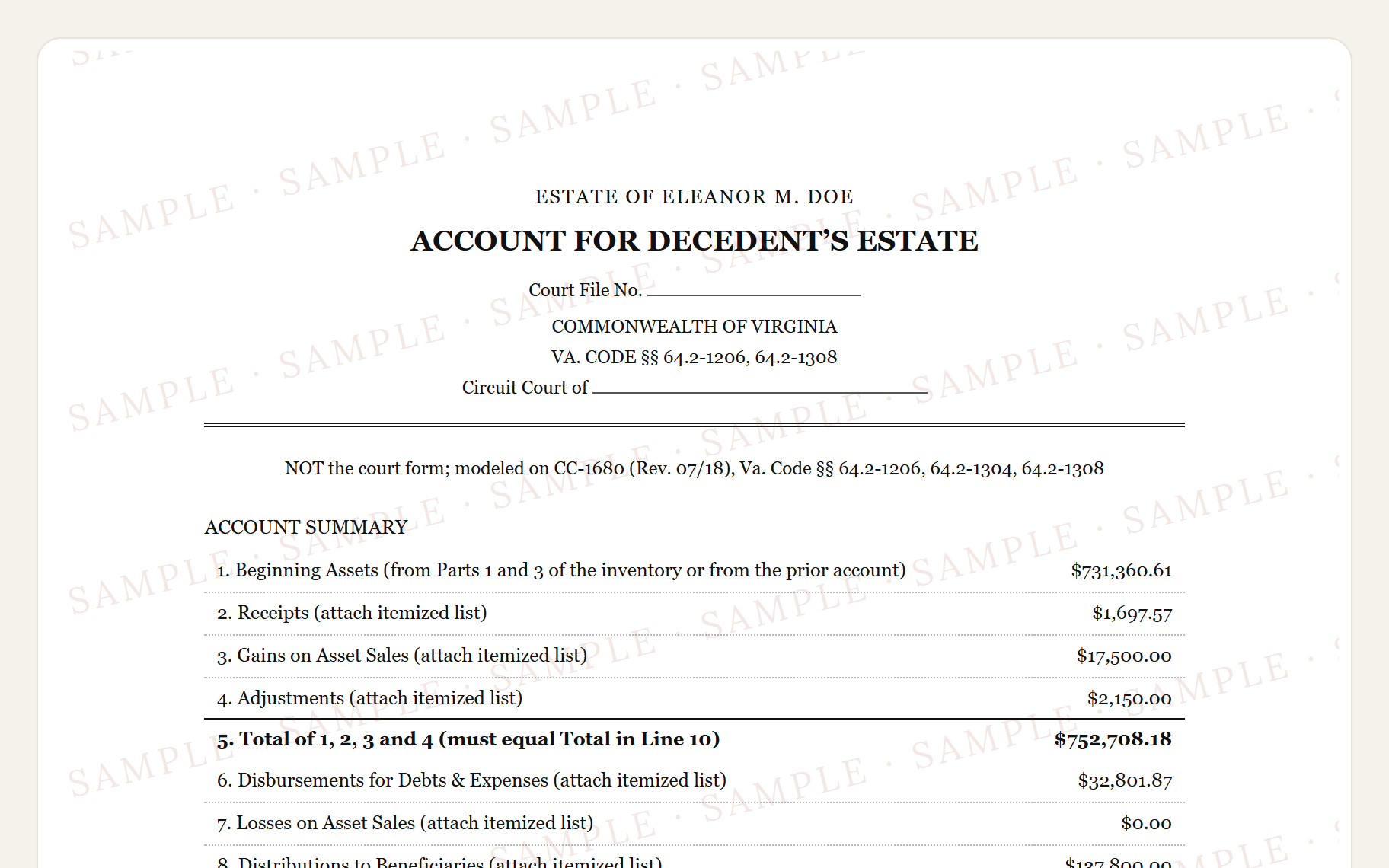
CC-1680's Account Summary runs ten numbered lines, each marked "attach itemized list" except the totals. Line 1, Beginning Assets, is the date-of-death value of every Part 1 and Part 3 inventory asset on a first account, or the prior account's Assets on Hand at carrying value on a later one. Line 2, Receipts, itemizes every item of income separately and in order, interest, dividends, rental income, refunds, so a year of monthly bank interest is twelve dated lines, never one lump sum. Line 3, Gains on Asset Sales, and Line 7, Losses on Asset Sales, both measure against the carried value: for a broker sale, net proceeds less carrying value; for any other sale, total proceeds less the cost of sale and less carrying value. Line 4, Adjustments, covers two things: after-discovered property the Commissioner has allowed the fiduciary to report here instead of on a supplemental inventory, and corrections to a value or share count reported incorrectly on the inventory or a prior account.
Line 5 totals Lines 1 through 4, and it must equal Line 10, the total of Lines 6 through 9. This is the account's balancing identity: everything that came in during the period, plus what was already on hand, has to equal everything paid out, distributed, or still on hand at the end. One Commissioner's own instructions state the rule in capitals: lines 5 and 10 must be identical, or the account does not balance.
Line 6, Disbursements for Debts and Expenses, lists every payment from estate funds in order; a fiduciary's own commission is one more line here, since CC-1680 has no separate compensation line. Line 8, Distributions to Beneficiaries, states each beneficiary's name, the asset delivered, and its value. Line 9, Assets on Hand, lists what remains at its carrying value as of the account's end date; where the market value differs from the carrying value, the market value is shown in parentheses within the description. A single Market Value of Assets on Hand dollar figure sits at the foot of the summary, the only aggregate market-value line the printed form carries.
Every disbursement and distribution needs proof: a proper voucher, a signed invoice or receipt from the payee, or, for a distribution, a signed receipt from the beneficiary, with a canceled check endorsed on the back by whoever received it. Missing vouchers are the fiduciary's own exposure, not just a returned filing, so keep them as you go rather than reconstructing them later.
Section 6 of 7.Where ExecutorLedger fits
Recording is free for as long as the estate takes: every receipt and disbursement with its date and description, distributions per beneficiary, and a balance that checks itself as you go. ExecutorLedger builds Virginia-style documents from those records, an inventory shaped like CC-1670 and an account shaped like CC-1680, ready to transcribe if you end up filing them with your Commissioner of Accounts, sending copies to interested persons who request them, or handing them to your attorney. Neither is a court form, and your attorney should review them before anything is signed or filed. Every document previews free with your real numbers, and $149 once per estate lifts the watermark.
Section 7 of 7.Questions Virginia executors ask
Does Virginia require the CC-1670 inventory and CC-1680 account?
No. Va. Code § 64.2-1308 accepts the form, a computer-generated facsimile, or any other clear format for an inventory filed under § 64.2-1300 or an account filed under § 64.2-1206. The Commissioner of Accounts overseeing a given estate can still expect the form's own shape as a matter of local practice, so confirm the exact expectation with your estate's Commissioner.
When is the Virginia inventory due?
Within four months after the date of qualification, at fair market value on the date of death, with no reduction for a mortgage, loan, or other lien (Va. Code § 64.2-1300(A), (D)). It is filed with the Commissioner of Accounts, not the court directly.
How is a Virginia fiduciary paid?
Va. Code § 64.2-1208 sets reasonable compensation, with no statutory percentage. The Judicial Council's Standing Committee on Commissioners of Accounts publishes non-binding Guidelines many Commissioners apply: 5 percent of the first $400,000 of the probate estate, 4 percent of the next $300,000, 3 percent of the next $300,000, and 2 percent over $1,000,000, plus 5 percent of income receipts taken annually. Wholly failing to file a complete account for a year can forfeit that year's compensation (§ 64.2-1217).
How does a Virginia estate close?
Most estates close by continuing to file accounts under Va. Code § 64.2-1304 every 12 months until the Commissioner of Accounts states, settles, and reports the final account to the circuit court for confirmation (§§ 64.2-1312, 64.2-1212(A), (B)). When every distributee or residuary beneficiary is also a fiduciary of the estate, a sworn statement in lieu of settlement (CC-1681) can replace the final account instead (§ 64.2-1314).
What is a Commissioner of Accounts?
A private attorney appointed by the circuit court in each Virginia jurisdiction to review fiduciaries' inventories and accounts under Va. Code Chapter 12, not a probate judge. The fiduciary qualifies before the circuit court or its clerk, then files the inventory and every account with that circuit's own Commissioner of Accounts for review.
Not sure which accounting your situation calls for? Which accounting do I need? covers the choice, and the accounting guide explains the structure every format shares.
This page describes Virginia practice as our verified references state it; formats drift and estates differ, and none of this is legal advice. ExecutorLedger produces court-style documents for transcription. They are not official court forms. The accounting your estate needs is a question for its attorney.