Maryland's RW1122/RW1123 estate inventory, explained
Maryland requires an inventory of probate assets on Forms RW1122 and RW1123, filed with the county Register of Wills within three months of appointment. Here is what the forms ask for, part by part, and how to have every number ready.
Section 1 of 5.What Forms RW1122 and RW1123 are, and who files them
Maryland probate runs through the county Register of Wills, under the Orphans' Court. The inventory comes first: Form RW1122, the Inventory Summary, and Form RW1123, the Supporting Schedule. Filing the inventory is mandatory. The summary has seven lettered rows and a Total: A Real, B Leasehold, C Tangible personal, D Corporate stocks, E Bonds, notes, mortgages, debts due to the decedent, F Bank accounts, savings and loan accounts, cash, and G All other interests. Each letter equals the footed total of its own RW1123 page.
Section 2 of 5.When the inventory is due
Under Md. Code, Est. & Trusts §7-201 and Md. Rule 6-402, the personal representative generally must file an inventory of the probate assets, valued as of the date of death, within 3 months after appointment, and the Register of Wills reviews every filing. Confirm the exact due date with your attorney.
Section 3 of 5.What goes in it, part by part
You list what the decedent owned at death, solely or as a tenant in common, at gross fair market value as of that day, with any mortgage or lien disclosed in the description rather than netted out. Est. & Trusts §7-202 lets you value some things yourself: exchange-listed and over-the-counter stock, debts owed to the decedent including bonds and notes, and bank accounts and cash. Real and leasehold property can instead be carried at the full cash value for property-tax assessment as of the most recent date of finality, or at the contract price of an arm's-length sale settling within a year of death; a vehicle can be valued from a used-car guide. Anything else, such as household contents or a business interest, needs an independent appraisal. Confirm with the estate's attorney which method fits an item.
Property that passes outside probate goes on the Information Report (Form RW1124) instead, though an IRA, annuity, or life insurance payable to the estate, or with no named beneficiary, is a probate asset on Schedule G. The rest of the sorting is yours: bonds, notes, and debts owed to the decedent on E; directly held stock certificates on D; leasehold property (land subject to a ground rent the decedent didn't own) on B. Real property outside Maryland stays off the inventory entirely and goes on the Information Report instead. Brokerage accounts stay on G, per register practice, even when they hold stocks and bonds.
Section 4 of 5.From your records to the RW1122 and RW1123 forms
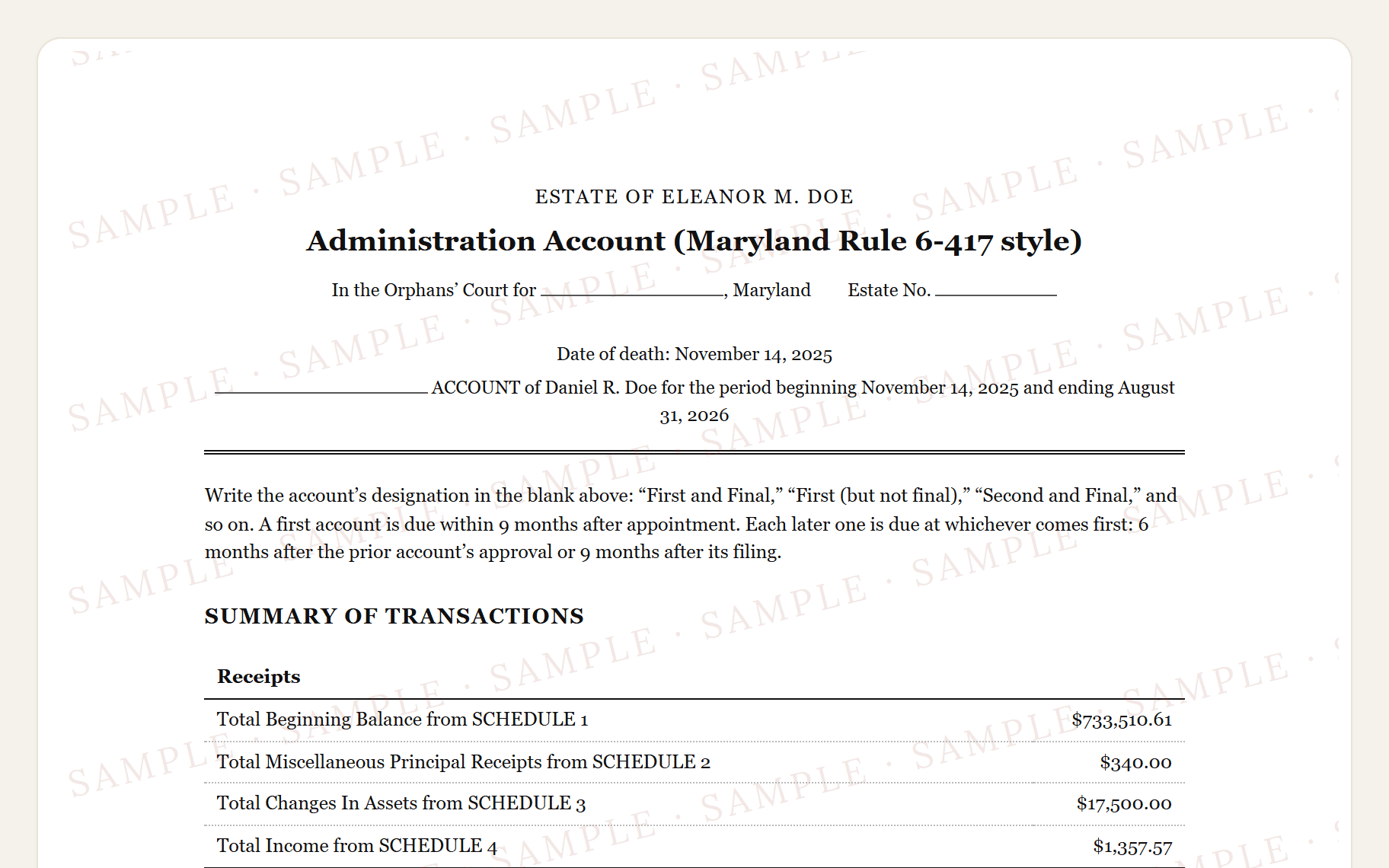
ExecutorLedger keeps the estate's books and builds these documents from them. Recording is free, and the court-style Maryland documents preview free with your real numbers: an inventory package grouped the way RW1122 and RW1123 expect, and a seven-schedule account in the shape of Md. Rule 6-417. They are not court forms. The inventory package mirrors RW1122 and RW1123 so you can transcribe it line for line onto the official Register of Wills forms. The estate's attorney should read both first.
Section 5 of 5.Questions about the Maryland inventory
What is the difference between the RW1122 inventory and the RW1124 Information Report?
Property that passes outside probate, such as joint accounts, trusts, beneficiary-designated assets, and certain pre-death transfers, goes on the Information Report (Form RW1124) instead of the inventory. An IRA, annuity, or life insurance payable to the estate, or with no named beneficiary, is a probate asset and belongs on the inventory instead, Schedule G.
How do I value property for the RW1122 and RW1123 inventory?
You can self-value exchange-listed and over-the-counter stock, debts owed to the decedent including bonds and notes, and bank accounts and cash. Real and leasehold property can be valued at the full cash value for property-tax assessment as of the most recent date of finality, or at the contract price of an arm's-length sale settling within a year of death. A vehicle can be valued from a used-car guide. Anything else, such as household contents or a business interest, needs an independent appraisal. Confirm with the estate's attorney which method fits each item.
The inventory is the first filing, not the last. The full Maryland guide covers the accounting that follows it, every deadline with its statute, what the executor is paid, and how estates close.
This page describes Maryland practice as our verified references state it; formats drift and estates differ, and none of this is legal advice. ExecutorLedger produces court-style documents for transcription. They are not official court forms. What your estate must file is a question for its attorney.