Colorado's JDF 941SC estate inventory, explained
Colorado requires a sworn inventory of the estate on Form JDF 941SC within three months of appointment, which may be filed with the court or sent to interested persons who request it. Here is what the form asks for, part by part, and how to have every number ready.
Section 1 of 5.What Form JDF 941SC is, and who files it
Colorado has two Judicial Branch forms. The inventory, JDF 941SC, sorts what the decedent owned into eight schedules: seven asset categories, real estate, stocks and investment accounts, mortgages and cash and bank accounts, life insurance payable to the estate, retirement funds payable to the estate, motor and recreation vehicles, and other assets, each feeding one Total Gross Value, plus an eighth schedule, liens and encumbrances, subtracted to reach Total Net Value. Each schedule carries its own None box. The personal representative, and any co-personal representative, sign under penalty of perjury.
Filing the inventory with the court is elective by default. C.R.S. 15-12-706(2) lets a personal representative send a copy of the inventory to interested persons who request it instead of filing the original with the court. Filing becomes a precondition only ahead of a formal complete-settlement petition, when a court orders it, or under supervised administration.
Section 2 of 5.When the inventory is due
Under Colo. Rev. Stat. §15-12-706, an inventory of probate property with date-of-death values and encumbrances is generally due within 3 months after appointment, and may either be filed with the court or sent to interested persons who request it; confirm the due date and whether to file or circulate it with your attorney.
When heirs or devisees are unknown or unqualified, a copy of the inventory also goes to the attorney general, within that same 3 months (C.R.S. 15-12-706(3)).
Section 3 of 5.What goes in it, part by part
The inventory, JDF 941SC, sorts what the decedent owned into eight schedules: seven asset categories, real estate, stocks and investment accounts, mortgages and cash and bank accounts, life insurance payable to the estate, retirement funds payable to the estate, motor and recreation vehicles, and other assets, each feeding one Total Gross Value, plus an eighth schedule, liens and encumbrances, subtracted to reach Total Net Value. Each schedule carries its own None box.
Section 4 of 5.From your records to the JDF form
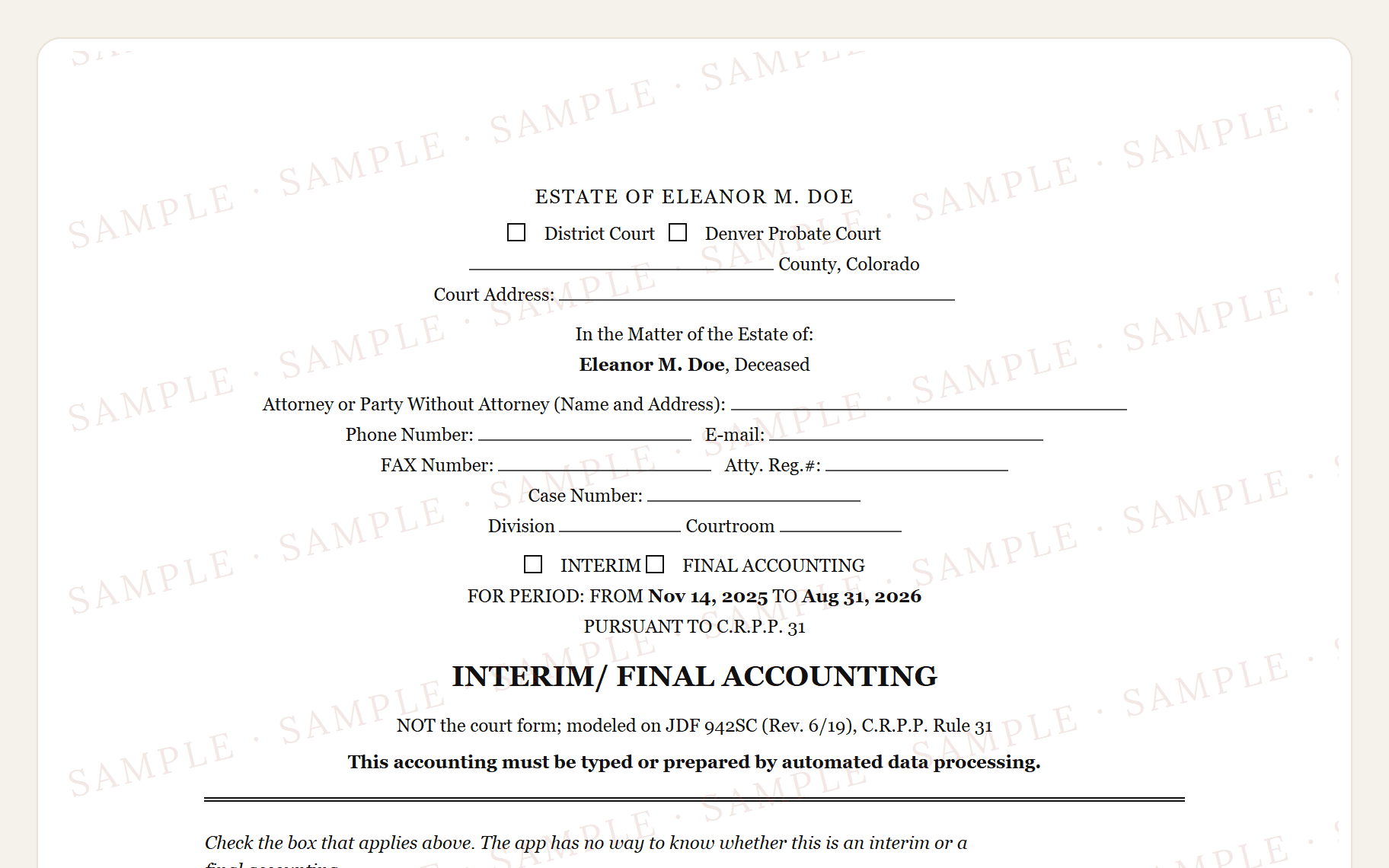
Recording is free for as long as the estate takes: every receipt and payment with its date and description, a cash balance that checks itself as you go, and the assets you are tracking by category. ExecutorLedger builds Colorado-style documents from those records, an inventory shaped like JDF 941SC and an accounting shaped like JDF 942SC, ready to transcribe if you end up needing to file or hand a copy to interested persons. Neither is the court's own form, and your attorney should review them before anything is signed or sent. Usually less than one attorney hour, and typically reimbursable by the estate.
Section 5 of 5.Questions about the Colorado inventory
Do I have to file the Colorado JDF 941SC inventory with the court?
Not usually. C.R.S. 15-12-706(2) lets you send a copy to interested persons who request it instead of filing the original with the court. Filing becomes a precondition only ahead of a formal complete-settlement petition, when a court orders it, or under supervised administration.
When is the Colorado inventory due?
Generally 3 months after your appointment, valued at fair market value as of the decedent's date of death (C.R.S. 15-12-706(1)).
The inventory is the first filing, not the last. The full Colorado guide covers the accounting that follows it, every deadline with its statute, what the executor is paid, and how estates close.
This page describes Colorado practice as our verified references state it; formats drift and estates differ, and none of this is legal advice. ExecutorLedger produces court-style documents for transcription. They are not official court forms. What your estate must file is a question for its attorney.