Colorado Estate Accounting: An Executor's Guide
Colorado calls the accounting the JDF 942SC, and most estates are never required to file either it or the JDF 941SC inventory with the court. Here is what the two Judicial Branch forms expect, and when the law requires filing one.
Section 1 of 7.The two documents: the JDF 941SC inventory and the JDF 942SC accounting
Colorado has two Judicial Branch forms. The inventory, JDF 941SC, sorts what the decedent owned into eight schedules: seven asset categories, real estate, stocks and investment accounts, mortgages and cash and bank accounts, life insurance payable to the estate, retirement funds payable to the estate, motor and recreation vehicles, and other assets, each feeding one Total Gross Value, plus an eighth schedule, liens and encumbrances, subtracted to reach Total Net Value. Each schedule carries its own None box. The personal representative, and any co-personal representative, sign under penalty of perjury.
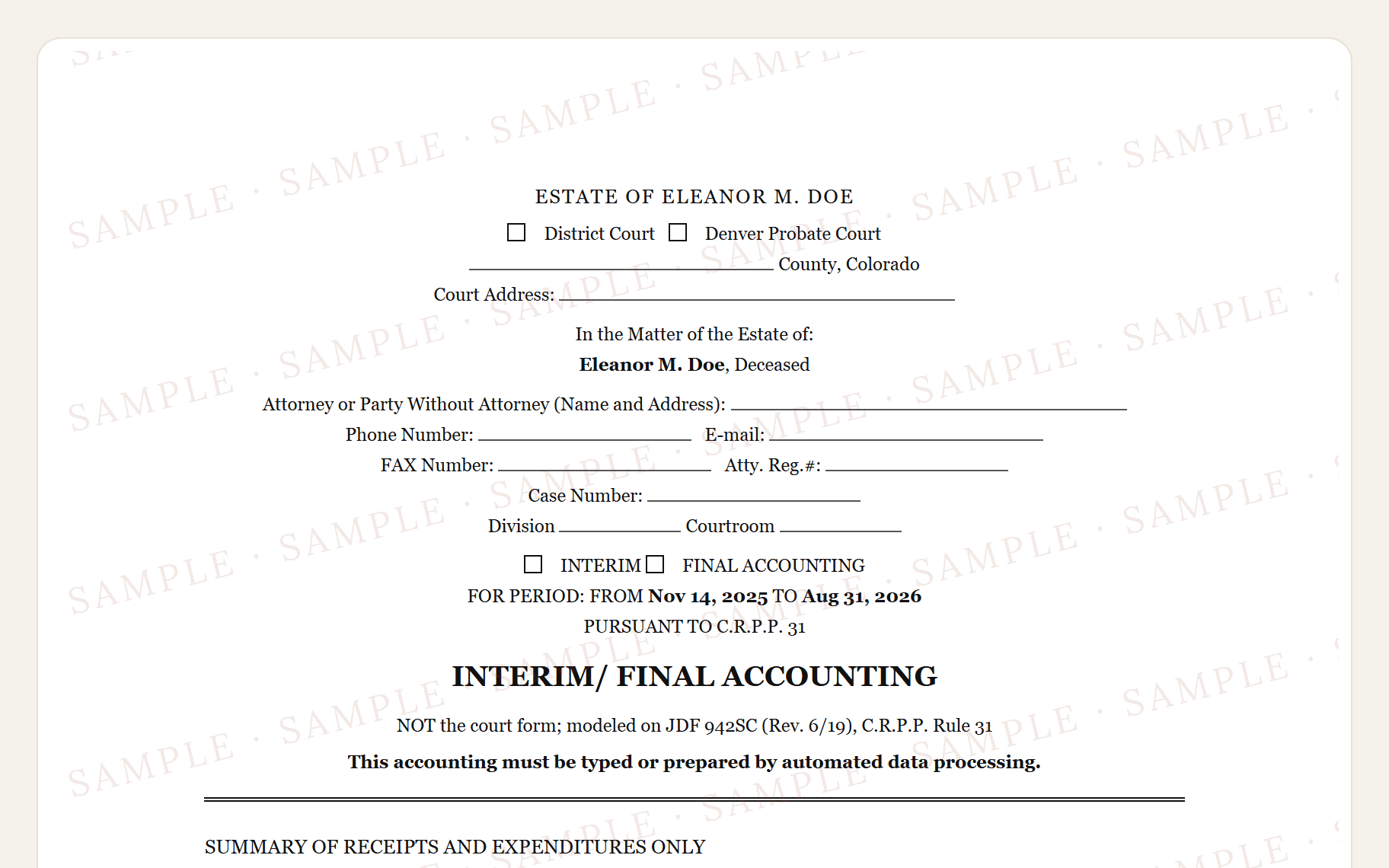
The accounting, JDF 942SC, is one form covering either an interim or a final accounting, told apart by a checkbox rather than two separate forms. It rolls forward from a beginning balance, adds funds received or collected during the period, detailed on page 2, subtracts payments made during the period, detailed on page 3, and reaches an ending balance. A one-page SUMMARY table then reuses the same eight schedule categories at their period-end values. The form's own header states it plainly: this accounting must be typed or prepared by automated data processing.
Filing either one with the court is elective by default. C.R.S. 15-12-706(2) lets a personal representative send a copy of the inventory to interested persons who request it, or file the original with the court, and there is no blanket duty to file an accounting with the court at all outside a few narrower routes. Neither document claims to be the court's own form here; each is shaped to transcribe onto it.
Section 2 of 7.Colorado deadlines, with the statute behind each
- Day 30 (about 1 month)Information of appointment to heirs and devisees
Why
Under Colo. Rev. Stat. §15-12-705, the personal representative generally must send information of the appointment (identifying the personal representative and the court, whether a bond was filed, whether administration is supervised, and the recipients' rights to an inventory, an accounting, and any allowances) to each heir and devisee whose address is reasonably available within 30 days after appointment; confirm the recipient list and exact timing with your attorney. - Day 30 (about 1 month)Publish notice to creditors
Why
Under Colo. Rev. Stat. §15-12-801, unless a year has already passed since death, the personal representative generally must have notice to creditors published at least once during each of three consecutive calendar weeks, setting a claims deadline no earlier than 4 months after first publication (or one year after death, whichever comes first); the statute ties this to the appointment itself without a fixed day count, so this entry is anchored to your letters date as a conservative prompt. Confirm the publication plan and dates with your attorney. - Day 90 (about 3 months)Inventory of estate property (JDF 941)
Why
Under Colo. Rev. Stat. §15-12-706, an inventory of probate property with date-of-death values and encumbrances is generally due within 3 months after appointment, and may either be filed with the court or sent to interested persons who request it; confirm the due date and whether to file or circulate it with your attorney. - Day 180 (about 6 months) · earliest possibleInformal closing statement first becomes available
Why
Under Colo. Rev. Stat. §15-12-1003, the sworn closing statement (JDF 965) generally may be filed no earlier than 6 months after the original appointment of a personal representative, or one year after death if that comes first, so this is the first day informal closing becomes possible rather than a due date; confirm the timing with your attorney.
- Day 270 (about 9 months)Federal estate tax return (Form 706), if required
Why
Under IRC §6075, Form 706 is due 9 months after death, but only if the gross estate exceeds the federal exemption or the estate elects portability, and a 6-month extension may be available; confirm applicability and timing with your attorney. - Day 365 (about 1 year)Absolute one-year bar on pre-death creditor claims
Why
Under Colo. Rev. Stat. §15-12-803, pre-death claims are generally barred one year after death regardless of notice (the statute is a nonclaim bar that cannot be waived or tolled), and often earlier: by the date set in the published notice (at least 4 months after first publication) or, for a creditor given written notice under §15-12-801(2), the later of the published deadline or 60 days after mailing, never past the one-year mark. Calendar the bar before paying or distributing; confirm the operative bar date for each creditor with your attorney.
The JDF 941SC inventory is generally due 3 months after your appointment, valued at fair market value as of the decedent's date of death, with the type and amount of any liens and encumbrances disclosed (C.R.S. 15-12-706(1)). When heirs or devisees are unknown or unqualified, a copy of the inventory also goes to the attorney general, within that same 3 months (C.R.S. 15-12-706(3)).
Read the full explanation
A general closing statement cannot be filed earlier than 6 months after your original appointment, or 1 year after the date of death, whichever comes first (C.R.S. 15-12-1003). Once a year passes with no proceeding pending, it becomes unchallengeable except for fraud or manifest error, and your appointment automatically ends.
A petition for formal complete settlement may be filed by the personal representative at any time; any other interested person must wait until 1 year after the original personal representative's appointment, and no petition is entertained until the creditor claims period has expired (C.R.S. 15-12-1001). Specific written objections to an account or a petition are due at or before the hearing, or 14 or more days before a scheduled appearance hearing (C.R.P.P. Rule 42).
Two clocks run after an estate closes. Filing a closing statement starts a 6-month bar on claims against you for breach of fiduciary duty (C.R.S. 15-12-1005). Against a distributee instead, a creditor's claim is barred 1 year after death, and any other claim to recover improperly distributed property is barred at the later of 3 years after death or 1 year after the distribution (C.R.S. 15-12-1006). Neither bar reaches a claim of fraud.
Section 3 of 7.What Colorado pays a personal representative
C.R.S. 15-10-602 and 15-10-603 set the rule: a fiduciary and the fiduciary's lawyer are entitled to reasonable compensation for services rendered on behalf of the estate. Colorado has no statutory percentage schedule. Section 15-10-603(2) says no method of charging a fee is presumed unreasonable on its own, and 15-10-603(3) lists thirteen reasonableness factors, among them the time and labor required, compensation customarily charged in the community, and the nature and size of the estate.
Compensation is normally paid without a court order, except that once you have notice of removal proceedings, payment requires one, and the court keeps authority in every case to review reasonableness and order a refund of anything excessive (C.R.S. 15-10-602(5)). The older personal-representative fee statute, C.R.S. 15-12-719, is repealed; it no longer governs anything.
Section 4 of 7.How a Colorado estate closes
Colorado has four routes to close an estate, and the JDF 942SC accounting is treated differently on each. A formal complete settlement (C.R.S. 15-12-1001) runs through an eight-form packet; it requires the JDF 941SC inventory already on file with the court, and the accounting joins the packet only when the required waivers of notice were not submitted with the petition. These hearings proceed without a personal appearance, at 8:00 a.m. on weekdays, unless contested (C.R.P.P. Rule 24).
A general closing statement (C.R.S. 15-12-1003) has no dollar ceiling and may be filed once 6 months have passed since your original appointment, or 1 year after the date of death, whichever comes first. The accounting is mailed or hand-delivered to interested persons under this route, but it does not need to be filed with the court.
A small estate can close by sworn statement (C.R.S. 15-12-1204) once the sum of the estate's fiduciary personal property, exempt property, family allowance, administration costs, funeral expenses, and last-illness medical expenses stays under a formula the statute sets, not a flat dollar figure. A separate, adjacent mechanism, the small-estate affidavit (C.R.S. 15-12-1201), lets an heir collect certain property without either JDF form at all, once the estate's value falls under twice the exempt-property figure, adjusted each year.
Supervised administration (C.R.S. 15-12-501, 504, and 505) is the one route that makes both documents mandatory filings on their own: the inventory, an annual interim accounting, and a final accounting, unless the court orders otherwise (C.R.P.P. Rule 54(b)).
- Wait until at least 6 months after your appointment (or 1 year after death, if that comes first) and until the creditor claim periods have run before starting to close (C.R.S. §15-12-1003).
- Prepare a final accounting showing receipts, disbursements, and remaining assets (the court's JDF 942 layout satisfies Rule 31) and send it to all distributees.
- File the sworn Statement of Personal Representative Closing Administration (JDF 965) under §15-12-1003 with the court, after mailing a copy to every distributee and known unpaid claimant. No hearing is required for the informal route.
- Keep your records for a year: your appointment terminates automatically one year after the closing statement is filed if no proceedings are pending, and interested persons can still object during that year.
- If disputes are likely or you want a court-ordered discharge, petition instead for formal final settlement (§15-12-1001, JDF 960) and collect a signed Receipt and Release (JDF 731) from each beneficiary.
Most uncontested Colorado estates close informally by sworn closing statement, the UPC §3-1003 pattern. Probate sits in the district court of the county where the decedent lived, except the City and County of Denver, which has a dedicated Denver Probate Court with exclusive probate jurisdiction (C.R.S. §13-9-103).
Section 5 of 7.The accounting explained for a first-time executor
The JDF 942SC accounting is a cash roll-forward, not a full transaction ledger. Four lines carry it: a beginning balance, funds received or collected during the period, payments made during the period, and an ending balance, which is the beginning balance plus what came in minus what went out. On a first accounting, the beginning balance is the date-of-death value of the bank and cash assets the estate owned at death.
A sale during the period counts as funds received at its full sale price, in date order, the same as any other money coming in. There is no separate schedule for gains or losses, no dedicated executor-fee line, and no principal-and-income split anywhere on the form.
Property handed to a beneficiary in kind, rather than sold for cash, is not a payment of funds, and it never appears on page 3. It leaves the SUMMARY table on page 1, the same table that lists the eight schedule categories from the inventory at their period-end values.
The app tracks no liens today. Schedule 8's five pre-printed rows, its Total Encumbrances line, and the Total Net Value that depends on it print as labeled blanks for you to fill in by hand, the same convention Arkansas and Massachusetts already use for what their own registries do not track.
Section 6 of 7.Where ExecutorLedger fits
Recording is free for as long as the estate takes: every receipt and payment with its date and description, a cash balance that checks itself as you go, and the assets you are tracking by category. ExecutorLedger builds Colorado-style documents from those records, an inventory shaped like JDF 941SC and an accounting shaped like JDF 942SC, ready to transcribe if you end up needing to file or hand a copy to interested persons. Neither is the court's own form, and your attorney should review them before anything is signed or sent. Every document previews free with your real numbers, and $149 once per estate lifts the watermark.
Section 7 of 7.Questions Colorado executors ask
Do I have to file the Colorado JDF 941SC inventory with the court?
Not usually. C.R.S. 15-12-706(2) lets you send a copy to interested persons who request it instead of filing the original with the court. Filing becomes a precondition only ahead of a formal complete-settlement petition, when a court orders it, or under supervised administration.
When is the Colorado inventory due?
Generally 3 months after your appointment, valued at fair market value as of the decedent's date of death (C.R.S. 15-12-706(1)).
Does the JDF 942SC accounting have to be filed with the court?
Only in narrower cases. C.R.P.P. Rule 54(b) makes filing mandatory under supervised administration. On the formal complete-settlement route it joins the petition packet only when the required waivers of notice were not submitted. Outside those cases, Colorado has no blanket duty to file an accounting with the court at all.
How is a Colorado personal representative paid?
C.R.S. 15-10-602 and 15-10-603 set reasonable compensation, with no statutory percentage schedule and thirteen reasonableness factors listed in 15-10-603(3). The older fee statute, C.R.S. 15-12-719, is repealed.
How does a Colorado estate close?
Four routes: a formal complete settlement (C.R.S. 15-12-1001), a general closing statement (C.R.S. 15-12-1003), a small-estate closing by sworn statement (C.R.S. 15-12-1204), or supervised administration (C.R.S. 15-12-501, 504, and 505). Only supervised administration makes filing the inventory and the accounting mandatory on its own.
Not sure which accounting your situation calls for? Which accounting do I need? covers the choice, and the accounting guide explains the structure every format shares.
This page describes Colorado practice as our verified references state it; formats drift and estates differ, and none of this is legal advice. ExecutorLedger produces court-style documents for transcription. They are not official court forms. The accounting your estate needs is a question for its attorney.