Alaska's P-370 estate inventory, explained
Alaska requires an inventory of the estate on Form P-370, prepared within three months of appointment. The inventory can be filed with the court or sent to interested persons who request it. Here is what the form asks for, part by part, and how to prepare it.
Section 1 of 5.What Form P-370 is, and who files it
Alaska probate is handled by the Superior Court statewide. There is no separate probate court, surrogate, or register of wills, and no county-by-county variation. Probate follows the Alaska Probate Code, AS 13.16, and its fiduciary, the executor or administrator, is called the personal representative throughout the statute and the court's own forms.
P-370, Inventory of Property, is published statewide and maps the date-of-death value of everything the person who died owned onto three categories: real estate, personal property, and financial accounts and cash. AS 13.16.365 requires the underlying duty, not the form itself: prepare the inventory within three months of appointment, and satisfy it either by filing the original with the court or by sending a copy to every interested person who requests one.
Section 2 of 5.When the inventory is due
Under AS 13.16.365, an inventory listing estate property with date-of-death fair market values and encumbrances (court form P-370) is generally due within 3 months after appointment; in Alaska it is typically sent to interested persons who request it rather than filed, though filing the original with the court is allowed; confirm what to include and whether to file with your attorney.
Section 3 of 5.What goes in it, part by part
P-370 has four columns. The first, Description of Property, carries the appraiser's name and address next to any item that was appraised. The second is fair market value on the date of death. The third, Encumbrance, splits into Type and Value, the loan, lien, or joint ownership against the item. The fourth, Net Value, is column two minus column three.
Alaska's inventory duty covers only the description, the date-of-death value, and the encumbrance amount and type. Sorting items into real and personal property, noting how title was held, and naming a joint owner or payable-on-death beneficiary are helpful, not required, so anything of that kind goes into the free-text description by hand. Because Alaska tracks no lien or joint-ownership data on its own, the encumbrance column and the net value it produces are also left for the personal representative to complete once the encumbrance amount is known.
If property turns up after the inventory is done, or a value or description on it turns out wrong, AS 13.16.375 requires a supplementary inventory. It goes to the same people who received the original, and it gets filed with the court only if the original was filed there too.
Section 4 of 5.From your records to the P-370 form
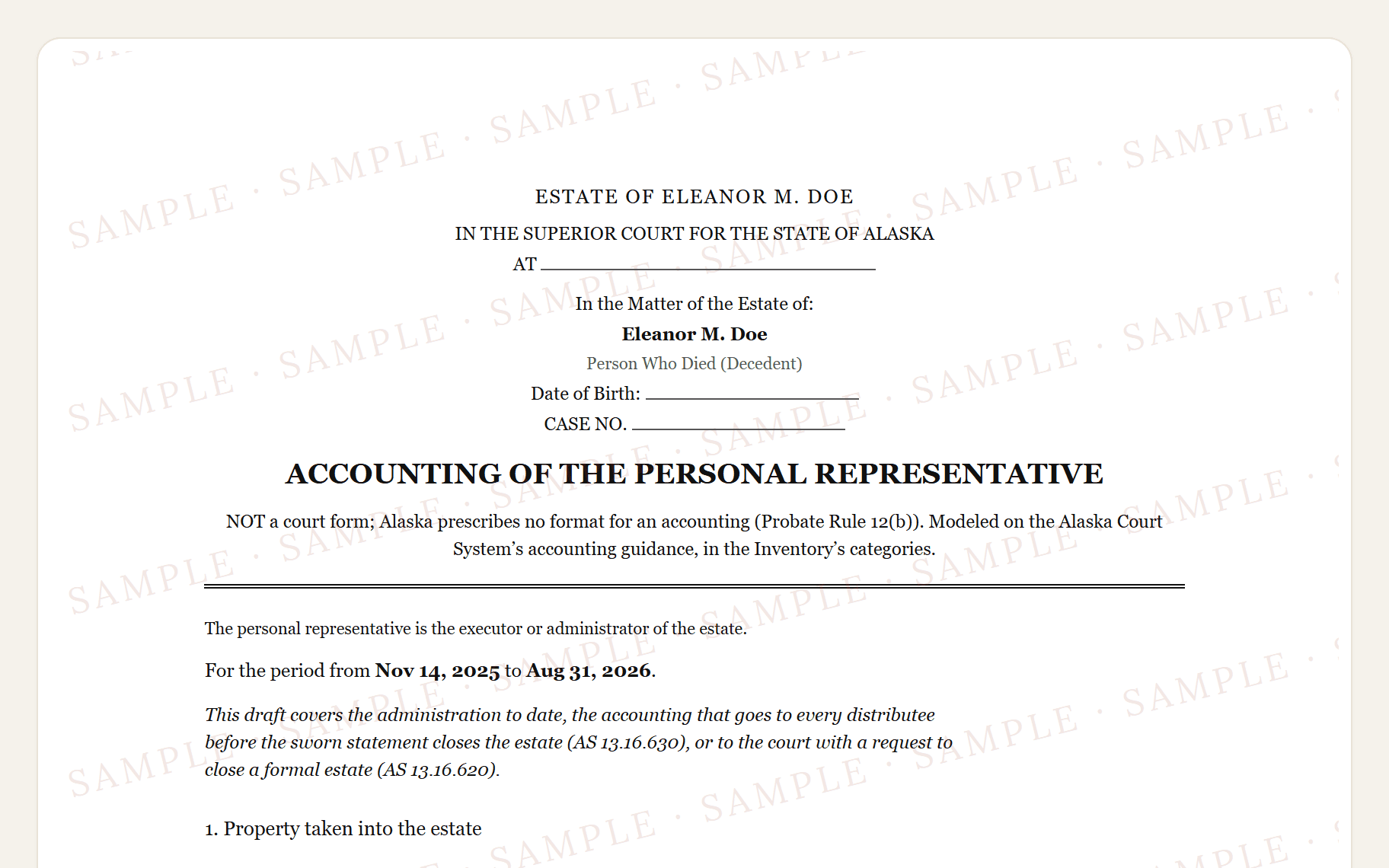
Recording is free for as long as the estate takes: every receipt and disbursement with its date and description, distributions per beneficiary, and a balance that checks itself as you go. ExecutorLedger builds Alaska-style documents from those records, an inventory shaped like P-370 and an accounting laid out the way the Alaska Court System's own guidance describes, ready to transcribe if you end up filing them, sending copies to distributees, or attaching them to a formal petition. Neither is a court form, and your attorney should review them before anything is signed or filed. Usually less than one attorney hour, and typically reimbursable by the estate.
Section 5 of 5.Questions about the Alaska inventory
Is there a court form for Alaska's inventory?
Alaska publishes P-370, Inventory of Property, statewide, but AS 13.16.365 does not require using it. The underlying duty, an inventory of property within three months of appointment, is what the law requires. Filing it with the court is optional as long as a copy goes to every interested person who requests one.
When is the Alaska inventory due?
Within three months after appointment, at fair market value on the date of death, with the type and amount of any encumbrance noted (AS 13.16.365).
The inventory is the first filing, not the last. The full Alaska guide covers the accounting that follows it, every deadline with its statute, what the executor is paid, and how estates close.
This page describes Alaska practice as our verified references state it; formats drift and estates differ, and none of this is legal advice. ExecutorLedger produces court-style documents for transcription. They are not official court forms. What your estate must file is a question for its attorney.