Alaska Estate Accounting: A Personal Representative's Guide
Alaska probate runs through the Superior Court statewide, and its fiduciary is the personal representative. Alaska publishes a statewide inventory form, P-370, but prescribes no format at all for the accounting. Here is what each covers, when the law requires filing one, and how an estate closes.
Section 1 of 7.The two documents: the P-370 inventory and the accounting
Alaska probate is handled by the Superior Court statewide. There is no separate probate court, surrogate, or register of wills, and no county-by-county variation. Probate follows the Alaska Probate Code, AS 13.16, and its fiduciary, the executor or administrator, is called the personal representative throughout the statute and the court's own forms.
P-370, Inventory of Property, is published statewide and maps the date-of-death value of everything the person who died owned onto three categories: real estate, personal property, and financial accounts and cash. AS 13.16.365 requires the underlying duty, not the form itself: prepare the inventory within three months of appointment, and satisfy it either by filing the original with the court or by sending a copy to every interested person who requests one.
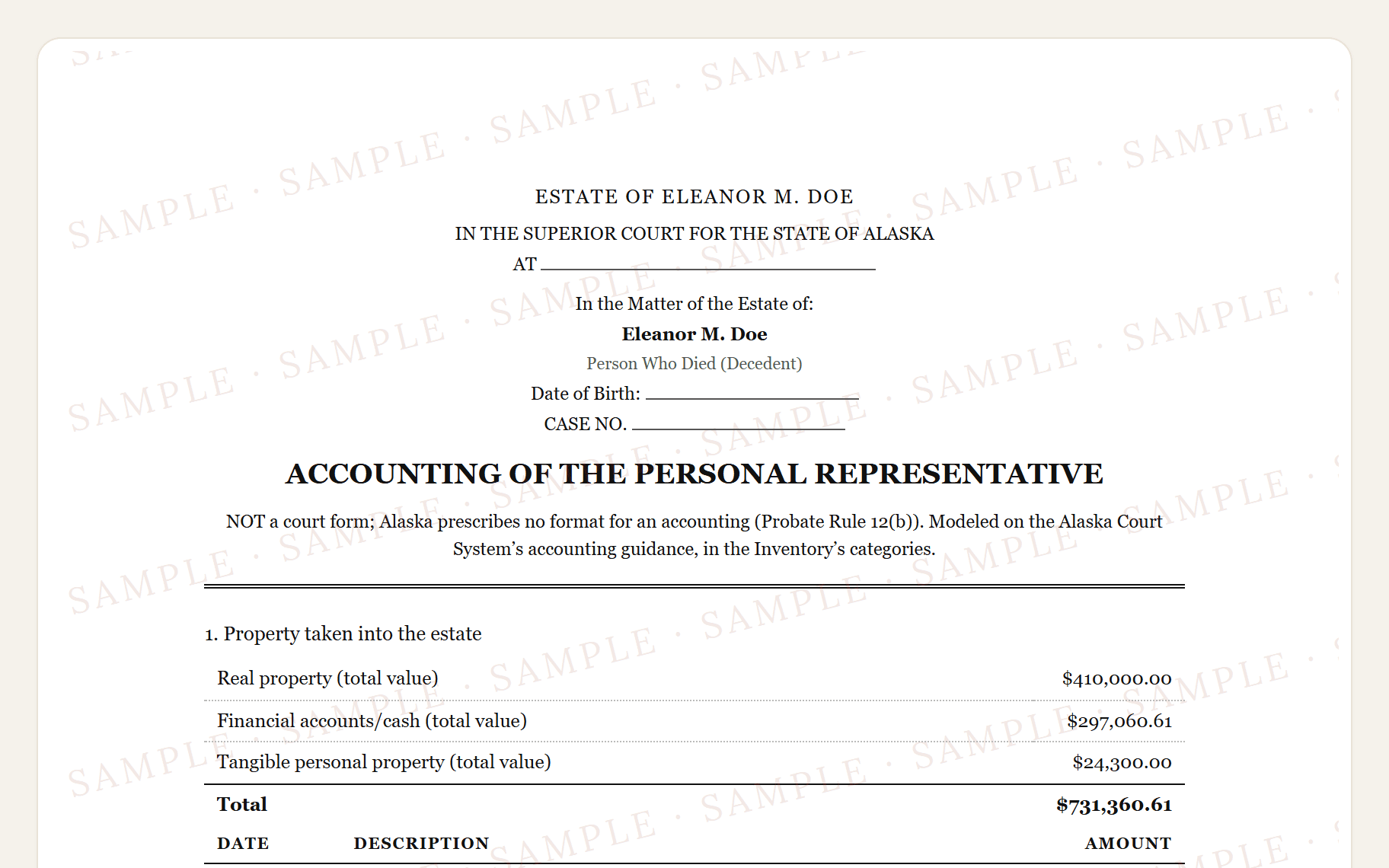
The accounting has no prescribed format anywhere in Alaska law. Probate Rule 12(b) says a final account under AS 13.16.620 or AS 13.16.625 only has to put interested persons on notice of significant cash and property transactions since the last accounting, or, if none, since administration began, and that 'no specific format is required for a final account.' The Alaska Court System's own self-help Accounting Requirements page lays that free-form account out in a shape close to the Inventory's own categories: property taken into the estate, paid out of the estate, and remaining in the estate.
On the formal closing route, the personal representative can attach a third form, P-380, Final Accounting and Proposed Distribution, to carry the proposed distribution schedule. Nothing in Alaska law requires using P-380 either; it is one way to satisfy the request to close a formal estate's own requirements, not the only way.
Section 2 of 7.Alaska deadlines, with the statute behind each
- Day 14 (about 2 weeks)Publish notice to creditors
Why
Under AS 13.16.450, upon appointment the personal representative generally must publish notice to creditors once a week for 3 successive weeks in a newspaper of general circulation in the judicial district (court form P-341); the statute says 'upon appointment' without a fixed day count, so this reminder is set 2 weeks after letters; confirm the timing and the right newspaper with your attorney. - Day 30 (about 1 month)Information of appointment to heirs and devisees
Why
Under AS 13.16.360, the personal representative generally must send basic information about the appointment (name, address, whether bond was filed, on court form P-340) to all heirs and devisees within 30 days after appointment; confirm the recipient list and timing with your attorney. - Day 90 (about 3 months)Inventory of estate property
Why
Under AS 13.16.365, an inventory listing estate property with date-of-death fair market values and encumbrances (court form P-370) is generally due within 3 months after appointment; in Alaska it is typically sent to interested persons who request it rather than filed, though filing the original with the court is allowed; confirm what to include and whether to file with your attorney. - Day 150 (about 5 months)Creditor claims bar date
Why
Under AS 13.16.460, creditor claims are generally barred 4 months after the date of first publication of the creditor notice; the true trigger is publication (not appointment), so this date assumes first publication within roughly 30 days after letters and the actual bar may fall later. Calendar this bar date before paying claims or distributing, and confirm the operative date with your attorney. - Day 180 (about 6 months) · earliest possibleEarliest informal closing by sworn statement
Why
Under AS 13.16.630, an informal estate generally may be closed by sworn statement (court form P-355) no earlier than 6 months after the original appointment, and only if the first creditor-notice publication is by then more than 6 months old, so the actual earliest date may be later than shown here; confirm timing and readiness to close with your attorney.
- Day 270 (about 9 months)Federal estate tax return (Form 706), if required
Why
Under IRC §6075, Form 706 is due 9 months after death, but only if the gross estate exceeds the federal exemption or the estate elects portability, and a 6-month extension may be available; confirm applicability and timing with your attorney.
Within 30 days after appointment, the personal representative sends basic information about the appointment, name, address, whether bond was filed, and the court where letters were granted, to every heir and devisee (AS 13.16.360, court form P-340).
Read the full explanation
Notice to creditors is published once a week for three successive weeks in a newspaper of general circulation in the judicial district, upon appointment (AS 13.16.450, court form P-341). Confirm the right newspaper and timing with your attorney.
The inventory is due within three months after appointment, at fair market value on the date of death, with the type and amount of any encumbrance noted (AS 13.16.365, P-370).
Creditor claims are barred four months after the date of first publication, or three years after death if notice is never published. A claim that arises after death is barred four months after it arises (AS 13.16.460).
The sworn statement that closes an informal estate (P-355) can be filed no earlier than six months after appointment, and only once the first creditor-notice publication is itself more than six months old (AS 13.16.630).
A federal estate tax return, Form 706, if the estate needs one, is due nine months after death (IRC section 6075), with a possible six-month extension. Confirm whether the estate needs one with your attorney.
Section 3 of 7.What Alaska pays a personal representative
AS 13.16.430 entitles the personal representative to reasonable compensation for services, with no statutory percentage, tier, or schedule of any kind. If the will fixes compensation and there is no separate contract with the person who died, the personal representative can renounce the will's compensation provision before qualifying and take reasonable compensation instead, and can renounce fees in whole or in part by a written renunciation filed with the court.
On petition of an interested person, or on the court's own notice, the court may review the reasonableness of the personal representative's compensation, and of any agents the personal representative employed, and order a refund of any excessive amount (AS 13.16.440).
When review is sought, Probate Rule 7.1 gives the court a ten-factor test: the time and labor required, the estate's complexity, the skill and training the duties demanded, the personal representative's exposure to individual liability, the time taken from the personal representative's own profession, expenses and costs incurred, any agents' fees, whether the personal representative charged separately for serving in more than one capacity, whether the estate has one, several, or a corporate personal representative, and any other equitable factor.
Section 4 of 7.How an Alaska estate closes
Most Alaska estates close informally, by sworn statement. Once six months have passed since appointment, and the first creditor-notice publication is itself more than six months old, the personal representative can file the sworn statement of personal representative to close informal estate (P-355) under AS 13.16.630. Before filing, the personal representative sends the accounting to every distributee, or files their written waivers with the statement instead, and attaches a blank order closing estate (P-301) with only the caption filled in, the rest left for the court.
Filing the sworn statement does not end the appointment right away. It ends automatically one year after the statement is filed, as long as no proceeding involving the personal representative is then pending.
The formal route closes instead with a request to close a formal estate and approve distribution (P-360), under AS 13.16.620, or the narrower testate-only AS 13.16.625. The personal representative can attach the final accounting and proposed distribution (P-380) as the distribution schedule, or describe the plan another way. The court sets a hearing, the personal representative notifies every interested person, and at the hearing the court reviews the inventory, the accounting, and the proposed distribution before closing the estate and ending the appointment immediately.
If property turns up after a settlement, or more than a year after a closing statement is filed, a subsequent administration can be opened to handle it. No claim already barred can be revived in it (AS 13.16.655).
- Send a final accounting (form P-380 fits what the court expects) to everyone whose interests are affected. Or collect signed waivers of the accounting instead, and file them along with your closing statement.
- Once at least 6 months have passed since your appointment and the first creditor-notice publication is more than 6 months old, file the Sworn Statement of Personal Representative to Close Informal Estate (form P-355) under AS 13.16.630, Alaska's version of the UPC §3-1003 verified closing statement, with a blank Order Closing Estate (P-301, caption filled in) attached.
- Mail a copy of the sworn statement (with the accounting) to every person who received estate property and to any creditor whose claim is unpaid and not barred.
- If a beneficiary objects or anything is contested, petition the Superior Court for a formal order of complete settlement under AS 13.16.620 instead of the sworn-statement route.
- Keep the estate records handy for a year. Your appointment ends automatically one year after the statement is filed if no proceeding involving you is pending (AS 13.16.630(b)).
Alaska probate is handled by the Superior Court. There is no separate probate court, surrogate, or register of wills. Most unsupervised estates close informally by the sworn statement; formal court settlement is the exception.
Section 5 of 7.The documents explained for a first-time personal representative
P-370 has four columns. The first, Description of Property, carries the appraiser's name and address next to any item that was appraised. The second is fair market value on the date of death. The third, Encumbrance, splits into Type and Value, the loan, lien, or joint ownership against the item. The fourth, Net Value, is column two minus column three.
Alaska's inventory duty covers only the description, the date-of-death value, and the encumbrance amount and type. Sorting items into real and personal property, noting how title was held, and naming a joint owner or payable-on-death beneficiary are helpful, not required, so anything of that kind goes into the free-text description by hand. Because Alaska tracks no lien or joint-ownership data on its own, the encumbrance column and the net value it produces are also left for the personal representative to complete once the encumbrance amount is known.
If property turns up after the inventory is done, or a value or description on it turns out wrong, AS 13.16.375 requires a supplementary inventory. It goes to the same people who received the original, and it gets filed with the court only if the original was filed there too.
The accounting lays out in three parts: property taken into the estate, paid out of the estate, and remaining in the estate. What is taken in, minus what is paid out, should equal what remains. Interested persons can waive the accounting entirely instead, often as part of a Receipt and Release signed when the estate closes.
Section 6 of 7.Where ExecutorLedger fits
Recording is free for as long as the estate takes: every receipt and disbursement with its date and description, distributions per beneficiary, and a balance that checks itself as you go. ExecutorLedger builds Alaska-style documents from those records, an inventory shaped like P-370 and an accounting laid out the way the Alaska Court System's own guidance describes, ready to transcribe if you end up filing them, sending copies to distributees, or attaching them to a formal petition. Neither is a court form, and your attorney should review them before anything is signed or filed. Every document previews free with your real numbers, and $149 once per estate lifts the watermark.
Section 7 of 7.Questions Alaska executors ask
Is there a court form for Alaska's inventory?
Alaska publishes P-370, Inventory of Property, statewide, but AS 13.16.365 does not require using it. The underlying duty, an inventory of property within three months of appointment, is what the law requires. Filing it with the court is optional as long as a copy goes to every interested person who requests one.
When is the Alaska inventory due?
Within three months after appointment, at fair market value on the date of death, with the type and amount of any encumbrance noted (AS 13.16.365).
Does the Alaska accounting have to be filed with the court?
Only on the formal route. Probate Rule 12(b) prescribes no format for either route. On the informal route, the accounting goes to every distributee, or their written waivers are filed instead, before the sworn statement (P-355) closes the estate. On the formal route, the accounting goes to the court with the request to close a formal estate (P-360), and P-380 may carry the proposed distribution.
How is an Alaska personal representative paid?
AS 13.16.430 sets reasonable compensation, with no statutory percentage or schedule. The court can review the amount on petition or its own notice, weighing the ten factors in Probate Rule 7.1 (AS 13.16.440).
How does an Alaska estate close?
Most estates close informally: six months after appointment, once the first creditor-notice publication is itself six months old, by filing a sworn statement (P-355) under AS 13.16.630. The formal route closes instead with a request to close a formal estate and approve distribution (P-360), a hearing, and a court order.
Not sure which accounting your situation calls for? Which accounting do I need? covers the choice, and the accounting guide explains the structure every format shares.
This page describes Alaska practice as our verified references state it; formats drift and estates differ, and none of this is legal advice. ExecutorLedger produces court-style documents for transcription. They are not official court forms. The accounting your estate needs is a question for its attorney.