Washington Estate Accounting: A Representative's Guide
Washington probate runs through the Superior Court in each county, and its fiduciary is the personal representative, the executor named in a will or the administrator appointed when there is none. Washington prescribes no probate form at all. The statutes are the whole specification, and the county courts add no form of their own. Here is what the statutes require of an inventory and of a report, the deadlines behind them, and how a Washington estate closes.
Section 1 of 7.The two documents: the Inventory and Appraisement and the Report
Washington administers decedents' estates under Title 11 RCW, through the Superior Court in each county. There is no statewide probate form category, and the local rules of the larger counties prescribe none either: King County LCR 98.04 and Snohomish County SCLSPR 98.04 both leave the format open. So there is no form number to look for and none to print. What the statutes say a document must contain is the whole of the requirement.
The first document is the Inventory and Appraisement, required by RCW 11.44.015. It lists all of the property of the estate in six lettered classifications, with a statement of any encumbrance, lien or other secured charge against each item, and the personal representative verifies it. It may be filed in the probate cause, and it may be kept out of the file instead. Either way, certain people can demand a copy of it in writing, and the personal representative then has ten days to furnish one.
The second document is a report of the affairs of the estate, and which report depends on how the estate is being administered. Most Washington estates are nonintervention estates, where the personal representative administers without returning to court and files no accounting at all. In that route the closing filing is a Declaration of Completion of Probate under RCW 11.68.110, which carries four fee figures and no accounting. A beneficiary who wants numbers can petition for a report under RCW 11.68.065, and the court may order one. A supervised estate instead files a final report and petition for distribution under RCW 11.76.030 when the estate is ready to be closed. Both routes want the same underlying facts: money collected, debts paid, property that has come in since the last report, and the property still held.
Section 2 of 7.Washington's deadlines, with the statute behind each
- Day 20 (about 3 weeks)Mail notice of appointment to heirs and beneficiaries
Why
Under RCW 11.28.237, the personal representative generally must serve or mail written notice of the appointment and the pendency of probate to every heir, legatee, devisee, and known beneficiary or transferee of a nonprobate asset within 20 days of appointment; confirm the exact recipient list and mailing date with your attorney. - Day 30 (about 1 month)Mail Medicaid estate-recovery notice to DSHS, if creditor notice wasn't given
Why
Under RCW 11.28.237(2), if you have not otherwise given notice to creditors under chapter 11.40 RCW within 30 days of appointment, you generally must separately mail notice of your appointment to the Washington Department of Social and Health Services' Office of Financial Recovery, which handles Medicaid estate-recovery claims; confirm whether this separate mailing is still required in your case with your attorney. - Day 90 (about 3 months)Prepare (and, if requested, produce) the estate inventory
Why
Under RCW 11.44.015, the personal representative generally must prepare and verify a full inventory and appraisement within 3 months of appointment (courts can grant more time), valuing each item at its fair net value at death after deducting liens and encumbrances. It typically need not be filed with the court, but any heir, legatee, devisee, unpaid creditor who filed a claim, nonprobate-asset beneficiary, or the Department of Revenue who asks in writing is generally owed a copy within 10 days; confirm the exact due date and whether court filing is required in your case with your attorney.
- Day 270 (about 9 months)Federal estate tax return (Form 706), if required
Why
Under IRC §6075, Form 706 is due 9 months after death, but only if the gross estate exceeds the federal exemption or the estate elects portability, and a 6-month extension may be available; confirm applicability and timing with your attorney. - Day 730 (about 2 years)Creditor claims bar date
Why
Under RCW 11.40.051, creditor claims are typically barred if not presented within 24 months of the date of death when no notice to creditors was given, and even published notice generally leaves a reasonably ascertainable creditor who wasn't mailed actual notice with that same 24-month bar. Publishing notice under RCW 11.40.020 usually cuts the bar to 4 months after first publication for creditors who weren't reasonably ascertainable, and actual mailed notice to a known creditor cuts their time to the later of 30 days after mailing or 4 months after first publication; confirm which bar date actually governs your estate with your attorney before paying or distributing.
The inventory and appraisement is due within three months after appointment, unless the court grants a longer time (RCW 11.44.015).
Read the full explanation
Property discovered after the inventory gets an additional inventory and appraisement, due within thirty days of the discovery (RCW 11.44.025).
A written request for a copy of the inventory has to be answered within ten days of receiving it. The people who may request one are an heir, a legatee, a devisee, a creditor who has filed a claim, a nonprobate beneficiary under RCW 11.18.200, and the Department of Revenue (RCW 11.44.015(2)).
Which creditor bar date applies depends on the notice each creditor got (RCW 11.40.051). A creditor who was mailed actual notice is barred at the later of thirty days after that mailing and four months after first publication. A creditor who was not reasonably ascertainable and only got the published notice is barred four months after first publication. A reasonably ascertainable creditor who was never mailed notice has twenty-four months from the date of death, and so does every creditor if notice was never published at all. Because publication happens after letters issue rather than on a fixed day count, confirm the actual first-publication date before relying on any of these.
A beneficiary who has not acknowledged receipt of full payment may petition for a report of the affairs of the estate once a year has passed since the last report, or since appointment if there has been no report (RCW 11.68.065).
In a supervised estate, the court may presume the estate is ready to be closed twenty-four months after the personal representative's date of appointment, unless it is closed earlier (RCW 11.76.030(2), added by chapter 204, Laws of 2026).
A federal estate tax return, Form 706, if the estate needs one, is due nine months after death (IRC § 6075), with a possible six-month extension. Confirm whether the estate needs one with your attorney.
Section 3 of 7.What Washington pays a personal representative
There is no percentage schedule. RCW 11.48.210 allows the personal representative such compensation for their services as the court deems just and reasonable, and it names no brackets and no rates. RCW 11.48.210 adds one allowance: additional compensation may be allowed for the personal representative's services as attorney and for other services not required of a personal representative.
If the will names an amount or a method for the personal representative's compensation, that provision is the full compensation, unless the personal representative files a written renunciation of it in court before qualifying (RCW 11.48.210).
So a Washington fee is an amount you have to justify rather than a number you can look up. Keep the hours, the tasks and the dates as you go, because the record of the work is what supports the figure. ExecutorLedger never computes a Washington commission from a percentage, since no Washington statute sets one.
Section 4 of 7.How a Washington estate closes
Nonintervention powers are what make a Washington estate simple, and most solvent estates have them. The court grants them on a finding that the estate is solvent, and from then on the personal representative administers, sells, pays and distributes without further court orders. RCW 11.68.090(2)(b) gives a personal representative with nonintervention powers no duty to follow the procedures of RCW 11.76.010 through 11.76.080, so no periodic report and no final report reaches the court. The inventory duty survives, because that carve-out names only RCW 11.76.010 through 11.76.080 and chapter 11.56 RCW, leaving chapter 11.44 RCW untouched. A will cannot waive it either: RCW 11.68.090(4) says no testamentary provision may limit the effect of chapter 11.44 RCW.
A nonintervention estate closes by filing a Declaration of Completion of Probate under RCW 11.68.110. It states that the estate has been fully administered, that the personal representative has paid or provided for the debts, expenses, claims and taxes, and that distribution has been made. Paragraph (g) holds the money in it: the amount of fees paid or to be paid to the personal representative, to the lawyer, to the appraiser and to the accountant, with a statement that the personal representative believes the fees to be reasonable and does not intend to obtain court approval of them or to submit an estate accounting to the court for approval. Those four figures are the whole of the financial disclosure. No receipts schedule is attached to a declaration of completion.
A supervised estate closes the older way. RCW 11.76.030 requires a final report and petition for distribution, made, verified and filed with the court when the estate is ready to be closed. It shows the money collected since the previous report, the property that has come into the personal representative's hands since then, the debts paid, and the condition of the estate at that time. It gives the names and addresses, as nearly as may be, of the legatees and devisees, or of the heirs on intestacy, and a particular description of all the property of the estate remaining undisposed of. Since chapter 204, Laws of 2026, the court may also presume that the estate is ready to be closed twenty-four months after appointment.
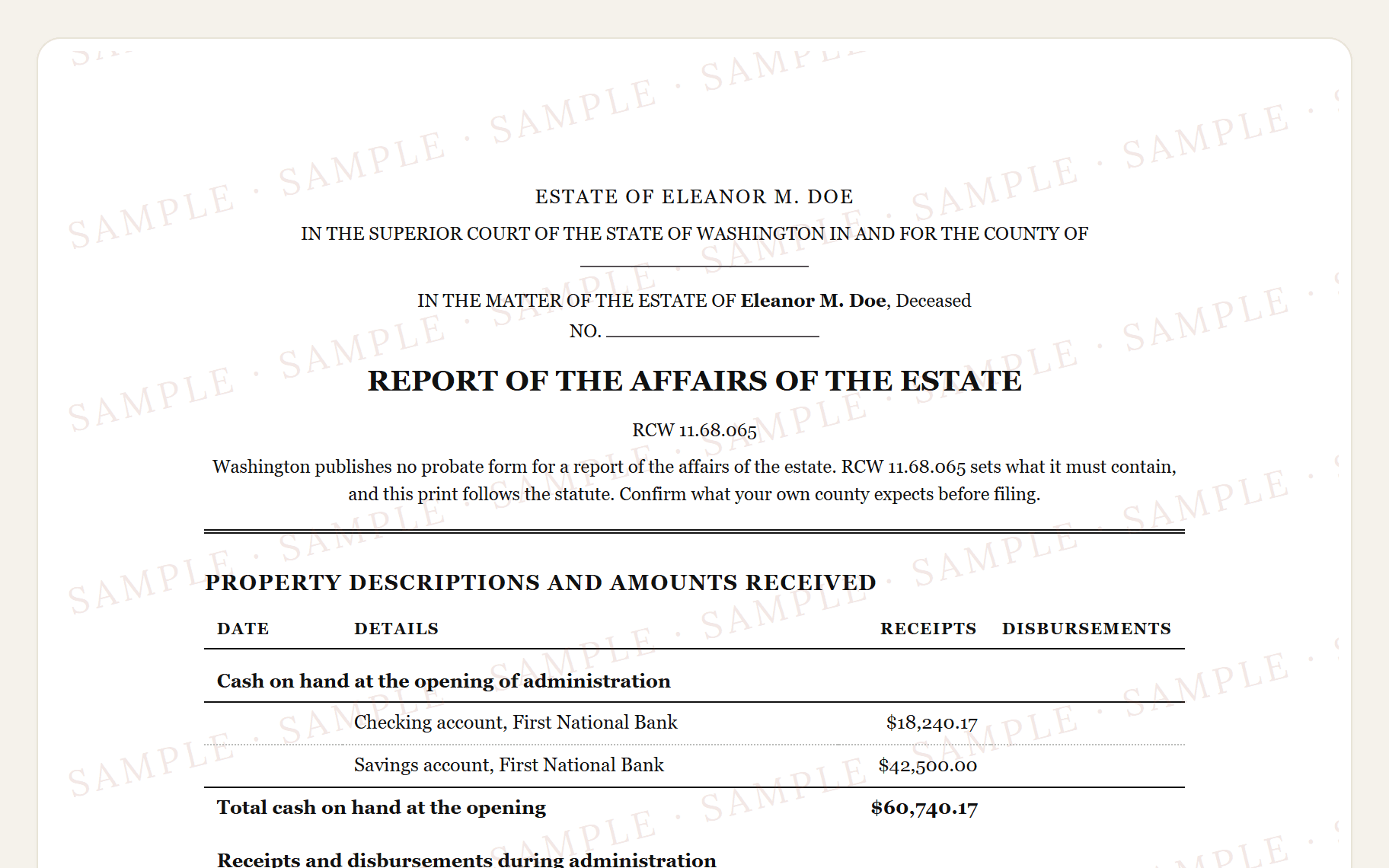
Between those two routes sits RCW 11.68.065. A beneficiary who has not acknowledged receipt of full payment may petition for a report of the affairs of the estate. After notice and a hearing the court may order a report, signed and verified, covering descriptions and amounts of property received, statements of property collected and property distributed, claims filed and whether they were allowed or rejected, the tax returns filed, and anything else the court orders. That is the accounting a nonintervention estate may still have to produce, and it is the shape ExecutorLedger's Washington report follows.
Washington law changed in this area in June 2026, when chapter 204, Laws of 2026 took effect. Guidance written before then, including much of what is online, may describe the older rules. Check the current statute, or ask your attorney, before relying on an older summary.
- Finish paying valid creditor claims, expenses, and taxes, then check whether you were granted "nonintervention" powers (RCW 11.68). Most solvent WA estates get them, and they let you close without a court hearing.
- If you have nonintervention powers, file a Declaration of Completion of Probate (RCW 11.68.110) stating the estate is fully administered and listing the fees paid or to be paid to the PR, lawyers, appraisers, and accountants.
- Mail a copy of the declaration, within 5 days of filing, to every heir, beneficiary, and interested party who hasn't already waived notice or received their full distribution.
- If nobody petitions the court within 30 days (or everyone entitled to notice waived it in writing up front), the declaration itself becomes the legal equivalent of a decree of distribution and automatically discharges you and any bond, with no separate hearing needed.
- If you never obtained nonintervention powers, or an interested party objects, file a final report and petition for distribution under chapter 11.76 RCW instead, attend the court hearing, and hand in signed beneficiary receipts so the court can adjudge the estate closed and discharge you under RCW 11.76.050.
Washington's default path (Declaration of Completion) is closer to a self-executing sworn closing statement than to a Uniform Probate Code §3-1003 filing. Washington has not adopted UPC Article 3. The court-supervised final-report path (chapter 11.76 RCW, decree and discharge under RCW 11.76.050) is the fallback when nonintervention powers were never granted or someone objects.
Section 5 of 7.The Inventory and the Report explained for a first-time personal representative
The inventory's six classifications come from RCW 11.44.015, in the statute's own lettered order: (a) real property, by legal description; (b) stocks and bonds; (c) mortgages, notes and other written evidences of debt; (d) bank accounts and money; (e) furniture and household goods; and (f) all other personal property accurately identified, including the decedent's proportionate share in any partnership, with no inventory of the partnership property itself required. ExecutorLedger's own asset categories have nothing that lands in class (c) today, so that line prints with a blank, so a reader can see what belongs in it.
The statute asks for the fair net value of each item as of the date of death, after deducting the encumbrances, liens and other secured charges on that item. ExecutorLedger records no lien data, so each item prints the value you recorded and a ruled blank for the statement of any encumbrance, lien or other secured charge, and the print says the deduction is the preparer's to make. An asset with no date-of-death value on file prints a blank rather than a zero, and is counted in the schedule without being summed into the total. Real property keeps its own total, separate from the personal property total and never added into it, because real property vests in the heirs or devisees at death (RCW 11.04.250) and never enters the cash balance.
Verification is a declaration, not an affidavit sworn before a notary. Chapter 5.50 RCW governs unsworn declarations, and RCW 5.50.050 prescribes the words: a declaration under penalty of perjury under the law of Washington that the foregoing is true and correct, with the date, the place, the printed name and the signature. Older Washington templates in circulation cite RCW 9A.72.085 instead. That section was repealed effective July 1, 2021, so a document citing it names authority that no longer exists.
The report's money columns say Receipts and Disbursements. Those are the plain words for what the statutes call moneys collected and debts paid (RCW 11.76.030(1)) and sums collected and sums paid out (RCW 11.76.010(3)(a)). No Washington source read for this guide uses the pair Charges and Credits for a decedent's estate, so ExecutorLedger's Washington report does not either. There is no gain or loss line, and no recapitulation that has to balance charges against credits, because no Washington statute asks for one. A sale posts once, at the amount collected, and the asset sold stops appearing among the property remaining undisposed of.
Property that came in after the inventory gets its own printed line whatever its category, since both RCW 11.44.025 and RCW 11.76.030(1) ask for it. A distribution in kind is not a payment of money. It gets its own list, naming the beneficiary and the item, and the item leaves the property remaining undisposed of. Sections the app has no data for still print, with ruled blanks, so nothing is quietly dropped: claims filed, allowed or rejected, the tax returns filed, and the names and addresses of the legatees, devisees or heirs. In a supervised estate, RCW 11.76.100 has the personal representative produce receipts or canceled checks for the expenses and charges paid. An item of expenditure of twenty dollars or less may be allowed without a receipt if the personal representative's own oath supports it, and those allowances without receipts may not exceed three hundred dollars in any one estate.
Community property changes the scope of the inventory and not its columns. RCW 11.02.070 puts the whole of the community property into administration, and the decree of distribution confirms one half of it to the surviving spouse. So a community asset is listed at its full value, never halved, and the six classifications carry no community-versus-separate column. A note is the most the print says about it.
Section 6 of 7.Where ExecutorLedger fits
Recording is free for as long as the estate takes: every receipt and disbursement with its date and description, distributions per beneficiary, and a balance that checks itself as you go. ExecutorLedger builds Washington-style documents from those records, an Inventory and Appraisement laid out in RCW 11.44.015's six classifications and a Report of the Affairs of the Estate in whichever route your estate is in, nonintervention or supervised, ready to transcribe or attach when you file or furnish one. Neither is a court form, and your attorney should review them before anything is signed or filed. Every document previews free with your real numbers, and $149 (one-time payment) per estate lifts the watermark.
Section 7 of 7.Questions Washington executors ask
Is there a court form for Washington's inventory or accounting?
No. Washington publishes no statewide probate form, and the local rules of the larger counties prescribe none, including King County LCR 98.04 and Snohomish County SCLSPR 98.04. RCW 11.44.015 and RCW 11.76.030 say what the documents must contain, and that is the whole requirement. Any Washington document you find online is someone's template, not an official form.
When is the Washington inventory due?
Within three months after appointment, unless the court grants a longer time (RCW 11.44.015). Property discovered later gets an additional inventory and appraisement within thirty days of the discovery (RCW 11.44.025).
Does a Washington estate have to file an accounting with the court?
Usually not. A personal representative with nonintervention powers has no duty to follow the procedures of RCW 11.76.010 through 11.76.080, so no accounting reaches the court, and the Declaration of Completion of Probate carries only four fee figures. A beneficiary who has not acknowledged receipt of full payment may still petition for a report of the affairs of the estate under RCW 11.68.065, and the court may order one. A supervised estate files a final report and petition for distribution under RCW 11.76.030.
How is a Washington personal representative paid?
Washington sets no percentage schedule. RCW 11.48.210 allows such compensation as the court deems just and reasonable, and additional compensation may be allowed for the personal representative's services as attorney and for other services not required of a personal representative. If the will names an amount or a method, that is the full compensation, unless the personal representative files a written renunciation of it in court before qualifying.
Does community property get halved on a Washington inventory?
No. RCW 11.02.070 puts the whole of the community property into administration, and the decree of distribution confirms one half of it to the surviving spouse. The asset is listed at its full value. RCW 11.44.015's six classifications carry no community-versus-separate column, so the inventory splits nothing.
Not sure which accounting your situation calls for? Which accounting do I need? covers the choice, and the accounting guide explains the structure every format shares.
This page describes Washington practice as our verified references state it; formats drift and estates differ, and none of this is legal advice. ExecutorLedger produces court-style documents for transcription. They are not official court forms. The accounting your estate needs is a question for its attorney.