Rhode Island Estate Accounting: A Fiduciary's Guide
Rhode Island probate courts sit in each city and town, not statewide, and its fiduciary is the executor named in a will or the administrator appointed when there is none. Rhode Island's inventory covers personal property only. RIGL 33-9-1 lists everything the deceased owned other than real property, in the statute's own words, so a house never appears on this document at all. Here is what the statutes and Form PC-7.1 require, the deadlines behind them, and how a Rhode Island estate closes.
Section 1 of 7.The two documents: the Inventory and the Account
Rhode Island administers decedents' estates under title 33 of the General Laws, through the probate court of the city or town where the estate is opened. A caption on a Rhode Island filing reads STATE OF RHODE ISLAND, County of ______, Estate of ______, Alias ______, PROBATE COURT OF THE City or Town of ______, No. ______. The city or town and the county both appear because Rhode Island runs its probate courts locally, one in each city and town, rather than through a single statewide court. Alias is a field on the state's own forms, for another name the decedent was known by.
The first document is the inventory, required by RIGL 33-9-1. It covers all the personal property, both tangible and intangible, and all claims, rights, causes of action and other assets of the deceased, other than real property, appraised as of the date of death. Real property is excluded by the statute's own words. No real estate rows, no real estate subtotal and no real estate schedule belong on this document. If the estate owns a house, that value is not missing from the inventory. Rhode Island's inventory never covers real property, and real estate is handled elsewhere.
Rhode Island otherwise prescribes its own probate forms, printed by the Secretary of State, but no PC-numbered form exists for the original inventory. Only the supplemental inventory has one, Form PC-10.4. So ExecutorLedger's Rhode Island inventory is this product's own presentation of what RIGL 33-9-1 requires, named as such, with no form number printed on it.
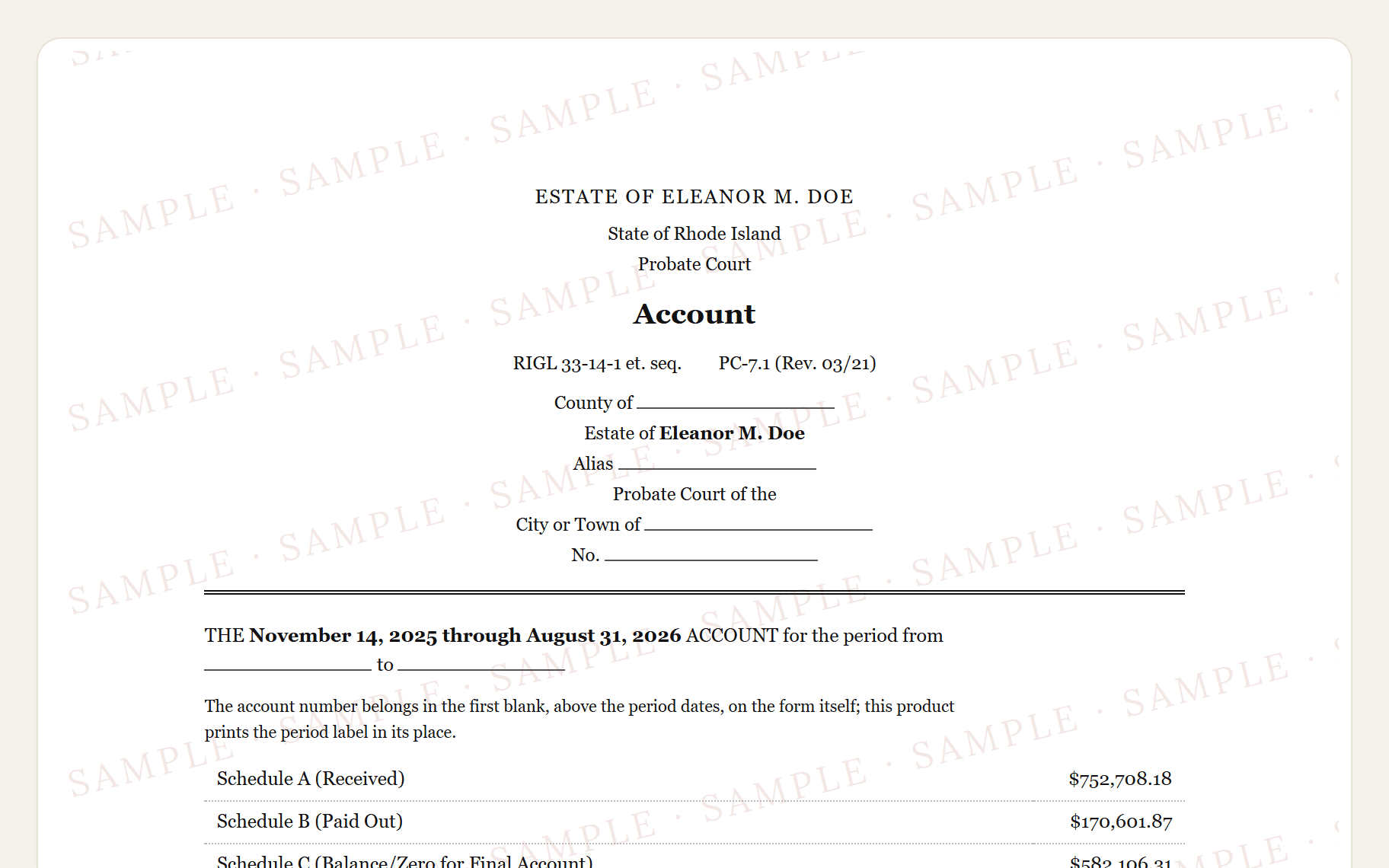
The second document is the account, filed on Form PC-7.1 under RIGL 33-14-1 et seq. It has three schedules: Schedule A for what the fiduciary received, Schedule B for what the fiduciary paid out, and Schedule C for the personal property still on hand, which is zero on a final account. The form itself prints the words MUST BE ADVERTISED, so filing an account also means giving notice of it.
Section 2 of 7.Rhode Island's deadlines, with the statute behind each
- Day 0Send the probate petition and death certificate to EOHHS (Medicaid recovery)
Why
Under R.I. Gen. Laws §40-8-15(g), if the decedent was 55 or older, a copy of the petition for probate or administration and a copy of the death certificate generally must be sent to the Executive Office of Health and Human Services upon the filing of the petition (so at or before your appointment); if that wasn't done and the decedent received recoverable Medicaid benefits, the statute bars disbursing any distributions or payments (including your own administration fees), so confirm whether this applies and that it was completed with your attorney. - Day 30 (about 1 month)Mail notice of the estate to known creditors
Why
Under R.I. Gen. Laws §33-11-5.1, within a reasonable period of time after you qualify, you generally must mail notice of the estate's commencement to each creditor whose identity is known or reasonably ascertainable, using the prescribed notice telling them they generally have six months after qualification to present a claim; the statute sets no fixed day count, so confirm the timing and recipient list with your attorney. - Day 90 (about 3 months)File the inventory with the probate court
Why
Under R.I. Gen. Laws §33-9-1, the inventory of the decedent's personal property and other non-real-estate assets is typically due within 90 days after your appointment, valued as of the date of death, though the probate court can allow more time; confirm the exact date with your attorney. - Day 180 (about 6 months)Calendar the creditor claim cutoff date
Why
Under R.I. Gen. Laws §33-11-5, creditor claims are typically barred six months after the notice of the estate is first published, not six months after letters issue; this date is calendared conservatively from letters as a placeholder, so confirm the actual first-publication date and bar date with your attorney before paying claims or distributing.
- Day 270 (about 9 months)Federal estate tax return (Form 706), if required
Why
Under IRC §6075, Form 706 is due 9 months after death, but only if the gross estate exceeds the federal exemption or the estate elects portability, and a 6-month extension may be available; confirm applicability and timing with your attorney.
The inventory is due within 90 days after the executor's or administrator's appointment, not from the date of death, unless the probate court allows a longer period. It is returned to the probate court under oath (RIGL 33-9-1).
Read the full explanation
The appraisal is the executor's or administrator's own by default. A court-appointed appraiser is only assigned when a party in interest petitions for one (RIGL 33-9-4).
The account is filed upon completion of the period of administration, and at other times the probate court requires. No interim accounting is required unless an interested party asks for one, and the probate court may excuse an interim accounting for good cause (RIGL 33-14-1).
Creditor claims are due within six months from the first publication of notice, subject to extensions, or they are forever barred. Late-claim relief is available by petition before distribution (RIGL 33-11-5). RIGL 33-11-5(b), the late-claim subsection, adds that notice of commencement of probate under RIGL 33-11-5.1, given at least sixty days before the six-month period expires, is deemed adequate. That sits inside the late-claim rules and is not a separate general rule about notice.
A federal estate tax return, Form 706, if the estate needs one, is due nine months after death (IRC § 6075), with a possible six-month extension. Confirm whether the estate needs one with your attorney.
Section 3 of 7.What Rhode Island pays a fiduciary
There is no percentage schedule. RIGL 33-14-8 allows an executor or administrator such compensation for their services as the probate court considers just, and names no rate and no bracket. It appears in the account as a line item the court has allowed, never as a number ExecutorLedger computes.
The account also allows all reasonable and proper charges and disbursements for the funeral, and for carrying out the fiduciary's trust (RIGL 33-14-6).
A fiduciary may be charged interest for the unreasonable detention of estate money, at a rate of not more than twelve percent per annum (RIGL 33-14-9). That is discretionary and decided by the court on the facts of the estate. ExecutorLedger does not calculate it and does not assume it applies to your estate.
Section 4 of 7.How a Rhode Island estate closes
RIGL 33-14-1 has the account filed upon completion of the period of administration. An executor or administrator who is the sole beneficiary, or who files a release from every beneficiary, may file an Affidavit of Completed Administration, Form PC-7.3, instead of a final account. PC-7.3 is a different document from the account, and ExecutorLedger does not build it.
Form PC-7.1's own Schedule C line reads Balance/Zero for Final Account, so the form itself tells the two kinds of account apart. ExecutorLedger's Rhode Island account is marked final or interim by whoever prepares it, never guessed from the period label, and only a final account is presented as closing the estate.
RIGL 33-14-2 sets the account's arithmetic. The fiduciary is charged with the amount of the inventory, or the balance of the prior account, all income, all gains from the sale of personal property, all other property received though not inventoried, and all rents and proceeds of the sale of real estate. The fiduciary is credited with all charges, losses and payments, including legacies, distributions and specific personal property delivered. So real estate is absent from the inventory and present in the account as money once it produces rent or a sale. The same statute has the account display the investments of the balance, if any, and any changes of investments, a separate line this product's ledger has no figures for and prints as a labelled note for the preparer.
A gain on the sale of personal property is netted onto Schedule A, and a loss is netted onto Schedule B among the payments, charges, losses and distributions. Rhode Island does not post a sale's full value on both schedules the way some other states do.
When an account carries a credit for the proceeds of a sale or mortgage of real estate, RIGL 33-22-9 requires the notice given before the account is settled to state that the account contains that credit. Watch for this whenever the estate has sold real property during the accounting period.
An executor represented by an attorney in good standing with the Rhode Island Bar may file a certification in place of original supporting documents, except for what RIGL 33-14-8 requires. Most ExecutorLedger users administer without an attorney, and for them the statute asks for copies of the front sides of all checks or other documents evidencing the charges, losses and payments in the account. That is a real filing task, worth planning for as you go rather than assembling at the end.
- Get a signed release from every beneficiary (Form PC-7.7, General Release). If you're the sole beneficiary, or once you hold every beneficiary's release, R.I. Gen. Laws §33-14-1 lets you skip a full account and instead file a sworn Affidavit of Complete Administration (Form PC-7.3) with the probate court.
- Before filing that affidavit, confirm the funeral bill is paid, every claim that was filed is paid or otherwise satisfied, and any Rhode Island estate or inheritance tax is settled. Section 33-14-1 requires evidence of all three.
- File the affidavit of notice to creditors (Form PC-10.14), confirming notice was mailed to known creditors and, if the decedent was 55 or older, that the petition and death certificate went to the Executive Office of Health and Human Services (Medicaid). R.I. Gen. Laws §33-11-5.2 makes this a prerequisite to closing, whether you close by account or by affidavit.
- If even one beneficiary won't sign a release, file a formal account (Form PC-7.1) with the probate court instead, and let the court settle it under §33-14-1.
- File everything with the same probate court that issued your letters. Rhode Island has no single state probate court; each of the state's 39 cities and towns runs its own, so confirm you're filing locally, not with a county or state court.
Rhode Island probate runs through 39 municipal probate courts, each with its own clerk and local habits. The closing path can differ town to town.
Section 5 of 7.The Inventory and the Account explained for a first-time executor
Wearing apparel is excluded from the inventory and from the assets available to pay debts, except for jewels and watches, which stay on it (RIGL 33-9-2). ExecutorLedger's personal-property category covers clothing and jewelry together, so this is a note for the preparer rather than something the software can separate on its own.
The supplemental inventory, Form PC-10.4, covers personal property found after the original inventory was filed. The form itself has two sections on one page: one for additional personal property in a decedent's estate, and a separate one for additional personal property and real estate in a guardianship. The guardianship section is for a living ward, not a decedent's estate, and it is the only place real estate appears on either inventory form. ExecutorLedger's supplemental inventory uses the estate section only, and real estate never enters through it.
Verification on both the inventory and the account is a notarized oath, not a plain declaration. RIGL 33-22-18 lets a notary public, a justice of the peace, or the probate judge or clerk administer it, and both PC-10.4 and PC-7.1 carry the same jurat for the notary to complete.
Local probate rules cannot change any of this. RIGL 33-22-29 bars a local administrative rule from expanding, contracting or otherwise varying a provision of title 33 or of the General Laws generally, so no local rule can change what title 33 requires of an inventory or an account. That is not the same as saying a city's rules say nothing about them: Providence's own local rules do set filing practice, and they request, though do not require, a real estate listing alongside the inventory: an address, the Assessor's Plat and Lot number, or a copy of the deed, with no value attached. That is Providence's own practice, not a statewide requirement, and it is not the same thing as RIGL 33-9-1's exclusion of real property from the inventory itself. Confirm local filing practice with your own city or town probate clerk.
Section 6 of 7.Where ExecutorLedger fits
Recording is free for as long as the estate takes: every receipt and disbursement with its date and description, distributions per beneficiary, and a balance that checks itself as you go. ExecutorLedger builds Rhode Island-style documents from those records, an inventory of personal property the way RIGL 33-9-1 describes it and a three-schedule account laid out the way Form PC-7.1 prints it, ready to transcribe or attach when you file. Neither is a court form, and your attorney should review them before anything is signed or filed. Every document previews free with your real numbers, and $149 (one-time payment) per estate lifts the watermark. Usually less than one attorney hour, and typically reimbursable by the estate.
Section 7 of 7.Questions Rhode Island executors ask
Does the Rhode Island inventory include real estate?
No. RIGL 33-9-1 covers all the personal property, tangible and intangible, and all claims, rights, causes of action and other assets of the deceased, other than real property, in the statute's own words. There is no real estate row, subtotal or schedule on the inventory. Real estate reaches the account instead, once it is rented or sold, because RIGL 33-14-2 charges the fiduciary with rents and proceeds of a sale of real estate.
Is there a court form for Rhode Island's inventory or account?
The account has one, Form PC-7.1. The original inventory does not. Rhode Island otherwise prescribes its own probate forms, but no PC-numbered form covers the original inventory, only the later supplemental inventory, Form PC-10.4. ExecutorLedger's inventory print is its own presentation of what RIGL 33-9-1 requires, with no form number printed on it.
When is the Rhode Island inventory due?
Within 90 days after the executor's or administrator's appointment, not from the date of death, unless the probate court allows longer. It is returned to the probate court under oath (RIGL 33-9-1). The appraisal is the fiduciary's own by default; a court-appointed appraiser is assigned only when a party in interest petitions for one (RIGL 33-9-4).
How is a Rhode Island fiduciary paid?
RIGL 33-14-8 allows an executor or administrator such compensation for their services as the probate court considers just, with no percentage schedule. It appears in the account as a figure the court has allowed. Reasonable and proper funeral and administration charges are separately allowed under RIGL 33-14-6.
Does a Rhode Island estate have to file an accounting with the court?
The account is filed upon completion of the period of administration, and at other times the probate court requires. No interim accounting is required unless an interested party asks for one, and the court may excuse an interim accounting for good cause. An executor who is the sole beneficiary, or who holds a release from every beneficiary, may file an Affidavit of Completed Administration, Form PC-7.3, instead of a final account (RIGL 33-14-1).
Not sure which accounting your situation calls for? Which accounting do I need? covers the choice, and the accounting guide explains the structure every format shares.
This page describes Rhode Island practice as our verified references state it; formats drift and estates differ, and none of this is legal advice. ExecutorLedger produces court-style documents for transcription. They are not official court forms. The accounting your estate needs is a question for its attorney.