New Mexico Estate Accounting: A Representative's Guide
New Mexico probate can run through the county probate court or the district court, and its fiduciary is the personal representative, the executor named in a will or the administrator appointed when there is none. New Mexico is one of the few states where the Supreme Court prescribes a single statewide set of probate forms, the 4B series in the Rules of Probate Procedure, rather than leaving the format to each county. Here is what the two 4B forms ask for, the deadlines behind them, and how a New Mexico estate closes.
Section 1 of 7.The two documents: Form 4B-601, Inventory, and Form 4B-602, Accounting
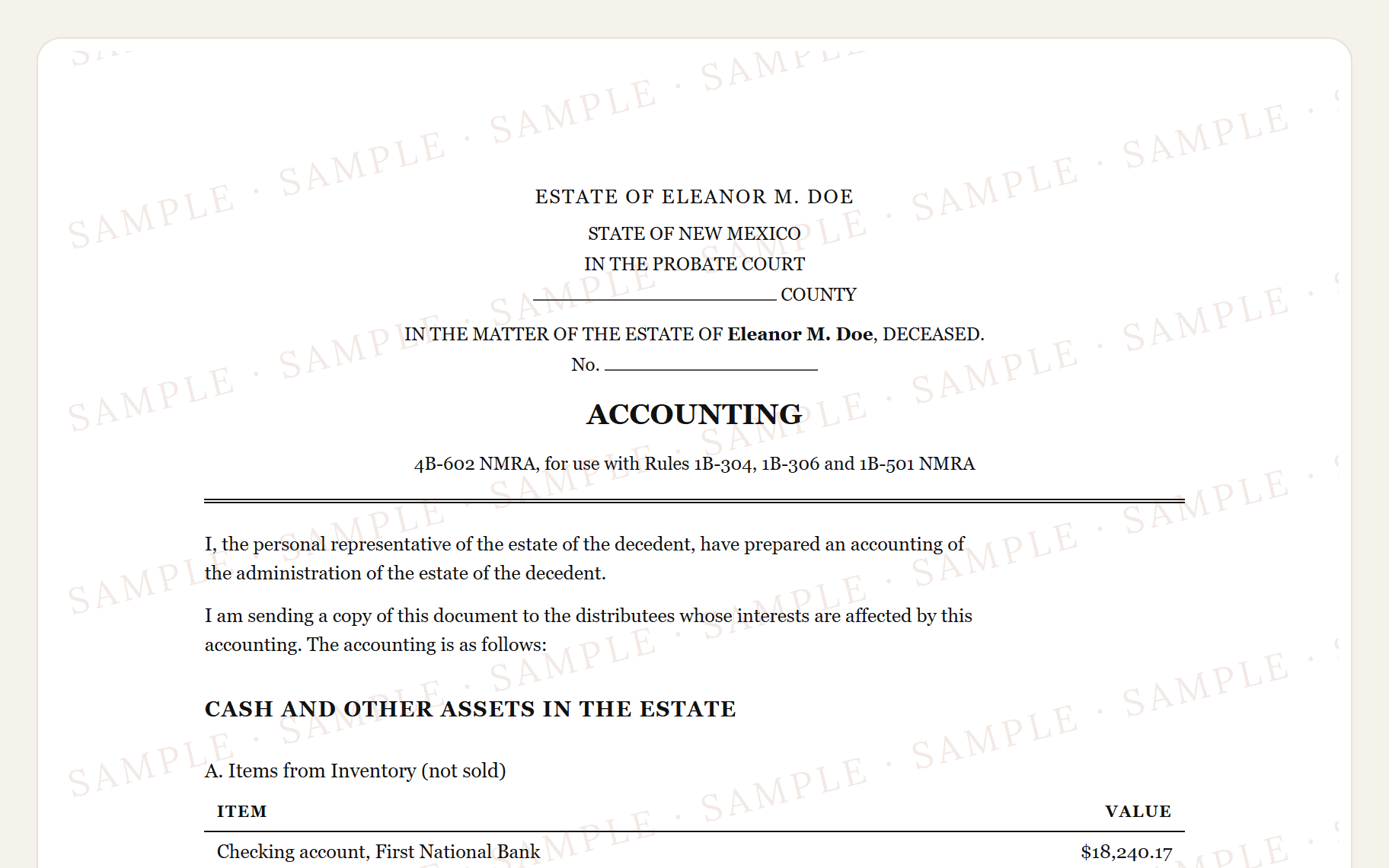
New Mexico's Supreme Court approves a statewide set of probate forms under NMRA 1B-304, 1B-306 and 1B-501, and every county probate court uses the same set. Form 4B-601 is the Inventory, and Form 4B-602 is the Accounting. Both were recompiled to their current numbers, from 4B-401 and 4B-501, by Supreme Court Order 18-8300-014, effective December 31, 2018; a document still citing the old numbers is out of date.
New Mexico also runs two courts with overlapping ground. The county probate court and the district court share concurrent jurisdiction over informal, uncontested proceedings only. Formal proceedings, contests, will construction, supervised administration and questions of heirship belong to the district court alone, under NMSA 45-1-302. The 4B forms carry the probate court's own caption, STATE OF NEW MEXICO, IN THE PROBATE COURT, and that is the caption printed here. No form for a formal or supervised district-court inventory or accounting was found, so none is invented.
Form 4B-601 lists three columns and nothing more: the item, its estimated value on the date of death, and any mortgage or lien against it. It carries no classification scheme, no legal description line, no community-versus-separate column, and no appraiser block. New Mexico is a community property state, and even so its inventory form asks for no characterization of an asset as community or separate.
Form 4B-602 is not a receipts-and-disbursements ledger. It is a net-worth reconciliation: a Cash and Other Assets side built from what the estate holds and what it has taken in, and a Payments and Distributions side built from what has gone out. Both sides total, and the form says they should match once the estate is wound up.
Section 2 of 7.New Mexico's deadlines, with the statute behind each
- Day 30 (about 1 month)Notice of appointment to heirs and devisees
Why
Under NMSA 1978 § 45-3-705, the personal representative generally must mail or deliver notice of the appointment to heirs and devisees no later than 30 days after appointment; confirm your complete distributee list with your attorney. - Day 90 (about 3 months)Inventory and appraisement due
Why
Under NMSA 1978 § 45-3-706, the personal representative generally must prepare the inventory within 3 months after appointment and send a copy to any interested person who requests it (filing the original with the court is optional unless your court requires it); confirm the filing requirement with your attorney. - Day 120 (about 4 months)Four-month creditor claims window (if notice is published)
Why
Under NMSA 1978 § 45-3-801, publishing notice to creditors is optional, but if you publish, claims are typically barred 4 months after the date of first publication (or 60 days after a mailed direct notice, if later), not from the date of appointment itself; this entry assumes publication happens right after you receive letters, so confirm your actual publication date and the resulting bar date with your attorney. - Day 180 (about 6 months) · earliest possibleEarliest date to file the verified closing statement
Why
Under NMSA 1978 § 45-3-1003, the informal verified (sworn) closing statement generally cannot be filed until at least 6 months after the date of original appointment, and only once the claims period has run and the estate is fully administered; confirm you're ready to close with your attorney.
- Day 270 (about 9 months)Federal estate tax return (Form 706), if required
Why
Under IRC §6075, Form 706 is due 9 months after death, but only if the gross estate exceeds the federal exemption or the estate elects portability, and a 6-month extension may be available; confirm applicability and timing with your attorney. - Day 365 (about 1 year)Absolute one-year claims bar
Why
Under NMSA 1978 § 45-3-803, creditor claims that arose before death are generally barred no later than one year after the date of death regardless of what notice was given, though an earlier notice-based bar date under § 45-3-801 may control instead; confirm which bar date applies with your attorney.
The inventory is prepared within three months after appointment (NMSA 45-3-706). The personal representative sends a copy to interested persons who request it; filing the original with the court is optional, not required, though the form itself says nothing about filing: the rule is the statute's alone.
Read the full explanation
A supplementary inventory is required when property not in the original inventory is discovered, or when an original item's value or description turns out to have been erroneous or misleading (NMSA 45-3-708). No numeric deadline applies to it. It carries the same optional-filing, copy-on-request rule as the original.
The creditor-claim publication bar is four months after the first publication of notice to creditors (NMSA 45-3-801(A)). It was two months before July 1, 2016, and older sources, including a 1981 case reading the earlier statute, still circulate that figure.
A closing statement may be filed no earlier than six months after appointment (NMSA 45-3-1003(A)). It was three months before July 1, 2016, and much of what is online still says three.
A federal estate tax return, Form 706, if the estate needs one, is due nine months after death (IRC 6075), with a possible six-month extension. Confirm whether the estate needs one with your attorney.
Section 3 of 7.What New Mexico pays a personal representative
New Mexico sets no fee schedule. The percentage schedule that once lived in NMSA 45-3-719 was repealed in 1995, and nothing replaced it with tiers or a base. What is left is bare reasonable compensation, for the personal representative and for the attorney alike, and what is reasonable is the court's to decide, not a number a form or a calculator can produce.
ExecutorLedger computes no New Mexico percentage and prints none. What it reports is the compensation your own ledger already recorded, the figure you and your attorney arrive at, not a figure this product invents.
Section 4 of 7.How a New Mexico estate closes
An informal, uncontested estate can close in the probate court once creditor claims are resolved, the accounting is prepared and distributions are ready. The closing statement, Form 4B-701 for a general estate or Form 4B-702 for a small one, may be filed no earlier than six months after appointment (NMSA 45-3-1003(A)). Unlike the inventory and the accounting, the closing statement is verified: it carries the words "I affirm under penalty of perjury under the laws of the State of New Mexico," an unsworn declaration under penalty of perjury, not a notarized oath. ExecutorLedger does not build the closing statement; it is the next step after the accounting this guide covers.
Two different "small estate" routes exist in New Mexico and they are not the same thing. Form 4B-702, the small-estate closing statement, tests the value of the entire estate against the family and personal property allowances, administration costs, and last-illness and funeral expenses. NMSA 45-3-1201 is a separate route, collection of property by affidavit without any administration at all, with its own dollar ceiling. Confirm the current figure with your attorney before relying on it; it has moved before.
A contested matter, a formal proceeding, supervised administration, or a question of heirship goes to the district court instead of the probate court, under NMSA 45-1-302. The 4B forms are the probate court's own forms; nothing here substitutes for district-court practice.
- Make sure the creditor-claims period has run and pay all valid claims, administration expenses, and taxes before filing anything to close the case.
- File a verified (sworn) closing statement under NMSA 1978 § 45-3-1003, New Mexico's informal, no-hearing closing route, available no earlier than 6 months after your original appointment.
- Send a copy of that closing statement to every distributee and to any known creditor whose claim is neither paid nor barred, and give the distributees whose interests are affected a full written account of your administration.
- If a will contest, a disputed account, or an uncooperative beneficiary is in play, petition the district court instead for formal proceedings terminating administration and an order of complete settlement under NMSA 1978 § 45-3-1001.
- Keep your file open until a year has passed after the closing statement is filed. Your appointment terminates automatically at that point if no proceedings involving you are pending.
New Mexico runs two tracks: routine, uncontested estates are opened and closed in the county Probate Court (probate judges are elected and need not be attorneys); anything contested, or a formal § 45-3-1001 settlement petition, goes to District Court instead.
Section 5 of 7.The Inventory and the Accounting explained for a first-time personal representative
Form 4B-601 prints six ruled rows and no total. ExecutorLedger adds a total of the estimated values below the form's own rows, because a reader needs one and the ledger has it, and the print says plainly that the approved form itself carries no total line. An asset with no date-of-death value on file prints as a blank, never as a manufactured $0.00, and is still counted among the items with a missing value.
The mortgage-or-lien column is ruled on the form, and ExecutorLedger records no encumbrance data, so every row's lien cell prints blank for the preparer to fill in. A lien is never netted against a value; the form keeps them in separate columns, and so does this one.
Form 4B-602's Cash and Other Assets side has four parts. Section A is items from the inventory that have not been sold and are still held. Section B is items received since the inventory was made, also not sold. Section C is items sold, and it is the only place a sale appears: an inventoried asset that has since been sold moves out of Section A and into Section C, never both. Section D is income received. The Payments and Distributions side has two parts: payments to creditors and for administration expenses, and distributions to devisees or heirs, cash and in-kind alike, because the form's own column is Value of Distribution.
Section C nets only the cost of the sale: Sales Price minus Sales Expense equals Net Amount Received. The item's inventory value never re-enters the calculation. There is no gain, no loss, and no comparison to what the asset was carried at. ExecutorLedger records no selling expense, so that column is ruled per row and the Net Amount Received equals the Sales Price until a preparer fills it in, and the print says so.
The form's own sentence says the two totals should be equal once the estate is wound up, because by then everything that came in has been paid out or distributed. While the estate still holds anything, and most estates being accounted for still do, the two totals will not match, and that is expected rather than an error. ExecutorLedger prints both totals exactly as the form does, prints the form's own sentence, and adds a note of its own explaining what the difference represents and that the form's own identity is met once everything has been paid out or distributed. Nothing here forces a distribution to make the numbers match.
Section 6 of 7.Where ExecutorLedger fits
Recording is free for as long as the estate takes: every receipt and disbursement with its date and description, distributions per beneficiary, and a balance that checks itself as you go. ExecutorLedger builds New Mexico-style documents from those records, an inventory shaped like Form 4B-601 and an accounting shaped like Form 4B-602, ready to transcribe onto the court's own forms when you send a copy or file one. Neither is a court form, and your attorney should review them before anything is signed or filed. Every document previews free with your real numbers, and $149 (one-time payment) per estate lifts the watermark. Usually less than one attorney hour, and typically reimbursable by the estate.
Section 7 of 7.Questions New Mexico executors ask
Does New Mexico have a statewide probate form?
Yes, unlike most states in this guide. The New Mexico Supreme Court approves the 4B series under NMRA 1B-304, 1B-306 and 1B-501, and every county probate court uses the same forms: Form 4B-601 for the inventory and Form 4B-602 for the accounting. They were recompiled from 4B-401 and 4B-501 to their current numbers effective December 31, 2018.
Do I have to file the New Mexico inventory with the court?
No. NMSA 45-3-706 has the personal representative send a copy of the inventory to interested persons who request it. Filing the original with the court is optional under NMSA 45-3-706. Form 4B-601's own opening line covers only the copy that goes to interested people who asked for it, and says nothing about filing.
Is the New Mexico inventory or accounting sworn?
No. Neither Form 4B-601 nor Form 4B-602 carries an oath or a penalty-of-perjury clause; the signature block is just a signature, printed name, date and address. Only the closing statement, Form 4B-701 or 4B-702, is verified, with an unsworn declaration under penalty of perjury.
Why don't the accounting's two totals match on my draft?
Form 4B-602's own note says the Total of Cash and Other Assets should equal the Total of Payments and Distributions. That holds once the estate is wound up, because everything that came in has by then gone out. While the estate still holds anything, the two totals differ by exactly what remains on hand, which is normal, not an error.
How is a New Mexico personal representative paid?
New Mexico sets no fee schedule. The percentage schedule once in NMSA 45-3-719 was repealed in 1995. What is left is bare reasonable compensation, for the personal representative and for the attorney, decided case by case rather than computed from a rate.
When can a New Mexico estate close?
The closing statement may be filed no earlier than six months after appointment (NMSA 45-3-1003(A)). That is a change from the pre-2016 rule of three months, which is still what much of the internet says.
Not sure which accounting your situation calls for? Which accounting do I need? covers the choice, and the accounting guide explains the structure every format shares.
This page describes New Mexico practice as our verified references state it; formats drift and estates differ, and none of this is legal advice. ExecutorLedger produces court-style documents for transcription. They are not official court forms. The accounting your estate needs is a question for its attorney.