Missouri Estate Accounting: A Representative's Guide
Missouri probate runs through the Probate Division of the Circuit Court in each county, not a single statewide court, and its fiduciary is the personal representative, the executor named in a will or the administrator appointed when there is none. Missouri has adopted no statewide form for the inventory or the settlement; each circuit's probate division publishes its own. Here is what the circuit templates commonly cover, the deadlines behind them, and how a Missouri estate closes.
Section 1 of 7.The two documents: the Inventory and the Settlement
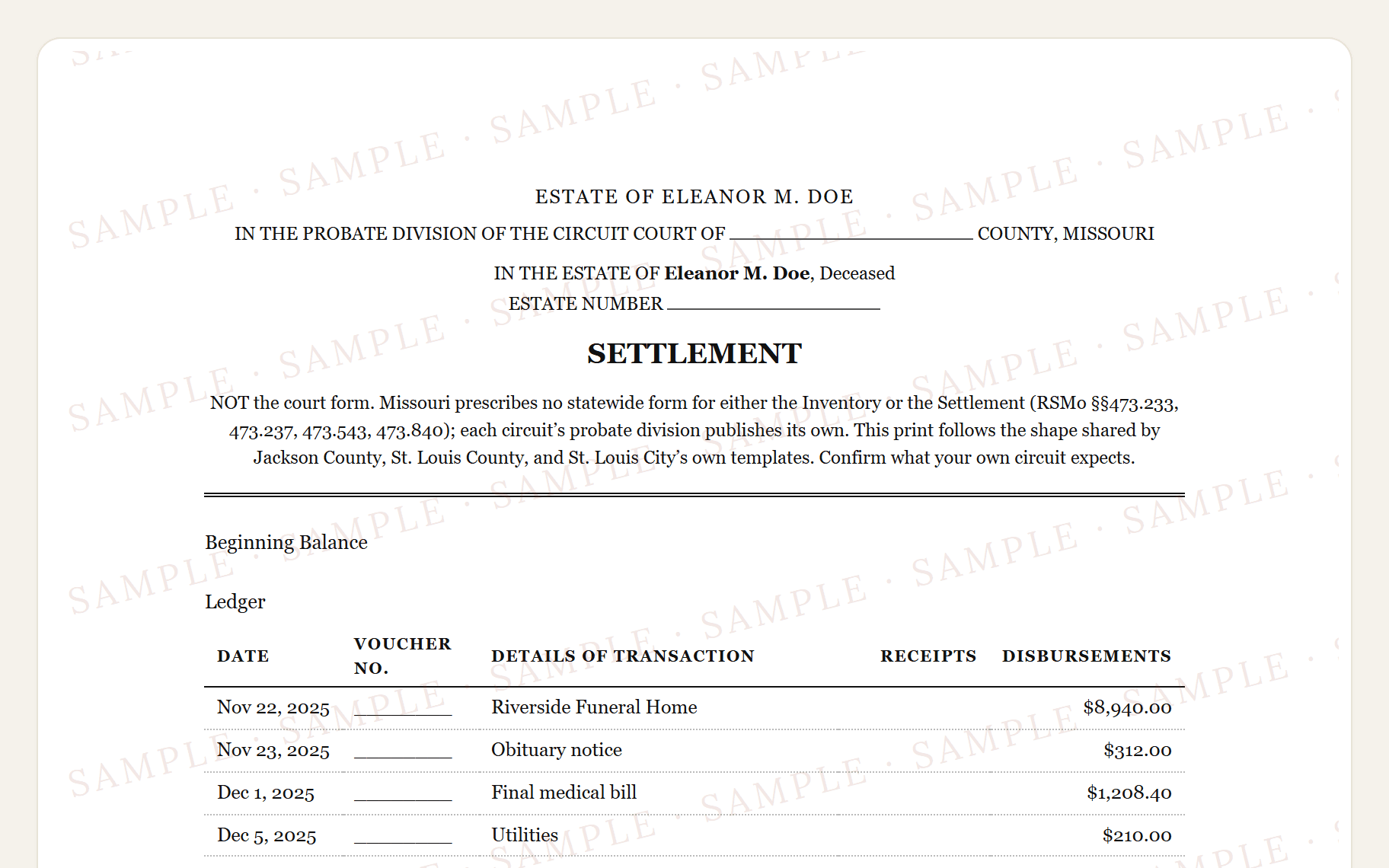
Missouri administers decedents' estates under RSMo Chapter 473, through the Probate Division of the Circuit Court in each county. The statute calls the fiduciary the personal representative throughout, and this guide uses the same term. Missouri has two administration routes: supervised administration, which settles with the court annually, and independent administration, the route most Missouri estates elect, which closes by filing a statement of account instead of annual settlements. RSMo § 473.233, § 473.237, § 473.540, and § 473.543 prescribe what the inventory and the settlement must contain, and § 473.840 does the same for the independent route's statement of account. None of them names or requires a specific numbered form.
What gets filed is whatever inventory and settlement template the estate's own circuit's probate division publishes. This guide draws on the shape shared across several circuits: Jackson County's Inventory of Property and Settlement, St. Louis County's Inventory and Appraisement and its Annual/Final Settlement, and St. Louis City's own settlement, which is word for word identical to St. Louis County's. Other circuits publish their own; Clay County's forms differ enough to matter. Jackson County and St. Louis County define the word Debit on a settlement as money received and Credit as money paid out, while Clay County's form reverses that. St. Louis County's and St. Louis City's own settlements avoid the ambiguity by using the plain words Receipts and Disbursements instead, and that is the wording this guide and ExecutorLedger's own Missouri print follow. Check your own circuit's probate division for its current template before filing.
The Inventory has two schedules. Personal property is classified into five numbered categories, taken from Jackson County's own recapitulation: furniture, household goods and wearing apparel; corporation stocks; mortgages, bonds and notes; cash, bank and savings and loan accounts, and insurance policies; and all other personal property. Real property gets its own separate schedule, with its own total, and is never folded into the personal property total. Supervised administration settles with the court annually, on the anniversary of the date letters were granted, until the estate closes (RSMo § 473.540). Independent administration instead closes by filing a statement of account under RSMo § 473.840, once at least six months and ten days have passed since the first published notice of letters.
Section 2 of 7.Missouri's deadlines, with the statute behind each
- Day 30 (about 1 month)Inventory and appraisement due
Why
Under RSMo §473.233, the inventory and appraisement of estate property is generally due within 30 days after letters are granted, unless the court allows more time, and it must classify assets into the statute's categories; confirm the exact due date and any local form requirements with your attorney. - Day 190 (about 6 months)Creditor claims bar (six months after first published notice)
Why
Under RSMo §473.360, creditors generally must file claims within 6 months after the first published notice of letters (or, for a creditor who was mailed or served notice, 2 months after that notice if later), so calendar this bar date before paying or distributing; the clock runs from first publication, which the clerk starts shortly after letters issue, so this date is an approximation. Confirm the actual first-publication date and bar date with your attorney. - Day 200 (about 7 months) · earliest possibleEarliest filing of the closing statement of account (independent administration)
Why
Under RSMo §473.840, an independent personal representative generally may file the closing statement of account no earlier than six months and ten days after the first published notice of letters, and only after the required 29-day advance notice; the trigger is first publication rather than the appointment itself, so this date is an approximation. Confirm the actual first-publication date with your attorney. - Day 365 (about 1 year)Close the estate or request an extension (independent administration)
Why
Under RSMo §473.843, an independent personal representative generally must file the §473.840 statement of account or petition for complete settlement under §473.837 within one year after appointment, or ask the court to extend the time (supervised estates instead file settlements annually on the anniversary of letters under §473.540); confirm the timing and whether an extension is needed with your attorney.
- Day 270 (about 9 months)Federal estate tax return (Form 706), if required
Why
Under IRC §6075, Form 706 is due 9 months after death, but only if the gross estate exceeds the federal exemption or the estate elects portability, and a 6-month extension may be available; confirm applicability and timing with your attorney. - Day 365 (about 1 year)Absolute one-year claims bar
Why
Under RSMo §473.444, claims against the estate are generally barred one year after death regardless of whether administration began or notice was given, with exceptions for administration costs, statutory allowances, U.S. and taxing-authority claims, and secured liens; confirm which claims survive this bar with your attorney.
The inventory and appraisement is due within 30 days after letters are granted, unless the court allows more time (RSMo § 473.233).
Read the full explanation
In a supervised administration, settlements are due annually, on the anniversary of the date letters were granted, until the estate closes; the final settlement is due on the first court day after six months and ten days from the first published notice of letters, or as soon as administration is complete (RSMo § 473.540).
Creditor claims are generally barred six months after the first published notice of letters, or two months after a mailed or served notice if that is later (RSMo § 473.360). Because the clerk starts publication shortly after letters issue rather than on a fixed day count, ExecutorLedger calendars this bar at 190 days after letters as an approximation, and asks you to confirm the actual first-publication date with your attorney.
An absolute bar closes out all claims one year after death regardless of whether administration ever opened, with exceptions for administration costs, statutory allowances, and United States or taxing-authority claims (RSMo § 473.444).
Independent administration, the route most Missouri estates use, may close no earlier than six months and ten days after the first published notice of letters, and only after the required 29-day advance notice (RSMo § 473.840). The independent personal representative must then file the statement of account, or petition for complete settlement under RSMo § 473.837, within one year after the original appointment, unless the court grants an extension (RSMo § 473.843).
A federal estate tax return, Form 706, if the estate needs one, is due nine months after death (IRC § 6075), with a possible six-month extension. Confirm whether the estate needs one with your attorney.
Section 3 of 7.What Missouri pays a personal representative
RSMo § 473.153 sets the schedule: absent a will provision or a written agreement, a personal representative earns 5 percent of the first $5,000 of the value of the personal property administered and the proceeds of real property sold under court order, 4 percent of the next $20,000, 3 percent of the next $75,000, 2.75 percent of the next $300,000, 2.5 percent of the next $600,000, and 2 percent of everything over $1,000,000.
This schedule is a floor, not a ceiling. When reasonable compensation would exceed it, the court shall allow whatever additional amount makes the compensation reasonable and adequate, and the personal representative does not have to show extraordinary services to earn that addition.
What counts toward the compensable value depends on who handles a real property sale's closing. If the personal representative personally disburses the proceeds, paying the lien and the expenses of sale out of the full purchase price, the full gross price counts. If a title company or broker escrows the sale and remits only the net proceeds, only that net figure counts. Real property sold under a power of sale in the will, or under an independent personal representative's own statutory authority, does not count toward compensation at all unless an actual court order authorized that specific sale.
When two or more personal representatives serve together, their combined compensation is capped at the lesser of twice the single-representative schedule or 5 percent of the compensable value, apportioned between them by the court, though the cap does not apply if the estate still holds unsold, court-possessed real property, or if extraordinary services were performed (RSMo § 473.153.2).
Section 4 of 7.How a Missouri estate closes
If the decedent was enrolled in MO HealthNet, Missouri's Medicaid program, request a release from the MO HealthNet Division early. The court will not close the estate without that release, or a waiver, on file (RSMo § 473.398.6).
Most Missouri estates elect independent administration. That personal representative publishes and mails the required closing notice, then files a statement of account with a complete accounting and a proposed schedule of distribution (RSMo § 473.840). Filing is allowed once six months and ten days have passed since the first published notice of letters. If no one objects within 20 days, the personal representative distributes per the filed schedule, and is discharged automatically, with no court order, if no proceeding is commenced within six months after the statement is filed.
In a supervised administration, or in an estate where anyone contests the accounting, the personal representative instead files a final settlement and a petition for distribution with the probate division, after the published and mailed notice required by RSMo § 473.583 and § 473.587, and after a 20-day window for a written objection. The personal representative then files signed receipts from each distributee, so the court can enter the order of discharge (RSMo § 473.660). Discharge releases the personal representative from further duty, and bars a suit against the personal representative or the bond's sureties unless it is brought within one year of the discharge date.
- If the decedent was enrolled in MO HealthNet (Medicaid), request a release from the MO HealthNet Division early. The court won't let the estate close without that release (or a waiver) on file (RSMo §473.398.6).
- In an independent administration (the common Missouri route), publish and mail the required closing notice, then file a verified statement of account with a complete accounting and a proposed distribution schedule (RSMo §473.840). This is allowed once six months and ten days have passed since the first published notice of letters.
- If no one objects within 20 days, distribute exactly per the filed schedule; the representative is discharged automatically if no proceeding is commenced within six months after the statement is filed.
- In a supervised administration, or if anyone is fighting, file a final settlement and petition for distribution with the Probate Division instead, after the published and mailed notice (RSMo §§473.583, 473.587), then file signed receipts from each distributee so the court can enter the order of discharge (RSMo §473.660).
Missouri probate is handled by the Probate Division of the Circuit Court. Most estates elect independent administration, which swaps annual court settlements for a mailed-and-filed statement of account and changes the deadline set. There is no UPC §3-1003 sworn-statement mechanism, but §473.840 plays the equivalent role.
Section 5 of 7.The Inventory and the Settlement explained for a first-time personal representative
The Inventory's personal property schedule has five numbered categories. Category 1 is furniture, household goods and wearing apparel. Category 2 is corporation stocks. Category 3 is mortgages, bonds, notes and other written evidence of debt; ExecutorLedger's own asset categories have nothing that lands here today, so this line prints with a blank, so a reader can see what belongs in it. Category 4 is cash, bank and savings and loan accounts, and insurance policies. Category 5 is all other personal property, and is where ExecutorLedger places a vehicle, a business interest, or anything else its own categories do not fit into one of the first four.
Real property gets its own schedule, with its own total, separate from the five personal property categories and never added into their total. It prints one value, the asset's date-of-death value, with a note that Missouri practice expects that figure already net of any lien, since ExecutorLedger does not record liens. If an asset has no date-of-death value on file, its line prints blank rather than a zero, and it is counted in the schedule but never summed into the total.
The Settlement is a single running ledger, not separate schedules for receipts and disbursements. Its columns are Date, Voucher No., Details of Transaction, Receipts, and Disbursements. Voucher No. always prints blank; ExecutorLedger does not record a voucher number for any transaction. A voucher itself is the receipt, cancelled check, or bank statement a personal representative keeps to support a disbursement; Missouri requires one for every disbursement over $75 (RSMo § 473.543).
A sale of personal property posts as two full, separate lines rather than one gain or loss. The full sale proceeds post as a receipt, and the asset's full inventory value posts as a second line removing it from its category, worded like the Jackson County Probate Procedures Manual's own worked example, which posted a $400 furniture sale as a $400 receipt and a separate $350 line crediting Inventory Item 1. The $50 difference between them is never itself printed anywhere on the form. A sale of real property instead posts only its proceeds as a receipt, since real property is never part of the personal property recapitulation and is never compared to its own inventory value.
A cash distribution reduces the cash category by the amount distributed. A distribution in kind carries no dollar figure of its own; it removes the asset's carried value from its category, and the print names the beneficiary and the item without a value. The Settlement ends with a recapitulation that breaks the ending balance back into the same five categories the Inventory uses. On a first settlement, the beginning balance has to equal the Inventory's own personal property total; on every later settlement, it has to equal the prior settlement's ending balance. When ExecutorLedger's own figures do not tie, it prints the difference in a warning block rather than hiding it behind a zero the numbers do not support.
Section 6 of 7.Where ExecutorLedger fits
Recording is free for as long as the estate takes: every receipt and disbursement with its date and description, distributions per heir or devisee, and a balance that checks itself as you go. ExecutorLedger builds Missouri-style documents from those records, an Inventory of Property shaped like Jackson County's own template and a Settlement laid out the way St. Louis County's Annual/Final Settlement is, ready to transcribe onto your own circuit's template if you end up filing one. Neither is a court form, and your attorney should review them before anything is signed or filed. Every document previews free with your real numbers, and $149 (one-time payment) per estate lifts the watermark.
Section 7 of 7.Questions Missouri executors ask
Is there a court form for Missouri's inventory or settlement?
No. RSMo § 473.233, § 473.237, § 473.540, and § 473.543 set what the inventory and the settlement must contain, but none of them names or requires a specific numbered form. What gets filed is whatever template the estate's own circuit's probate division publishes, such as Jackson County's or St. Louis County's.
When is the Missouri inventory due?
Within 30 days after letters are granted, unless the court allows more time (RSMo § 473.233).
How is a Missouri personal representative paid?
Absent a will provision or a written agreement, RSMo § 473.153 sets 5 percent of the first $5,000 of the compensable value, 4 percent of the next $20,000, 3 percent of the next $75,000, 2.75 percent of the next $300,000, 2.5 percent of the next $600,000, and 2 percent of everything over $1,000,000. This schedule is a floor, not a ceiling; the court allows more whenever reasonable compensation would exceed it.
How does a Missouri estate close?
Most estates elect independent administration and close by filing a statement of account with a proposed schedule of distribution, once six months and ten days have passed since the first published notice of letters (RSMo § 473.840). A supervised administration, or a contested one, instead files a final settlement and a petition for distribution with the probate division (RSMo § 473.583, § 473.587).
Why does a Missouri sale post two lines instead of a gain or loss?
Because that is how the local settlement forms and Jackson County's own Probate Procedures Manual describe it: the full sale proceeds post as a receipt, and the asset's full inventory value posts as a separate line removing it from its category. No Missouri settlement form read for this guide computes or prints a gain or loss figure anywhere.
Not sure which accounting your situation calls for? Which accounting do I need? covers the choice, and the accounting guide explains the structure every format shares.
This page describes Missouri practice as our verified references state it; formats drift and estates differ, and none of this is legal advice. ExecutorLedger produces court-style documents for transcription. They are not official court forms. The accounting your estate needs is a question for its attorney.