Mississippi Estate Accounting: A Representative's Guide
Mississippi probate runs through the Chancery Court in each county, and its fiduciary is the executor named in a will or the administrator appointed when there is none. Mississippi publishes no statewide form for the inventory or the account. The statutes fix the content, and the chancery clerks and local practice fill in the layout. Here is what the statutes require, the waiver that can excuse either document, the deadlines behind them, and how a Mississippi estate closes.
Section 1 of 8.The two documents: the Inventory and the Account
Mississippi administers decedents' estates under Title 91, Chapter 7 of the Mississippi Code, before the Chancery Court of the county where the estate is opened. There is no statewide probate form category for either document, the way there is none in Missouri, Washington or Alabama. What the statutes say a document must contain is the whole of the requirement.
The first document is the Inventory, required by Miss. Code Ann. § 91-7-93. It is one list, verified by oath, of the money and property the decedent owned at death, described in reasonable detail, each item at its market value as of the date of death and with the type and amount of any encumbrance that may exist with reference to it. Mississippi's statute sets no classification scheme and no numbered classes, so ExecutorLedger prints one list in the order you entered it, with a column naming the kind of each thing, and says on the print that the kind column is the app's own choice rather than a statutory category.
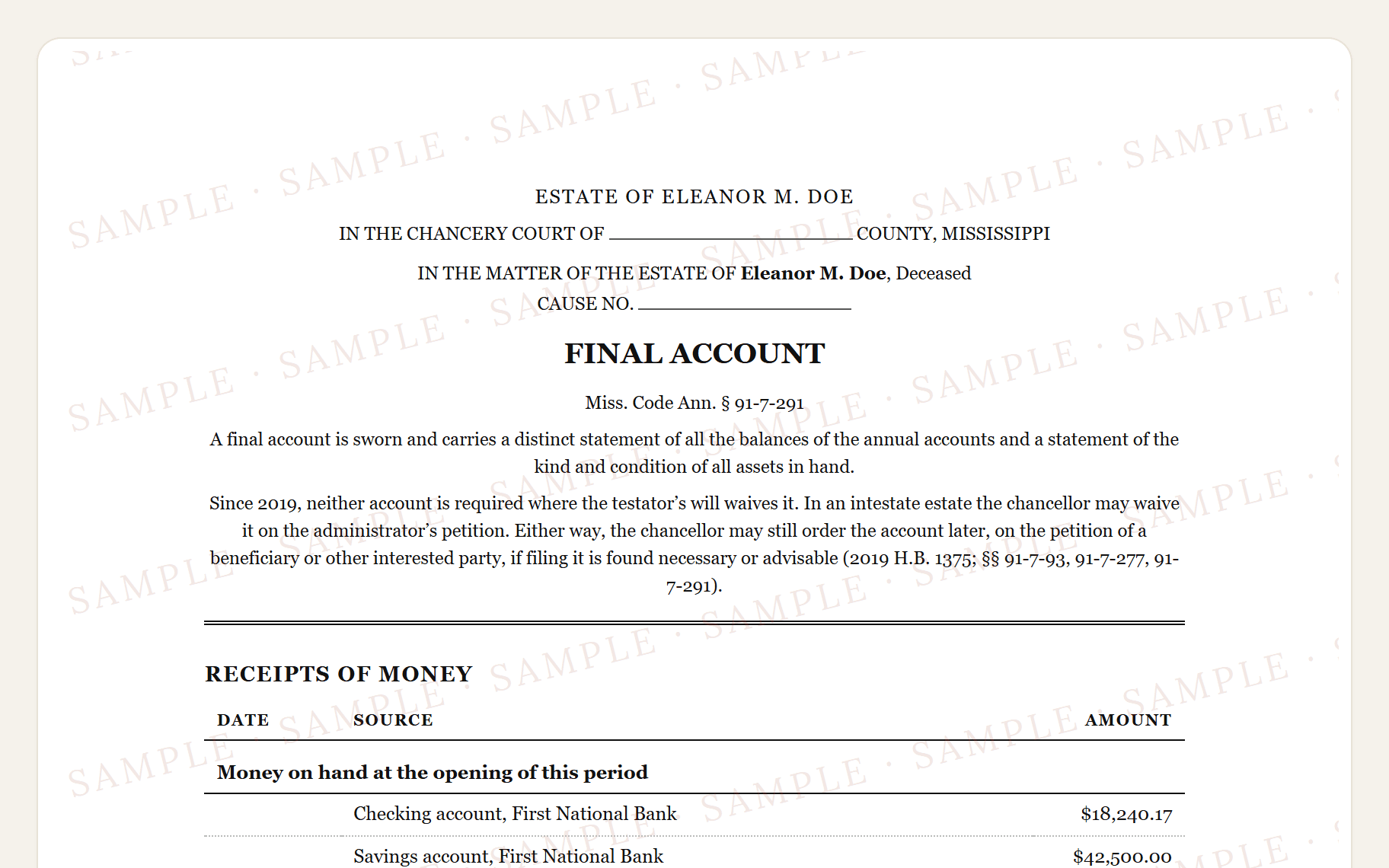
The second document is the Account, sworn like the inventory: an annual account under § 91-7-277 while the estate stays open, and a final account under § 91-7-291 when it closes. Both are accounts of money. The annual account states the receipts of money with their sources and the disbursements with each item and amount distinctly stated. The final account adds a distinct statement of all the balances of the annual accounts and a statement of the kind and condition of all assets in the executor's or administrator's hands.
Section 2 of 8.Mississippi's deadlines, with the statute behind each
- Day 30 (about 1 month)Creditor search affidavit, mailed notices, and published notice to creditors
Why
Under Miss. Code §91-7-145, the executor generally must make reasonably diligent efforts to identify creditors, file an affidavit of that search with the clerk, mail notice to each known creditor at their last known address, and publish notice to creditors in a county newspaper for 3 consecutive weeks; the statute sets no fixed day count (this entry assumes roughly 30 days after letters), but Chancery Rule 6.03 requires publication for creditors to be made promptly, and first publication is what starts the 90-day claims bar; confirm the timing with your attorney. - Day 30 (about 1 month)Notice to Division of Medicaid (estate recovery), if decedent received Medicaid
Why
Under Miss. Code §43-13-317, if the decedent ever received Medicaid, the Division of Medicaid generally must be noticed as an identified creditor through the §91-7-145 known-creditor process so its claim runs with the other creditors (recovery itself typically targets nursing-facility, home- and community-based, and related benefits paid at age 55 or older, with exceptions for a surviving spouse or certain dependents); the statute sets no separate day count, so this entry mirrors the creditor-notice step anchored to letters; confirm whether this applies with your attorney. - Day 90 (about 3 months)File sworn inventory with the chancery clerk
Why
Under Miss. Code §91-7-93, the executor generally must file a sworn inventory of the decedent's money and property within 90 days after letters are granted, listed in reasonable detail with date-of-death market values and any encumbrances, unless the will waives the inventory or the court or clerk allows more time; confirm whether an inventory is required and the exact date with your attorney. - Day 120 (about 4 months)Creditor claims bar (90 days after first publication)
Why
Under Miss. Code §91-7-151, creditor claims generally must be registered, probated and allowed with the chancery clerk within 90 days after the first publication of the notice to creditors or they are forever barred, even claims the executor knew about; this entry conservatively assumes publication about 30 days after letters, so count 90 days from your actual first-publication date and let the bar pass before paying unprobated claims or distributing; confirm the operative bar date with your attorney. - Day 365 (about 1 year)First annual account of the administration
Why
Under Miss. Code §91-7-277, the executor generally must present a sworn account of the administration at least once each year, showing receipts by source and every disbursement distinctly stated and supported by a legal voucher, unless the will waives accountings or the court waives them in an intestate estate; failing to account annually is typically treated as a breach of the administration bond (though the court can extend the time on cause shown), so calendar this even if you expect to close sooner; confirm whether an accounting is required and its due date with your attorney.
- Day 270 (about 9 months)Federal estate tax return (Form 706), if required
Why
Under IRC §6075, Form 706 is due 9 months after death, but only if the gross estate exceeds the federal exemption or the estate elects portability, and a 6-month extension may be available; confirm applicability and timing with your attorney.
The inventory is due within ninety days of the grant of letters, unless the court or the clerk allows further time (§ 91-7-93).
Read the full explanation
The supplementary inventory under § 91-7-95 carries no deadline. It covers property discovered after the original inventory, and a value or a description in the original that turns out to be wrong. It is filed with the court if the original inventory was filed, and otherwise furnished to the persons interested.
The annual account is filed at least once a year, or oftener if the court orders it, and failing to account annually is treated as a breach of the executor's or administrator's bond (§ 91-7-277).
Creditor claims are barred ninety days after the first publication of the notice to creditors, which runs for three consecutive weeks (§ 91-7-145). The clock runs from first publication, never from the date of death or the grant of letters.
A federal estate tax return, Form 706, if the estate needs one, is due nine months after death (IRC § 6075), with a possible six-month extension. Confirm whether the estate needs one with your attorney.
Section 3 of 8.The 2019 waiver: none of this is simply required
House Bill 1375, approved April 16, 2019, added the same waiver to three statutes at once: the inventory (§ 91-7-93), the annual account (§ 91-7-277), and the final account (§ 91-7-291). Each of the three says the filing is not required at all if the requirement is waived in the testator's will, and each may also be waived by the court or the chancellor in an intestate estate, on the administrator's petition.
None of the three waivers is the last word. The chancellor may still order the executor or administrator to file an inventory, or to account, later, on the petition of a beneficiary or another interested party, if the chancellor decides the filing is necessary or advisable. So no Mississippi document in this guide is simply required. Every one of the three can have been waived, and the chancellor can order it filed anyway.
Section 4 of 8.What Mississippi pays an executor or administrator
There is no percentage schedule. § 91-7-299 lets the court allow the executor or administrator such sum as the court deems proper, considering the value and worth of the estate and the extent or degree of difficulty of the duties discharged, in a partial or a final settlement. The court may also allow necessary expenses, including a reasonable attorney's fee, assessed out of the estate, in an amount the court determines.
Nothing in § 91-7-299 sets a rate, a range, or a cap. ExecutorLedger never computes a Mississippi commission from a percentage, and prints no ceiling either, since the statute names none.
Section 5 of 8.How a Mississippi estate closes
The final account under § 91-7-291 carries a distinct statement of all the balances of the annual accounts on file, and a statement of the kind and condition of all assets still in the executor's or administrator's hands, real property included. It stays on file for inspection, together with a statement of the parties in interest, and summons issues or publication is made for interested parties as in other chancery suits (§ 91-7-295).
Vouchers supporting the account need not be filed separately if the decree approving the account recites that they were exhibited to and approved by the court, but the executor or administrator must preserve them until the final accounting is approved (§ 91-7-295). § 91-7-297 sets the hearing and the decree on the final account, which the chancellor enters after considering it.
An appraiser is optional, not required. § 91-7-109 lets the executor or administrator employ a qualified and disinterested appraiser for an asset whose value may be subject to reasonable doubt. Nothing in Mississippi law requires one for every estate.
- Wait out the 90-day claims bar, pay the properly probated claims, and collect the assets. Mississippi estates open and close in the Chancery Court, and your Mississippi attorney (required for most fiduciaries by Chancery Rule 6.02) files the closing papers.
- Prepare and file a sworn final account under Miss. Code §91-7-291, covering the balances of all annual accounts, every disbursement backed by a voucher, and the kind and condition of remaining assets, along with the sworn statement of heirs, devisees and legatees (names, addresses, and any minors or incapacitated parties) that §91-7-293 requires (skip the account itself only if the will waives accountings or the court excuses them).
- Get each beneficiary to sign a waiver and joinder consenting to the final account; for anyone who won't sign, have summons issued or notice published under §91-7-295 at least 30 days before the hearing.
- At the hearing, ask the chancellor for a final decree approving and allowing the account and ordering distribution of the property in your hands (§91-7-297).
- Distribute per the decree, collect a signed receipt from each beneficiary, and file the receipts so the court can enter the decree closing the estate and discharging you and your bond.
Mississippi is not a UPC state. There is no §3-1003-style sworn closing statement; closing is by chancery decree on a final account, or on beneficiary waivers/joinders where accountings are waived. Probate personal property of $75,000 or less can skip administration entirely via the §91-7-322 successor affidavit (30 days after death).
Section 6 of 8.The Inventory and the Account explained for a first-time executor or administrator
The inventory is one list, at the market value of each item as of the date of death, with no statutory grouping. ExecutorLedger's print groups the list by asset type for readability and says so, rather than presenting the grouping as something the statute requires. Real property is on the list too, since § 91-7-93 covers the property owned by the decedent at the time of death, but it carries its own total, kept apart so the account of money below does not include it.
The supplementary inventory under § 91-7-95 gets its own section, separate from the original list, since the statute sets no deadline and treats it as a filing of its own. It covers new property that turns up later, and a corrected value or description for something already listed, in the same section.
The account is an account of money, built the way § 91-7-277 describes it: receipts of money with their sources, and disbursements with each item and amount distinctly stated. It is not a charge-and-discharge account of property, the way some other states' accounts run. Money the estate already held at the start of the period opens the account; money found later, still held, adds to the closing figure on its own line, since it was never collected as a receipt; and each dollar is counted once, whether it opened the account, was found later, or was collected as a receipt.
A sale of real property brings its full proceeds into the account as a receipt, with no gain or loss figure anywhere, since nothing in Mississippi's statutes computes one. An in-kind distribution is not a disbursement of money; it gets its own list, naming the beneficiary and the item, and the item leaves the assets still in the executor's or administrator's hands. Sections the app has no data for still print, with ruled blanks rather than disappearing: the balances of the annual accounts, the condition of each asset still held, and the statement of the parties in interest.
Section 7 of 8.Where ExecutorLedger fits
Recording is free for as long as the estate takes: every receipt and disbursement with its date and description, distributions per beneficiary, and a balance that checks itself as you go. ExecutorLedger builds Mississippi-style documents from those records, an Inventory under § 91-7-93 and an Account under § 91-7-277 or § 91-7-291, ready to transcribe onto whatever your own chancery clerk expects when you file. Neither is a court form, and your attorney should review them before anything is signed or filed. Every document previews free with your real numbers, and $149 (one-time payment) per estate lifts the watermark.
Section 8 of 8.Questions Mississippi executors ask
Is there a court form for Mississippi's inventory or account?
No. Mississippi publishes no statewide form for either document. §§ 91-7-93, 91-7-277, and 91-7-291 set what each must contain, and the chancery clerks and local practice fill in the layout, the way Missouri, Washington, and Alabama work too.
Can a Mississippi estate skip the inventory or the account?
Sometimes. House Bill 1375, effective in 2019, lets a will waive the inventory, the annual account, or the final account, and lets the chancellor waive any of the three in an intestate estate on the administrator's petition. Even after a waiver, the chancellor may still order the filing later, on the petition of a beneficiary or another interested party, if the chancellor decides it is necessary or advisable (§§ 91-7-93, 91-7-277, 91-7-291).
When is the Mississippi inventory due?
Within ninety days of the grant of letters, unless the court or the clerk allows further time (§ 91-7-93). A supplementary inventory for property discovered later, or a corrected value or description, carries no deadline (§ 91-7-95).
How is a Mississippi executor or administrator paid?
§ 91-7-299 lets the court allow such sum as it deems proper, considering the value and worth of the estate and the difficulty of the duties discharged, plus necessary expenses including a reasonable attorney's fee. There is no percentage, no range, and no cap anywhere in the statute.
When are Mississippi creditor claims barred?
Ninety days after the first publication of the notice to creditors, which runs for three consecutive weeks (§ 91-7-145). The clock runs from first publication, not from death or from the grant of letters.
Not sure which accounting your situation calls for? Which accounting do I need? covers the choice, and the accounting guide explains the structure every format shares.
This page describes Mississippi practice as our verified references state it; formats drift and estates differ, and none of this is legal advice. ExecutorLedger produces court-style documents for transcription. They are not official court forms. The accounting your estate needs is a question for its attorney.