Kansas Estate Accounting: A Representative's Guide
Kansas probate runs through the district court in each county, and its fiduciary is the personal representative, the executor named in a will or the administrator appointed when there is none. The Kansas Judicial Council publishes a few free probate forms for a decedent's estate, among them a hearing notice, a petition for allowance of demand and a small estates affidavit, and none of them is an inventory or an account. Its sample inventory and account forms sit in Probate Forms 3d, a paywalled attorney's sample set, not a court-mandated form. Here is what the statutes require of an inventory and of a final settlement, the deadlines behind them, and how a Kansas estate closes.
Section 1 of 7.The two documents: the Inventory and the Petition for Final Settlement
Kansas administers decedents' estates under Chapter 59 of the Kansas Statutes Annotated, through the district court of the county where the estate is opened. The first document is the inventory and valuation, required by K.S.A. 59-1201. It lists the estate's property in five lettered classes, with the full and fair value of each item as of the date of death, verified by the personal representative's affidavit.
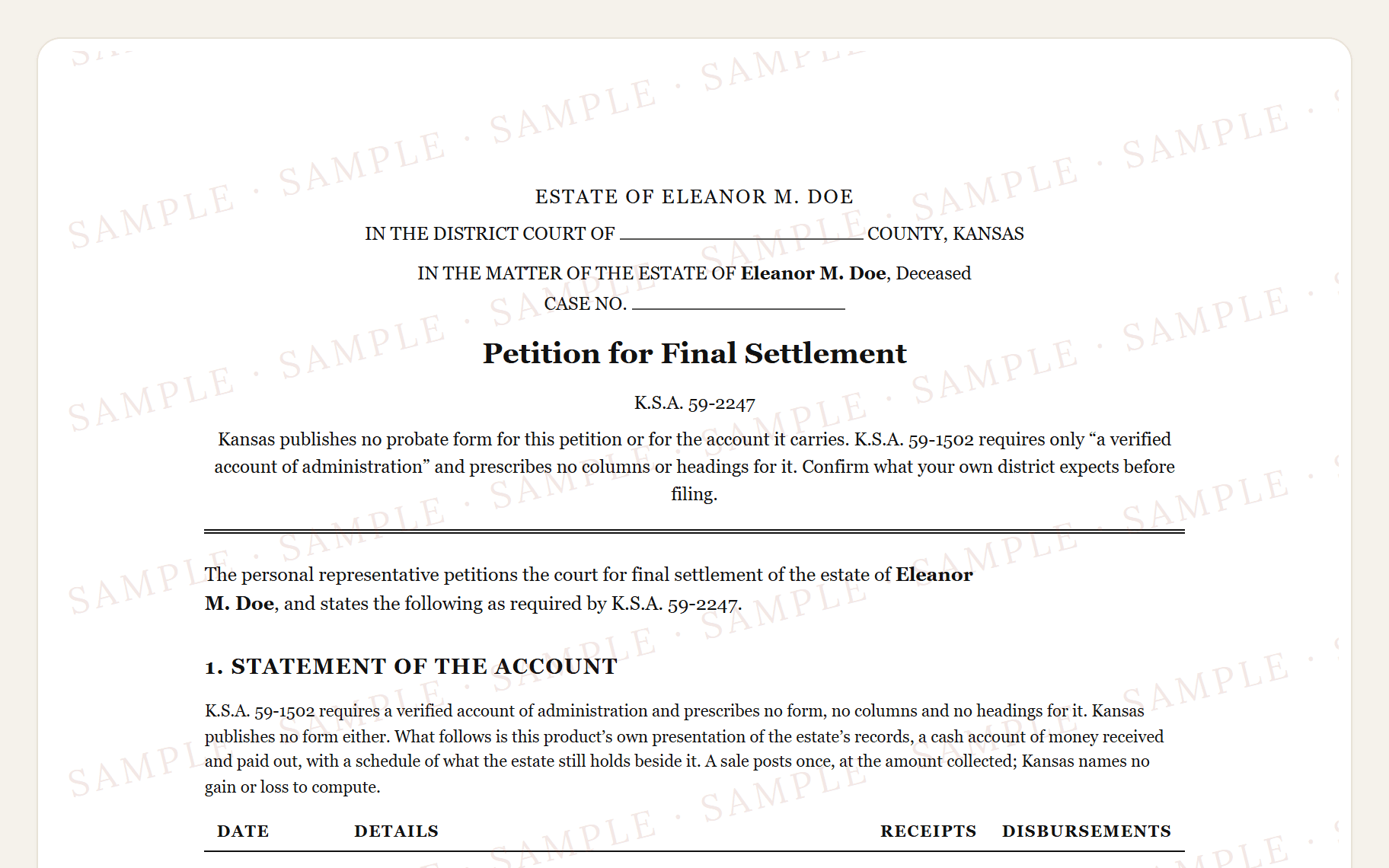
The second document is the account that the personal representative presents when asking the court to settle the estate. K.S.A. 59-1502 requires a verified account of administration, but says nothing about its shape: no columns, no headings, no schedules, and this short section has not been amended since 1939. Kansas leaves the account's format to the preparer. Because nothing in the statute names a gain or a loss, ExecutorLedger's Kansas account is a cash account of money received and money paid out, with a schedule of what the estate still holds beside it. That shape is ExecutorLedger's own choice, not a Kansas requirement, made the way a plain cash accounting is built for other states that prescribe no form.
The account itself is filed inside a petition for final settlement, and K.S.A. 59-2247 does prescribe what that petition contains: a statement of the account, the heirs' and beneficiaries' names, a description of the real estate and the decedent's interest in it at death, the nature of each heir's or beneficiary's claim, and a statement about whether the decedent or a predeceased spouse received state medical assistance. ExecutorLedger's Kansas documents are the inventory and this final settlement petition, built from your own records, for you to review with your attorney before filing on whatever format your district court expects.
Section 2 of 7.Kansas's deadlines, with the statute behind each
- Day 14 (about 2 weeks)Notice to creditors (published and mailed)
Why
Under K.S.A. 59-2236, notice to creditors is typically published together with the notice of the probate hearing (so publication often starts before letters issue; this entry is anchored to your appointment as a conservative reminder), and known or reasonably ascertainable creditors generally must also receive actual notice, such as a mailed copy of the published notice; confirm the publication dates and the known-creditor mailing list with your attorney. - Day 30 (about 1 month)Inventory and valuation due
Why
Under K.S.A. 59-1201, the verified inventory, stating the full and fair date-of-death value of each asset, is generally due within 30 days after your letters are issued unless the court grants more time, and assets discovered later typically need a supplemental inventory filed within 30 days of discovery (K.S.A. 59-1203); confirm the due date and any extension with your attorney. - Day 120 (about 4 months)Creditor claims bar date
Why
Under K.S.A. 59-2239, creditor demands are generally barred at the later of 4 months after the date of first published notice or, for a known or reasonably ascertainable creditor given actual notice, 30 days after that notice; the true trigger is publication (which usually begins before letters issue), not your appointment, so this letters-anchored date is a conservative placeholder. Confirm the operative bar date before paying claims or distributing with your attorney.
- Day 180 (about 6 months)Petition to admit the will to probate (6-month bar)
Why
Under K.S.A. 59-617, a Kansas resident's will is generally ineffective to pass property unless a petition for its probate is filed within 6 months after death, with only narrow exceptions (for example, K.S.A. 59-618 lets an innocent beneficiary of a knowingly withheld will petition within 90 days after gaining knowledge of and access to it); confirm whether this bar applies and the exact filing date with your attorney. - Day 180 (about 6 months) · earliest possibleEarliest date the estate can be closed
Why
Under K.S.A. 59-3205, in a simplified estate the court generally may order the estate closed under K.S.A. 59-2247 and 59-2249 only after the claims period has run, the appeal time on admitting (or refusing) the will has expired, and 6 months have passed since death, so final settlement typically first becomes possible around this date; confirm the timing with your attorney. - Day 270 (about 9 months)Federal estate tax return (Form 706), if required
Why
Under IRC §6075, Form 706 is due 9 months after death, but only if the gross estate exceeds the federal exemption or the estate elects portability, and a 6-month extension may be available; confirm applicability and timing with your attorney.
The inventory is due within 30 days after the date of the personal representative's letters of appointment, unless the court grants more time. The clock runs from letters, not from the date of death (K.S.A. 59-1201).
Read the full explanation
Property discovered after the inventory is filed goes on a supplementary inventory, due within 30 days of the discovery. It is its own instrument with its own total, never folded into the original inventory (K.S.A. 59-1203).
Nine months from appointment is the ordinary period for settling the estate, extendable by the court for cause. The court may also close an inactive estate after five years (K.S.A. 59-1501).
Creditor claims are generally barred four months from the date of the first published notice to creditors (K.S.A. 59-2236).
Notice of the final settlement hearing runs either as reasonable notice the court sets, which can be waived, or, where the settlement assigns title to real estate, by publication once a week for three consecutive weeks: the first publication within 30 days of the order setting the hearing, the hearing no earlier than 10 and no later than 30 days after the last publication, and mailing to known interested persons within 7 days of the first publication (K.S.A. 59-2208, K.S.A. 59-2209).
A federal estate tax return, Form 706, if the estate needs one, is due nine months after death (IRC § 6075), with a possible six-month extension. Confirm whether the estate needs one with your attorney.
Section 3 of 7.What Kansas pays a personal representative
There is no percentage schedule. K.S.A. 59-1717 allows a fiduciary such compensation for services, and for the services of the fiduciary's attorneys, as is just and reasonable, and it has not been amended since 1939. One section covers both the personal representative and the attorney, which is unusual: most states set them apart.
The court determines what is just and reasonable on application, and may allow it at any time during administration. ExecutorLedger computes no Kansas commission from a percentage, because no Kansas statute sets one. Its final settlement reports only the compensation your own records show was paid or recorded, and leaves the rest to the court.
An independent appraisement of the inventory happens only if a party interested in the estate requests one; the personal representative then appoints up to three appraisers, subject to the court's approval. Absent a request, the personal representative's own stated values stand, and nothing about Kansas probate requires an appraisal as a matter of course (K.S.A. 59-1202).
Section 4 of 7.How a Kansas estate closes
The personal representative files a petition for final settlement under K.S.A. 59-2247. Besides the account itself, the petition names the heirs, devisees and legatees with their residences and addresses, describes the real estate and the decedent's interest in it as of the date of death, states the nature of each heir's or beneficiary's claim, and states whether the decedent or a predeceased spouse received medical assistance under K.S.A. 39-709, or that the state agency providing it was given notice of the petition as K.S.A. 59-2222 requires.
At the hearing, the personal representative must, and any other interested person may, be examined on the account and the proposed distribution. If the account is correct and the taxes are paid so far as the estate's funds allow, the court settles and allows the account, and the decree names the heirs, devisees and legatees, describes the property, and states each one's share (K.S.A. 59-2249).
Three routes sometimes get confused because their names sound alike. The small-estate affidavit under K.S.A. 59-1507b needs no administration at all: no letters, no inventory, no account, and it transfers personal property to a successor on an affidavit when the estate's total assets subject to probate do not exceed $75,000. Summary proceedings under K.S.A. 59-1507 are a shortcut inside a supervised administration, for an estate too small to cover more than funeral costs, last-sickness expenses, administration costs and priority debts; an account is still required, just an abbreviated one. The Kansas Simplified Estates Act, K.S.A. 59-3201 and following, is full administration with letters, and the inventory is still required (K.S.A. 59-3204); what it removes is interim court supervision of claims and personal property sales, and the estate still closes through the same final settlement petition and hearing. K.S.A. 59-3202 gives the choice between simplified and supervised administration to the court, not to the personal representative, weighing the size of the estate, the heirs' relationship to the decedent, solvency, the nature of the estate, the heirs' own wishes, the probable cost, and other pertinent matters.
Kansas publishes no form for the caption or the case number of either document, so this guide states none. Confirm what your own district court expects before filing.
- Wait out the claims window, generally 4 months after the first published creditor notice, plus 30 days after any actual notice you mailed to a known creditor, and pay or resolve the allowed demands before wrapping up.
- File a petition for final settlement and accounting with the district court (K.S.A. 59-2247): it contains your account, names the heirs, devisees, and legatees, describes any real estate, and must state whether the decedent or a predeceased spouse ever received Medicaid (medical assistance).
- Give notice of the final-settlement hearing: published notice under K.S.A. 59-2209 is required when the court will assign title to real estate, and in other cases notice is given or waived as provided in K.S.A. 59-2208. Or collect signed waivers and consents from everyone entitled to notice.
- At the hearing the court settles and allows your account, determines the heirs and beneficiaries, and assigns the property by decree under the will, intestacy law, or a valid family settlement agreement (K.S.A. 59-2249).
- If the estate was handled under the Simplified Estates Act, note that court supervision was suspended mid-administration but the estate still closes through this same final-settlement route once 6 months have passed since death (K.S.A. 59-3205).
Probate is handled by the probate department of the district court in the decedent's county. Kansas has no separate probate, surrogate's, or orphans' court, and Kansas is not a UPC state: there is no sworn closing statement filed without a hearing; even simplified estates end with a court decree of final settlement and discharge.
Section 5 of 7.The Inventory and the Final Settlement explained for a first-time personal representative
The inventory's five classes come from K.S.A. 59-1201, in the statute's own lettered order: (a) real estate, with a plat or survey description; (b) furniture, household goods and wearing apparel; (c) corporation stocks, described by certificate numbers; (d) bonds, mortgages, notes and other written evidence of debt, described by the debtor's name, recording data and other identification; and (e) all other personal property accurately identified. Three of the five classes ask for detail ExecutorLedger's asset registry does not record: class (a) wants a plat or survey description where the registry holds a plain description, class (c) wants certificate numbers the registry does not track, and class (d) wants a debtor's name, recording data and other identification the registry has no field for. Each of those classes still prints, with a note explaining what the statute asks for and leaving the blank to the preparer. No app category maps to bonds, mortgages, notes or other written evidence of debt owed to the estate, so class (d) prints with its own note saying so rather than an empty, unexplained schedule.
An item with no date-of-death value on file prints as a blank rather than a zero, and is counted in the schedule without being summed into the total. The supplementary inventory for later-discovered property keeps its own total, separate from the original inventory's total.
Verification is either a notarized affidavit or the unsworn declaration K.S.A. 53-601 allows in its place: 'I declare (or verify, certify or state) under penalty of perjury that the foregoing is true and correct' when executed in Kansas, or 'I declare (or verify, certify or state) under penalty of perjury under the laws of the state of Kansas that the foregoing is true and correct' when executed outside Kansas. Both are printed on ExecutorLedger's Kansas documents with a place to mark which applies, because some offices still expect a notarized affidavit.
The account's columns are Receipts and Disbursements: money the personal representative collected, and money paid out, with a running balance. Because nothing in Chapter 59 names a gain or a loss, a sale posts once, at the amount collected, and the asset sold leaves the schedule of property the estate still holds. Property found after the inventory was filed is not treated as a receipt of money; it gets its own line, the way it does on the inventory. The final settlement also carries the real estate and the decedent's interest in it as of the date of death, which is the inventory's own figure and not a current one, because K.S.A. 59-2247(3) asks for the value at death.
The heirs, devisees and legatees section names everyone ExecutorLedger has a distribution recorded for. Their residences, addresses, and the nature and character of each one's claim are not data ExecutorLedger records, so those fields print ruled and blank for the preparer to fill in. The medical assistance statement prints both branches, that no assistance was received or that the providing state was given notice, because the record on file cannot say which applies.
Section 6 of 7.Where ExecutorLedger fits
Recording is free for as long as the estate takes: every receipt and disbursement with its date and description, distributions per heir or beneficiary, and a balance that checks itself as you go. ExecutorLedger builds Kansas-style documents from those records, an inventory and valuation laid out in K.S.A. 59-1201's five lettered classes and a petition for final settlement laid out the way K.S.A. 59-2247 numbers its own required items, ready to transcribe or attach when you file. Neither is a court form, since Kansas publishes none for either document, and your attorney should review them before anything is signed or filed. Every document previews free with your real numbers, and $149 (one-time payment) per estate lifts the watermark. Usually less than one attorney hour, and typically reimbursable by the estate.
Section 7 of 7.Questions Kansas executors ask
Is there a court form for Kansas's inventory or account?
No. The Kansas Judicial Council's free probate forms run to a hearing notice, a petition for allowance of demand and a small estates affidavit, and none of them is an inventory or an account. Sample inventory and account forms exist in Probate Forms 3d, a paywalled attorney's sample set, not a court-mandated form. K.S.A. 59-1201 and K.S.A. 59-2247 say what the documents must contain, and that is the whole requirement.
When is the Kansas inventory due?
Within 30 days after the date of the personal representative's letters of appointment, unless the court grants more time (K.S.A. 59-1201). Property discovered later goes on a supplementary inventory, due within 30 days of the discovery (K.S.A. 59-1203).
What does the Kansas account have to look like?
K.S.A. 59-1502 requires a verified account of administration but sets no columns, headings or schedules, and has not been amended since 1939. ExecutorLedger builds a cash account of money received and money paid out, with a schedule of property still on hand, since Chapter 59 names no gain or loss and no other shape.
How is a Kansas personal representative paid?
K.S.A. 59-1717 allows a fiduciary such compensation for services, and for the services of the fiduciary's attorneys, as is just and reasonable, with no percentage and no schedule. One section covers both the personal representative and the attorney. The court determines the amount on application.
What is the Kansas small-estate affidavit threshold?
$75,000 in total assets of the estate subject to probate (K.S.A. 59-1507b), raised from $40,000 effective July 1, 2023 by L. 2023 ch. 77 section 7, and amended again by L. 2024 ch. 35 section 2. No administration, letters, inventory or account is required under this route.
Is the Kansas Simplified Estates Act a shortcut around the inventory?
No. The Simplified Estates Act, K.S.A. 59-3201 and following, is full administration with letters, and the inventory is still required (K.S.A. 59-3204). What it removes is interim court supervision of claims and personal property sales, not the inventory or the accounting, and the estate still closes through the same final settlement petition and hearing. K.S.A. 59-3202 gives the choice between simplified and supervised administration to the court, not to the personal representative.
Not sure which accounting your situation calls for? Which accounting do I need? covers the choice, and the accounting guide explains the structure every format shares.
This page describes Kansas practice as our verified references state it; formats drift and estates differ, and none of this is legal advice. ExecutorLedger produces court-style documents for transcription. They are not official court forms. The accounting your estate needs is a question for its attorney.