Iowa Estate Accounting: A Representative's Guide
Iowa probate runs through the district court in each county, and its fiduciary is the personal representative, the executor named in a will or the administrator appointed when there is none. Iowa prescribes no probate form at all. The chapter 633 rules for adult guardianships and conservatorships have their own mandatory forms, but a decedent's estate is a different proceeding, and no Iowa Judicial Branch form covers it. Here is what the statutes require of a report and inventory and of a final report, the deadlines behind them, and how an Iowa estate closes.
Section 1 of 7.The two documents: the Report and Inventory and the Final Report
Iowa administers decedents' estates under Iowa Code chapter 633, through the district court in each county, filed with the clerk. The statute calls the fiduciary the personal representative throughout, and this guide uses the same term. Iowa has adopted no statewide form for either document the personal representative files, and none of the mandatory forms in the court rules apply, because those forms govern guardianships and conservatorships, not a decedent's estate. What the statutes say a document must contain is the whole of the requirement.
The first document is the report and inventory, required by Iowa Code § 633.361. Its name says what it is: a report of the family and the heirs as much as an inventory of the property. It lists who the decedent was, who the heirs and beneficiaries are, and what the decedent owned, all in one instrument, and the personal representative verifies it under penalty of perjury. Filing it is not optional. Iowa Code § 633.362 makes it mandatory, and no estate closes without one on file.
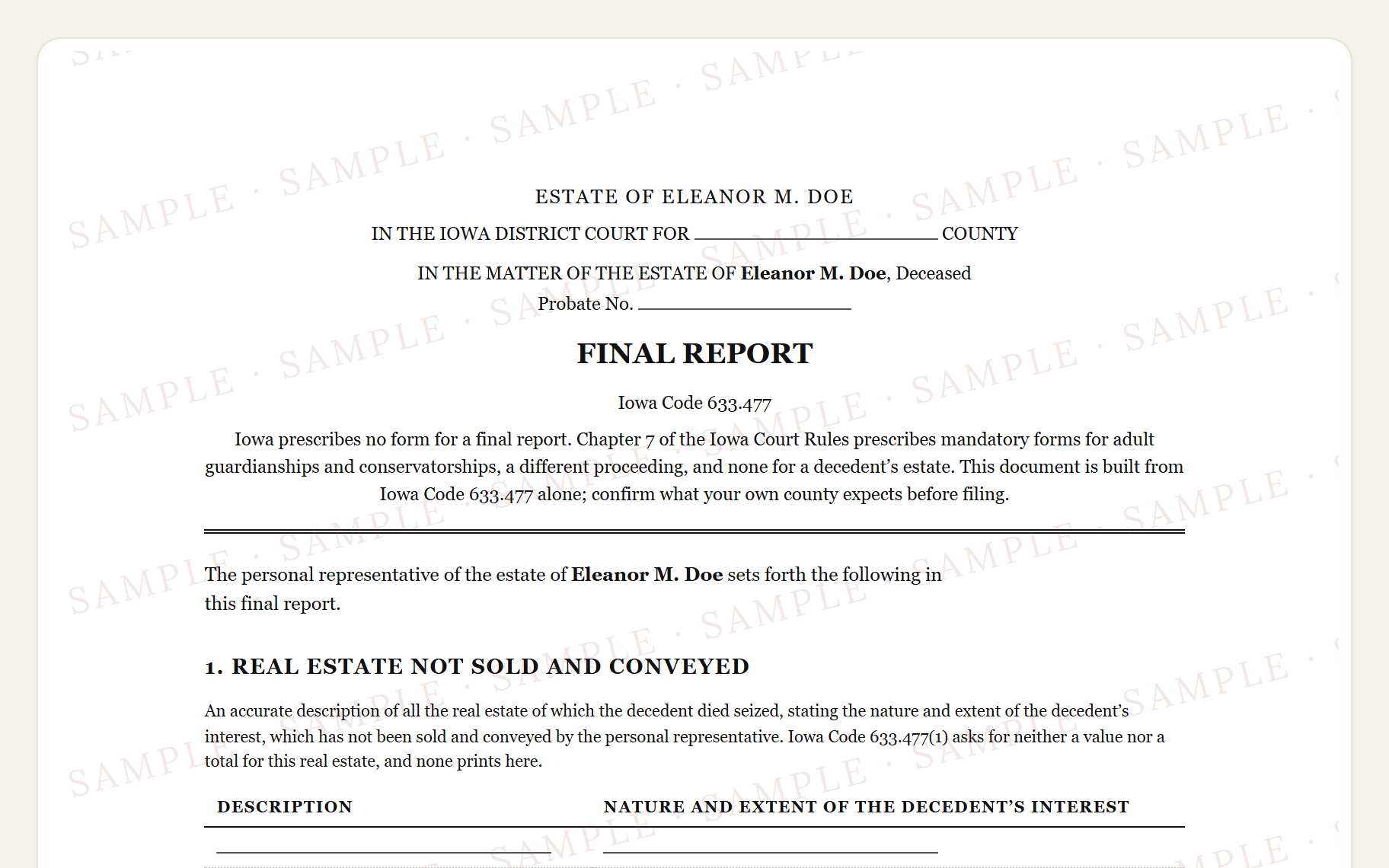
The second document is the final report, required by Iowa Code § 633.477. It sets out what has not been sold, what has been collected and paid out, and what remains to be distributed, closing with the personal representative's account of the whole administration. Between the two, Iowa Code § 633.364 adds a third, smaller instrument: a supplementary report and inventory, due whenever property or information not in the original report and inventory comes to light, filed on its own, never folded into the original.
Section 2 of 7.Iowa's deadlines, with the statute behind each
- Day 14 (about 2 weeks)Publish and mail notice to creditors
Why
Under Iowa Code §633.304, the executor generally must begin newspaper publication of the notice of appointment and notice to creditors as soon as letters issue (once a week for two consecutive weeks) and mail notice to each known claimant whose claim may go unpaid; this 14-day entry is a conservative prompt because the statute says 'as soon as letters are issued' rather than a day count, so confirm the publication timing with your attorney. - Day 14 (about 2 weeks)Mail notice to surviving spouse, heirs, and devisees
Why
Under Iowa Code §633.304, the executor generally must mail notice of the will's admission to probate and of the appointment, 'as soon as practicable,' to the surviving spouse, each heir, and each devisee whose identity is reasonably ascertainable; this 14-day entry is a conservative prompt because the statute sets no fixed day count, so confirm the mailing timing with your attorney. - Day 14 (about 2 weeks)Medicaid estate recovery notice to Iowa DHHS
Why
Under Iowa Code §§633.304A and 633.410(2), the executor generally must send the Medicaid estate recovery notice electronically, on the DHHS-approved form, to the department's designated entity (the counterpart form for intestate estates is in §633.231), and the department then has 6 months from the date of sending to file a claim or be forever barred; that 6-month clock runs from sending (not from your appointment), so send promptly and confirm the timing and correct recipient with your attorney. - Day 90 (about 3 months)File the report and inventory
Why
Under Iowa Code §633.361, the verified report and inventory generally must be filed with the clerk within 90 days after you qualify, a limit 2026 Iowa Acts, HF 2532 extends to 120 days (in force since July 1, 2026) unless the court grants more time; this entry keeps the conservative 90-day target because estates opened before that date may still be on the 90-day clock, so confirm which deadline applies to your estate with your attorney. - Day 150 (about 5 months)General creditor claims bar date
Why
Under Iowa Code §633.410, creditor claims are generally barred unless filed within the later of 4 months after the second newspaper publication of the notice to creditors or, for known creditors, 1 month after mailed notice, so calendar this bar date before paying claims or distributing; this entry is estimated from your appointment because the true trigger is the second publication date, so confirm the operative bar date with your attorney. - Day 1095 (about 3 years)Final settlement of the estate
Why
Under Iowa Code §633.473, final settlement generally must be made within 3 years after the second publication of the notice to creditors unless the court orders otherwise after notice to interested parties; this entry is estimated from your appointment because the true trigger is the second publication date, so confirm the operative date (and any extension) with your attorney.
- Day 270 (about 9 months)Federal estate tax return (Form 706), if required
Why
Under IRC §6075, Form 706 is due 9 months after death, but only if the gross estate exceeds the federal exemption or the estate elects portability, and a 6-month extension may be available; confirm applicability and timing with your attorney.
The report and inventory is due within ninety days after the personal representative qualifies, not ninety days from death, unless the court grants a longer time (Iowa Code § 633.361).
Read the full explanation
Property or information discovered later gets a supplementary report and inventory, due within thirty days of the discovery (Iowa Code § 633.364).
Final settlement is due within three years of the second publication of the notice to creditors, unless the court extends that time (Iowa Code § 633.473).
Notice of the final report and of the personal representative's discharge is served under Iowa Code § 633.40, and the notice itself is waivable (Iowa Code § 633.478).
A federal estate tax return, Form 706, if the estate needs one, is due nine months after death (IRC § 6075), with a possible six-month extension. Confirm whether the estate needs one with your attorney.
Section 3 of 7.What Iowa pays a personal representative
Iowa Code § 633.197 sets a schedule, and unlike many states, the schedule runs off a figure this app already holds: the gross assets of the estate listed in the probate inventory. It is a maximum the court may allow, not an amount owed automatically. The statute's words are that reasonable fees may be determined by the court, but not in excess of the schedule. The schedule is marginal, not flat: six percent of the first $1,000 of gross assets, four percent of the amount between $1,000 and $5,000, and two percent of everything above $5,000.
Life insurance proceeds are left out of that base, unless the policy is payable to the estate itself rather than to a named beneficiary. ExecutorLedger's records do not show who a policy names, so a ceiling built from the inventory may need to be reduced by hand once that is checked.
Iowa Code § 633.198 caps the estate's attorney at the same schedule, not a separate one of its own. Iowa Code § 633.199 allows further amounts for extraordinary services and expenses, outside the schedule and on no formula, again subject to the court's approval.
So an Iowa fee has a ceiling you can compute from the inventory, but the actual figure still comes from the court. ExecutorLedger shows the maximum the schedule allows; it is never a promise that the court has allowed it or will.
Section 4 of 7.How an Iowa estate closes
Most Iowa estates go through full chapter 633 administration, whatever the estate's size, filing both the report and inventory and the final report. Iowa Code § 633.477's final report sets out an accounting of all property that came into the personal representative's hands, and a detailed accounting of all cash receipts and disbursements, though the statute lets all interested parties waive the accounting entirely. Real estate the decedent died owning and that has not been sold is described in the final report, not valued or totaled there; the report and inventory is where a value is estimated for it.
No appraisement is required to reach any of these figures, except for inheritance tax on a death before January 1, 2025, or when the court orders one (Iowa Code § 633.365). So every value on an Iowa report and inventory is the personal representative's own estimated value, the statute's own phrase, not an appraised or fair-market figure.
A smaller estate has two other routes, and they are not the same thing despite similar names. Chapter 635 administration of small estates is still a supervised administration with letters issued by the clerk, available when the gross value of the probate assets does not exceed $200,000; chapter 633's report and inventory still applies, and the estate closes with a chapter 635 closing statement instead of a final report, with its own fee cap of three percent of the gross value unless the personal representative itemizes services (Iowa Code § 635.1, § 635.8). Separately, the Iowa Code § 633.356 affidavit is not administration at all: no letters, no inventory, no final report, available at least forty days after death when the decedent's probate assets are personal property only, with no interest in real estate, and a gross value of $100,000 or less.
That $100,000 figure is current as of House File 2660, 2026 Iowa Acts chapter 1048, effective July 1, 2026, which raised the affidavit threshold from $50,000. The published Iowa Code 2026 compilation predates the act and still shows $50,000, and guidance written before the change online does too. Use $100,000.
Iowa's inheritance tax no longer applies to a death on or after January 1, 2025. A death before that date still carries it, and the report and inventory, the final report, and the § 633.197 fee base all keep language conditioned on the date of death for exactly that reason.
- Square away taxes first. The final report must state that all tax requirements are satisfied, including Iowa income tax compliance under Iowa Code §422.27 (and, for deaths before January 1, 2025, inheritance tax clearance under §450.58).
- Prepare and file the final report with the clerk of the district court, covering everything Iowa Code §633.477 lists: remaining real estate, who takes and where they live, tax and claims statements, and a detailed accounting of all receipts and disbursements unless every interested party waives the accounting.
- Collect a signed waiver of notice (§633.478) and a statement of consent from every adult distributee, dated no more than 30 days before the final report. With those on file, §633.479(2) treats the final report's prayer as granted, and the estate closes and you are discharged without a hearing or even a court order.
- If anyone won't sign, give notice of the final report and set it for hearing instead, then ask the court for an order approving the report and discharging you (§633.479(1)).
- Watch the outer limit: final settlement is due within 3 years of the second publication of the creditor notice unless the court orders otherwise (§633.473).
Iowa has no separate probate court, surrogate, or register of wills. The district court sitting in probate handles estates, and all filings go to the clerk of the district court in the county where the estate is pending.
Section 5 of 7.The Report and Inventory and the Final Report explained for a first-time personal representative
The report and inventory's thirteen items, in the statute's own order, split into a family report and a property inventory. The first seven cover the decedent's name, age and residence, the date of death, whether the decedent died testate or intestate, the personal representative's address, the surviving spouse if any, every beneficiary or heir with their relationship and address, and any child born to or adopted by the decedent after the will was signed. ExecutorLedger knows the decedent's name, date of death and the beneficiary names on file; it does not know ages, addresses or relationships, so those print as ruled blanks in the statute's own words rather than a guess.
The remaining six items are the property inventory: real estate inside Iowa and real estate outside Iowa on two separate schedules, both asking for a legal description; personal property exempt from execution and all other personal property on two more separate schedules; a listing of items subject to inheritance tax for a death before January 1, 2025, or to federal estate tax; and a report on any reduction in the federal estate tax unified credit. ExecutorLedger records no exemption from execution, so everything it holds prints on the all-other-personal-property schedule, with a note that anything exempt has to move to the exempt schedule by hand. It also records no legal description or which state a parcel sits in, so real estate prints on a single ruled schedule with a place to mark Iowa or out of state and fill in the legal description.
Verification on both documents is a certification under penalty of perjury, in the words Iowa Code § 633.35 sets out, with a signature and a date. Neither document carries a notary jurat. A supplementary report and inventory under § 633.364 covers additional property and additional information both, filed within thirty days of the discovery, and it is its own instrument with its own total, never merged into the original.
The final report's accounting, required by § 633.477(9), is two things together: an accounting of all property that came into the personal representative's hands, and a detailed accounting of all cash receipts and disbursements, a shape close to Washington's combined report. There is no gain-or-loss vocabulary anywhere in the sections that govern it, so a sale posts once, at the amount actually collected. Money found after the report and inventory reaches the closing cash figure on its own line rather than as a receipt, and other property found later gets its own schedule, the same split Washington's report uses. An account still held that was also inventoried as cash is never charged twice, once as opening cash and again as sale proceeds.
Section 6 of 7.Where ExecutorLedger fits
Recording is free for as long as the estate takes: every receipt and disbursement with its date and description, distributions per beneficiary, and a balance that checks itself as you go. ExecutorLedger builds Iowa-style documents from those records, a report and inventory laid out in § 633.361's thirteen items and a final report in § 633.477's shape, ready to transcribe or file when you're ready. Neither is a court form, and your attorney should review them before anything is signed or filed. Every document previews free with your real numbers, and $149 (one-time payment) per estate lifts the watermark. Usually less than one attorney hour, and typically reimbursable by the estate.
Section 7 of 7.Questions Iowa executors ask
Is there a court form for Iowa's report and inventory or final report?
No. Iowa publishes no probate form for either document. Chapter 7 of the Iowa Court Rules has mandatory forms, but they are for adult guardianships and conservatorships, a different proceeding, and no form number from that chapter belongs on a decedent's report and inventory or final report. Iowa Code § 633.361 and § 633.477 say what each document must contain, and that is the whole requirement.
When is the Iowa report and inventory due?
Within ninety days after the personal representative qualifies, not ninety days from the date of death, unless the court grants more time (Iowa Code § 633.361). Property or information discovered afterward goes on a supplementary report and inventory, due within thirty days of the discovery (Iowa Code § 633.364).
Does an Iowa estate have to file an accounting with the court?
The final report's accounting of property and of cash receipts and disbursements may be omitted if all interested parties waive it (Iowa Code § 633.477(9)). Where it is not waived, it has to show both: what property came into the personal representative's hands, and a detailed record of every dollar collected and paid out.
How is an Iowa personal representative paid?
Iowa Code § 633.197 sets a ceiling the court may allow: six percent of the first $1,000 of the gross assets listed in the probate inventory, four percent of the amount between $1,000 and $5,000, and two percent above that, with life insurance left out of the base unless it is payable to the estate. It is a maximum, not an entitlement, and Iowa Code § 633.198 caps the estate's attorney at the same schedule rather than a separate one.
What is the small-estate affidavit threshold in Iowa?
$100,000 in personal property, with no interest in real estate, at least forty days after death (Iowa Code § 633.356). House File 2660, 2026 Iowa Acts chapter 1048, raised the figure from $50,000 effective July 1, 2026. The published Iowa Code 2026 compilation predates the act and still shows the old figure, and older guidance online does too; $100,000 is current.
Not sure which accounting your situation calls for? Which accounting do I need? covers the choice, and the accounting guide explains the structure every format shares.
This page describes Iowa practice as our verified references state it; formats drift and estates differ, and none of this is legal advice. ExecutorLedger produces court-style documents for transcription. They are not official court forms. The accounting your estate needs is a question for its attorney.