Indiana Estate Accounting: A Personal Representative's Guide
Indiana probate runs through the circuit or superior court in each county, and its fiduciary is the personal representative, the executor named in a will or the administrator appointed when there is none. Indiana publishes no statewide probate form. The Indiana Judicial Branch's forms page has twelve categories, and none of them is probate. Here is what the statutes require of the verified inventory and of the account, the deadlines behind them, and how an Indiana estate closes.
Section 1 of 7.The two documents: the verified inventory and the account
Indiana administers estates under IC 29-1, through the circuit or superior court in each county. There is no statewide probate form category on the Indiana Judicial Branch's own forms page, and the counties say so themselves: Allen County's printed guide describes the final report and closing statement by saying "the formats of these reports will differ from case to case; therefore, no forms are available." So the statutes are the whole specification, and there is no form number to look for or to print.
The first document is the verified inventory, required by IC 29-1-12-1 in a supervised estate and IC 29-1-7.5-3.2 in an unsupervised one. It lists the fair market value of every item of the estate as of the date of death, sorted into seven statutory classes, along with a separate statement of any known liens or other charges against an item. One real Indiana document survives for this: Allen County's own Inventory (rev. 08/2015), whose schedule order and headings track the statute, and this guide and the documents ExecutorLedger builds follow its shape.
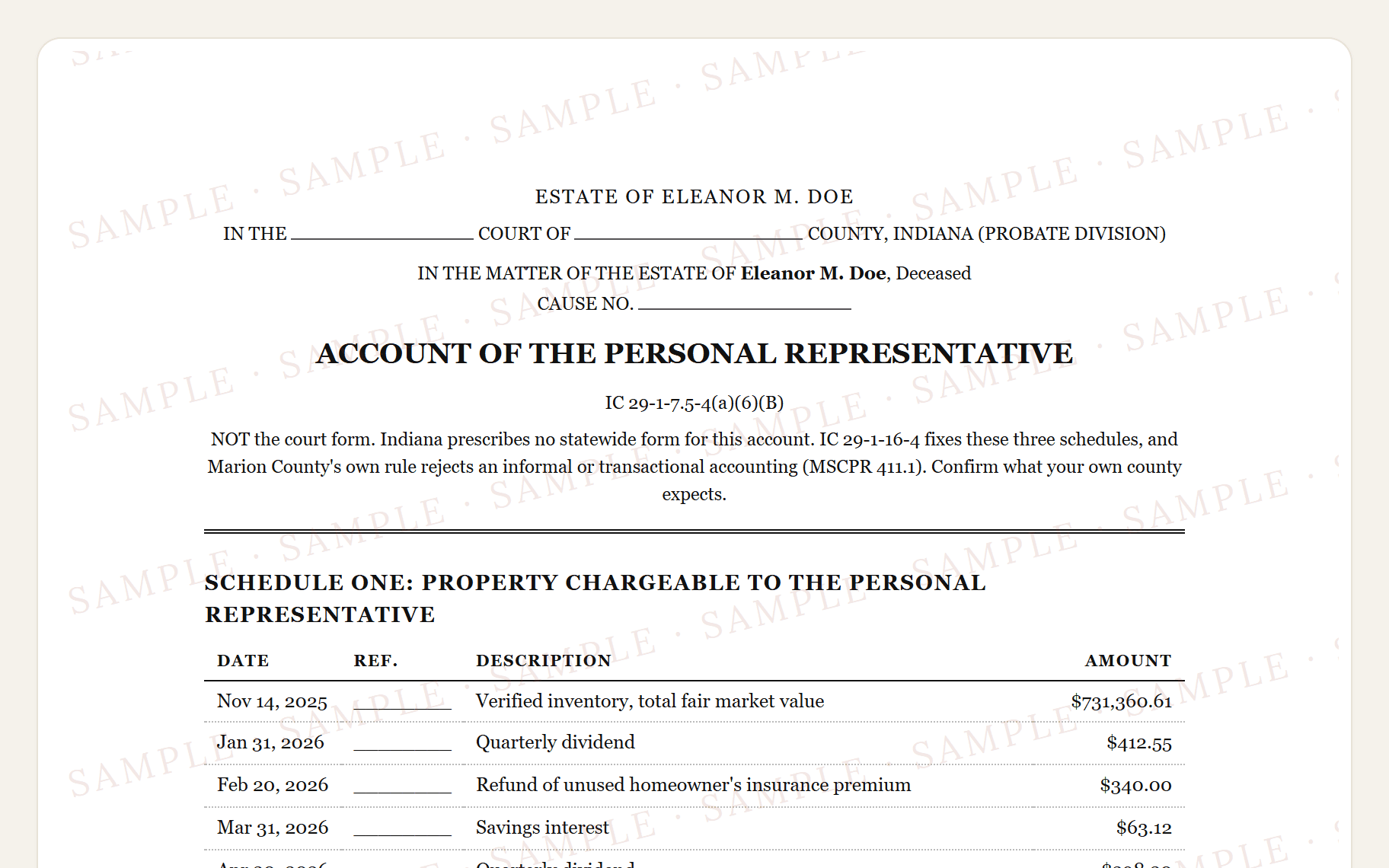
The second document is the account, fixed by IC 29-1-16-4 into three schedules: property chargeable to the personal representative, payments and distributions, and the property remaining on hand. Which court paper carries it depends on the estate's route. A supervised estate files the three-schedule final account itself. An unsupervised estate files only a closing statement, with the three-schedule account going to the beneficiaries instead. Marion, Lake, and Hamilton counties all require the three-schedule format by local rule and reject anything else: Marion County MSCPR 411.1 says plainly, "Informal, handwritten or transactional accountings will not be accepted."
Section 2 of 7.Indiana's deadlines, with the statute behind each
- Day 30 (about 1 month)Serve notice of administration on heirs, beneficiaries, and known creditors
Why
Under Ind. Code §29-1-7-7, once letters issue the notice of administration is generally published and served on each heir, devisee, legatee, and known creditor named in the petition, and known or reasonably ascertainable creditors typically must be served within 1 month after the first published notice; that creditor-service clock runs from first publication, so it is anchored here to your appointment as a conservative stand-in; confirm the publication date and the full service list with your attorney. - Day 30 (about 1 month)Serve Indiana Medicaid estate recovery notice (decedent 55 or older)
Why
Under Ind. Code §29-1-7-7(d), if the decedent was at least 55 at death, the estate recovery unit of Indiana's office of Medicaid policy and planning (FSSA) is generally treated as a reasonably ascertainable creditor, so the notice of administration typically must be served on the unit within 1 month after first publication; the true trigger is first publication, anchored here to your appointment as a conservative stand-in; confirm whether this applies and the timing with your attorney. - Day 60 (about 2 months)Prepare the verified inventory
Why
Under Ind. Code §29-1-12-1, the personal representative generally must prepare a verified inventory of the probate estate, showing the fair market value of each item and all known liens, within 2 months of appointment; in unsupervised administration it typically is not filed with the court (the court may not require filing) but a copy must be furnished to any distributee who requests it (§29-1-7.5-3.2); confirm whether your court wants it filed and the exact due date with your attorney. - Day 90 (about 3 months) · earliest possibleEarliest date to file the closing statement (unsupervised)
Why
Under Ind. Code §29-1-7.5-4, in unsupervised administration the verified closing statement generally may not be filed until 3 months after the date of the first published notice to creditors; that clock runs from publication, which typically happens a few days after appointment, so the actual earliest date may fall slightly later than this estimate; confirm the earliest filing date with your attorney. - Day 365 (about 1 year)Close the estate or explain the delay
Why
Under Ind. Code §29-1-7.5-3.8, an unsupervised estate typically should be closed as promptly as possible, and if the closing statement is not filed within 1 year of appointment the personal representative generally must file a statement telling the court why the estate remains open; confirm your court's expectations and any supervised-estate schedule with your attorney.
- Day 270 (about 9 months)Creditor claims bar date
Why
Under Ind. Code §29-1-14-1, creditor claims are generally barred if not filed within 3 months after the first published notice to creditors, and in any event claims filed more than 9 months after death are typically barred outright, so calendar this outside bar date before paying claims or distributing; confirm the operative bar dates with your attorney. - Day 270 (about 9 months)Federal estate tax return (Form 706), if required
Why
Under IRC §6075, Form 706 is due 9 months after death, but only if the gross estate exceeds the federal exemption or the estate elects portability, and a 6-month extension may be available; confirm applicability and timing with your attorney.
The verified inventory is due within two months after appointment, unless the court grants a longer time (IC 29-1-12-1, IC 29-1-7.5-3.2).
Read the full explanation
The inventory is normally furnished on request rather than filed. IC 29-1-12-1(d) makes it available to an interested person who asks, and IC 29-1-7.5-3.2(e) says the court may not require an unsupervised personal representative to file a copy at all. A supervised estate in Marion, Lake, Hamilton, or Allen County files it anyway, because those counties' own local rules require filing, not because the statute does.
Property found after the inventory is filed or furnished gets a second, separately numbered inventory, not a revision of the first. Allen County's own form carries a line for the inventory's number for exactly this reason.
Creditor notice is published, and claims are barred under the timetable in IC 29-1-14-1. A supervised final account cannot be filed until more than three months have passed since the first publication (IC 29-1-17-2(b)), and an unsupervised closing statement cannot be filed earlier than three months after the first publication either (IC 29-1-7.5-4). P.L.50-2025 added a late-creditor notice route at IC 29-1-7-7(f), and P.L.160-2026 changed a claim window in IC 29-1-14-1(g), so guidance written before those amendments may describe an older claims timetable.
A federal estate tax return, Form 706, if the estate needs one, is due nine months after death (IRC section 6075), with a possible six-month extension. Confirm whether the estate needs one with your attorney.
Section 3 of 7.What Indiana pays a personal representative
If the will fixes the personal representative's compensation, that provision is the full compensation unless it was renounced in writing before qualifying. Otherwise IC 29-1-10-13 allows the personal representative reasonable compensation for services. There is no percentage schedule either way: the section names no rate, bracket or table, and neither Marion, Lake nor Hamilton County's local rules add one.
So an Indiana fee is an amount you have to justify rather than a number you can look up. Keep the hours, the tasks, and the dates as you go, because the record of the work is what supports the figure. ExecutorLedger never computes an Indiana commission from a percentage, since no Indiana statute sets one.
Section 4 of 7.How an Indiana estate closes
A supervised estate closes with the three-schedule final account under IC 29-1-16-3 and IC 29-1-16-4, together with a petition to settle and allow the account and a petition for distribution. IC 29-1-16-5 lets the personal representative fold both petitions into the account itself, and it must name the persons to whom distribution is to be made and the share each is entitled to. The final account also carries the verified statement IC 29-1-17-2(b) requires: that notice to creditors was published, that first publication was more than three months before the date of the account, and that notice was given as IC 29-1-7-7(c), (d), and (f) require. Distribution follows the court's approval, and receipts come in afterward in a supplemental report under IC 29-1-17-13, so the final account itself does not have to balance to zero.
An unsupervised estate closes with a closing statement under IC 29-1-7.5-4 instead, filed no earlier than three months after the first published notice to creditors. The closing statement carries no schedules of its own. The three-schedule account is still prepared, but IC 29-1-7.5-4(a)(6)(B) sends it to the distributees, not the court, as a full written account of the administration, unless waived in writing. Filing the statement does not close the estate: if no proceeding involving the personal representative is then pending, the estate closes by operation of law three months after the statement is filed, and the appointment ends with it (IC 29-1-7.5-4(b)). Marion County MSCPR 406.7 says the court issues no order approving the closing statement and no order discharging the personal representative.
Indiana's inheritance tax is repealed for deaths after December 31, 2012 (IC 6-4.1-12-0.5), even though IC 29-1-7.5-4(a)(3), IC 29-1-17-2(d), and Marion County MSCPR 420.5 still mention it. Nothing ExecutorLedger prints for Indiana carries an inheritance tax line.
- Run the estate unsupervised when the will authorizes it or the distributees consent. That is how most Indiana estates close, without court approval of an account (Ind. Code §29-1-7.5).
- After the claim period runs, file a verified closing statement under Ind. Code §29-1-7.5-4 stating that notice was published, creditors were served, claims and taxes are handled, and everything has been distributed.
- Send a copy of the closing statement to every distributee and to any creditor with an unpaid, unbarred claim, along with a full written account of your administration, unless the distributee waives the account in writing.
- Wait out the 3 months after you file. If no proceedings involving you are pending by then, the estate closes and your appointment ends by operation of law, with no discharge order needed.
- In a supervised estate, instead file a final account in the statutory three-schedule format with a petition for final settlement and distribution, and get approval and discharge from the circuit or superior court sitting in probate (Ind. Code §29-1-16).
Indiana has no surrogate, register of wills, or orphans' court. Probate is handled by the circuit or superior court of the county (St. Joseph County has a standalone probate court).
Section 5 of 7.The inventory and the account explained for a first-time personal representative
The inventory's seven classes come from IC 29-1-12-1(b), in the statute's own order, with Allen County's own parenthetical instructions: (1) real property, with a plat or survey description, and the homestead designated as such; (2) furniture and household goods; (3) emblements and annual crops raised by labor; (4) corporate stock, with par value, class, and preferred dividend rate; (5) mortgages, bonds, notes, and other written evidence of debt; (6) bank accounts, money, and insurance payable to the estate; and (7) all other personal property, including a partnership interest. ExecutorLedger's own asset categories have nothing that lands in classes (3) or (5), so those headings print with a None line, the way a reader can see what belongs there.
The statute asks for the fair market value of each item as of the date of death, plus a separate statement of any known liens or other charges. That statement stands apart from the value; it is never subtracted from it, which is the opposite of how some other states' inventories work. Real property is inventoried too, because IC 29-1-13-1 puts all of the decedent's real and personal property into the personal representative's possession. The recapitulation totals classes (2) through (7) as the personal property total, holds class (1) real property out on its own line, and adds the two into a grand total, the way Allen County's own inventory does.
The account's schedule one is the whole inventory, real property included, plus income received, property found later, and adjustments, an approach Lake County's own instructions describe as covering "all assets listed on the inventory, any income and additional assets obtained during administration, and any adjustments to the inventory." Because schedule one already carries the whole inventory, charging it once and then also charging full sale proceeds as new income counts the same asset twice; only the gain or loss on a sale belongs in the account beyond the opening figure.
Schedule two lists payments, charges, losses, and distributions, one line per item, in the field order Marion County MSCPR 411.1 fixes: date, check number or other identifying number for the payment, the payee's name, the amount, and a description where the purpose is not obvious. ExecutorLedger records no check number, so that column prints as a ruled blank on every row. Gains, losses, and changes in value get their own single section, as Marion County MSCPR 411.8(c) requires, with a zero printed for a sale at no change rather than the line being left off, since a missing line reads as an unreported sale.
Schedule three recaps the property remaining on hand, grouped by inventory class, real property included, and Lake County's own instructions call it plainly "a recapitulation indicating the remaining estate property after subtracting expenditures." An empty schedule three is normal; the statute's own words allow it, "if any." An item distributed in kind carries at ExecutorLedger's own recorded figure, labeled as the carried value, because IC 29-1-17-10(a) fixes the distribution value at a time within ten days of the petition for distribution, a valuation the preparer still has to confirm.
Section 6 of 7.Where ExecutorLedger fits
Recording is free for as long as the estate takes: every receipt and disbursement with its date and description, distributions per beneficiary, and a balance that checks itself as you go. ExecutorLedger builds Indiana-style documents from those records, a verified inventory shaped like Allen County's own form and a three-schedule account shaped like IC 29-1-16-4, ready to transcribe whether your estate furnishes, files, or hands the account to beneficiaries. Neither is a court form, and your attorney should review them before anything is signed or filed. Every document previews free with your real numbers, and $149 (one-time payment) per estate lifts the watermark.
Section 7 of 7.Questions Indiana executors ask
Is there a court form for Indiana's inventory or accounting?
No statewide form exists for either. The Indiana Judicial Branch's forms page has twelve categories and none of them is probate, and county guides say the same: Allen County's own guide says the formats of the final report and closing statement will differ from case to case, so no forms are available. One real document survives for the inventory, Allen County's own Inventory (rev. 08/2015), which this guide and ExecutorLedger's documents follow as a model.
When is the Indiana inventory due, and does it have to be filed?
Within two months after appointment, unless the court grants more time (IC 29-1-12-1, IC 29-1-7.5-3.2). It is normally furnished only on request, not filed. IC 29-1-12-1(d) makes it available on request in a supervised estate, and IC 29-1-7.5-3.2(e) says the court may not require it to be filed at all in an unsupervised one. Some counties, including Marion, Lake, Hamilton, and Allen, require filing it anyway by their own local rules.
Does an Indiana estate have to file an accounting with the court?
It depends on the route. A supervised estate files the three-schedule final account with the court under IC 29-1-16-4. An unsupervised estate files only a closing statement under IC 29-1-7.5-4, with no schedules attached, and sends the three-schedule account to the distributees instead, unless every distributee waives it in writing.
How is an Indiana personal representative paid?
If the will fixes the personal representative's compensation, that provision is the full compensation unless it was renounced in writing before qualifying. Otherwise IC 29-1-10-13 allows reasonable compensation for services. There is no statutory percentage schedule either way, and Marion, Lake and Hamilton County's local rules add nothing to that standard.
Does Indiana still have an inheritance tax?
No. Indiana's inheritance tax is repealed for deaths after December 31, 2012 (IC 6-4.1-12-0.5), even though a few statutes and a Marion County local rule still mention one. Nothing ExecutorLedger prints for Indiana carries an inheritance tax line.
Not sure which accounting your situation calls for? Which accounting do I need? covers the choice, and the accounting guide explains the structure every format shares.
This page describes Indiana practice as our verified references state it; formats drift and estates differ, and none of this is legal advice. ExecutorLedger produces court-style documents for transcription. They are not official court forms. The accounting your estate needs is a question for its attorney.