West Virginia's ET 6.01 appraisement, explained
West Virginia requires a sworn appraisement of the estate on Form ET 6.01, filed with the clerk of the county commission within 90 days of qualifying. Here is what the form asks for, part by part, and how to have every number ready.
Section 1 of 5.What Form ET 6.01 is, and who files it
West Virginia administers decedents' estates under Chapter 44 of the West Virginia Code, through the county commission of the county where the estate is opened. There is no probate court and no circuit court in the usual course of an estate. The county commission appoints the personal representative, and the clerk of the county commission is the office that receives the filings.
Appraisement filing is required by W. Va. Code 44-1-14 on Form ET 6.01, published by the State Tax Division. The form is the one West Virginia document with a mandatory statewide form number and doubles as the estate-tax intake. Original and two copies must be returned to the clerk of the county commission within 90 days of qualifying.
Section 2 of 5.When the appraisement is due
Under W. Va. Code §44-1-14(f), the personal representative generally must complete the appraisement (inventory) on the form prescribed by the Tax Commissioner and return it to the clerk of the county commission or the fiduciary supervisor within 90 days of qualifying; confirm the exact filing deadline with your attorney.
The notice of administration is published within 30 days after the appraisement is filed. Creditors then have 60 days from that publication to file their claims, so the estates that meet their deadlines comfortably are the ones that gather their asset list early.
Section 3 of 5.What goes in it, part by part
Form ET 6.01 has eight parts: a general information questionnaire naming the decedent, the counties where real estate was held, and the fiduciary; a questionnaire of nonprobate real estate; a summary of the six schedules' totals; the schedules themselves in detail; a list of beneficiaries; an oath the fiduciary swears before a notary that every effort was made to list and describe the assets completely; approval by the fiduciary commissioner or fiduciary supervisor, named as alternatives; and a block for the clerk of the county commission. The six schedules are always printed in full, even if you have no assets in a given schedule, because the oath is sworn and nothing may be shown as if it did not exist.
Schedule A, covering real estate, displays the recorded date-of-death value in its Appraised column; the Assessed column is left for the preparer to complete from the county assessor's records. Schedule A also asks for a legal description and, where the decedent held only a fractional interest, the value of that share alone. Schedule B covers tangible personal property. Schedule C covers bonds and securities other than corporate stock. Schedule D covers corporate stock. Schedule E covers money, bank accounts, certificates of deposit and receivables. Schedule F covers everything else, including life insurance payable to the estate.
Section 4 of 5.From your records to the ET 6.01 appraisement
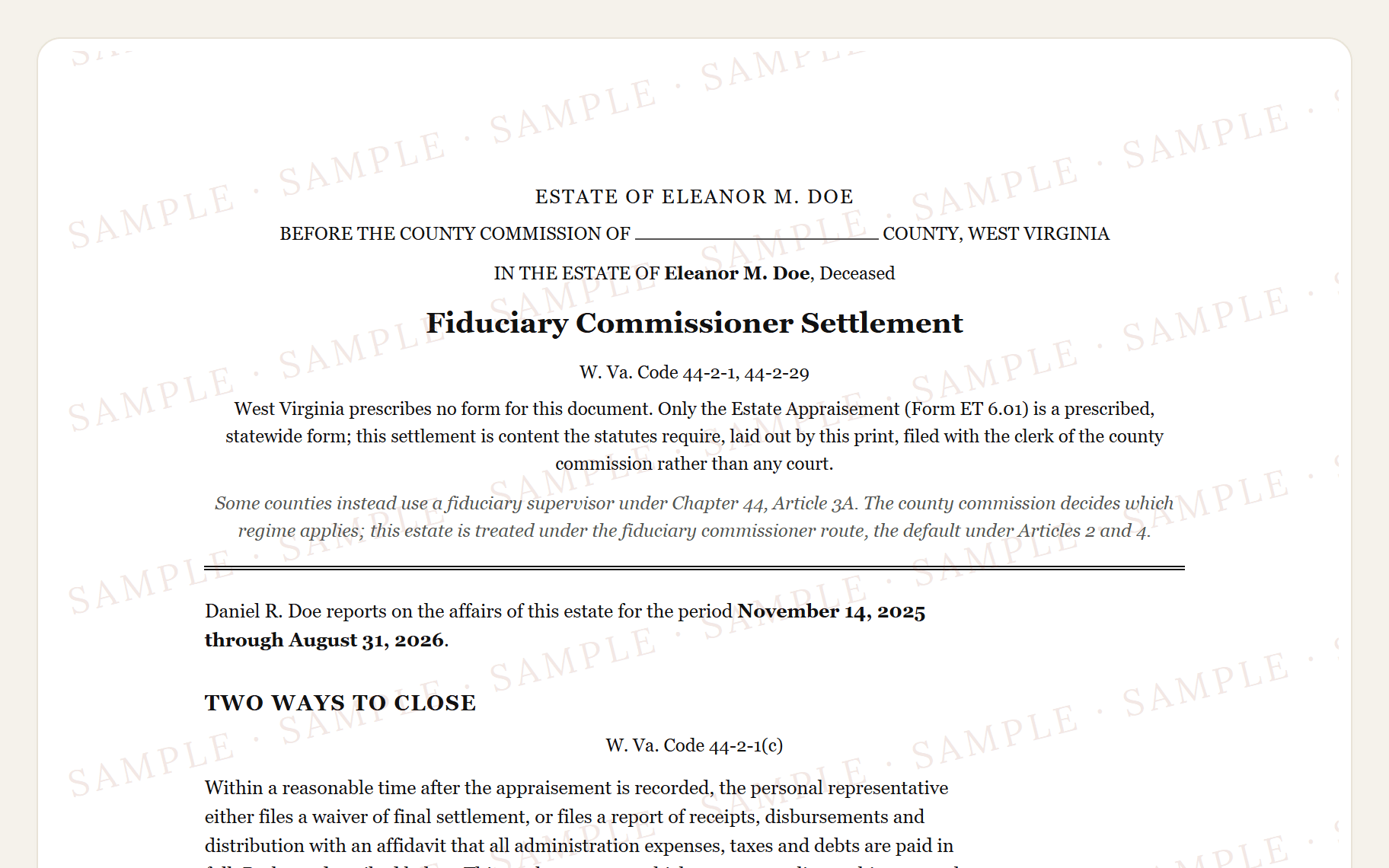
Recording is free for as long as the estate takes: every receipt and disbursement with its date and description, distributions per beneficiary, and a balance that checks itself as you go. ExecutorLedger builds West Virginia-style documents from those records, an Appraisement laid out in Form ET 6.01's own eight parts and six schedules, and a settlement in whichever route your county uses, ready to transcribe or attach when you file or swear one. Neither replaces the county's own form or the notary's oath, and your attorney should review them before anything is signed or filed. Usually less than one attorney hour, and typically reimbursable by the estate.
Section 5 of 5.Questions about the West Virginia inventory
Is there a court form for the West Virginia inventory or accounting?
Only the Appraisement has one: Form ET 6.01, published by the State Tax Division, filed with the county clerk within 90 days of qualification and sworn before a notary. Neither Article 2 nor Article 3A prescribes a form for the settlement, in either oversight route, and none should ever be printed or implied for it.
The inventory is the first filing, not the last. The full West Virginia guide covers the accounting that follows it, every deadline with its statute, what the executor is paid, and how estates close.
This page describes West Virginia practice as our verified references state it; formats drift and estates differ, and none of this is legal advice. ExecutorLedger produces court-style documents for transcription. They are not official court forms. What your estate must file is a question for its attorney.