West Virginia Estate Accounting: A Fiduciary's Guide
West Virginia has no probate court and no circuit court in the ordinary run of an estate. Administration runs through the county commission of the county where the estate is opened, and its clerk. The fiduciary is the personal representative, the executor named in a will or the administrator appointed when there is none. Oversight splits into two routes a county chooses between, so a reader arriving from another state's guide looking for a court, or for a single set of rules, will not find either here. Here is what the statutes and the one mandatory form require, the deadlines behind them, and how a West Virginia estate closes.
Section 1 of 7.The two documents: the Appraisement and the Settlement, and the county's two routes
West Virginia administers decedents' estates under Chapter 44 of the West Virginia Code, through the county commission of the county where the estate is opened. There is no probate court and no circuit court in the usual course of an estate. The county commission appoints the personal representative, and the clerk of the county commission is the office that receives the filings. Nothing here should ever read as a court proceeding, because it is not one.
Oversight of the personal representative runs through one of two officers, and which one depends on the county, not on the estate. The default, under Articles 2 and 4 of Chapter 44, is a fiduciary commissioner, appointed case by case by the county commission. The alternative, under Article 3A, is a fiduciary supervisor, a standing officer in a county that has elected to proceed under that article, by a public hearing under W. Va. Code 44-3A-1. No authoritative statewide list of which counties have elected Article 3A exists. Ask your county clerk which route your county uses before relying on either half of this guide.
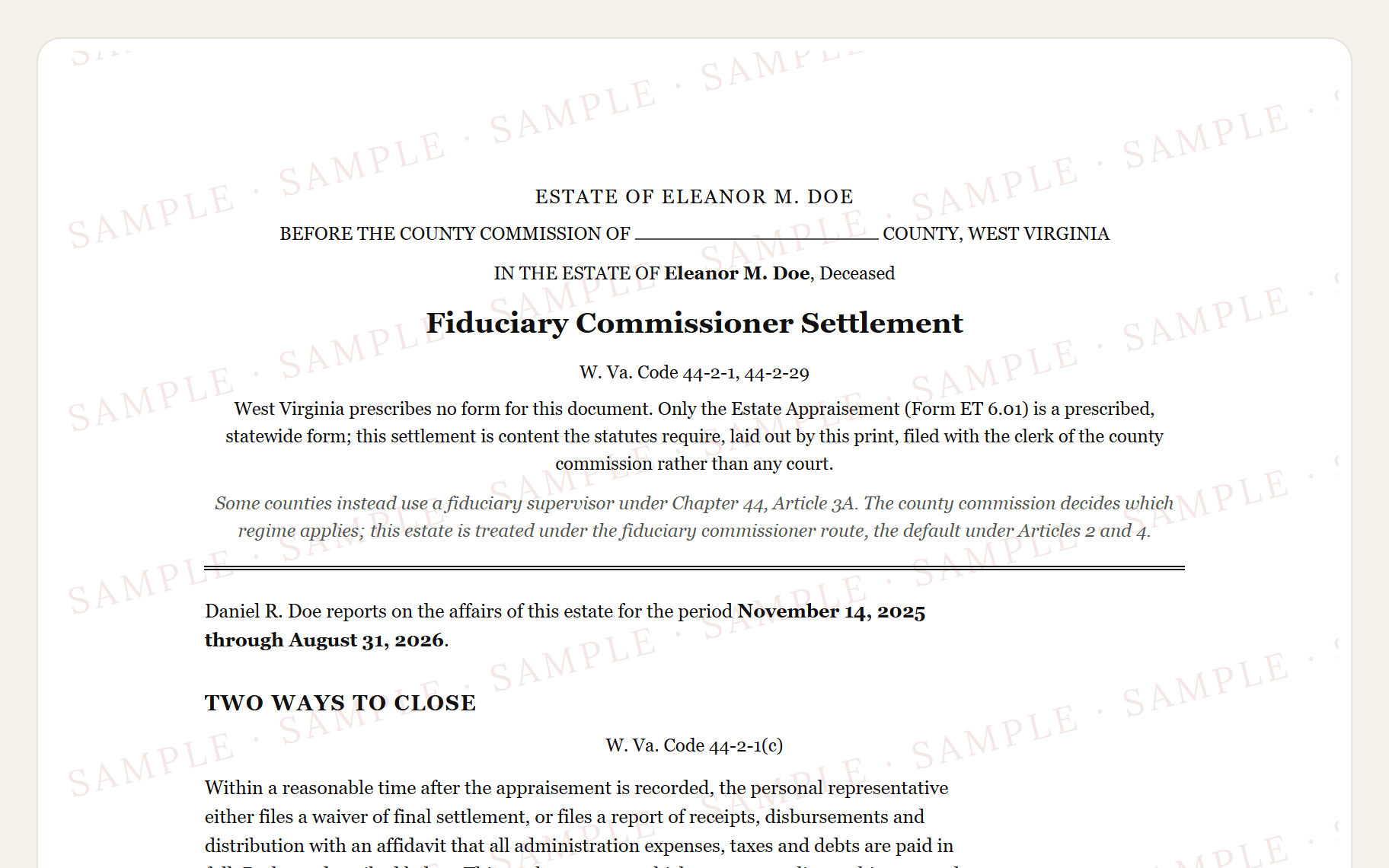
The first document is the Appraisement, Form ET 6.01, required by W. Va. Code 44-1-14 and published by the State Tax Division because it doubles as the estate-tax intake. It is the one West Virginia document with a real, mandatory, statewide form number, and it prints the same whichever oversight route the county uses. The second is the settlement, the cash accounting of what the estate took in and paid out. Neither Article 2 nor Article 3A prescribes a form for it. There is no ET number, no form name, for the settlement in either route, and none should ever be printed or implied.
Section 2 of 7.West Virginia's deadlines, with the statute behind each
- Day 90 (about 3 months)File the appraisement (inventory)
Why
Under W. Va. Code §44-1-14(f), the personal representative generally must complete the appraisement (inventory) on the form prescribed by the Tax Commissioner and return it to the clerk of the county commission or the fiduciary supervisor within 90 days of qualifying; confirm the exact filing deadline with your attorney. - Day 90 (about 3 months)File the nonprobate inventory (state filing)
Why
Under W. Va. Code §11-11-7, the personal representative generally must list and appraise, under oath on the Tax Commissioner's nonprobate-inventory form, the decedent's nonprobate personal property (jointly held property, payable-on-death accounts, revocable trusts, life insurance, and similar assets) and file it with the county clerk or fiduciary supervisor within 90 days of qualifying, together with the appraisement; confirm whether this filing applies to your estate with your attorney. - Day 120 (about 4 months)Notice of administration must be published
Why
Under W. Va. Code §44-1-14a(a), the county clerk generally must publish the notice of administration within 30 days after the appraisement is filed, or within 120 days of qualification if no appraisement was filed, so 120 days is the outer date by which publication should have begun; confirm the actual publication date with your attorney. - Day 180 (about 6 months)Creditor claims bar date
Why
Under W. Va. Code §44-1-14a(a), creditors generally must file claims against the estate within 60 days of the date of first publication of the notice, which (using the latest allowed publication date) falls no later than about 180 days after qualification; confirm the true bar date from the actual publication date with your attorney before paying claims or distributing. - Day 180 (about 6 months)Serve notice on heirs, beneficiaries, and known creditors
Why
Under W. Va. Code §44-1-14a(d), the personal representative generally must mail (first class) or personally serve a copy of the published notice on the surviving spouse, beneficiaries, heirs, and identified creditors within 60 days after the date of first publication, which (using the latest allowed publication date) falls no later than about 180 days after qualification, and earlier if publication ran earlier; confirm the actual service deadline from the real publication date with your attorney. - Day 1825 (about 5 years)Final settlement and accounting due
Why
Under W. Va. Code §44-4-14a, the fiduciary generally must make a full and final settlement, report, and accounting within 5 years of appointment or risk personal liability for resulting loss, discharge, and misdemeanor penalties; confirm your estate's realistic closing timeline with your attorney.
- Day 270 (about 9 months)Federal estate tax return (Form 706), if required
Why
Under IRC §6075, Form 706 is due 9 months after death, but only if the gross estate exceeds the federal exemption or the estate elects portability, and a 6-month extension may be available; confirm applicability and timing with your attorney.
The Appraisement, Form ET 6.01, is due within 90 days of qualification, sworn before a notary and returned to the clerk of the county commission, or to the fiduciary supervisor in a county that uses one. The original and two copies go in together, with the nonprobate inventory form. A supervisor who approves it delivers it to the clerk within 10 days (W. Va. Code 44-1-14).
Read the full explanation
On the default route, once the Appraisement is recorded, the personal representative has a reasonable time to file either a waiver of final settlement under W. Va. Code 44-2-29 or a report of receipts, disbursements and distribution with a paid-in-full affidavit (W. Va. Code 44-2-1(c)). The waiver itself is not available until more than 90 days have passed since the filing of any notice the article requires.
Where the estate was referred to a fiduciary commissioner, an annual exhibit of money and property received, chargeable or disbursed is due within two months after the end of each year from qualification, with vouchers for the disbursements (W. Va. Code 44-4-2).
On the Article 3A route, the short form settlement is available once more than 60 days have passed since the filing of the notice Article 3A requires, and any estate-tax lien has been released and the release filed with the clerk (W. Va. Code 44-3A-4a). The long form settlement is available at any time after the period for filing claims has expired, where the estate was never referred to a fiduciary commissioner or was withdrawn from one (W. Va. Code 44-3A-19).
A creditor with an unpaid claim may file it, and the personal representative then has 20 days to approve or reject it before the estate is referred to a fiduciary commissioner. Approving every claim as filed avoids the referral (W. Va. Code 44-2-1(b)).
A federal estate tax return, Form 706, if the estate needs one, is due nine months after death (IRC section 6075), with a possible six-month extension. Confirm whether the estate needs one with your attorney.
Section 3 of 7.What West Virginia pays a fiduciary
W. Va. Code 44-4-12a sets a tiered commission schedule on the personal estate the fiduciary is accountable for, including income received, and on the proceeds of real estate that is sold: 5 percent on the first $100,000, 4 percent on the amount over $100,000 up to $400,000, 3 percent on the amount over $400,000 up to $800,000, and 2 percent on the amount over $800,000. A further 1 percent is allowed on the value of real estate that is not sold, and 1 percent on property that is not subject to administration but is includable for federal estate tax purposes. No commission at all is allowed on joint and survivorship property, whether real or personal. ExecutorLedger records the schedule as a note on the settlement and computes no percentage; the figure the fiduciary actually charged is what the record carries.
A fiduciary commissioner's own fee for settling the estate is separately capped at $300 plus expenses, unless the personal representative approves a higher fee or the county commission sets one based on actual time spent under a published schedule (W. Va. Code 44-2-1(a)). That cap is the commissioner's fee for the settlement work, not the personal representative's commission under 44-4-12a.
No statutory attorney-fee schedule was found for West Virginia. This guide says nothing about one.
Section 4 of 7.How a West Virginia estate closes
On the default route, once the Appraisement is recorded, the county clerk records the estate without referring it to a fiduciary commissioner if the Appraisement shows a value of $200,000 or less, exclusive of real estate specifically devised and of nonprobate assets, or if only one beneficiary exists and that beneficiary is competent at law (W. Va. Code 44-2-1(b)). Otherwise the estate is referred to a fiduciary commissioner for proof of debts and claims, their priority, and the shares of the legatees and distributees.
The personal representative then closes with one of two filings: a waiver of final settlement under W. Va. Code 44-2-29, available once more than 90 days have passed since the required notice and any estate-tax lien has been released, or a report of receipts, disbursements and distribution with an affidavit that every claim for administration expenses, taxes and debts has been paid in full (W. Va. Code 44-2-1(c)). Each beneficiary signs the waiver, unless that beneficiary receives a bequest of tangible personal property or of cash, in which case a signature is not required. The clerk records whichever filing is used, mails copies to each beneficiary and creditor, and holds the report for 10 days so a beneficiary or creditor can appear before the county commission.
On the Article 3A route, the short form settlement under W. Va. Code 44-3A-4a carries no dollar threshold. It gates on time and on paperwork: more than 60 days since the required notice, any estate-tax lien released and filed, an affidavit that the claims period has expired with no known unpaid claims, the allocation to each distributee and beneficiary, and a waiver each beneficiary signs, again excusing one who receives a bequest of tangible personal property or of cash.
The long form settlement under W. Va. Code 44-3A-19 is available once the claims period has expired, for an estate never referred to a fiduciary commissioner or withdrawn from one. It contains six things: proof that every filed claim has been paid or provided for, a verification that the personal representative knows of no other claims after due diligence, a verification and accounting of income the estate received, provision for or proof of payment of all taxes due, a proposed plan of distribution, and any other information the fiduciary supervisor asks for.
This guide does not say which route is more common, and names no county as using either one. The Appraisement names both the fiduciary commissioner and the fiduciary supervisor as alternative approving officers, because the form is the same whichever regime a county has chosen.
- Find out first whether the estate was referred to a fiduciary commissioner at all. The clerk records the appraisement without a referral where it shows $200,000 or less, exclusive of specifically devised real estate and nonprobate assets, or where there is one competent beneficiary, and approving every filed claim within 20 days also avoids one (W. Va. Code §44-2-1(b)).
- If there was no referral, close by filing either a waiver of final settlement signed by the beneficiaries (W. Va. Code §44-2-29), or a report of your receipts, disbursements and distribution with an affidavit that expenses, taxes and debts are paid in full (§44-2-1(c)). The clerk records it, mails copies, and holds it ten days.
- If the estate was referred, file your final account (the 'settlement') with the fiduciary commissioner or fiduciary supervisor handling it. West Virginia gives you up to five years from your appointment to do this, though most estates settle well before then (W. Va. Code §44-4-14a).
- Once the commissioner completes the report on your account, it stays in their office for ten days so interested parties can inspect it and file exceptions; the commissioner then files the report, vouchers, and any exceptions with the county commission (W. Va. Code §§44-4-15 and 44-4-16).
- If the county commission confirms the report, the confirmed settlement is binding and conclusive on creditors and on every beneficiary who received the required notice. That confirmation is what closes the estate in West Virginia, rather than a separate sworn closing statement (W. Va. Code §44-4-18).
- Distribute the remaining balance to the beneficiaries once the settlement is confirmed; if an ordered payment isn't made or a dispute holds things up, any interested person can sue in the circuit court of the county to compel compliance (W. Va. Code §44-4-20).
Which official reviews your account, a privately appointed 'fiduciary commissioner' or a salaried 'fiduciary supervisor', depends on whether your county has adopted the fiduciary-supervisor system under W. Va. Code §44-3A-1. Check with the county commission clerk's office for the county where the estate is pending.
Section 5 of 7.The Appraisement and the Settlement explained for a first-time fiduciary
Form ET 6.01 has eight parts: a general information questionnaire naming the decedent, the counties where real estate was held, and the fiduciary; a questionnaire of nonprobate real estate; a summary of the six schedules' totals; the schedules themselves in detail; a list of beneficiaries; an oath the fiduciary swears before a notary that every effort was made to list and describe the assets completely; approval by the fiduciary commissioner or fiduciary supervisor, named as alternatives; and a block for the clerk of the county commission.
The six schedules run A through F and are always printed in full, even where ExecutorLedger's own records reach none of a schedule, because the oath is sworn and nothing may be shown as if it did not exist. Schedule A, real estate, carries the recorded date-of-death figure in its Appraised column; its Assessed column is left ruled for the preparer, because that figure comes from the county assessor and is not one the record holds. Schedule A also asks for a legal description and, where the decedent held only a fractional interest, the value of that share alone; both print as ruled blanks. Schedule B covers tangible personal property. Schedule C covers bonds and securities other than corporate stock. Schedule D covers corporate stock, with a closely-held column, and prints ruled and empty, because the record keeps no separate corporate-stock category; a share holding recorded as brokerage belongs on Schedule C or D depending on how it is held, and moving an individually held share from C to D is the preparer's own step. Schedule E covers money, bank accounts, certificates of deposit and receivables. Schedule F covers everything else, including life insurance payable to the estate itself rather than to a named beneficiary.
Form ET 6.02, the nonprobate inventory, is a separate form for nonprobate personal property and is not recorded with the county clerk's office. ExecutorLedger does not build it. The Appraisement print names it and notes that Part 1 of the form asks whether it is required. Check the current revision of both forms with your county clerk before filing; this guide does not print a revision date, because the copy it was checked against is hosted by a county rather than the State Tax Division.
The settlement is one plain cash ledger, not a charge-and-discharge account. It lists receipts and disbursements, with a distribution to a beneficiary folded into the disbursements side rather than kept separate. It opens with the estate's beginning cash and bank balance and closes with an ending balance equal to the beginning balance plus receipts minus disbursements. A handover of property in kind, rather than cash, is not a ledger row: it gets its own list, naming the beneficiary and the item.
Real estate is appraised on Schedule A but kept out of the settlement's cash ledger, because it vests in the heirs or devisees outside administration and re-enters only if it is sold or the will directs a sale. Real estate still held prints as a description, never as a figure added into a total. If it was sold, the proceeds post as a receipt.
Section 6 of 7.Where ExecutorLedger fits
Recording is free for as long as the estate takes: every receipt and disbursement with its date and description, distributions per beneficiary, and a balance that checks itself as you go. ExecutorLedger builds West Virginia-style documents from those records, an Appraisement laid out in Form ET 6.01's own eight parts and six schedules, and a settlement in whichever route your county uses, ready to transcribe or attach when you file or swear one. Neither replaces the county's own form or the notary's oath, and your attorney should review them before anything is signed or filed. Every document previews free with your real numbers, and $149 (one-time payment) per estate lifts the watermark. Usually less than one attorney hour, and typically reimbursable by the estate.
Section 7 of 7.Questions West Virginia executors ask
Does West Virginia have a probate court?
No. There is no probate court and no circuit court in the ordinary run of a West Virginia estate. The county commission of the county where the estate is opened runs administration, and the clerk of the county commission receives the filings.
What are West Virginia's two oversight routes, and how do I know which one my county uses?
The default, under Chapter 44, Articles 2 and 4, is a fiduciary commissioner appointed case by case. A county may instead elect a fiduciary supervisor, a standing officer, under Article 3A, by a public hearing under W. Va. Code 44-3A-1. No authoritative statewide list of which counties have elected Article 3A exists. Ask your county clerk which route your county uses.
Is there a court form for the West Virginia inventory or accounting?
Only the Appraisement has one: Form ET 6.01, published by the State Tax Division, filed with the county clerk within 90 days of qualification and sworn before a notary. Neither Article 2 nor Article 3A prescribes a form for the settlement, in either oversight route, and none should ever be printed or implied for it.
How does a West Virginia estate close?
On the default route, with a waiver of final settlement under W. Va. Code 44-2-29, available once more than 90 days have passed since the required notice, or with a report of receipts, disbursements and distribution and a paid-in-full affidavit. On the Article 3A route, with a short form settlement after 60 days or a long form settlement once the claims period has expired. Each route excuses a beneficiary who receives a bequest of tangible personal property or of cash from signing the waiver.
How is a West Virginia fiduciary paid?
W. Va. Code 44-4-12a sets a tiered commission: 5 percent on the first $100,000, 4 percent up to $400,000, 3 percent up to $800,000 and 2 percent above that, plus 1 percent on unsold real estate and 1 percent on property not subject to administration but includable for federal estate tax. No commission is allowed on joint and survivorship property. A fiduciary commissioner's own settlement fee is separately capped at $300 plus expenses unless the personal representative approves more or the county commission sets one on actual time.
Not sure which accounting your situation calls for? Which accounting do I need? covers the choice, and the accounting guide explains the structure every format shares.
This page describes West Virginia practice as our verified references state it; formats drift and estates differ, and none of this is legal advice. ExecutorLedger produces court-style documents for transcription. They are not official court forms. The accounting your estate needs is a question for its attorney.