Vermont's 700-00030 estate inventory, explained
Vermont requires an inventory of the estate on Form 700-00030, filed with the Probate Division of the Superior Court within 60 days of appointment. Here is what the form asks for, part by part, and how to have every number ready.
Section 1 of 5.What Form 700-00030 is, and who files it
Vermont administers estates under 14 V.S.A. chapter 63, through the Probate Division of the Superior Court in the unit where the estate is opened. The fiduciary is the executor named in a will or the administrator appointed when there is none. Filing the inventory is mandatory, not optional.
The inventory is Form 700-00030 (Rev 02/2024), a single table with four columns: item number, description, fair market value as of the date of death, and mortgage or lien. Vermont does not net the encumbrance against the value the way some states do; the lien or mortgage sits in its own column, beside the value, for the reader to weigh. The form closes with a declaration under penalty of perjury and asks for no notary.
Section 2 of 5.When the inventory is due
Under 14 V.S.A. §1051, the executor or administrator generally must file an inventory of the decedent's probate assets, valued at fair market value as of the date of death, within 60 days after appointment, and the court can extend this on request for good cause. Confirm the exact date with your attorney.
The original is filed with the Probate Division, and the executor or administrator must also serve a copy on every interested person and file a Certificate of Service telling the court how that was done. The Vermont Judiciary's own Estates and Wills page and its self-help booklet still say 30 days and call the inventory notarized. Neither is correct. The statute sets 60 days, and the current form ends in a declaration, not a notarized oath.
Section 3 of 5.What goes in it, part by part
14 V.S.A. §1054 excludes only two things from the inventory: wearing apparel of the decedent or any household member, and provisions and other articles consumed or used in the household's subsistence. Furniture, jewelry, antiques and collectibles are ordinary inventory items in Vermont. Property found after the inventory, or a listed value or description that turns out to be erroneous or misleading, goes on a supplemental inventory, filed with the court and served the same way as the original (14 V.S.A. §1053(a)).
A creditor owed more than $1,000, or an heir, devisee or legatee whose share is worth more than $500, can move within 30 days after an inventory or supplemental inventory is filed for a hearing and a reappraisal. The hearing is mandatory once that motion qualifies, and the court may then appoint a special appraiser (14 V.S.A. §1053(b)).
Section 4 of 5.From your records to the 700-00030 form
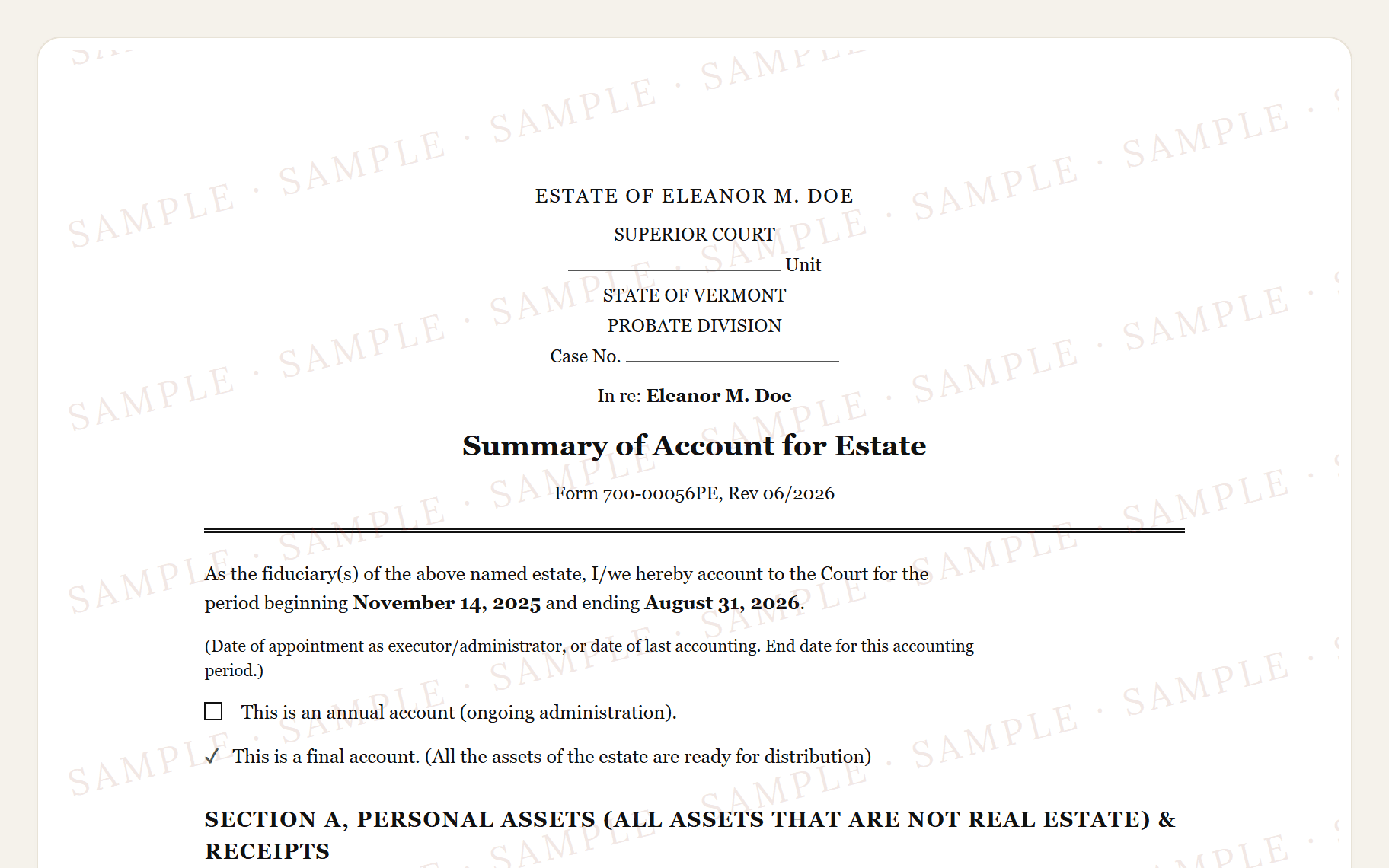
Recording is free for as long as the estate takes: every receipt and disbursement with its date and description, distributions per beneficiary, and a balance that checks itself as you go. ExecutorLedger builds Vermont-style documents from those records, an Inventory laid out in form 700-00030's four columns and a Summary of Account laid out in form 700-00056PE's own numbered lines, ready to transcribe onto the court's forms when you file them. Neither is a court form, and your attorney should review them before anything is signed or filed. Usually less than one attorney hour, and typically reimbursable by the estate.
Section 5 of 5.Questions about the Vermont inventory
Does Vermont require Form 700-00030?
Yes. 14 V.S.A. §1051 requires an inventory on Form 700-00030 within 60 days of appointment, and the statute sets no cap on an extension the court may grant for good cause.
Is the Vermont inventory really due in 30 days, and is it notarized?
No. The Vermont Judiciary's own Estates and Wills page and its self-help booklet both say 30 days and call it notarized. 14 V.S.A. §1051 sets 60 days, and the current form, revised 02/2024, ends in a declaration under penalty of perjury, not a notarized oath. Rely on the statute and the current form.
What can be excluded from the Vermont inventory?
14 V.S.A. §1054 excludes only wearing apparel of the decedent or any household member, and provisions and other articles consumed or used in the household's subsistence. An excluded item comes back into the inventory only after a hearing on a motion, if the court finds it has value beyond its use or wear, or that including it would otherwise benefit the estate.
The inventory is the first filing, not the last. The full Vermont guide covers the accounting that follows it, every deadline with its statute, what the executor is paid, and how estates close.
This page describes Vermont practice as our verified references state it; formats drift and estates differ, and none of this is legal advice. ExecutorLedger produces court-style documents for transcription. They are not official court forms. What your estate must file is a question for its attorney.