Vermont Estate Accounting: A Personal Representative's Guide
Vermont probate runs through the Probate Division of the Superior Court, organized by unit rather than by county, and its fiduciary is the executor named in a will or the administrator appointed when there is none. Vermont prescribes two statewide forms: 700-00030, the Inventory, and 700-00056PE, the Summary of Account for Estate. Here is what each form asks for, the deadlines behind them, and how a Vermont estate closes.
Section 1 of 7.The two documents: the Inventory and the Summary of Account for Estate
Vermont administers estates under 14 V.S.A. chapter 63, through the Probate Division of the Superior Court in the unit where the estate is opened. A caption on a Vermont probate filing reads SUPERIOR COURT, the unit, STATE OF VERMONT, PROBATE DIVISION, because Vermont organizes its trial courts by unit rather than by the county-court structure some other states use. One form, 700-00030, also serves guardianships and trusts, which is why its own instructions speak of the decedent's estate in one limb and every other case in the other.
The first document is the Inventory, form 700-00030 (Rev 02/2024). It is a single table, four columns: item number, description, fair market value, and mortgage or lien. Vermont does not net the encumbrance against the value the way some states do; the lien or mortgage sits in its own column, beside the value, for the reader to weigh. The form closes with a declaration under penalty of perjury and asks for no notary.
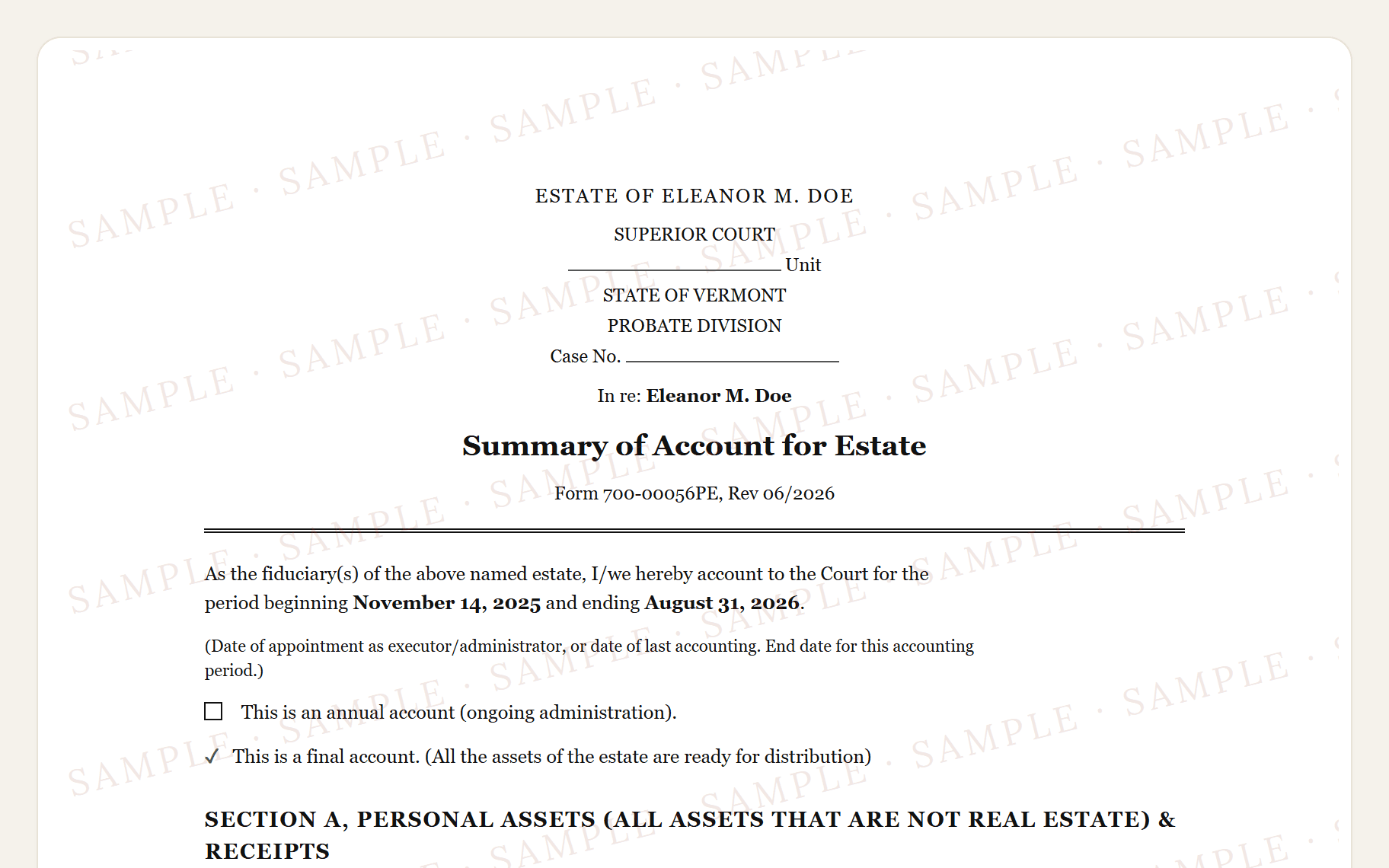
The second document is the Summary of Account for Estate, form 700-00056PE (Rev 06/2026). It totals the personal and real-estate assets separately before combining them, lists every disbursement, and, on a final account, lists the proposed distribution to each beneficiary. It too closes with a declaration and no notary. Neither form is generated by ExecutorLedger as a substitute for the court's own document; ExecutorLedger builds the figures a preparer transcribes onto them.
Section 2 of 7.Vermont's deadlines, with the statute behind each
- Day 30 (about 1 month)Publish the Notice to Creditors
Why
Under 14 V.S.A. §1201 and V.R.P.P. 64, unless the court excused this step (allowed when all debts are known and payable, there are no debts, or a very small estate passes to the surviving spouse), the fiduciary typically must publish the Notice to Creditors once in a local newspaper within 30 days of appointment and send copies to all known or reasonably ascertainable creditors; confirm whether publication was required or waived in this estate with your attorney. - Day 60 (about 2 months)File the estate inventory
Why
Under 14 V.S.A. §1051, the executor or administrator generally must file an inventory of the decedent's probate assets, valued at fair market value as of the date of death, within 60 days after appointment (extendable by the court for good cause), but the Vermont Judiciary's own estate guide and website still instruct fiduciaries to file within 30 days, so treating 30 days as the target is the safe play; confirm the operative due date and any extension with your attorney. - Day 150 (about 5 months)Creditor claims are generally barred
Why
Under 14 V.S.A. §1203(a), creditor claims are typically barred 4 months after the first publication of the Notice to Creditors (or 1 year after death if notice was never published), so this entry calendars conservatively from appointment on the assumption publication happened near the 30-day publication deadline; confirm the actual publication date and the true bar date with your attorney before paying claims or distributing. - Day 180 (about 6 months) · earliest possibleFinal accounting may be waived
Why
Under 14 V.S.A. §1069, once the estate has been open at least 6 months and the remaining assets include no real estate, a formal final accounting generally may be waived by filing the fiduciary's verified representation that all claims and obligations are satisfied, a schedule of remaining assets, a proposed distribution, a waiver and consent signed by all interested parties, and a Vermont tax clearance; confirm eligibility for this shortcut with your attorney. - Day 365 (about 1 year)First annual account due
Why
Under 14 V.S.A. §1055, the executor or administrator generally must render an account of the administration within one year of receiving letters, and annually thereafter (or as the court orders) until the estate is wholly settled; confirm whether the court ordered a different accounting schedule with your attorney.
- Day 270 (about 9 months)Vermont estate tax return, if required
Why
Under 32 V.S.A. §§7444, 7446, a Vermont estate tax return (Form EST-191) is typically required only if a federal Form 706 must be filed or the federal gross estate plus taxable gifts made within 2 years of death exceeds $5,000,000, and it is generally due within 9 months of death (Form EST-195 can extend filing by 6 months, though under §7447 any tax is still payable at the 9-month mark); confirm applicability and the exact due date with your attorney. - Day 270 (about 9 months)Federal estate tax return (Form 706), if required
Why
Under IRC §6075, Form 706 is due 9 months after death, but only if the gross estate exceeds the federal exemption or the estate elects portability, and a 6-month extension may be available; confirm applicability and timing with your attorney.
The inventory is due within 60 days after appointment, and the statute sets no cap on an extension the court may grant for good cause (14 V.S.A. § 1051). The original is filed with the Probate Division, and the executor or administrator must also serve a copy on every interested person and file a Certificate of Service telling the court how that was done. The Certificate of Service is its own filing, separate from the inventory itself.
Read the full explanation
The Vermont Judiciary's own Estates and Wills web page, and its self-help booklet 700-00302, both say the inventory is due within 30 days and call it notarized. Neither is right. The statute sets 60 days, and the current form ends in a declaration, not a notarized oath. If a page or a booklet you find says 30 days or asks for a notary, it is describing an older rule or an older form revision, not the one in force.
Property found after the inventory, or a listed value or description that turns out to be erroneous or misleading, goes on a supplemental inventory, filed with the court and served the same way as the original (14 V.S.A. § 1053(a)). A creditor owed more than $1,000, or an heir, devisee, or legatee whose share is worth more than $500, can move within 30 days after an inventory or supplemental inventory is filed for a hearing and a reappraisal; the hearing is mandatory once that motion qualifies, and the court may then appoint a special appraiser (14 V.S.A. § 1053(b)).
An account is due within one year of the executor or administrator receiving letters, and annually after that, or otherwise as the Probate Division orders, until the estate is wholly settled (14 V.S.A. § 1055).
A creditor's claim that arose before death is barred unless presented within four months after the first publication of notice to creditors, or, if notice was never published or otherwise given, within one year after the decedent's death. That bar does not reach claims for possession of or title to real estate, or claims for injury to a person or damage to property caused by the decedent (14 V.S.A. § 1203(a)). A claim arising at or after death has four months (14 V.S.A. § 1203(b)). A claim filed by the State on behalf of Vermont Medicaid is not excepted from a bar. It has its own, stricter one: four months after the first publication of notice to creditors, regardless of the decedent's date of death or when the estate is opened, with no fallback to one year if notice was never published (14 V.S.A. § 1203(d)).
Section 3 of 7.What Vermont pays a personal representative
14 V.S.A. § 1065 allows necessary expenses in caring for, managing, and settling the estate, plus reasonable fees for services. There is no percentage schedule and no per diem. If the will sets its own compensation for the executor, that provision is full satisfaction for the executor's services unless the executor renounces it in a written instrument filed with the Probate Division, or the court orders otherwise.
So a Vermont fee is a reasonable amount you support with a record, not a number you look up on a table. ExecutorLedger never computes a Vermont commission from a percentage, since no Vermont statute sets one.
Section 4 of 7.The Inventory and the Summary of Account explained for a first-time executor
14 V.S.A. § 1054 excludes only two things from the inventory: wearing apparel of the decedent or of any household member, and provisions and other articles consumed or used in the household's subsistence. Furniture, jewelry, antiques, and collectibles are ordinary inventory items in Vermont; nothing in the statute sends them to the executor free of the estate. Even the narrow exclusion is not the executor's call to make alone: an excluded item comes back into the inventory only after a hearing on a motion, if the court finds it has value beyond its use or wear, or that including it would otherwise benefit the estate.
The inventory's own instructions ask for documents the app cannot supply, so ExecutorLedger prints each as a ruled note for the preparer: a deed or the latest property tax bill for real property, with the deed type, grantor, grantee, execution date, book and page, and recording town; a bill of sale or transfer document for a mobile home; a bank or investment account identified by institution, account type, and the last four digits; a title or registration for a motor vehicle; a description and value for any item or collection worth more than $5,000; and a lienholder's name and approximate amount owed for any lien on the property it burdens. The form also asks whether any listed item was appraised, and if so for the appraiser's name and address, which 14 V.S.A. § 1052 is the authority for.
The Summary of Account's numbered lines mirror the form's own schedule letters, personal assets first (A-1 through A-6), then real estate (A-7 through A-11), then disbursements (B-1 through B-10). A line the app has nothing to answer, such as monies advanced to the estate or attorney fees, prints a ruled blank rather than a zero, because a zero on this form says the preparer looked and found none. Gain and loss on a sale are measured against the inventory value, never the carried value, because 14 V.S.A. § 1058 says an executor or administrator neither profits by an increase nor bears a loss on a decrease without fault, and the gain or loss on a sale is measured against what the inventory said the property was worth. Gain and loss post on their own lines and are never netted against each other.
The account form states its own tie: on a final account, the current balance managed by the fiduciary should match the total of the proposed distributions, so that after distribution the estate holds a balance of zero. ExecutorLedger computes the current balance, which is pure arithmetic from the totals above it, but it does not compute the other side of that comparison, because the app holds no distribution plan. The proposed distribution to each beneficiary is the preparer's own to fill in, and checking the two sides against each other is the preparer's job, not something a silent zero-figure should pretend to do for them.
Section 5 of 7.How a Vermont estate closes
14 V.S.A. § 1057 requires the accounting to be done on a cash basis, and it expressly allows the account to be prepared on a spreadsheet or on any generally accepted software format the court accepts, as an alternative to the court's own forms, so long as it carries the balance at the start of the period, every receipt and payment, and the balance at the end. The Probate Division still has to accept the format offered, and nothing ExecutorLedger produces is itself a court form; the statute simply means a court is not required to insist on its own blank paper.
An account consented to by all interested parties is allowed without a hearing unless the court sets one, and an account may not be rejected for de minimis discrepancies unless the court finds good cause to reject it on that basis (14 V.S.A. § 1066).
If an estate has been open at least six months and the remaining assets include no real estate, a final accounting can be waived instead of filed. The executor or administrator files the fiduciary's verified representation that every claim and obligation is satisfied, a schedule of the remaining assets, a schedule of the proposed distribution, a waiver of final accounting signed by every interested party, and a tax clearance from the Vermont Department of Taxes (14 V.S.A. § 1069). Vermont keeps two forms for this route, a Motion to Waive Accounting and a Waiver of Final Accounting and Consent, which ExecutorLedger does not generate; the account print names both and states the two gates so a qualifying estate knows the route exists.
Vermont still has an estate tax, unlike most states this product covers. The Summary of Account's Affidavit of All Debts Paid, filed with a final account, asks whether an Application for Tax Clearance was filed with the Vermont Department of Taxes, and on what date. ExecutorLedger does not hold that date and prints a ruled blank for it. Ask your attorney or the Department of Taxes whether the estate owes anything and when a clearance is required; this guide states no exclusion amount, because it was not part of what was verified for this page.
- File the Final Summary of Account with Schedules & Motion to Allow Account (Form 700-00056PE) listing every receipt, disbursement, and the proposed distribution, and send it with a consent form to each beneficiary. If everyone consents, the Probate Division can allow it without a hearing (14 V.S.A. §1066).
- If the estate has been open at least 6 months and no real estate remains, ask to skip the full accounting instead: file the Waiver of Final Accounting and Consent (Form 700-00406B) under 14 V.S.A. §1069, with the verified representation that all claims are satisfied, schedules of remaining assets and proposed distribution, every interested party's consent, and the Vermont tax clearance.
- Get the Vermont Department of Taxes' clearance letter before distributing. Apply on Form E-2A (Vermont Estate Tax Information and Application for Tax Clearance); the Probate Division will not issue the final Decree of Distribution without it.
- If any beneficiary won't consent, the court will set a hearing on the account; written objections are generally due at least 7 days before the hearing (V.R.P.P. 66(e)), and the court decides whether to allow the account.
- Once the Decree of Distribution is final, collect a signed Receipt (Form 700-00153) from every beneficiary and file the Fiduciary's Closing Report & Discharge (Form 700-00152) with those receipts so the Probate Division can close the estate.
Vermont's probate matters are handled by the Probate Division of the Superior Court (Vermont folded its standalone probate courts into the Superior Court system effective February 1, 2011), not a surrogate's court or orphans' court. See 14 V.S.A. §§1066, 1069 and the Vermont Judiciary's 'Probating a Vermont Estate' booklet (Form 700-00302).
Section 6 of 7.Where ExecutorLedger fits
Recording is free for as long as the estate takes: every receipt and disbursement with its date and description, distributions per beneficiary, and a balance that checks itself as you go. ExecutorLedger builds Vermont-style documents from those records, an Inventory laid out in form 700-00030's four columns and a Summary of Account laid out in form 700-00056PE's own numbered lines, ready to transcribe onto the court's forms when you file them. Neither is a court form, and your attorney should review them before anything is signed or filed. Every document previews free with your real numbers, and $149 (one-time payment) per estate lifts the watermark. Usually less than one attorney hour, and typically reimbursable by the estate.
Section 7 of 7.Questions Vermont executors ask
Does Vermont have a statewide probate form?
Yes. Vermont prescribes two: form 700-00030, the Inventory (Rev 02/2024), and form 700-00056PE, the Summary of Account for Estate (Rev 06/2026). Both close with a declaration under penalty of perjury; neither asks for a notary.
When is the Vermont inventory due, and where does it go?
Within 60 days after appointment, with no statutory cap on an extension the court may grant for good cause (14 V.S.A. § 1051). The original is filed with the Probate Division, and a copy goes to every interested person, with a Certificate of Service filed to tell the court how that was done.
Is the Vermont inventory really due in 30 days, and is it notarized?
No. The Vermont Judiciary's own Estates and Wills page and its self-help booklet, 700-00302, both say 30 days and call the inventory notarized. 14 V.S.A. § 1051 sets 60 days, and the current form, revised 02/2024, ends in a declaration under penalty of perjury, not a notarized oath. Rely on the statute and the current form rather than those two pages.
How is a Vermont executor or administrator paid?
14 V.S.A. § 1065 allows necessary expenses and reasonable fees for services, with no percentage schedule and no per diem. If the will sets the executor's compensation, that provision controls unless the executor renounces it in writing or the court orders otherwise.
Does Vermont still have an estate tax?
Yes. Vermont is one of the few states this product covers that still taxes estates. The Summary of Account's final-account affidavit asks whether an Application for Tax Clearance was filed with the Vermont Department of Taxes and on what date; ask your attorney or the Department of Taxes whether the estate owes anything.
How does a Vermont estate close?
By filing the account required under 14 V.S.A. § 1055, which is allowed without a hearing if every interested party consents and may not be rejected for de minimis discrepancies (14 V.S.A. § 1066). An estate open at least six months with no real estate among its remaining assets can instead waive the final accounting under 14 V.S.A. § 1069, filing a verified representation, asset and distribution schedules, a signed waiver from every interested party, and a tax clearance.
Not sure which accounting your situation calls for? Which accounting do I need? covers the choice, and the accounting guide explains the structure every format shares.
This page describes Vermont practice as our verified references state it; formats drift and estates differ, and none of this is legal advice. ExecutorLedger produces court-style documents for transcription. They are not official court forms. The accounting your estate needs is a question for its attorney.