South Dakota estate inventory: why UJS-140 doesn't apply
South Dakota administers decedents' estates through the circuit court under Codified Law 29A-3, with no separate probate court or division. The Unified Judicial System publishes an Initial Inventory form numbered UJS-140, but it is a conservatorship and guardianship form under chapter 5 and has nothing to do with a decedent's estate. No court form exists for a decedent's estate inventory. Here is what SDCL 29A-3-706 requires, when the inventory is due, and what goes in it.
Section 1 of 5.What the inventory is and who files it
South Dakota administers decedents' estates under Codified Law 29A-3, Probate of Wills and Administration. SDCL 29A-1-201(8) defines court to mean the circuit court, so there is no separate probate court and no probate division the way some other states have.
The inventory is required by SDCL 29A-3-706. It is one list of the property the decedent owned at death, with reasonable detail, its fair market value as of the date of death, and the type and amount of any encumbrance against it. Furnishing a copy to anyone who asks is mandatory and has to happen promptly. Filing the original with the court is the personal representative's own option.
The only inventory form the Unified Judicial System publishes is UJS-140, titled Initial Inventory. It is a conservatorship and guardianship form under chapter 5, sworn by a conservator, and it has nothing to do with a decedent's estate. A personal representative who finds it while searching the court's own site should not use it for a probate inventory.
Section 2 of 5.When the inventory is due
Under SDCL 29A-3-706, the personal representative generally must prepare an inventory of the decedent's property, with fair market values as of the date of death, within nine months after death (or six months after appointment, if that is later); confirm the exact controlling date with your attorney.
Property discovered later, or a value that needs correcting, goes on a supplementary inventory under SDCL 29A-3-708. It is its own instrument, never added into the original's total, and the statute sets no deadline for filing it.
Section 3 of 5.What goes in it, part by part
SDCL 29A-3-706 names no classification scheme for the inventory. The statute defines property to include both real and personal property, with no carve-out, so real property sits on the same single list as everything else, at its full value, with its own subtotal shown as a subtotal of that list rather than a second schedule.
The inventory lists each item at its fair market value on the date of death. The statute requires the type and amount of any encumbrance against each item to appear separately, not netted against the value.
Employing an appraiser is optional under SDCL 29A-3-707, for any asset whose value may not be readily ascertainable, and different people may appraise different kinds of assets. Once an appraiser is used, the appraiser's name and address must appear on the inventory beside the item or items they appraised.
A supplementary inventory under SDCL 29A-3-708 covers property found after the original inventory, and a value or description in the original that turns out to be erroneous or misleading. It shows the date-of-death value of a newly found item, or the revised value or description, and the appraisers or other data relied on, if any. It has no deadline of its own.
Section 4 of 5.From your records to South Dakota documents
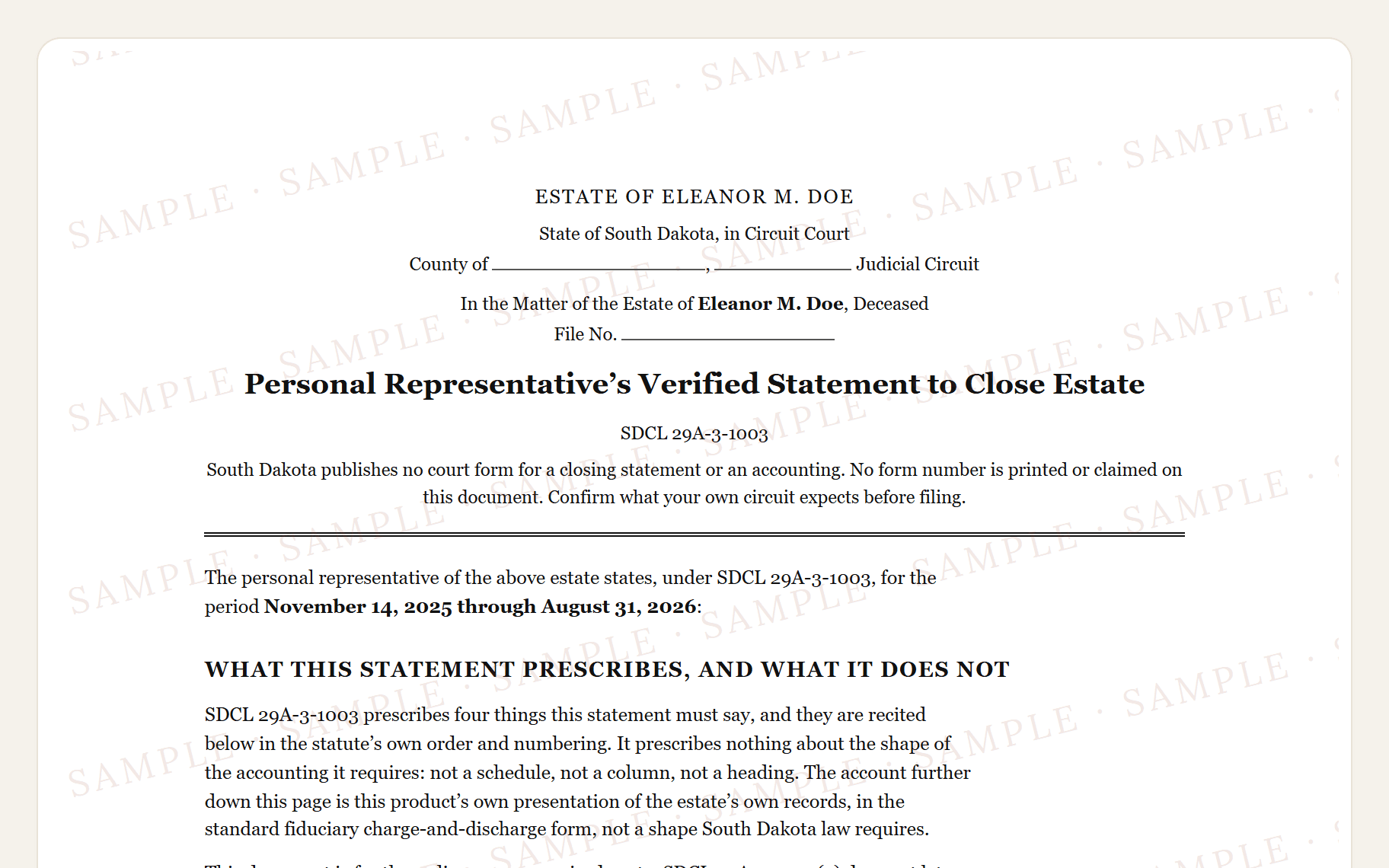
Recording is free for as long as the estate takes: every receipt and disbursement with its date and description, distributions per beneficiary, and a balance that checks itself as you go. ExecutorLedger builds South Dakota-style documents from those records, an inventory in the statute's own single, undifferentiated list and a closing statement carrying all four of SDCL 29A-3-1003's recitals, ready to transcribe or attach when you furnish a copy to an interested person or send a statement and accounting to a distributee. Neither is a court form, and your attorney should review them before anything is signed or filed. Usually less than one attorney hour, and typically reimbursable by the estate.
Section 5 of 5.Questions about the South Dakota inventory
Is there a court form for South Dakota's inventory or closing statement?
No. South Dakota's Unified Judicial System publishes no form for a decedent's estate inventory, account or closing statement. The only Initial Inventory form on the court's own site, UJS-140, is a conservatorship and guardianship form under chapter 5 and has nothing to do with a decedent's estate. SDCL 29A-3-706 and 29A-3-1003 say what a personal representative's inventory and closing statement must contain, and that is the whole requirement.
When is the South Dakota inventory due, and do I have to file it?
Within six months after appointment, or nine months after the decedent's death, whichever is later (SDCL 29A-3-706). Furnishing a copy to anyone who asks is mandatory and has to happen promptly, by mail or delivery. Filing the original with the court is the personal representative's own option.
The inventory is the first filing, not the last. The full South Dakota guide covers the accounting that follows it, every deadline with its statute, what the executor is paid, and how estates close.
This page describes South Dakota practice as our verified references state it; formats drift and estates differ, and none of this is legal advice. ExecutorLedger produces court-style documents for transcription. They are not official court forms. What your estate must file is a question for its attorney.