Ohio's Form 6.0 estate inventory, explained
Ohio probate runs through the probate court in each county, a division of the county Court of Common Pleas. Ohio requires an inventory of the estate on Form 6.0, filed with the probate court within three months of appointment. Here is what the form asks for, part by part, and how to have every item ready.
Section 1 of 5.What Form 6.0 is, and who files it
Ohio probate runs through the probate court in each county, a division of the county Court of Common Pleas, under the Ohio Revised Code and the rules that govern probate practice statewide. The fiduciary is called an executor when named in a will, or an administrator when appointed under intestacy. Ohio requires filing the inventory on the state's Standard Probate Form 6.0, a mandate set by Civ.R. 73.2 (formerly Sup.R. 51): once a document is filed with the probate court, it must be on the Supreme Court of Ohio's approved form.
The inventory is Standard Probate Form 6.0, Inventory and Appraisal (Amended October 1, 2020), with Form 6.1, Schedule of Assets, attached. Under Ohio Rev. Code §2115.02, the fiduciary must file the inventory with the probate court within three months after appointment absent a good-cause extension, listing the decedent's Ohio real property and tangible and intangible personal property at its value on the date of death. An asset whose value is readily ascertainable does not need an appraiser's valuation, but it still has to be listed.
Section 2 of 5.When the inventory is due
Under Ohio Rev. Code §2115.02, the executor generally must file an inventory of the decedent's Ohio real estate and personal property, valued as of the date of death, within 3 months after appointment, unless the probate court extends the time for good cause; confirm the exact due date with your attorney.
Notice that the will was admitted to probate generally goes to the surviving spouse, the intestate heirs, and the named legatees and devisees within two weeks of admission, and the certificate of that notice, or signed waivers, is generally due at the probate court within two months of the fiduciary's appointment. The inventory deadline and the notice deadline run on separate clocks, so calendar both to make sure neither is missed.
Section 3 of 5.What goes in it, part by part
Form 6.0's recapitulation sorts everything the decedent owned into three classes feeding one total: tangible personal property, intangible personal property, and real property. Form 6.1's schedule lists every asset by item, with an Appraised checkbox and a value column. The checkbox is left for the fiduciary to mark by hand for any item an appraiser valued, and stays blank for a value the fiduciary determined was readily ascertainable. A separate, uncounted block discloses automobiles transferred to a surviving spouse under Ohio Rev. Code §2106.18, capped at $65,000 in total value, outside the inventory's grand total.
The fiduciary's own appraisal is the default. The statute ties the appraisement requirement to readily ascertainable value: where the fiduciary can determine it, no appraiser is needed. Where the value is not readily ascertainable, the fiduciary may hire an appraiser at the estate's expense, and an interested party may petition the probate court to appoint appraisers on the estate's behalf. Either way, the asset and its value go on Form 6.1 by item.
Section 4 of 5.From your records to the Form 6.0
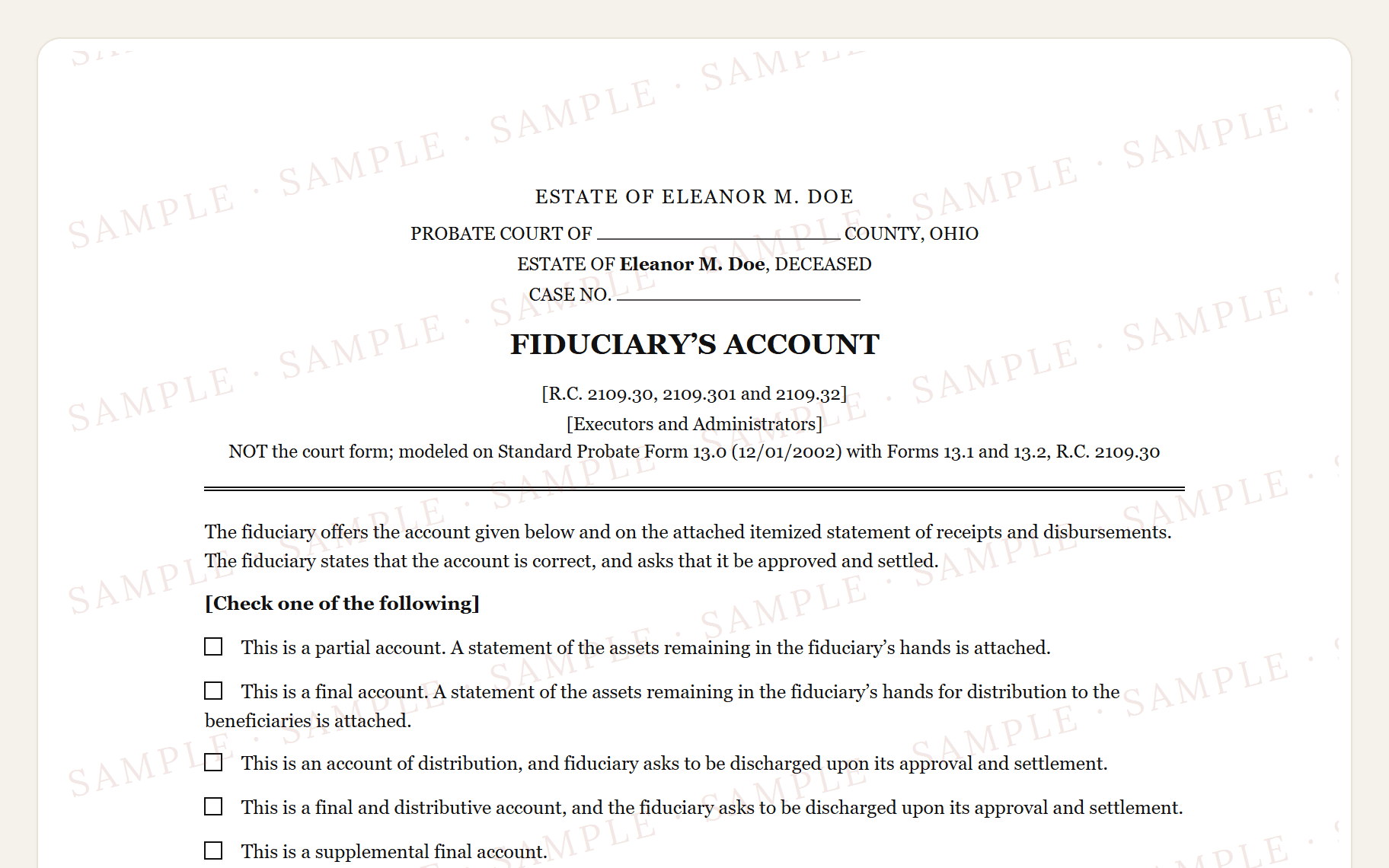
Recording is free for as long as the estate takes: every receipt and disbursement with its date and description, distributions per beneficiary, and a balance that checks itself as you go. ExecutorLedger builds Ohio-style documents from those records, an inventory shaped like Form 6.0 and Form 6.1 and an account shaped like Form 13.0, Form 13.1, and Form 13.2, ready to transcribe onto the Standard Probate Forms when you file, send copies to heirs or beneficiaries, or hand them to your attorney. Neither is a court form, and your attorney should review them before anything is signed or filed. Usually less than one attorney hour, and typically reimbursable by the estate.
Section 5 of 5.Questions about the Ohio inventory
Does Ohio require the Form 6.0 inventory?
Yes, on the Standard Probate Forms, once the document is filed. Civ.R. 73.2 (formerly Sup.R. 51) requires the Supreme Court's own approved form whenever a probate document is filed, and filing itself is the general rule in Ohio: the inventory under Ohio Rev. Code §2115.02. An estate that qualifies for release from administration or summary release from administration (§2113.03, §2113.031) never files it.
When is the Ohio inventory due?
Within three months after appointment, valued as of the date of death, unless the probate court extends the time for good cause (Ohio Rev. Code §2115.02).
The inventory is the first filing, not the last. The full Ohio guide covers the accounting that follows it, every deadline with its statute, what the executor is paid, and how estates close.
This page describes Ohio practice as our verified references state it; formats drift and estates differ, and none of this is legal advice. ExecutorLedger produces court-style documents for transcription. They are not official court forms. What your estate must file is a question for its attorney.