Ohio Estate Accounting: A Fiduciary's Guide
Ohio probate runs through the probate court, a division of the county Court of Common Pleas. The statutes call its fiduciary an executor or administrator; the state's own forms call the same person the fiduciary throughout. Ohio requires both the inventory and the account, and requires them on the state's Standard Probate Forms once they are filed. Here is what each covers, the deadlines behind each, and how an Ohio estate closes.
Section 1 of 7.The two documents: the Form 6.0 inventory and the Form 13.0 account
Ohio probate runs through the probate court in each county, a division of the county Court of Common Pleas, under the Ohio Revised Code and the rules that govern probate practice statewide, now Civ.R. 73 and following (formerly the Rules of Superintendence, Sup.R. 50 through 79, until a restructuring moved them into the Rules of Civil Procedure effective July 1, 2026). Civ.R. 73.2 (formerly Sup.R. 51) sets the mandate this guide is built around: once a document is filed with the probate court, it has to be on the Standard Probate Form the Supreme Court of Ohio has approved and published for that purpose. Ohio is different here from many states this guide covers: filing the inventory and the account is the general rule, not something an estate opts into.
The inventory is Standard Probate Form 6.0, Inventory and Appraisal (Amended October 1, 2020), with Form 6.1, Schedule of Assets, attached. Under Ohio Rev. Code §2115.02, the fiduciary must file the inventory with the probate court within three months after appointment absent a good-cause extension, listing the decedent's Ohio real property and tangible and intangible personal property at its value on the date of death. An asset whose value is readily ascertainable does not need an appraiser's valuation, but it still has to be listed.
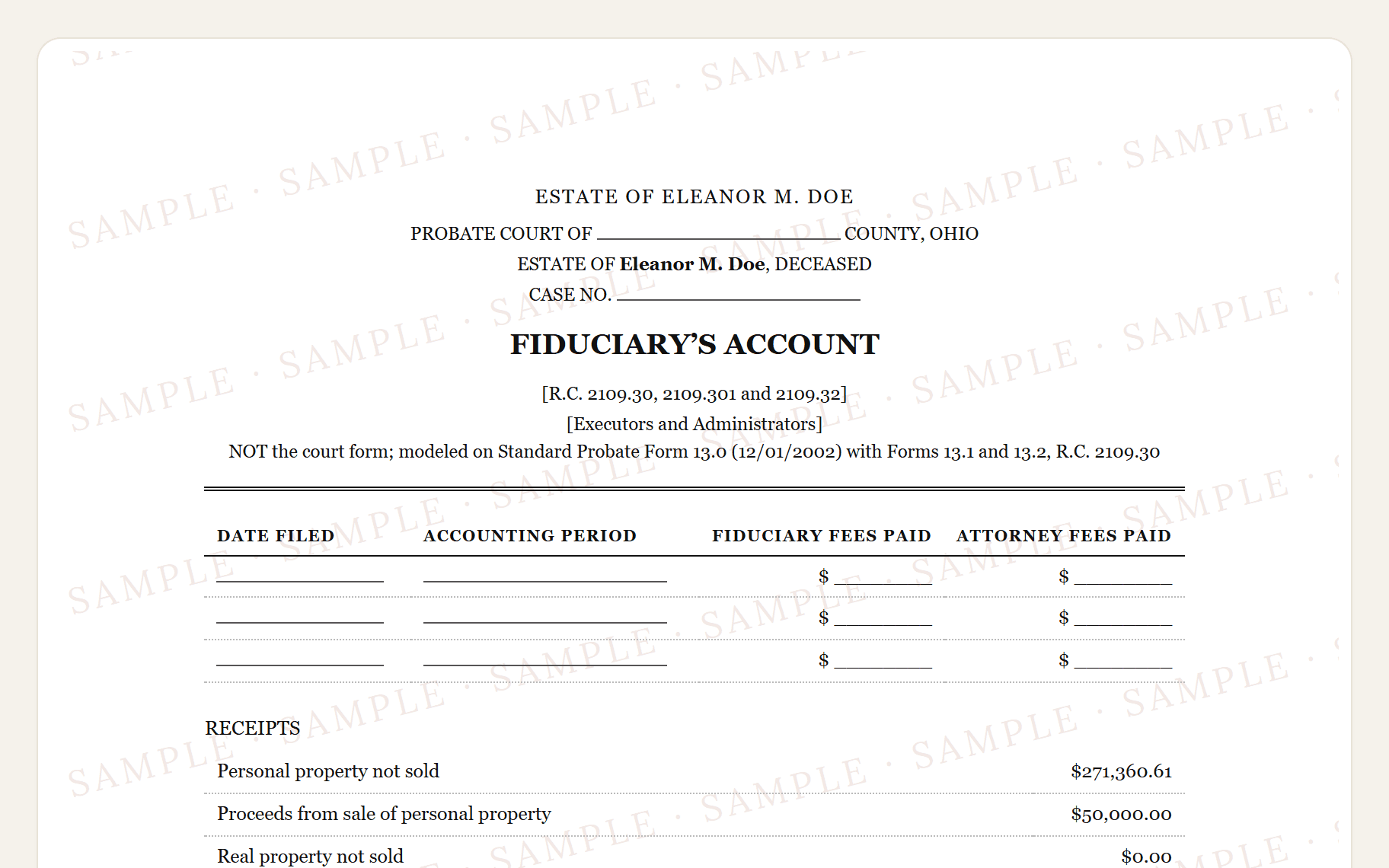
The account is Standard Probate Form 13.0, Fiduciary's Account (12/01/2002), with Form 13.1, Receipts and Disbursements, and Form 13.2, Assets Remaining in Fiduciary's Hands, attached. Ohio Rev. Code §2109.301 sets the timeline: a final and distributive account is generally due within six months after appointment, extending to a first account by thirteen months and at least annually after that when one of the statute's exceptions applies (an Ohio estate tax return is due, a will contest or spousal election is pending, the fiduciary is a party to a civil action, the estate is insolvent, among others). Every heir of an intestate estate or beneficiary of a testate one gets a copy of the account when it is filed, under Ohio Rev. Code §2109.32(B)(1).
Two small-estate routes skip both documents entirely because neither appoints an executor or administrator for the underlying inventory and account duties to attach to. Release from administration (Ohio Rev. Code §2113.03) is available when the estate's assets are worth $35,000 or less, or $100,000 or less when a surviving spouse is left the entire estate. Summary release from administration (Ohio Rev. Code §2113.031) is available when the assets do not exceed the lesser of $5,000 or the decedent's funeral and burial expenses for someone other than a spouse, or a spouse's statutory support allowance plus up to $5,000 of those expenses. An estate that qualifies for either route never files a Form 6.0 or a Form 13.0, because there is no administration to inventory or account for.
Section 2 of 7.Ohio deadlines, with the statute behind each
- Day 30 (about 1 month)Send the Medicaid estate recovery notice
Why
Under Ohio Rev. Code §2117.061, if the decedent (or the decedent's spouse) was subject to the Medicaid estate recovery program, the person responsible for the estate generally must submit the Medicaid estate recovery notice form to the program's administrator at the Ohio Department of Medicaid within 30 days after letters are granted; confirm whether this applies to your estate and the filing method with your attorney. - Day 60 (about 2 months)Give notice the will was admitted to probate, then file the certificate
Why
Under Ohio Rev. Code §2107.19, notice that the will was admitted to probate generally must go to the surviving spouse, the intestate heirs, and the named legatees and devisees within 2 weeks after admission, and the certificate of that notice (or signed waivers) is generally due at the probate court within 2 months after the fiduciary's appointment. This reminder is anchored to that certificate deadline; confirm the recipient list and exact timing with your attorney. - Day 90 (about 3 months)File the inventory with the probate court
Why
Under Ohio Rev. Code §2115.02, the executor generally must file an inventory of the decedent's Ohio real estate and personal property, valued as of the date of death, within 3 months after appointment, unless the probate court extends the time for good cause; confirm the exact due date with your attorney. - Day 180 (about 6 months)Render the account (or certificate of termination)
Why
Under Ohio Rev. Code §2109.301, the executor generally must render a final and distributive account within 6 months after appointment unless a statutory exception applies (an estate tax return due, a will contest, a spousal election, pending litigation, or an insolvent estate, among others), and in any event generally must file an account no later than 13 months after appointment and at least once a year until the estate closes; confirm your account schedule with your attorney.
- Day 180 (about 6 months)Calendar the creditor claim cutoff date
Why
Under Ohio Rev. Code §2117.06, creditors generally must present claims within 6 months after the date of death or the claim is forever barred as to all parties (devisees, legatees, and distributees included), whether or not an executor has even been appointed, so calendar this cutoff before paying claims or distributing; confirm how the bar date affects your estate with your attorney. - Day 270 (about 9 months)Federal estate tax return (Form 706), if required
Why
Under IRC §6075, Form 706 is due 9 months after death, but only if the gross estate exceeds the federal exemption or the estate elects portability, and a 6-month extension may be available; confirm applicability and timing with your attorney.
The inventory is due within three months (90 days) after appointment, valued as of the date of death, unless the probate court extends the time for good cause (Ohio Rev. Code §2115.02).
Read the full explanation
Notice that the will was admitted to probate generally goes to the surviving spouse, the intestate heirs, and the named legatees and devisees within two weeks of admission, and the certificate of that notice, or signed waivers, is generally due at the probate court within two months of the fiduciary's appointment (Ohio Rev. Code §2107.19).
Creditors generally must present a claim within six months after the date of death or it is forever barred as to every devisee, legatee, and distributee, whether or not an executor has even been appointed by then (Ohio Rev. Code §2117.06).
If the decedent or the decedent's spouse was subject to Ohio's Medicaid estate recovery program, the person responsible for the estate generally must submit the Medicaid estate recovery notice to the Ohio Department of Medicaid within 30 days after letters are granted (Ohio Rev. Code §2117.061).
The final and distributive account is generally due within six months after appointment unless a statutory exception applies, and in any event a first account is generally due no later than thirteen months after appointment, with at least one more account every year after that until the estate closes (Ohio Rev. Code §2109.301).
A federal estate tax return, Form 706, if the estate needs one, is due nine months after death (IRC section 6075), with a possible six-month extension. Confirm whether the estate needs one with your attorney.
Section 3 of 7.What Ohio pays a fiduciary
Ohio Rev. Code §2113.35 sets the fiduciary's fee on a tiered schedule: 4 percent of the first $100,000, 3 percent of the next $300,000 (up to $400,000), and 2 percent above $400,000. That schedule applies to personal property, plus any income it earned, received and accounted for during administration, plus the gross proceeds of any estate real property sold; everything else counts at its fair market value on the date of death, and sold real property counts at its gross sale proceeds, per §2113.35(C).
The statute adds two more pieces this guide's figure leaves out: a further 1 percent on the value of real property that is not sold, and 1 percent on the value of property not subject to administration but subject to Ohio estate tax. Confirm both with your attorney if they apply to the estate.
If the will fixes the fiduciary's compensation, that amount is full satisfaction for the fiduciary's services in place of the statutory fee, unless the fiduciary renounces the will's provision by an instrument filed with the court within four months of appointment (Ohio Rev. Code §2113.36).
The probate court can deny or reduce a fiduciary's commission if the inventory or an account is filed late, or if, after a hearing, the court finds the fiduciary has not faithfully discharged the duties of the office (Civ.R. 73.22, formerly part of the Rules of Superintendence).
Section 4 of 7.How an Ohio estate closes
Most Ohio estates close by filing the final and distributive account on Standard Probate Form 13.0, with Form 13.1 and Form 13.2 attached, asking the probate court to approve and settle it and to discharge the fiduciary on approval. A copy goes to every heir or beneficiary at the time of filing, and the fiduciary files the Form 13.9 certificate of service along with it (Ohio Rev. Code §2109.32(B)(1), (B)(2)).
Every disbursement and distribution needs a voucher or other proof referenced to the account by number, letter, or date. Signed receipts from each distributee satisfy this under Civ.R. 73.15 (formerly Sup.R. 64), so collect them as you distribute, not after.
The probate court sets a hearing no earlier than 30 days after the account is filed, with notice on Form 13.5 or signed Form 13.7 waivers from interested parties. If nobody files exceptions, at least five days before the hearing (Ohio Rev. Code §2109.33), the court approves and settles the account on a Form 13.3 entry and can discharge the fiduciary at the same time (Ohio Rev. Code §2109.32).
A fiduciary who is also the estate's sole heir, legatee, or devisee can skip the partial accounting altogether and instead file a Certificate of Termination, Form 13.6, within 30 days after administration is complete (Ohio Rev. Code §2109.301(B)(2)).
Once a final and distributive account is approved, the fiduciary is automatically discharged twelve months later as long as no proceeding involving the fiduciary is then pending.
- Prepare the fiduciary's account on Standard Probate Form 13.0 (with the Form 13.1 receipts-and-disbursements and Form 13.2 assets-remaining schedules), itemizing everything received, paid out, and still on hand, per Ohio Rev. Code §2109.301.
- Give a copy of the account to every heir (intestate) or beneficiary (testate) when you file it and file the Form 13.9 certificate of service. Ohio Rev. Code §2109.32 requires service at the time of filing.
- Back every disbursement and distribution with vouchers or proofs for the court's audit. Signed receipts from each distributee satisfy this under Civ.R. 73.15, so collect them as you distribute, not after.
- The court sets a hearing no earlier than 30 days after the account is filed (notice via Form 13.5, or signed Form 13.7 waivers from interested parties); if no one objects, the court approves and settles the account (Form 13.3 entry) and can discharge you, per Ohio Rev. Code §2109.32.
- If you are both the executor and the estate's sole heir, legatee, or devisee, you can generally skip the account and instead file a Certificate of Termination (Form 13.6) within 30 days after administration is complete, per Ohio Rev. Code §2109.301(B)(2).
Ohio's probate court (a division of the county Court of Common Pleas) handles this, and the whole process runs on the Ohio Supreme Court's statewide Standard Probate Forms. A locally-drafted account or closing statement isn't a substitute for Forms 13.0/13.6.
Section 5 of 7.The documents explained for a first-time fiduciary
Form 6.0's recapitulation sorts everything the decedent owned into three classes feeding one total: tangible personal property, intangible personal property, and real property. Form 6.1's schedule lists every asset by item, with an Appraised checkbox and a value column; the checkbox is left for the fiduciary to mark by hand for any item an appraiser valued, and stays blank for a value the fiduciary determined was readily ascertainable. A separate, uncounted block discloses automobiles transferred to a surviving spouse under Ohio Rev. Code §2106.18, capped at $65,000 in total value, outside the inventory's grand total.
Form 13.0's RECEIPTS recapitulation has six lines feeding one Total receipts figure: Personal property not sold, Proceeds from sale of personal property, Real property not sold, Proceeds from sale of real property, Income, and Other receipts. "Not sold" is generally understood as how the value of whatever is still on hand from the inventory, or from the prior account, carries forward into the new period. A sale posts its full, gross proceeds as a receipt; there is no gain-or-loss line anywhere on Form 13.0, 13.1, or 13.2, so a gain or a loss is never itself calculated or reported.
The DISBURSEMENTS recapitulation has nine lines feeding one Total disbursements figure: fiduciary fees, attorney fees, other administration costs and expenses, debts and claims against the estate, Ohio and federal estate taxes, personal property distributed in kind, real property transferred, other distributions to beneficiaries, and other disbursements. Total receipts minus total disbursements is the form's own bottom line, BALANCE REMAINING IN FIDUCIARY'S HANDS.
That balance has to match Form 13.2's own total. Form 13.2 recapitulates what is left as tangible personal property plus intangible personal property, subtotaled as Total Personal property, plus Real Estate, for a grand total of assets remaining in the fiduciary's hands, then lists every one of those assets by item underneath.
Form 13.1 is where the detail behind both recapitulations lives: every receipt and every disbursement for the period, itemized, referenced back to the account by voucher number, letter, or date, the same referencing Civ.R. 73.15 requires. A reader can walk from any figure on Form 13.0's recap back to the individual entries on Form 13.1, and from the closing balance to the itemized list on Form 13.2.
Section 6 of 7.Where ExecutorLedger fits
Recording is free for as long as the estate takes: every receipt and disbursement with its date and description, distributions per beneficiary, and a balance that checks itself as you go. ExecutorLedger builds Ohio-style documents from those records, an inventory shaped like Form 6.0 and Form 6.1 and an account shaped like Form 13.0, Form 13.1, and Form 13.2, ready to transcribe onto the Standard Probate Forms when you file, send copies to heirs or beneficiaries, or hand them to your attorney. Neither is a court form, and your attorney should review them before anything is signed or filed. Every document previews free with your real numbers, and $149 once per estate lifts the watermark.
Section 7 of 7.Questions Ohio executors ask
Does Ohio require the Form 6.0 inventory and Form 13.0 account?
Yes, on the Standard Probate Forms, once either document is filed. Civ.R. 73.2 (formerly Sup.R. 51) requires the Supreme Court's own approved form whenever a probate document is filed, and filing itself is the general rule in Ohio: the inventory under Ohio Rev. Code §2115.02 and the account under §2109.301. An estate that qualifies for release from administration or summary release from administration (§2113.03, §2113.031) never files either.
When is the Ohio inventory due?
Within three months after appointment, valued as of the date of death, unless the probate court extends the time for good cause (Ohio Rev. Code §2115.02).
How is an Ohio fiduciary paid?
Ohio Rev. Code §2113.35 sets a tiered fee: 4 percent of the first $100,000, 3 percent of the next $300,000, and 2 percent above $400,000 of personal property (plus its income) and real property sold, plus 1 percent each of real property not sold and of certain non-probate property. The will can set a different amount instead (Ohio Rev. Code §2113.36).
How does an Ohio estate close?
By filing the final and distributive account on Form 13.0, with Form 13.1 and Form 13.2 attached, and asking the probate court to approve, settle, and discharge on it. The court sets a hearing at least 30 days after filing, and once it approves the account the fiduciary is automatically discharged twelve months later absent a pending proceeding (Ohio Rev. Code §2109.301, §2109.32).
Can a small Ohio estate skip the inventory and the account?
Yes, through release from administration or summary release from administration. Release from administration covers estates worth $35,000 or less, or $100,000 or less when a surviving spouse takes everything (Ohio Rev. Code §2113.03). Summary release covers estates at or below the lesser of $5,000 or the decedent's funeral and burial expenses, or a spouse's support allowance plus up to $5,000 of those expenses (Ohio Rev. Code §2113.031). Neither route appoints an executor or administrator, so neither the inventory nor the account is ever filed.
Not sure which accounting your situation calls for? Which accounting do I need? covers the choice, and the accounting guide explains the structure every format shares.
This page describes Ohio practice as our verified references state it; formats drift and estates differ, and none of this is legal advice. ExecutorLedger produces court-style documents for transcription. They are not official court forms. The accounting your estate needs is a question for its attorney.