North Dakota's Form 10 estate inventory, explained
North Dakota requires Form 10, the Inventory and Appraisement, filed with the district court or mailed to heirs and devisees within six months of appointment or nine months of death, whichever is later. Here is what the form asks for, part by part, and how to have every number ready.
Section 1 of 5.What Form 10 is, and who files it
North Dakota administers decedents' estates under Title 30.1 of the Century Code, through the district court of the county where the estate is opened. The Judicial Branch publishes Form 10, the Inventory and Appraisement, revised September 2026, under N.D.C.C. 30.1-18-06. The inventory is mandatory: the statute requires an inventory of everything the decedent owned, with fair market values as of the date of death. A personal representative may file the inventory with the court, or choose not to file and instead mail a copy to every heir in an intestate estate, every devisee if a will was probated, and any other interested person who asks for one.
Form 10 lists property in four classes in this order: real property owned solely by the decedent, real property owned jointly, personal property owned solely, and personal property owned jointly, each with its own subtotal. A Total Gross Estate follows, and then the form subtracts a Total Liens, Mortgages and Encumbrances line to reach a Total Value of Net Estate in North Dakota. Form 10 and Form 15 (the closing statement) are both notarized.
Section 2 of 5.When the inventory is due
Under N.D.C.C. 30.1-18-06, the personal representative typically must file the inventory or mail copies within six months after appointment, or nine months after the decedent's death, whichever is later. The choice between filing and mailing changes who must receive it: filing with the court means you only have to send a copy to an interested person who asks, while not filing means you must mail a copy to every heir or devisee and any other interested person who asks.
An asset whose value is subject to reasonable doubt may be appraised, with the appraiser's name and address noted next to the item. A supplementary inventory is required when property turns up that was not on the original, or when an original item's value or description was erroneous or misleading, with no deadline for filing it.
Section 3 of 5.What goes in it, part by part
Form 10's opening has the personal representative state that the listed property is a true statement of what the decedent owned at death, so far as known, valued at fair market value as of the date of death, with the type and amount of any encumbrance on each item. The form lists property in four classes: real property owned solely, real property owned jointly, personal property owned solely, and personal property owned jointly, each with its own subtotal.
Total Value of Real Property, Total Value of Personal Property, and Total Gross Estate are figures derived from the listed items. The Liens, Mortgages and Encumbrances line subtracts debts secured by estate property to reach a Total Value of Net Estate in North Dakota. Form 10's jurat has the personal representative swear not only to the inventory's completeness but also to all just claims of the Decedent against me: a debt the personal representative personally owed the decedent belongs on this inventory.
Section 4 of 5.From your records to the Form 10
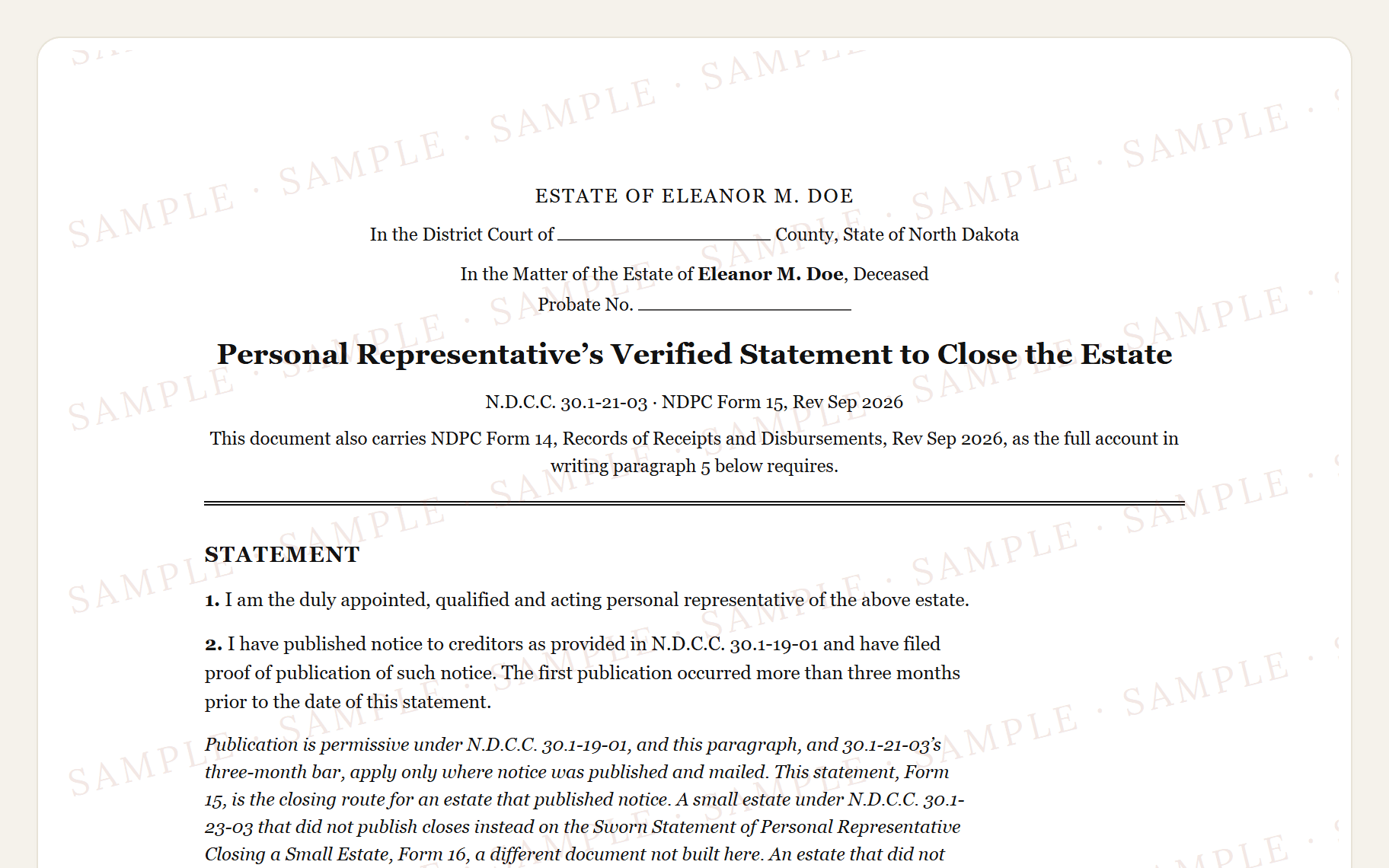
Recording is free for as long as the estate takes: every receipt and disbursement with its date and description, distributions per beneficiary, and a balance that checks itself as you go. ExecutorLedger builds North Dakota-style documents from those records, an inventory shaped like Form 10 and a register shaped like Form 14 folded into a closing statement shaped like Form 15, ready to transcribe onto the court's own forms when you file or send one. Neither is a court form, and your attorney should review them before anything is signed, notarized or filed. Usually less than one attorney hour, and typically reimbursable by the estate.
Section 5 of 5.Questions about the North Dakota inventory
Does North Dakota have a court form for the inventory?
Yes. North Dakota's Judicial Branch publishes Form 10, the Inventory and Appraisement, revised September 2026, under its guidebook for informal administration of an estate.
Do I have to file Form 10 with the court?
No, and the choice matters more here than in most states. Filing it with the court under N.D.C.C. 30.1-18-06(2) means you only have to send a copy to an interested person who asks. Not filing it means you must mail a copy to every heir or devisee and to any other interested person who asks.
When is the North Dakota inventory due?
Within six months after appointment, or nine months after the decedent's death, whichever is later (N.D.C.C. 30.1-18-06(1)).
The inventory is the first filing, not the last. The full North Dakota guide covers the accounting that follows it, every deadline with its statute, what the executor is paid, and how estates close.
This page describes North Dakota practice as our verified references state it; formats drift and estates differ, and none of this is legal advice. ExecutorLedger produces court-style documents for transcription. They are not official court forms. What your estate must file is a question for its attorney.