North Dakota Estate Accounting: A Representative's Guide
North Dakota probate runs through the district court in the county where the estate is opened, and its fiduciary is the personal representative, the executor named in a will or the administrator appointed when there is none. North Dakota is a prescribed-form state. Its Judicial Branch publishes NDPC Form 10, Form 14 and Form 15, each revised September 2026, and a personal representative fills those forms in rather than writing a document from a statute alone. Here is what each form asks for, the deadlines behind them, and how a North Dakota estate closes.
Section 1 of 7.The three documents: Form 10, Form 14 and Form 15
North Dakota administers decedents' estates under Title 30.1 of the Century Code, through the district court of the county where the estate is opened. The Judicial Branch's own Guidebook and Forms for Informal Administration of an Estate carries nineteen numbered forms, and three of them are the ones this guide covers: Form 10, the Inventory and Appraisement, under N.D.C.C. 30.1-18-06; Form 14, the Records of Receipts and Disbursements; and Form 15, the Personal Representative's Verified Statement to Close the Estate, under N.D.C.C. 30.1-21-03. All three carry a September 2026 revision date.
Form 10 lists property in four classes in this order: real property owned solely by the decedent, real property owned jointly, personal property owned solely, and personal property owned jointly, each with its own subtotal. A Total Gross Estate follows, and then the form does something no other state's inventory form in this guide does: it subtracts a Total Liens, Mortgages and Encumbrances line from the Gross Estate to reach a Total Value of Net Estate in North Dakota. ExecutorLedger records no lien or encumbrance data, so that subtraction and the net figure are lines the preparer fills in by hand, never a number this product computes.
Form 14 is not a charge-and-discharge account. It is one combined register, a single date-ordered table with four columns: Date, Paid By/To, For, and Amount, plus a Beginning Balance and an Ending Balance. A receipt and a disbursement share the same table, told apart only by which direction the money moved. The Paid By/To column holds the payer on a receipt or the payee on a disbursement, and the For column holds the purpose, never a repeat of the same name.
Form 10 and Form 15 are both notarized. N.D.C.C. 30.1-02-07 separately deems every document filed with the district court under Title 30.1 to include an oath that its representations are true so far as the filer knows or is informed, with perjury penalties for deliberate falsification. That deemed oath attaches on its own and offers no choice about a notary, and the forms ask for one regardless, so a personal representative signs both in front of a notary.
Section 2 of 7.North Dakota's deadlines, with the statute behind each
- Day 30 (about 1 month)Send heirs and devisees notice of your appointment
Why
Under N.D.C.C. §30.1-18-05, within 30 days after appointment, the personal representative generally must deliver or mail information about the appointment (your name and address, whether bond was filed, and the court where estate papers are on file) to the heirs and devisees whose addresses are reasonably available; confirm your recipient list and required contents with your attorney. - Day 30 (about 1 month)Publish and mail the notice to creditors, if you choose to
Why
Under N.D.C.C. §30.1-19-01, publishing a notice to creditors is optional in North Dakota, and if you elect to publish, the notice generally runs once a week for three successive weeks in a newspaper of general circulation in the county and you must also mail a copy to creditors whose identities are known or reasonably ascertainable and who have not already filed claims; the statute sets no fixed day count for starting, so this date is only a prompt target that starts the short 3-month claims bar below; confirm the timing and whether to publish at all with your attorney. - Day 30 (about 1 month)Send probate paperwork to ND Health & Human Services (Medicaid estate recovery)
Why
Under N.D.C.C. §50-24.1-07(3), upon the granting of letters, the personal representative generally must forward the department a copy of the petition or application commencing probate together with a list of the legatees, devisees, surviving joint tenants, and heirs at law, and must later provide a statement of assets and disbursements unless a properly filed department claim is paid in full; the statute ties this to the grant of letters rather than a fixed day count, so treat this date as a prompt target; confirm whether the decedent received medical assistance and the required timing with your attorney.
- Day 270 (about 9 months)File the estate inventory with the court or mail it to heirs/devisees
Why
Under N.D.C.C. §30.1-18-06, the inventory is typically due within 6 months after your appointment or 9 months after death, whichever is later (so if letters were delayed, your true deadline can fall after this date), and you may either file it with the court or skip the court filing and instead mail a copy to each heir (or each devisee if a will was probated) plus any other interested persons who request it; confirm the applicable date and delivery method with your attorney. - Day 270 (about 9 months)Federal estate tax return (Form 706), if required
Why
Under IRC §6075, Form 706 is due 9 months after death, but only if the gross estate exceeds the federal exemption or the estate elects portability, and a 6-month extension may be available; confirm applicability and timing with your attorney. - Day 1095 (about 3 years)Outer deadline for creditor claims against the estate
Why
Under N.D.C.C. §30.1-19-03, if you publish and mail notice to creditors under §30.1-19-01, pre-death claims are generally barred 3 months after the date of the first publication and mailing (not from letters or death); if notice is never published, claims are generally barred 3 years after the date of death instead, which is the outer backstop this date reflects; confirm which bar date actually applies to your estate with your attorney. - Day 1095 (about 3 years)Target date to have the estate closed (3-year show-cause mark)
Why
Under N.D.C.C. §30.1-21-03.1, if the estate is still not closed 3 years after the date of death, any heir, devisee, distributee, or claimant (or the court on its own motion) generally can force you and your attorney into a show-cause hearing, with a detailed accounting of all fees and disbursements due within 20 days of the order, a court-ordered closing timetable, and possible attorney's fees and costs awarded against you if you cannot show good cause, so aim to close well before this date; confirm your closing plan and timing with your attorney.
The inventory is due within six months after appointment, or nine months after the decedent's death, whichever is later (N.D.C.C. 30.1-18-06(1)).
Read the full explanation
How you handle the inventory changes who has to be told about it, and North Dakota is the only state in this guide where that choice matters. Under N.D.C.C. 30.1-18-06(2), a personal representative may file the inventory with the court and then send a copy only to an interested person who asks for one. Or the personal representative may choose not to file it, and if so must mail a copy to every heir in an intestate estate, or every devisee if a will was probated, and to any other interested person who asks. Filing lowers the duty to furnish a copy on your own; not filing raises it.
An asset whose value is subject to reasonable doubt may be appraised, and the appraiser's name and address go on the inventory next to the item appraised (N.D.C.C. 30.1-18-07). Form 10 has no printed box for this, so ExecutorLedger's inventory adds a ruled line for it.
A supplementary inventory is required when property turns up that was not on the original, or when an item's value or description on the original turns out to be erroneous or misleading (N.D.C.C. 30.1-18-08). No deadline applies to it.
Where the personal representative published and mailed notice to creditors under N.D.C.C. 30.1-19-01, a closing statement on Form 15 cannot be filed until three months after the date of that first publication and mailing, so the later of the two starts the clock (N.D.C.C. 30.1-21-03). Publication is optional, and the bar applies only where it happened. If no proceeding involving the personal representative is pending one year after that closing statement is filed, the appointment terminates on its own (N.D.C.C. 30.1-21-03(2)).
If three years pass from the date of death with no closing statement filed, anyone with an interest in the estate can ask the court, or the court can act on its own, to make the personal representative and the estate's attorney show cause for the delay (N.D.C.C. 30.1-21-03.1). This is North Dakota's own addition; it is not in the Uniform Probate Code.
Publishing notice to creditors is not required in North Dakota, but a personal representative who chooses to publish, once a week for three successive weeks in a newspaper of general circulation in the county, must also mail a copy of the notice to every creditor known or reasonably ascertainable who has not already filed a claim (N.D.C.C. 30.1-19-01). A reasonably ascertainable creditor includes one who regularly sends billings to the decedent or the estate, where the personal representative has had access to those billings. A claim not filed within three months after the date of the first publication or mailing is forever barred.
A federal estate tax return, Form 706, if the estate needs one, is due nine months after death (IRC 6075), with a possible six-month extension. Confirm whether the estate needs one with your attorney.
Section 3 of 7.What North Dakota pays a personal representative
N.D.C.C. 30.1-18-19 sets no percentage and no schedule. It allows the personal representative reasonable compensation for services, and that is the whole rule. N.D.C.C. 30.1-18-21 lets an interested person petition the court to review a fee already paid, so a figure that looked reasonable when it was taken can still be examined later.
ExecutorLedger computes no North Dakota percentage and prints none. What a North Dakota document shows is the compensation your own ledger already recorded, not a number this product works out for you.
Section 4 of 7.How a North Dakota estate closes
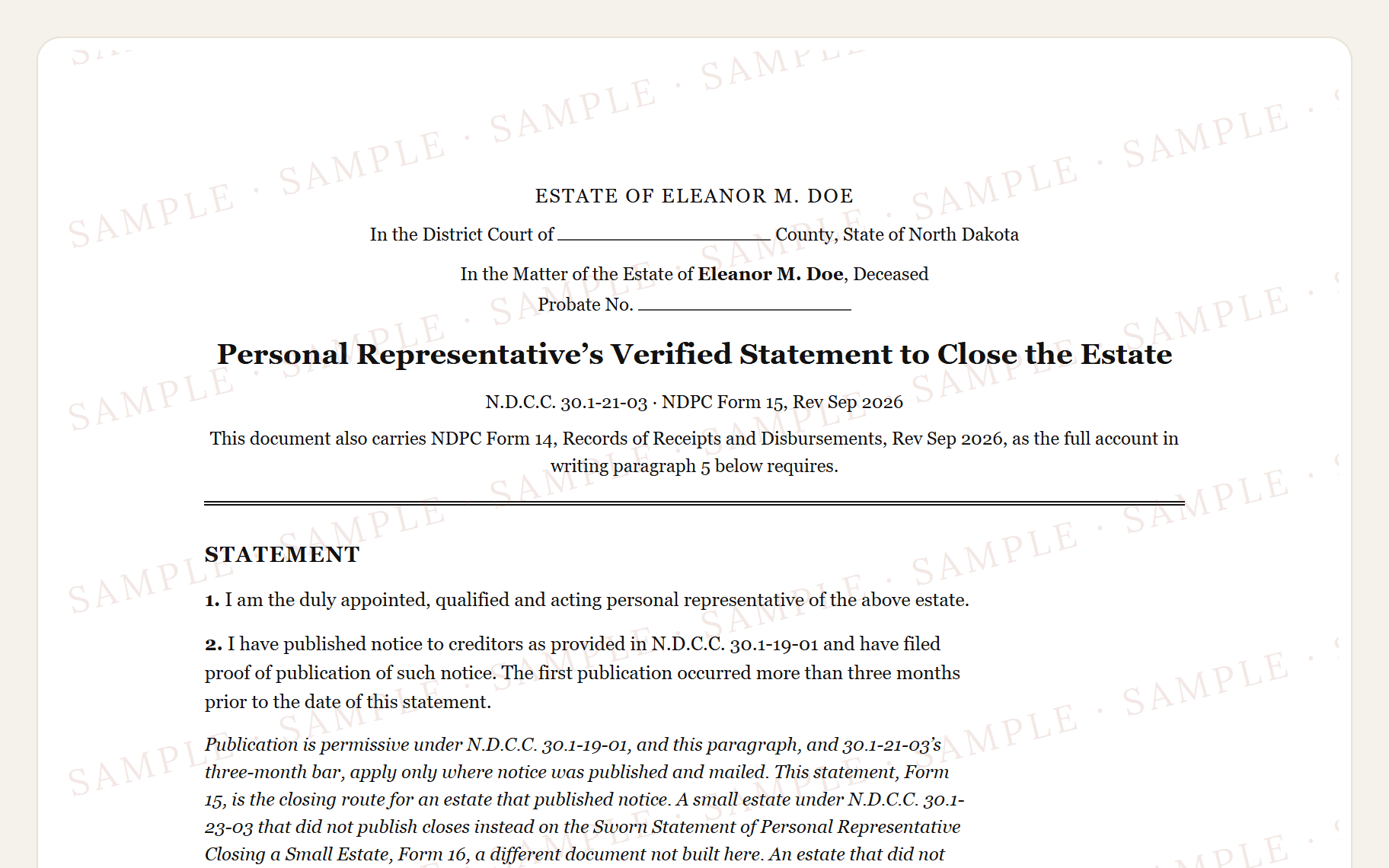
Form 15 is the route for an estate that published notice to creditors. It has six numbered paragraphs: that the personal representative is duly appointed and acting; that notice was published under N.D.C.C. 30.1-19-01 and proof of publication was filed, with the first publication more than three months before the date of the statement; that all presented claims, administration expenses, and estate, inheritance and other death taxes are paid, apart from any exceptions listed by name; that the assets have been distributed to the people entitled to them, either by agreement that the distributees take subject to any outstanding liabilities or by some other arrangement stated in detail; that a copy of the statement went to every distributee and to every creditor whose claim is neither paid nor barred, and that a full written account, Form 14's register, reached the distributees whose interests it affects; and that the statement is filed to close the estate and end the personal representative's appointment under N.D.C.C. 30.1-21-03. A personal representative signs and has the statement notarized.
Publication of notice to creditors is optional in North Dakota, so paragraph two of Form 15 does not fit every estate. The Judicial Branch's own guidebook gives the alternative: an estate that is a small estate as defined in N.D.C.C. 30.1-23-03, and where notice to creditors was never published, closes instead on Form 16, the Sworn Statement of Personal Representative Closing a Small Estate, which may be filed any time after the assets are distributed. An estate that did not publish and is not a small estate under that definition cannot truthfully sign Form 15's paragraph two as printed.
Form 14's register, the Date, Paid By/To, For and Amount table with its Beginning and Ending Balance, is the full written account paragraph five of Form 15 asks for. It is not filed on its own; it goes in with the closing statement.
The appointment terminates on its own one year after the closing statement is filed, so long as no proceeding involving the personal representative is then pending (N.D.C.C. 30.1-21-03(2)). Left open past three years from the date of death with no closing statement filed, the estate is exposed to N.D.C.C. 30.1-21-03.1's show-cause procedure, which can reach the estate's attorney as well as the personal representative and, after a hearing, can end in a complaint to the attorney disciplinary board.
North Dakota's estate tax chapter, N.D.C.C. ch. 57-37.1, has not been repealed. Under N.D.C.C. 57-37.1-04(1), the tax on the transfer of a North Dakota taxable estate equals the maximum credit for state death taxes once allowed against the federal estate tax. The guidebook's own time schedule lists a North Dakota Estate Tax Return as due fifteen months after death, if one is required. Whether your estate needs one is a question for your attorney or the state Tax Commissioner, not a figure ExecutorLedger computes.
- Once claims and expenses are handled and assets are ready to distribute, file the personal representative's verified statement to close the estate under N.D.C.C. §30.1-21-03. North Dakota sets no six-month minimum wait after appointment, but if you published and mailed notice to creditors you may not file until 3 months after the first publication and mailing.
- In that statement, certify that you've paid, settled, or otherwise resolved every claim that was presented, paid expenses of administration and any death taxes, and distributed the estate's assets. Then send a copy of the statement to every distributee and to any known creditor whose claim is still neither paid nor barred, and give each affected distributee a full written account of your administration.
- If a claim is still outstanding when you file, describe in the statement how you're handling it (distributed subject to possible liability with the distributees' agreement, or some other specific arrangement) rather than waiting indefinitely to close.
- Prefer a court order instead of relying on your own sworn statement? Petition for a formal order of complete settlement under §30.1-21-01 (or, for a will-only settlement that doesn't adjudicate testacy, §30.1-21-02) and let the district court sign off after notice and a hearing.
- Watch the 3-year mark from the date of death: under §30.1-21-03.1, any heir, devisee, distributee, or claimant, or the court on its own motion, can force you and your attorney into a show-cause hearing to explain why the estate isn't closed, with a court-ordered timetable and possible fee-shifting against you if you can't show good cause.
North Dakota's district courts (through each county's Clerk of District Court) handle all probate matters directly. There is no separate surrogate's court, orphans' court, or register of wills. Your appointment terminates automatically one year after the closing statement is filed if no proceedings are pending (§30.1-21-03(2)).
Section 5 of 7.The inventory and the register explained for a first-time personal representative
Form 10's own opening line has the personal representative state that the listed property is a true statement of what the decedent owned at death, so far as known, valued at fair market value as of the date of death, with the type and amount of any encumbrance on each item. ExecutorLedger's own asset categories map every one to a solely owned class, real property to the real-property block and everything else to the personal-property block, because the app records no form of co-ownership at all. The two jointly owned classes print ruled and empty rather than filled in as zero, because saying there was none would be a sworn statement this product cannot support.
The guidebook's own Figure A is what tells the two jointly owned classes apart before you fill them in by hand: property a decedent owned with others as tenants in common is probate property and belongs on the inventory, while property owned with others as joint tenants passes outside probate and does not. Form 10 does not spell this distinction out itself; the guidebook does.
Total Value of Real Property, Total Value of Personal Property, and Total Gross Estate are figures ExecutorLedger computes from what the ledger holds. The Liens, Mortgages and Encumbrances line and the Total Value of Net Estate in North Dakota line print ruled and blank, because the app records no encumbrance data and a net figure without it would understate what the estate owes against. A missing date-of-death value prints blank, not as a manufactured zero, and is counted separately rather than folded silently into a total.
Form 10's jurat has the personal representative swear not only to the inventory's completeness but to all just claims of the Decedent against me: a debt the personal representative personally owed the decedent belongs on this inventory too, and the print carries a note saying so.
Form 14's register orders every receipt and disbursement by date in one table, and a cash distribution to a beneficiary counts as a disbursement in it. An in-kind distribution moves no money, so it never gets a row; it gets its own short list underneath, naming the beneficiary, the item and the value it was carried at, with a note explaining why it sits apart. The Beginning Balance is the cash and bank money the estate held at the inventory; the Ending Balance is that figure plus every receipt and minus every disbursement, and the register's own rows are built to add up to exactly that difference.
The For column is always the purpose of a payment, memo first, then the transaction's own category, and it never repeats the name already sitting in Paid By/To. Form 14 keeps the two as separate columns on the state's own form, and a row that says the same name twice, once as payee and once as purpose, tells the reader nothing a single column would not.
Section 6 of 7.Where ExecutorLedger fits
Recording is free for as long as the estate takes: every receipt and disbursement with its date and description, distributions per beneficiary, and a balance that checks itself as you go. ExecutorLedger builds North Dakota-style documents from those records, an inventory shaped like Form 10 and a register shaped like Form 14 folded into a closing statement shaped like Form 15, ready to transcribe onto the court's own forms when you file or send one. Neither is a court form, and your attorney should review them before anything is signed, notarized or filed. Every document previews free with your real numbers, and $149 (one-time payment) per estate lifts the watermark. Usually less than one attorney hour, and typically reimbursable by the estate.
Section 7 of 7.Questions North Dakota executors ask
Does North Dakota have court forms for the inventory and the account?
Yes. North Dakota's Judicial Branch publishes Form 10, the Inventory and Appraisement, Form 14, the Records of Receipts and Disbursements, and Form 15, the Verified Statement to Close the Estate, all revised September 2026, inside its guidebook for informal administration of an estate.
When is the North Dakota inventory due?
Within six months after appointment, or nine months after the decedent's death, whichever is later (N.D.C.C. 30.1-18-06(1)).
Do I have to file the North Dakota inventory with the court?
No, and the choice matters more here than in most states. Filing it with the court under N.D.C.C. 30.1-18-06(2) means you only have to send a copy to an interested person who asks. Not filing it means you must mail a copy to every heir or devisee and to any other interested person who asks.
Does North Dakota's inventory net out liens and mortgages?
Its form does, unlike most states in this guide. Form 10 subtracts a Total Liens, Mortgages and Encumbrances line from the Gross Estate to reach a Total Value of Net Estate in North Dakota. ExecutorLedger records no encumbrance data, so that line and the net figure print ruled and blank for the preparer to complete.
How is a North Dakota personal representative paid?
North Dakota sets no percentage and no schedule. N.D.C.C. 30.1-18-19 allows reasonable compensation, and N.D.C.C. 30.1-18-21 lets an interested person petition the court to review a fee already taken.
What happens if a North Dakota estate stays open too long?
If three years pass from the date of death with no closing statement filed, N.D.C.C. 30.1-21-03.1 lets an interested person, or the court on its own, require the personal representative and the estate's attorney to show cause for the delay. After a hearing, the court can also file a complaint against the attorney with the disciplinary board.
How does a North Dakota estate close?
By filing Form 15, the Verified Statement to Close the Estate. Where notice to creditors was published and mailed under N.D.C.C. 30.1-19-01, Form 15 cannot be filed until three months after the later of that first publication and that mailing (N.D.C.C. 30.1-21-03). An estate that is a small estate under N.D.C.C. 30.1-23-03 and never published notice closes instead on Form 16.
Not sure which accounting your situation calls for? Which accounting do I need? covers the choice, and the accounting guide explains the structure every format shares.
This page describes North Dakota practice as our verified references state it; formats drift and estates differ, and none of this is legal advice. ExecutorLedger produces court-style documents for transcription. They are not official court forms. The accounting your estate needs is a question for its attorney.