North Carolina's AOC-E-505 estate inventory, explained
North Carolina requires a sworn, itemized inventory of the estate on Form AOC-E-505, filed with the Clerk of Superior Court within three months of qualifying. Here is what the form asks for, part by part, and how to have every number ready.
Section 1 of 5.What Form AOC-E-505 is, and who files it
North Carolina administers estates under Chapter 28A of the General Statutes, before the Clerk of Superior Court, Estates Division, in each county. There is no separate probate court, surrogate, or register of wills. The statute calls the fiduciary the personal representative throughout, whether appointed under a will or without one.
Filing the inventory is mandatory, not customary: G.S. 28A-20-1 requires a sworn, itemized inventory of everything the decedent owned, and the clerk audits every filing. The inventory is also where the clerk's own filing fee starts: under G.S. 7A-307, it runs $106 plus 40 cents per $100 of the estate's gross value, capped at $6,000, computed first from the inventory and then, as new gross estate comes in, from each later account.
Section 2 of 5.When the inventory is due
Under N.C. Gen. Stat. §28A-20-1, the personal representative typically must file a sworn, itemized inventory of the estate's property within three months after qualifying, and the clerk can extend this on request; confirm the exact date with your attorney.
The creditor notice work runs in the same weeks, publication and the mailings to known creditors both, so the estates that file comfortably are the ones that start listing assets early.
Section 3 of 5.What goes in it, part by part
AOC-E-505's Part I, Property Of The Estate, has eight numbered items: bank accounts in the decedent's sole name, joint accounts without a right of survivorship, stocks and bonds, cash and undeposited checks, all other personal property, real estate the will specifically gave to the estate and directed to be sold, once it has sold, and a yes-or-no question about a pending lawsuit. Total Part I adds up only items 1 through 6; item 7, real estate the will gave to the estate but that has not sold yet, is disclosed in its own box outside that total, at its fair market value on the date of death.
The decedent's home usually never enters Part I at all. Title passes directly to the heirs and devisees at death, so it appears only contingently, in Part II, as property that could be pulled in if creditors need to be paid. Only real estate the will specifically gave to the estate shows up in Part I, in item 6 once it sells or item 7 while it is still unsold.
Section 4 of 5.From your records to the AOC form
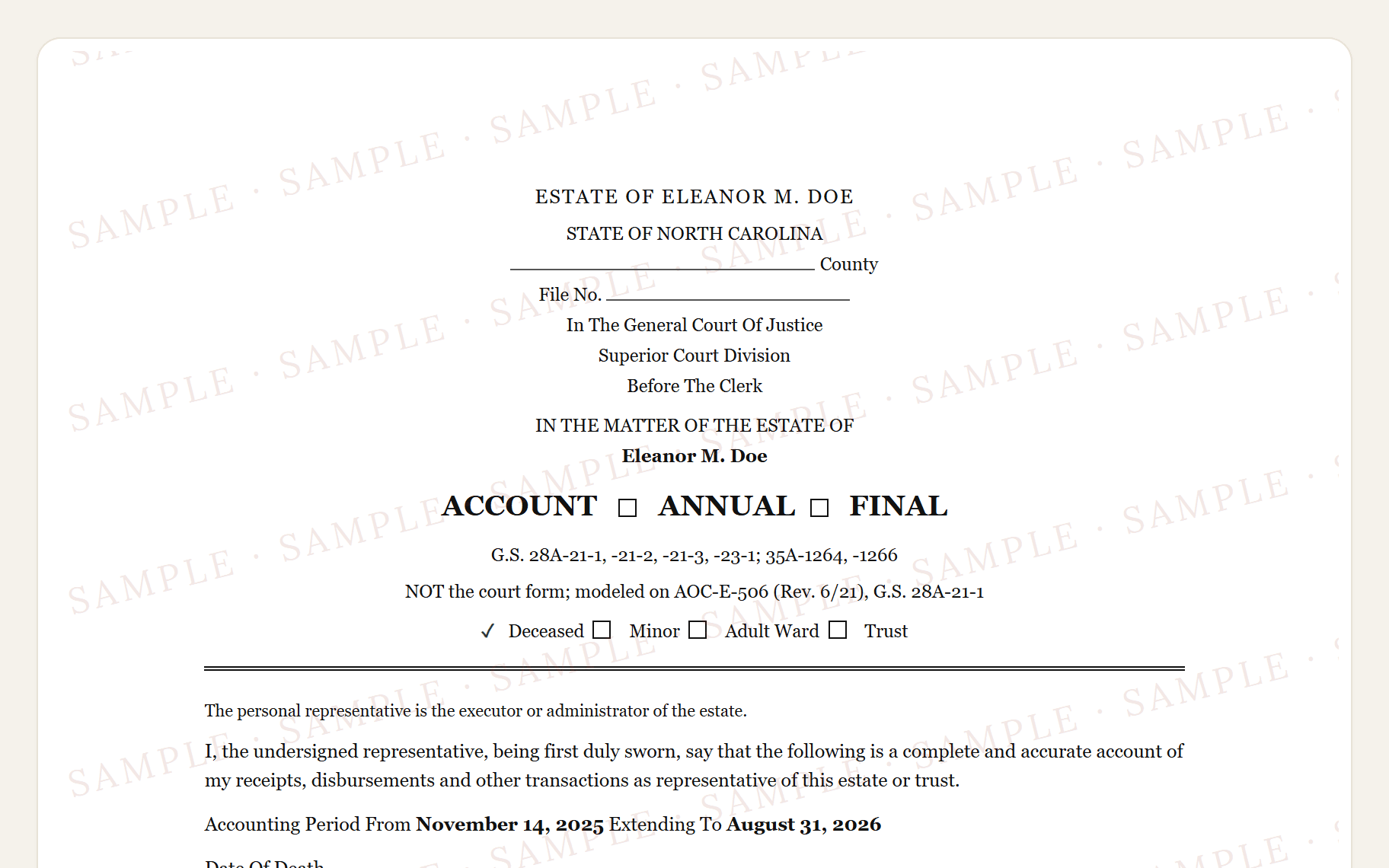
Recording is free for as long as the estate takes: every receipt and disbursement with its date and description, distributions per beneficiary, and a balance that checks itself as you go. ExecutorLedger builds North Carolina-style documents from those records, an inventory shaped like AOC-E-505 and an account shaped like AOC-E-506, ready to transcribe onto the AOC forms when you file them with the clerk. Neither is a court form, and your attorney should review them before anything is signed or filed.
Section 5 of 5.Questions about the North Carolina inventory
Does North Carolina require the AOC-E-505 inventory?
Yes. G.S. 28A-20-1 requires a sworn, itemized inventory on AOC-E-505 within three months of qualifying, and G.S. 28A-21-1 and 28A-21-2 require an annual account, if the estate is still open after a year, and a final account, both on AOC-E-506. The clerk audits every account that gets filed, not only the final one (G.S. 28A-21-4).
Where does the decedent's house go on AOC-E-505?
It never enters the personal representative's inventory at all. Title passes directly to the heirs and devisees at death, so it appears only contingently, in AOC-E-505 Part II, as property that could be pulled in if creditors need to be paid. Only real estate the will specifically gave to the estate shows up in Part I, in item 6 once it sells or item 7 while it is still unsold.
The inventory is the first filing, not the last. The full North Carolina guide covers the accounting that follows it, every deadline with its statute, what the executor is paid, and how estates close.
This page describes North Carolina practice as our verified references state it; formats drift and estates differ, and none of this is legal advice. ExecutorLedger produces court-style documents for transcription. They are not official court forms. What your estate must file is a question for its attorney.