North Carolina Estate Accounting: A Representative's Guide
North Carolina probate runs through the Clerk of Superior Court in each county, and its fiduciary is the personal representative. Filing the AOC-E-505 inventory and the AOC-E-506 account is not optional here, and the clerk audits every one filed. Here is what each covers, the deadlines behind each, and how a North Carolina estate closes.
Section 1 of 7.The two documents: the AOC-E-505 inventory and the AOC-E-506 account
North Carolina administers estates under Chapter 28A of the General Statutes, before the Clerk of Superior Court, Estates Division, in each county. There is no separate probate court, surrogate, or register of wills. The statute calls the fiduciary the personal representative throughout, whether appointed under a will or without one, and this guide uses the same term (some call the role the executor or administrator instead). Filing both documents is mandatory, not customary: G.S. 28A-20-1 requires a sworn, itemized inventory of everything the decedent owned, filed with the clerk within three months of qualifying, on AOC-E-505, Inventory For Decedent's Estate (Rev. 3/18). G.S. 28A-21-1 and 28A-21-2 require an annual account, if the estate stays open past a year, and a final account, each filed on AOC-E-506, Account. The clerk audits every account that gets filed, annual or final, not only the last one (G.S. 28A-20-1, 28A-21-1, 28A-21-4).
AOC-E-505's Part I, Property Of The Estate, has eight numbered items: bank accounts in the decedent's sole name, joint accounts without a right of survivorship, stocks and bonds, cash and undeposited checks, all other personal property, real estate the will specifically gave to the estate and directed to be sold, once it has sold, and a yes-or-no question about a pending lawsuit. Total Part I adds up only items 1 through 6; item 7, real estate the will gave to the estate but that has not sold yet, is disclosed in its own box outside that total, at its fair market value on the date of death. Part II, Property Which Can Be Added To Estate If Needed To Pay Claims, is a separate, contingent section: joint accounts with survivorship rights, securities registered to transfer on death, and other property that is not yet part of the probate estate but could be pulled in if creditors need to be paid.
Real estate the will did not specifically give to the estate never appears on Part I at all. Under North Carolina law, title to that property passes directly to the heirs and devisees at the moment of death, so it stays off the personal representative's ledger unless a creditor's claim forces the issue, at which point it shows up only contingently, in Part II item 4. ExecutorLedger's inventory follows that same default: a real property asset in your records prints in Part II item 4 at its date-of-death value, with a note that a parcel the will gave to the estate belongs instead in Part I item 6, once it sells, or item 7, while it is still unsold, which you move by hand once you know which parcel that is.
Section 2 of 7.North Carolina deadlines, with the statute behind each
- Day 75 (about 2 months)Mail notice to known and reasonably ascertainable creditors
Why
Under N.C. Gen. Stat. §28A-14-1(b), in addition to publishing notice, the personal representative typically must personally deliver or mail a copy of the notice to creditors who are known or reasonably ascertainable within 75 days after letters issue, including the Division of Health Benefits if the decedent was receiving medical assistance; confirm the creditor list and timing with your attorney. - Day 90 (about 3 months)File the estate inventory with the court
Why
Under N.C. Gen. Stat. §28A-20-1, the personal representative typically must file a sworn, itemized inventory of the estate's property within three months after qualifying, and the clerk can extend this on request; confirm the exact date with your attorney. - Day 90 (about 3 months)Calendar the creditor claims bar date
Why
Under N.C. Gen. Stat. §28A-19-3(a), claims that arose before death are typically barred unless presented by the date set in the published notice to creditors, which must be at least three months after the notice's first publication (or 90 days after mailing to a known creditor, if later); this entry anchors conservatively to your appointment date since the real trigger is when you publish, so confirm the actual bar date printed on your notice with your attorney. - Day 365 (about 1 year)File the final account with the clerk
Why
Under N.C. Gen. Stat. §28A-21-2, once all claims are paid and distribution is complete, the final account is typically due within one year after you qualify (or by your annual-account date if that is later), and the clerk can extend the time; confirm your controlling deadline with your attorney. - Day 395 (about 13 months)File an annual account if the estate is still open
Why
Under N.C. Gen. Stat. §28A-21-1, if the estate isn't fully settled within a year, an annual account is typically due 30 days after the first anniversary of your qualification (or on a fiscal-year schedule if you elected one), and every year after that until the estate closes; confirm your schedule with your attorney.
- Day 270 (about 9 months)Federal estate tax return (Form 706), if required
Why
Under IRC §6075, Form 706 is due 9 months after death, but only if the gross estate exceeds the federal exemption or the estate elects portability, and a 6-month extension may be available; confirm applicability and timing with your attorney.
Within three months after qualifying, the personal representative files the sworn, itemized inventory, valued as of the decedent's date of death (G.S. 28A-20-1). Property discovered later, or a valuation later found wrong, goes on a supplemental inventory rather than an amended original (G.S. 28A-20-3).
Read the full explanation
Notice to known and reasonably ascertainable creditors, including the Division of Health Benefits if the decedent received Medicaid, goes out within 75 days after letters issue (G.S. 28A-14-1(b)). Claims that arose before death are barred on the later of the date set in the published notice, at least three months after its first publication, or 90 days after mailing to a known creditor (G.S. 28A-19-3(a)).
If the estate is not fully settled within a year, an annual account is due 30 days after the first anniversary of qualifying, or on an elected fiscal-year schedule capped at 12 months from death, and every year after that until the estate closes (G.S. 28A-21-1).
The final account is due within one year after qualifying, or within six months after the estate receives a state estate or inheritance tax release, or by the annual-account date, whichever of the three falls last (G.S. 28A-21-2).
A federal estate tax return, Form 706, if the estate needs one, is due nine months after death (IRC section 6075), with a possible six-month extension. Confirm whether the estate needs one with your attorney.
Section 3 of 7.What North Carolina pays a personal representative
G.S. 28A-23-3 lets the clerk fix a commission in the clerk's own discretion, up to two independent 5% ceilings: one on the receipts the personal representative brings into the estate, cash collected plus the value of personal property when the estate first receives it, and a separate one on the expenditures the personal representative pays out in accordance with law. Distributing an heir's or devisee's share is never a commissionable expenditure. The clerk weighs the time, responsibility, trouble, and skill involved in setting the actual number, so the 5%/5% figure is a ceiling, not an entitlement. A gross estate of $2,000 or less lets the clerk set a commission outside that formula instead, and a will's own compensation clause displaces the statutory formula unless the will itself defers to whatever the law provides.
A different fee, the clerk's own filing fee, is a cost the estate pays the court, not pay for the personal representative. Under G.S. 7A-307, it runs $106 plus 40 cents per $100 of the estate's gross value, capped at $6,000, computed first from the inventory and then, as new gross estate comes in, from each later account. That figure is guide information here, not something either AOC-E-505 or AOC-E-506 asks you to print.
Section 4 of 7.How a North Carolina estate closes
Once every valid claim is paid and the personal representative is ready to make final distributions, collecting a signed receipt from each beneficiary serves double duty: it documents the distribution, and it gives the clerk the voucher that G.S. 28A-21-3 and 28A-21-5 treat as presumptive proof of payment. If the decedent received Medicaid, the Division of Health Benefits' claim should be settled first; clerks generally expect to see it paid or waived before approving the final account. Sending heirs and devisees written notice of the proposed final account is optional, not required, but anything in it they do not object to within 30 days is deemed accepted, which heads off later disputes over the numbers (G.S. 28A-21-6).
The personal representative files the itemized final account, AOC-E-506 with FINAL checked, showing everything received and paid out since the last account and attaching the vouchers (G.S. 28A-21-2, 28A-21-3). Once the clerk audits it and approves it, the clerk enters an order discharging the personal representative from further duties and liability, though that order cannot excuse a breach of duty under G.S. 28A-13-10(c) (G.S. 28A-23-1). If either filing is missed, the clerk can compel it with an order to show cause, and continued failure can lead to removal or contempt (G.S. 28A-21-4).
- Pay every valid claim, make the final distributions, and collect a signed receipt and release from each beneficiary. Those receipts serve as the vouchers that are presumptive proof of each payment when the clerk audits your account (G.S. 28A-21-3, 28A-21-5).
- If the decedent received Medicaid, settle the Division of Health Benefits' estate-recovery claim before you distribute. You should have mailed DHB the creditor notice within 75 days of qualifying (G.S. 28A-14-1(b)); its claim ranks as a sixth-class claim (G.S. 108A-70.5), and clerks generally expect to see it paid or waived before approving the final account.
- Optional but useful: send devisees or heirs written notice of the proposed final account. Anything disclosed in it that they don't object to within 30 days is deemed accepted, which heads off later fights over your numbers (G.S. 28A-21-6).
- File the itemized final account with the Clerk of Superior Court, Estates Division, on form AOC-E-506, showing everything received and paid out since your last account and attaching the vouchers (G.S. 28A-21-2, 28A-21-3).
- After the clerk audits and approves the final account, the clerk enters an order discharging you from further duties and liabilities. That order is the official close (G.S. 28A-23-1).
The Clerk of Superior Court (Estates Division) in the county of administration handles the whole process. North Carolina has no separate probate court, surrogate, register of wills, or orphans' court. NC is not a UPC state and has no UPC §3-1003-style sworn closing statement; a clerk-audited final account, followed by a discharge order, is the norm instead.
Section 5 of 7.The AOC-E-505 and AOC-E-506 explained for a first-time personal representative
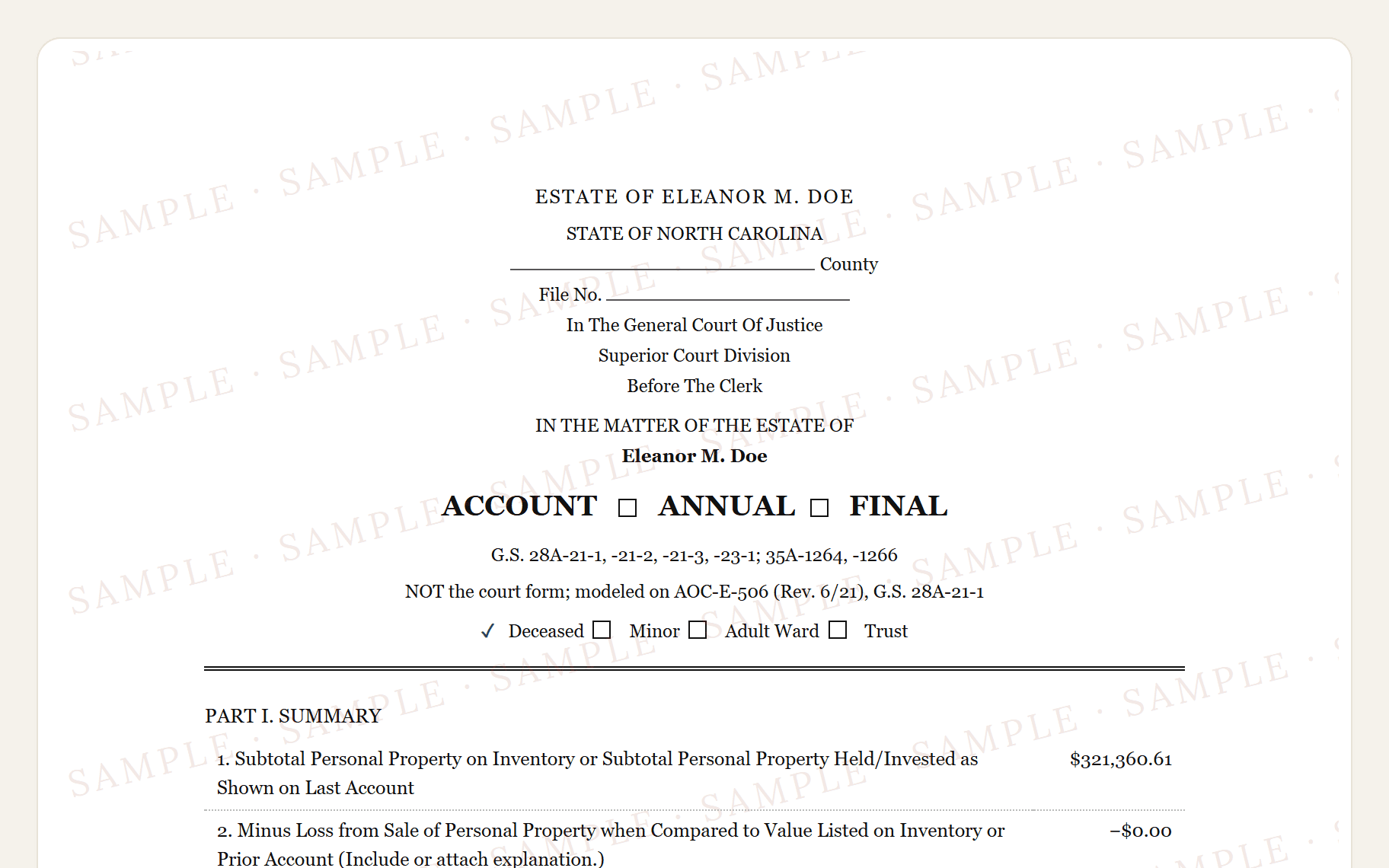
AOC-E-506's Part I, Summary, rolls the account forward in nine lines. Line 1 is the opening balance: the inventory's own Total Part I figure on a first account, or the prior account's own Part II total after that. Line 2 subtracts any loss from selling personal property for less than its inventory value, with a short explanation of each such sale attached; line 3 is the subtotal. Line 4 adds the total receipts shown on the back of the form, giving line 5's total assets. Line 6 subtracts disbursements, line 7 is the subtotal, line 8 subtracts distributions, and line 9 is the balance at the end of the accounting period, which should read zero on a final account.
Gains and losses are not treated the same way. A gain on selling personal property for more than its inventory value is a Part III receipt, described like any other receipt. A loss goes nowhere on Part III at all; it is subtracted directly on line 2 of the Summary instead, with the short explanation the form's own note asks for.
If any real estate the will gave to the estate has been sold, the entire sale proceeds post to Part III as a receipt, not just the gain over its inventory value; the form's own note says so directly. Distributions, cash or property handed to an heir or devisee, go on Part V: a cash distribution posts at its amount, and property distributed in kind posts at its inventory value with a note that it went out in kind, since the form counts both toward Total Part V.
Part II, Balance Held Or Invested, is completed only when filing an annual account with assets still in the estate, never on a final account. It rolls up what remains, by category, bank and cash balances, securities, and tangible personal property, into a subtotal, then adds real estate the estate acquired under G.S. 28A-15-1 and anything left over as Other. Real estate the will gave to the estate that has not sold yet is disclosed on its own line but is not added into that total, the same way item 7 is disclosed but excluded on the inventory. The total has to match the balance on the Summary's last line.
Every dollar figure on both forms needs backup the clerk can check: G.S. 28A-21-5 treats a voucher, a receipt, a cancelled or imaged check, or other detailed proof of payment as presumptive evidence of a disbursement unless someone impeaches it. Keeping that proof next to each entry as you go is what makes the account auditable when you file it.
Section 6 of 7.Where ExecutorLedger fits
Recording is free for as long as the estate takes: every receipt and disbursement with its date and description, distributions per beneficiary, and a balance that checks itself as you go. ExecutorLedger builds North Carolina-style documents from those records, an inventory shaped like AOC-E-505 and an account shaped like AOC-E-506, ready to transcribe onto the AOC forms when you file them with the clerk. Neither is a court form, and your attorney should review them before anything is signed or filed. Every document previews free with your real numbers, and $149 once per estate lifts the watermark.
Section 7 of 7.Questions North Carolina executors ask
Does North Carolina require the AOC-E-505 inventory and AOC-E-506 account?
Yes. G.S. 28A-20-1 requires a sworn, itemized inventory on AOC-E-505 within three months of qualifying, and G.S. 28A-21-1 and 28A-21-2 require an annual account, if the estate is still open after a year, and a final account, both on AOC-E-506. The clerk audits every account that gets filed, not only the final one (G.S. 28A-21-4).
When is the North Carolina inventory due?
Within three months after qualifying, itemized and valued as of the decedent's date of death (G.S. 28A-20-1). Property found later, or a value later found wrong, goes on a supplemental inventory instead of an amended original (G.S. 28A-20-3).
How is a North Carolina personal representative paid?
G.S. 28A-23-3 lets the clerk set a commission, up to 5% of the receipts the personal representative brings in and, separately, up to 5% of the expenditures paid out, weighed by the time, responsibility, trouble, and skill involved. The clerk's own filing fee under G.S. 7A-307 is a different, separate cost the estate pays the court, not pay for the personal representative.
How does a North Carolina estate close?
By filing the itemized final account on AOC-E-506 with FINAL checked and the vouchers attached (G.S. 28A-21-2, 28A-21-3). Once the clerk audits and approves it, the clerk enters an order discharging the personal representative, though that order cannot excuse a breach of duty under G.S. 28A-13-10(c) (G.S. 28A-23-1).
What happens to real estate the will did not leave to the estate?
It never enters the personal representative's inventory at all. Title passes directly to the heirs and devisees at death, so it appears only contingently, in AOC-E-505 Part II, as property that could be pulled in if creditors need to be paid. Only real estate the will specifically gave to the estate shows up in Part I, in item 6 once it sells or item 7 while it is still unsold.
Not sure which accounting your situation calls for? Which accounting do I need? covers the choice, and the accounting guide explains the structure every format shares.
This page describes North Carolina practice as our verified references state it; formats drift and estates differ, and none of this is legal advice. ExecutorLedger produces court-style documents for transcription. They are not official court forms. The accounting your estate needs is a question for its attorney.