New Hampshire's NHJB-2125-Pe estate inventory, explained
New Hampshire requires an itemized inventory of the estate on the Inventory of Fiduciary (NHJB-2125-Pe), filed with the Circuit Court Probate Division within 90 days of your appointment. Here is what the form asks for, part by part, and how to have every value ready.
Section 1 of 5.What Form NHJB-2125-Pe is, and who files it
New Hampshire administers estates through the Circuit Court Probate Division under RSA Title LVI, chapters 552 through 556. There is no separate probate court, surrogate, or register of wills, and no county-by-county form variation. The statute defines the role broadly enough to cover an executor named in a will and an administrator appointed without one.
Probate Division Rule 4 makes the Inventory of Fiduciary (NHJB-2125-Pe) mandatory. The Register's approved form must be used in all proceedings to which it applies. A computer-generated reproduction is allowed only if it carries the identical wording, format, and pagination as the original; a discrepancy may result in court-imposed sanctions or penalties, including removal as fiduciary.
Section 2 of 5.When the inventory is due
Under RSA 554:1, the inventory of estate assets is typically due within 90 days after your appointment as executor or administrator, filed on the court's Inventory of Fiduciary form (NHJB-2125-Pe) with date-of-death fair market values; confirm the exact date with your attorney.
The Inventory must itemize each asset at fair market value as of date of death and state how each value was determined, whether from appraisal, tax information, bank statement, or other source.
Section 3 of 5.What goes in it, part by part
The Inventory's Estate Summary, item 5, has three lines: A, the total value of real estate, listed on a separate Attachment A by street address, city or town, county, book and page of the deed, and value; B, the total value of personal estate, carried from the second page; and C, the total value of the entire estate, A plus B.
The Personal Estate Detail, item 6, reuses the letter A for something different: eight lettered lines, A through H, each with its own attachment except line A itself. A is cash on hand, no attachment needed; B is household furnishings and effects; C is other tangible personal property, including vehicles listed by year, make, and model; D is stocks and bonds; E is money deposited in banks and financial institutions; F is business assets; G is notes receivable and other written evidence of debt owed to the deceased; and H is everything else. The eight lines add up to the total value of personal estate that feeds back into line 5B.
Section 4 of 5.From your records to the Inventory of Fiduciary
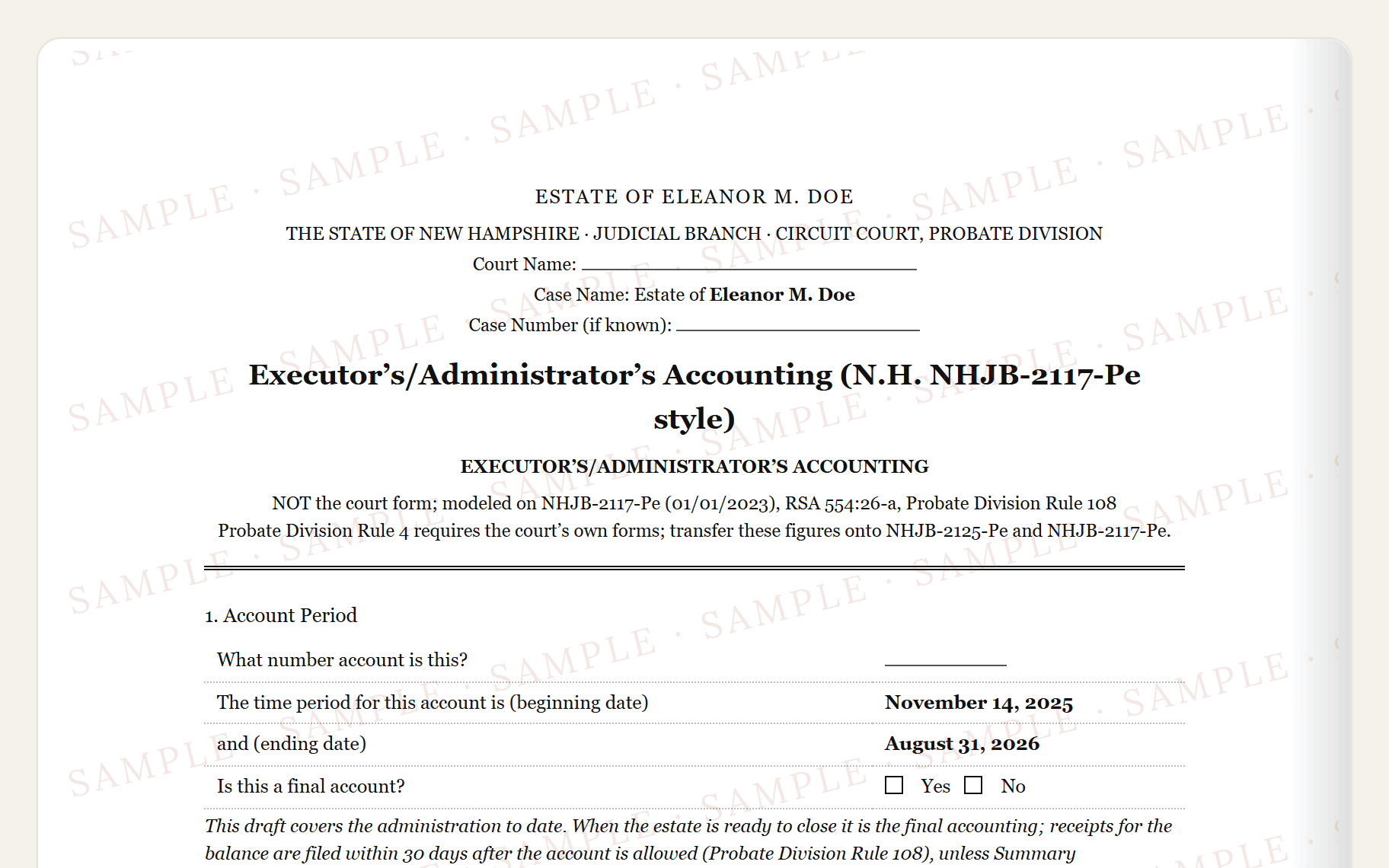
Recording is free for as long as the estate takes: every receipt and disbursement with its date and description, distributions per beneficiary, and a balance that checks itself as you go. ExecutorLedger builds New Hampshire-style documents from those records, an inventory shaped like the Inventory of Fiduciary and an account shaped like the Executor's/Administrator's Accounting, ready to transcribe onto NHJB-2125-Pe and NHJB-2117-Pe when you file them with the Circuit Court Probate Division. Neither is a court form, and your attorney should review them before anything is signed or filed. Usually less than one attorney hour, and typically reimbursable by the estate.
Section 5 of 5.Questions about the New Hampshire inventory
When is the New Hampshire inventory due?
Within 90 days after appointment, itemized at fair market value as of the decedent's date of death (RSA 554:1, I). Once it is filed, a written objection is due within 10 days or the right to object is waived (Probate Division Rule 105-A).
What values go on the New Hampshire inventory?
The inventory must be itemized at fair market value as of the decedent's date of death, with how each value was determined, whether appraisal, tax information, bank statement, or other source, stated on the form (RSA 554:1, I).
The inventory is the first filing, not the last. The full New Hampshire guide covers the accounting that follows it, every deadline with its statute, what the executor is paid, and how estates close.
This page describes New Hampshire practice as our verified references state it; formats drift and estates differ, and none of this is legal advice. ExecutorLedger produces court-style documents for transcription. They are not official court forms. What your estate must file is a question for its attorney.