New Hampshire Estate Accounting: A Fiduciary's Guide
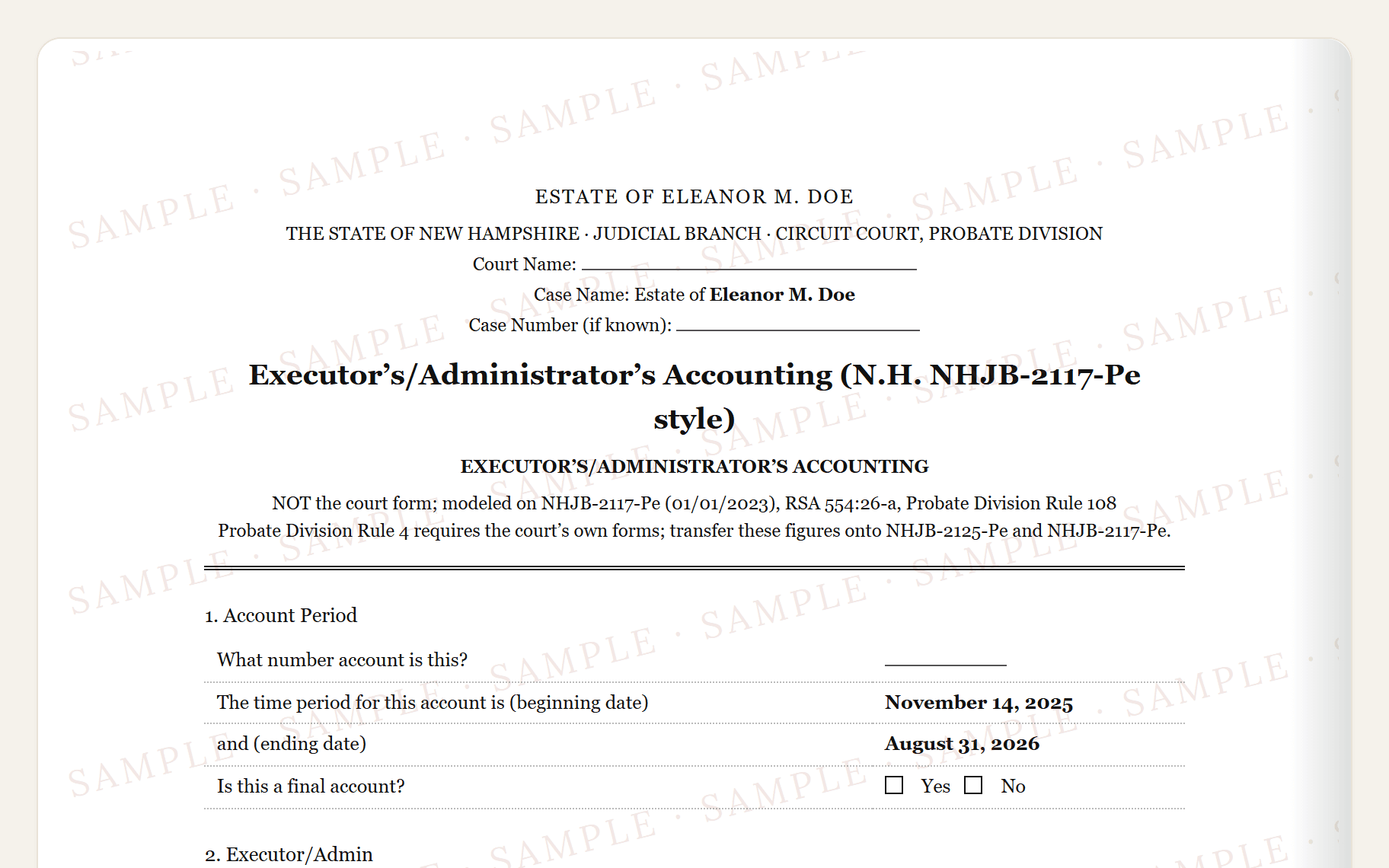
New Hampshire probate runs through the Circuit Court Probate Division, a single statewide court since 2011, and its fiduciary is called the executor or administrator. Probate Division Rule 4 makes both the Inventory of Fiduciary (NHJB-2125-Pe) and the Executor's/Administrator's Accounting (NHJB-2117-Pe) mandatory wherever they apply. Here is what each covers, the deadlines behind each, and how a New Hampshire estate closes.
Section 1 of 7.The two documents: the Inventory of Fiduciary and the Executor's/Administrator's Accounting
New Hampshire probate runs through the Circuit Court Probate Division, a single statewide trial court division created in 2011. There is no separate probate court, surrogate, or register of wills, and no county-by-county form variation: RSA Title LVI, chapters 552 through 556, governs administration everywhere in the state, and RSA 553:1 defines the role broadly enough to cover an executor named in a will and an administrator appointed without one. This guide calls the role the executor or administrator throughout, and uses fiduciary only where the forms themselves do.
Circuit Court Probate Division Rule 4 makes both forms mandatory wherever the underlying filing duty applies: approved forms shall be furnished by the Register and must be used in all proceedings to which they are applicable. The rule goes further than most states' form rules. A computer-generated reproduction is allowed only if it carries the identical wording, in the identical format, and pagination as in the original, and whoever signs or files it shall be held accountable for its form and content. A discrepancy between the reproduction and the Register's own form may subject the party who signs or files it to court-imposed sanctions or penalties, including removal as fiduciary. ExecutorLedger's printed documents are not a Rule 4 reproduction. They follow the Inventory of Fiduciary (NHJB-2125-Pe) and the Executor's/Administrator's Accounting (NHJB-2117-Pe) line for line, but filing means completing and filing the court's own NHJB-2125-Pe and NHJB-2117-Pe, not this printout.
Each form carries its own notice to beneficially interested parties, printed on the form itself. The Inventory may be accepted unless a written objection is filed within 10 days after it is filed with the court (Probate Division Rule 105-A); the Account may be approved unless a written objection is filed within 30 days after it is filed (Probate Division Rule 108-A). Missing either window waives the right to object and the right to further notice of any hearing on the document.
Section 2 of 7.The New Hampshire deadlines, with the statute behind each
- Day 15 (about 2 weeks)Notice of Appointment is published to creditors and the public
Why
Under RSA 553:16, the probate court clerk generally publishes the Notice of Appointment within 15 days after your appointment (no publication is required when the estate's gross value is $10,000 or less), which is what puts unknown creditors and the public on notice of the estate; confirm whether publication applies here with your attorney. - Day 60 (about 2 months)Notify legatees, the surviving spouse, and heirs at law
Why
Under RSA 552:15, you generally must notify each legatee specifically named in the will, and the surviving spouse and heirs at law, that the will has been proved within 60 days after your appointment, then certify to the judge within 90 days after appointment that this notice was given, stating how and to whom; confirm the recipient list and certification deadline with your attorney. - Day 90 (about 3 months)File the Inventory of Fiduciary with the probate court
Why
Under RSA 554:1, the inventory of estate assets is typically due within 90 days after your appointment as executor or administrator, filed on the court's Inventory of Fiduciary form (NHJB-2125-Pe) with date-of-death fair market values; confirm the exact date with your attorney. - Day 180 (about 6 months)Calendar the creditor claim cutoff date
Why
Under RSA 556:3, creditors generally must exhibit (present) their demand to you within 6 months after the original grant of administration or their suit on the claim is barred, so calendar this bar date before paying claims or distributing assets; confirm the operative date with your attorney. - Day 365 (about 1 year)File the account of administration with the probate court
Why
Under RSA 554:26-a, unless the estate has already been closed through summary administration or a waiver, an account of administration is typically due within 1 year after your appointment, and further accounts are generally required annually under RSA 554:26 until the estate closes; confirm your filing schedule with your attorney.
- Day 270 (about 9 months)Federal estate tax return (Form 706), if required
Why
Under IRC §6075, Form 706 is due 9 months after death, but only if the gross estate exceeds the federal exemption or the estate elects portability, and a 6-month extension may be available; confirm applicability and timing with your attorney.
The Inventory of Fiduciary is due within 90 days after appointment, itemized at fair market value as of the decedent's date of death, with how each value was determined, appraisal, tax information, bank statement, or other source, stated on the form (RSA 554:1, I).
Read the full explanation
The clerk generally publishes the Notice of Appointment within 15 days after appointment (RSA 553:16), unless the estate's gross value is $10,000 or less, in which case no publication is required.
The executor or administrator notifies each legatee named in the will, the surviving spouse, and the heirs at law within 60 days after appointment, then certifies to the judge within 90 days that this notice was given and how (RSA 552:15).
Creditors generally have to exhibit their demand within six months after the original grant of administration, or their suit on the claim is barred (RSA 556:1, 556:3).
The first Executor's/Administrator's Accounting is due within one year of appointment, and annually after that unless the judge excuses it, never for longer than three years at a stretch (RSA 554:26-a, I; RSA 554:26). Probate Division Rule 108 fixes the exact period: a first account runs from the date of appointment to the last day of the calendar month before the anniversary month of appointment, not to the literal one-year date. An appointment on May 1 closes its first period on April 30 the following year; every account after that covers a clean twelve calendar months starting the next day.
A federal estate tax return, Form 706, if the estate needs one, is due nine months after death (IRC section 6075), with a possible six-month extension. Confirm whether the estate needs one with your attorney.
Section 3 of 7.What New Hampshire pays an executor or administrator
Circuit Court Probate Division Rule 88 sets the only standard: fees and expenses of fiduciaries and attorneys shall be subject to the approval of the court, and in all cases shall be reasonable for the work, responsibility, and risk. No RSA section in Title LVI sets or caps a percentage; RSA 554:8, sometimes assumed to be a fee statute because of its number, is titled Accountability for Stocks, Etc. and governs gain or loss on selling stocks and bonds, not compensation.
Rule 88 lists the factors a court may weigh: the time and labor required, the size of the estate, the requisite skill, the customary fee, a fee agreement, the results obtained, time limitations, and the length of the professional relationship. Every fee, at any amount, needs the court's sign-off, and New Hampshire sets no floor or ceiling anywhere in statute or rule.
On the Executor's/Administrator's Accounting, Schedule 2 shows the fee in summary form only, attorney fees and executor or administrator fees split apart, with the current period and the amount allowed to date shown separately. The form's own note says summary form is enough unless the court asks for more detail.
Section 4 of 7.How a New Hampshire estate closes
Most New Hampshire estates close by filing the final Executor's/Administrator's Accounting. Once it is filed, the 30-day objection window runs (Probate Division Rule 108-A); if the account is allowed, receipts for the balance are due within 30 days after that. The executor or administrator then distributes what remains and files each beneficiary's signed Receipt (NHJB-2139-Pe).
Summary Administration, RSA 553:33, skips the final account and the balance receipts once the court grants a sworn motion (NHJB-2149-Pe). It is available no sooner than six months after appointment, and the sworn motion has to state that the estate has been open at least six months, that no debts or claims are outstanding, that New Hampshire estate tax is either not due or paid with an RSA 87:26 certificate on file, that federal estate tax is either not due or paid, and that court supervision is no longer needed. Every specific legatee gives a receipt or an assent, and every other beneficially interested person listed in RSA 550:12 signs an assent (NHJB-2122-Pe) agreeing that supervision can end. The Inventory is still required on this route; only the final account and balance receipts are skipped.
Waiver of Administration, RSA 553:32, is the strongest bypass: no inventory, no bond, and no accounting for assets at all, but only in six defined circumstances, mainly a sole beneficiary or sole heir serving as administrator, or every beneficiary or heir serving as co-administrator or consenting to the one who is. It closes by filing an affidavit of administration (NHJB-2144-Pe, the Waiver of Full Administration Statement) between 6 and 12 months after appointment, stating there are no outstanding debts and listing every piece of real estate the decedent owned at death. Any interested person can petition for full administration before that affidavit is filed.
- Pay all valid debts and expenses, then file the final Executor's/Administrator's Accounting (form NHJB-2117-Pe) with the Circuit Court Probate Division for approval.
- Once the court approves the account, distribute the remaining assets, have each beneficiary sign the court's Receipt form (NHJB-2139-Pe) for their share, and file the signed originals with the court.
- If every beneficiary assents, all debts and any estate taxes are paid, and it's been at least 6 months since your appointment, you can skip the final account by filing a Motion for Summary Administration under RSA 553:33 together with each beneficiary's signed Assent (NHJB-2122-Pe). Approval closes the estate without a final accounting.
- If the sole beneficiary or sole heir is serving as administrator, or all beneficiaries are serving as co-administrators or consented to the administrator's appointment, ask your attorney whether Waiver of Full Administration (RSA 553:32) applies instead: filing the Waiver of Full Administration Statement (NHJB-2144-Pe) 6 to 12 months after appointment closes the estate with no inventory or accounting.
- If the court required a surety bond, forward the court's release paperwork to the bonding company once the case closes so the bond can be discharged.
The Circuit Court – Probate Division (in the county where the decedent lived) handles all of this. New Hampshire has not adopted the Uniform Probate Code, so these closing mechanics are New Hampshire-specific rather than a UPC sworn-statement filing; confirm which path fits this estate with your attorney.
Section 5 of 7.The Inventory and the Account explained for a first-time executor or administrator
The Inventory's Estate Summary, item 5, has three lines: A, the total value of real estate, listed on a separate Attachment A by street address, city or town, county, book and page of the deed, and value; B, the total value of personal estate, carried from the second page; and C, the total value of the entire estate, A plus B. The Personal Estate Detail, item 6, reuses the letter A for something different: eight lettered lines, A through H, each with its own attachment except line A itself. A is cash on hand, no attachment needed; B is household furnishings and effects; C is other tangible personal property, including vehicles listed by year, make, and model; D is stocks and bonds; E is money deposited in banks and financial institutions; F is business assets; G is notes receivable and other written evidence of debt owed to the deceased, a line the registry has no matching category for, so it prints blank for a promissory note to be added by hand; and H is everything else. The eight lines add up to the total value of personal estate that feeds back into line 5B.
Real estate never enters the Executor's/Administrator's Accounting as an opening balance. Schedule A carries forward only the Inventory's total value of personal estate, and the form says directly not to include the value of real estate. Real estate enters the Account only when something happens to it: Schedule D if it is sold, and Schedule E if it earns rent. A parcel still on hand at the end of the period stays on the Inventory's Attachment A and nowhere on the Account.
A sale of anything other than real estate posts to Schedule B as one net figure, the sale price less the Inventory value, gains and losses netted together, and that figure can come out negative. A sale of real estate posts instead to Schedule D, the full sale price less whatever was deducted at the closing, a mortgage payoff, closing costs, transfer taxes, to reach the amount the estate received. At a final accounting, a debt owed to the estate that was never collected is entered on Schedule B as a loss.
Schedule 6 lists each distribution to a legatee who is not a residuary legatee, cash at its amount or property in kind at the value assigned when it was distributed, grouped by beneficiary. Schedule 7 is for an interim distribution already approved by the court on a separate motion; it stays blank unless that motion exists. Both require a signed Receipt (NHJB-2139-Pe) from each recipient.
Schedule 9, the balance held by the executor or administrator, is total receipts minus total disbursements, and its own attached sheet lists everything still on hand using the same lettered categories as the Inventory's Personal Estate Detail, excluding real estate. That figure becomes the opening Schedule A entry on the next accounting, an unbroken chain from one filing to the next.
Section 6 of 7.Where ExecutorLedger fits
Recording is free for as long as the estate takes: every receipt and disbursement with its date and description, distributions per beneficiary, and a balance that checks itself as you go. ExecutorLedger builds New Hampshire-style documents from those records, an inventory shaped like the Inventory of Fiduciary and an account shaped like the Executor's/Administrator's Accounting, ready to transcribe onto NHJB-2125-Pe and NHJB-2117-Pe when you file them with the Circuit Court Probate Division. Neither is a court form, and your attorney should review them before anything is signed or filed. Every document previews free with your real numbers, and $149 once per estate lifts the watermark.
Section 7 of 7.Questions New Hampshire executors ask
Does New Hampshire require the NHJB-2125-Pe inventory and NHJB-2117-Pe accounting?
Yes, wherever the underlying filing duty applies. Probate Division Rule 4 requires the Register's own approved forms in every proceeding they fit, and a filer who submits a reproduction that does not match the court-furnished original in wording, format, and pagination can face sanctions, including removal as fiduciary.
When is the New Hampshire inventory due?
Within 90 days after appointment, itemized at fair market value as of the decedent's date of death (RSA 554:1, I). Once it is filed, a written objection is due within 10 days or the right to object is waived (Probate Division Rule 105-A).
How is a New Hampshire executor or administrator paid?
Circuit Court Probate Division Rule 88 sets the standard: fees are subject to the court's approval and must be reasonable for the work, responsibility, and risk, weighed against factors like time and labor, estate size, skill, and results. No statute sets a percentage.
How does a New Hampshire estate close?
Most estates file a final Executor's/Administrator's Accounting, wait out the 30-day objection window, and file receipts for the balance within 30 days after allowance. Summary Administration (RSA 553:33) skips the final account after six months with the right assents and tax items in order; Waiver of Administration (RSA 553:32) skips the inventory, bond, and accounting entirely, but only in six defined circumstances.
Why does real estate stay off the New Hampshire account?
Because Schedule A only carries forward the Inventory's total value of personal estate, and the form says directly not to include the value of real estate. Real estate enters the Account only through Schedule D when it sells or Schedule E when it earns rent; a parcel still on hand stays on the Inventory's Attachment A.
Not sure which accounting your situation calls for? Which accounting do I need? covers the choice, and the accounting guide explains the structure every format shares.
This page describes New Hampshire practice as our verified references state it; formats drift and estates differ, and none of this is legal advice. ExecutorLedger produces court-style documents for transcription. They are not official court forms. The accounting your estate needs is a question for its attorney.