Michigan's PC 577 estate inventory, explained
Michigan requires an itemized inventory of the estate on Form PC 577, prepared within 91 days of appointment. Here is what the form asks for, part by part, and how to have every number ready.
Section 1 of 5.What Form PC 577 is, and who files it
Michigan probate runs through a probate court in each county under the Estates and Protected Individuals Code (EPIC, MCL 700.1101 et seq.) and the Michigan Court Rules (MCR Chapter 5). Its fiduciary is called the personal representative throughout the statute and the state's own forms, whether appointed under a will or without one.
PC 577, Inventory (Decedent Estate), is the inventory. It lists everything the person who died owned at its date-of-death value, split between a real property section and a personal property section, the form's own definition: personal property is everything owned except real property, bank accounts included. MCL 700.3706 requires that the inventory be prepared within 91 days of appointment and that a copy be sent to presumptive distributees and any interested person who requests it.
Section 2 of 5.When the inventory is due
Under MCL 700.3706(1), the personal representative must prepare an inventory of the decedent's property, valued at fair market value as of the date of death, within 91 days after appointment and send a copy to the presumptive distributees and to any interested person who requests it. Filing the inventory itself with the court is optional in unsupervised administration, but the information needed to compute the court's inventory fee must still reach the court on that same timetable under MCR 5.307.
Many Michigan estates prepare the inventory soon after appointment. Starting to list assets early ensures the fee information can reach the court without delay.
Section 3 of 5.What goes in it, part by part
PC 577 lists everything the person who died owned at its date-of-death value, split between a real property section and a personal property section. Each item goes with its fair market value as of the date of death and the type and amount of any lien, as MCL 700.3706(1) requires.
The form has four columns: description, Gross value (fair market value on the date of death), Lien amount, and Inventory value. For personal property, the form treats gross value and inventory value as the same figure, since a personal-property lien is disclosed but never subtracted. For real property, inventory value is gross value less the lien.
Section 4 of 5.From your records to the PC 577 form
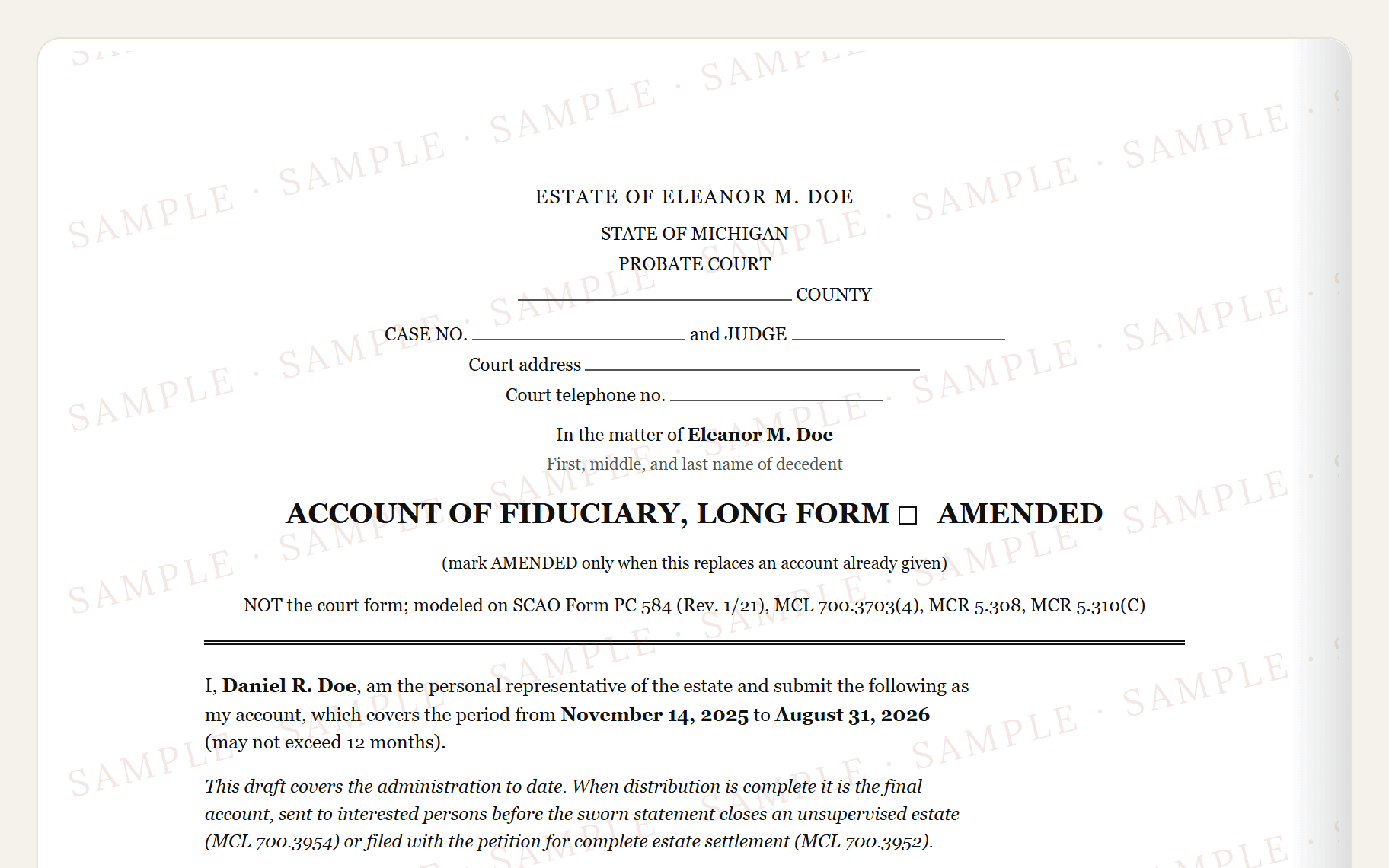
Recording is free for as long as the estate takes: every receipt and disbursement with its date and description, distributions per beneficiary, and a balance that checks itself as you go. ExecutorLedger builds Michigan-style documents from those records, an inventory shaped like PC 577 and an account shaped like PC 584, ready to transcribe onto the SCAO forms if you end up filing them, sending copies to distributees, or handing them to your attorney. Neither is a court form, and your attorney should review them before anything is signed or filed. Usually less than one attorney hour, and typically reimbursable by the estate.
Section 5 of 5.Questions about the Michigan inventory
Does Michigan require the PC 577 inventory and PC 584 account?
Whenever either is filed with the court, yes. MCR 5.113(A) requires the SCAO form once the State Court Administrative Office has approved one for that purpose. Filing both is mandatory in supervised administration (MCR 5.310(C)); in unsupervised administration the underlying duties, an inventory within 91 days and an account at least annually, are mandatory (MCL 700.3706; MCL 700.3703(4)), but filing either with the court is optional.
When is the Michigan inventory due?
Within 91 days after appointment, at fair market value as of the date of death, with the type and amount of any lien noted for each item (MCL 700.3706(1)). The information the court needs to compute the inventory fee is due to the court on that same 91-day timetable (MCR 5.307(A)).
The inventory is the first filing, not the last. The full Michigan guide covers the accounting that follows it, every deadline with its statute, what the executor is paid, and how estates close.
This page describes Michigan practice as our verified references state it; formats drift and estates differ, and none of this is legal advice. ExecutorLedger produces court-style documents for transcription. They are not official court forms. What your estate must file is a question for its attorney.