Michigan Estate Accounting: A Representative's Guide
Michigan probate runs through a probate court in each county, and its fiduciary is the personal representative. Unlike most states this guide covers, Michigan requires its SCAO forms whenever the inventory or account is filed with the court. Here is what each covers, the deadlines behind each, and how a Michigan estate closes.
Section 1 of 7.The two documents: the PC 577 inventory and the PC 584 account
Michigan probate runs through a probate court in each county under the Estates and Protected Individuals Code (EPIC, MCL 700.1101 et seq.) and the Michigan Court Rules (MCR Chapter 5). Its fiduciary is called the personal representative throughout the statute and the state's own forms, whether appointed under a will or without one. Michigan is different here from most states this guide covers: MCR 5.113(A) says that once the State Court Administrative Office (SCAO) has approved a form for a particular purpose, 'it must be used when preparing that particular document for filing with the court,' naming inventory and accounting directly. So whenever either document is filed with the court, using the SCAO form is not optional.
PC 577, Inventory (Decedent Estate), is the inventory. It lists everything the person who died owned at its date-of-death value, split between a real property section and a personal property section, the form's own definition: personal property is everything owned except real property, bank accounts included. MCL 700.3706 sets the underlying duty regardless of the form: prepare the inventory within 91 days of appointment, and send a copy to presumptive distributees and any interested person who requests one. Filing the original with the court is optional in unsupervised administration, but the information the court needs to compute the inventory fee has to reach it on that same 91-day timetable (MCR 5.307(A)).
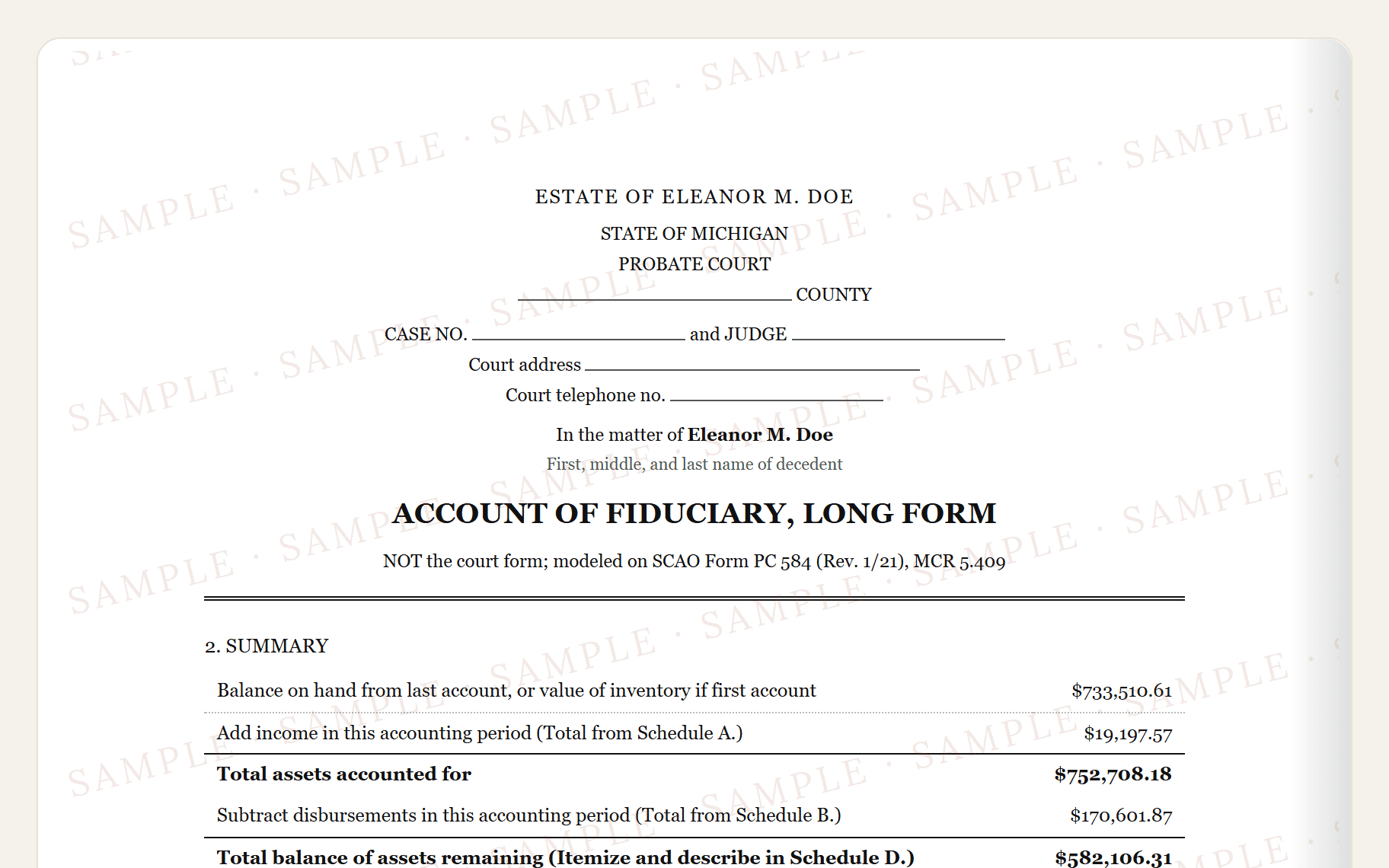
For the account, Michigan publishes two SCAO forms sharing an identical period line and summary structure: PC 583, Account of Fiduciary, Short Form, and PC 584, Account of Fiduciary, Long Form. Practitioners choose between them by whether a sale or other disposition produced a gain or loss during the period, not by estate size. PC 584 adds a Schedule C workspace for that gain or loss; PC 583 has none, so an estate with no sale during the period uses the short form instead. ExecutorLedger builds the PC 584 long-form shape, the one built to carry a sale's gain or loss.
Supervised administration is the one route where filing both documents with the court is itself mandatory (MCR 5.310(C)): the inventory, and an account within 56 days after each accounting-period anniversary, with a final account at closing. In unsupervised administration the underlying duties still apply, prepare and send the inventory within 91 days, account at least annually and again when the estate settles, to every beneficiary, but filing either document with the court is optional (MCL 700.3706(2); MCL 700.3703(4)). Either way, every interested person is entitled to a copy of both, under the notice Michigan requires within 28 days of appointment (MCL 700.3705(1)(d)).
Section 2 of 7.Michigan deadlines, with the statute behind each
- Day 28 (about 1 month)Notice of appointment to heirs and devisees
Why
Under MCL 700.3705(1), a personal representative generally must give notice of the appointment to the decedent's heirs and devisees (and certain trustees) within 28 days after being appointed, by personal service or first-class mail; confirm exactly who must receive notice and whether anyone has waived it with your attorney. - Day 91 (about 3 months)Inventory of estate property
Why
Under MCL 700.3706(1)-(2), a personal representative generally must prepare an inventory of the decedent's property, valued at fair market value as of the date of death, within 91 days after appointment and send a copy to the presumptive distributees and to any interested person who requests it; filing the inventory itself with the court is optional in unsupervised administration, but the information needed to compute the court's inventory fee must still reach the court on that same timetable (MCR 5.307), so confirm your county's filing practice with your attorney. - Day 120 (about 4 months)Creditor claims bar date
Why
Under MCL 700.3801; MCL 700.3803(1), creditors generally must present claims within 4 months after the personal representative publishes notice to creditors (and a known creditor who is mailed individual notice has until at least 1 month after that mailing, if later), not 4 months from the appointment itself; because Michigan law doesn't fix a calendar deadline for the publication, this entry conservatively counts the 4 months from your appointment date instead, so confirm the actual publication date and the resulting bar date with your attorney before paying claims or distributing. - Day 150 (about 5 months) · earliest possibleEarliest date to file sworn closing statement
Why
Under MCL 700.3954(1), in unsupervised administration, a personal representative generally may not file the sworn statement to close the estate any earlier than 5 months after the original personal representative's appointment, and only after the published creditor-claim period has expired and the estate is fully administered; confirm your estate qualifies for this informal route and the exact earliest date with your attorney. - Day 365 (about 1 year)Yearly account to the interested persons
Why
Under MCL 700.3703(4), a personal representative must account to each interested person at least once a year and again when the estate is settled; in an unsupervised administration the account goes to the interested persons rather than the court (SCAO form PC 583 or PC 584), and in supervised administration it is filed with the court under MCR 5.310(C). Confirm the first account's timing with your attorney.
- Day 270 (about 9 months)Federal estate tax return (Form 706), if required
Why
Under IRC §6075, Form 706 is due 9 months after death, but only if the gross estate exceeds the federal exemption or the estate elects portability, and a 6-month extension may be available; confirm applicability and timing with your attorney.
Within 28 days after appointment, the personal representative gives notice of the appointment to the decedent's heirs and devisees, unless they have waived it (MCL 700.3705(1)).
Read the full explanation
The inventory is due within 91 days after appointment, at fair market value on the date of death, with the type and amount of any lien noted for each item (MCL 700.3706(1)). The same 91-day clock covers the information the court needs to compute Michigan's inventory fee, a fee charged on the estate's value under a schedule set by statute and paid no later than the estate's closing filing or one year after appointment, whichever comes first (MCR 5.307(A); MCL 600.871).
The personal representative accounts to each beneficiary at least once a year, and again when the estate settles, specifying receipts, disbursements, and estate property, whether or not the account is ever filed with the court (MCL 700.3703(4)). In supervised administration, MCR 5.310(C)(2) turns that duty into a filing deadline: an account within 56 days after each accounting-period anniversary, and a final account at closing.
Creditor claims are barred four months after the personal representative publishes notice to creditors, and a known creditor gets at least one month after being mailed individual notice, if that falls later; if notice is never published, the bar runs three years after death (MCL 700.3801; MCL 700.3803(1)).
In unsupervised administration, the sworn statement that closes the estate can be filed no earlier than five months after the original personal representative's appointment, and only once the creditor-claims period has run and the estate is fully administered (MCL 700.3954(1)).
A federal estate tax return, Form 706, if the estate needs one, is due nine months after death (IRC section 6075), with a possible six-month extension. Confirm whether the estate needs one with your attorney.
Section 3 of 7.What Michigan pays a personal representative
MCL 700.3719(1) entitles the personal representative to reasonable compensation for services performed, with no statutory percentage, tier, or schedule of any kind, and lets the personal representative pay that compensation periodically as earned, without a court order first. If the will fixes compensation and there is no separate contract with the person who died, the personal representative can renounce the will's provision before qualifying and take reasonable compensation instead; a written compensation contract with the decedent is binding either way (MCL 700.3719(3)).
On an interested person's petition, on the court's own motion, or on appropriate motion in supervised administration, the probate court can review the reasonableness of the personal representative's own compensation and order a refund of any excess, with interest and penalties (MCL 700.3721).
Whatever fee is charged has to show up on the account. PC 584's own item 6 asks for the fiduciary fee incurred during the period, with a written description of the services attached, and Schedule B carries whatever part of that fee was paid out as an ordinary disbursement line during the period. Any account filed with the court has to meet that same itemization and fee-description standard, in supervised administration or not (MCR 5.310(C)(2)(c), extended to every filed account by MCR 5.308(A)).
Section 4 of 7.How a Michigan estate closes
Most Michigan estates close informally, by sworn statement. Unless prohibited by court order, and only in unsupervised administration, the personal representative can close the estate by filing a sworn statement (SCAO Form PC 591) with the probate court no earlier than five months after the original appointment, stating that notice was published and the claims period has run, that the estate has been fully administered, that a copy went to distributees and to any creditors whose claims are still open, and that a full written account went to every affected distributee, showing the fiduciary fees, attorney fees, and other professional fees paid (MCL 700.3954(1)). Before filing, personal representatives commonly collect a signed Receipt of Distributive Share (SCAO Form PC 588) from each distributee while distributing, evidence that protects the personal representative once it is signed (MCL 700.3910).
If no one objects within 28 days of that filing, the personal representative is entitled to a certificate of completion from the probate register (MCL 700.3958). The appointment itself ends automatically one year after the sworn statement is filed, as long as no proceeding involving the personal representative is pending.
Supervised estates cannot use the sworn-statement route at all (MCL 700.3954's own carve-out; MCR 5.310(H)). They, and any other estate that needs a court order rather than a release-based closing, close instead through a petition for an order of complete estate settlement (SCAO Form PC 593), which the court grants after notice to every interested person and a hearing (MCL 700.3952).
- Finish paying valid claims, administration expenses, and any taxes due, and distribute what's left to the people entitled to it. The sworn closing statement route below isn't available until this is done.
- Send every distributee a full written account of your administration that clearly states the fiduciary fees, attorney fees, and other professional fees paid, and have each one sign a Receipt of Distributive Share (SCAO Form PC 588) acknowledging what they received (MCL 700.3910).
- Once at least 5 months have passed since the original appointment and the published creditor-claim period has run, file a sworn statement to close the estate with the probate court (MCL 700.3954). No hearing is required unless someone objects.
- Send a copy of that sworn closing statement to all distributees and to any creditors or claimants you know of whose claims are still unpaid and not barred, as MCL 700.3954(1)(c) requires.
- If no objection is filed within 28 days, you're entitled to a certificate of completion from the probate register (MCL 700.3958); if a distributee won't sign off, the estate is contested, or you're in supervised administration, petition the probate court for an order of complete estate settlement instead (MCL 700.3952).
All of this runs through the probate court, the same court that issued your Letters of Authority. Michigan doesn't have a separate surrogate's court, register of wills, or orphans' court.
Section 5 of 7.The documents explained for a first-time personal representative
PC 577's grid has four columns: a description, then Gross value (fair market value on the date of death), Lien amount (a blank you complete by hand; the app records no liens), and Inventory value. For personal property, the form treats gross value and inventory value as the same figure, since a personal-property lien is disclosed but never subtracted. For real property, inventory value is gross value less the lien, and it cannot go below zero for a death on or after March 28, 2013; because the lien is unknown here, that cell prints blank for you to complete once you know it. There is no inventory-fee line on the form itself: the probate court computes and collects that fee separately, under MCL 600.871, once the estate's value is known.
PC 584's account opens with a five-line summary: the balance on hand from the last account (or the inventory total, on the first account), plus income for the period (Schedule A's total), giving the total assets accounted for; minus disbursements for the period (Schedule B's total), giving the balance remaining, which Schedule D itemizes. Four schedules carry the detail: A for income and gain, B for expenses, losses, and distributions, C for gain or loss on anything sold or otherwise disposed of, and D for what is still on hand at the end of the period.
A sale never posts its full sale price as income. Only the net gain or loss goes to Schedule A or B, itemized first on Schedule C: the description, the date acquired (the date of the fiduciary's appointment, for an asset already on the inventory) and the date sold, the value at the time the fiduciary acquired it, the proceeds, and the gain or loss. A gain transfers to Schedule A; a loss transfers to Schedule B, where the form insists on an entry even when it is zero.
Distributions to beneficiaries, cash or in kind, are Schedule B lines, right alongside ordinary expenses: the schedule's own heading is 'Expenses, losses, and other disbursements, including distributions to devisees and beneficiaries.' Michigan values an in-kind distribution at its fair market value on the date it is distributed, not at whatever value it was carried at on the inventory (MCL 700.3906), so that figure may need adjusting from what the ledger carries the asset at. Whatever remains after every schedule closes is Schedule D's itemized list, and Schedule D's total has to match the summary's last line, the same tie the form cross-references on its own face.
If property turns up after the inventory has already been filed, Michigan's mechanism is a fresh, amended PC 577, not a line on whatever account happens to be open, so a later-found asset becomes part of the opening balance the next account is built from. And fees appear in two different places that are not always the same number: item 6 and item 7 certify what has been incurred during the period, whether or not it has been paid yet, with a written description of the services attached; only a fee paid during the period also shows up as an ordinary Schedule B disbursement line.
Section 6 of 7.Where ExecutorLedger fits
Recording is free for as long as the estate takes: every receipt and disbursement with its date and description, distributions per beneficiary, and a balance that checks itself as you go. ExecutorLedger builds Michigan-style documents from those records, an inventory shaped like PC 577 and an account shaped like PC 584, ready to transcribe onto the SCAO forms if you end up filing them, sending copies to distributees, or handing them to your attorney. Neither is a court form, and your attorney should review them before anything is signed or filed. Every document previews free with your real numbers, and $149 (one-time payment) per estate lifts the watermark.
Section 7 of 7.Questions Michigan executors ask
Does Michigan require the PC 577 inventory and PC 584 account?
Whenever either is filed with the court, yes. MCR 5.113(A) requires the SCAO form once the State Court Administrative Office has approved one for that purpose. Filing both is mandatory in supervised administration (MCR 5.310(C)); in unsupervised administration the underlying duties, an inventory within 91 days and an account at least annually, are mandatory (MCL 700.3706; MCL 700.3703(4)), but filing either with the court is optional.
When is the Michigan inventory due?
Within 91 days after appointment, at fair market value as of the date of death, with the type and amount of any lien noted for each item (MCL 700.3706(1)). The information the court needs to compute the inventory fee is due to the court on that same 91-day timetable (MCR 5.307(A)).
Do I use PC 583 or PC 584 for the account?
PC 584 whenever a sale or other disposition produced a gain or loss during the period, since it carries the Schedule C workspace for that; PC 583, the short form, otherwise. ExecutorLedger builds the PC 584 long-form shape.
How is a Michigan personal representative paid?
MCL 700.3719 entitles the personal representative to reasonable compensation, with no statutory percentage schedule. The probate court can review the reasonableness of that fee on an interested person's petition or its own motion, and order a refund of any excess (MCL 700.3721).
How does a Michigan estate close?
Most unsupervised estates close informally: no earlier than five months after appointment, and once the creditor-claims period has run, by filing a sworn statement (SCAO Form PC 591) under MCL 700.3954. Supervised estates, and any estate that needs a court order, close instead with a petition for an order of complete estate settlement (SCAO Form PC 593) under MCL 700.3952.
Not sure which accounting your situation calls for? Which accounting do I need? covers the choice, and the accounting guide explains the structure every format shares.
This page describes Michigan practice as our verified references state it; formats drift and estates differ, and none of this is legal advice. ExecutorLedger produces court-style documents for transcription. They are not official court forms. The accounting your estate needs is a question for its attorney.