Kentucky's AOC-841 estate inventory, explained
Kentucky requires an inventory on Form AOC-841, filed under seal with the District Court within 90 days of qualifying. Here is what the form covers, part by part, and which details come from you.
Section 1 of 5.What Form AOC-841 is, and who files it
Kentucky requires an inventory of the estate filed with the District Court. The form is AOC-841, Inventory and Appraisement of Estate (Rev. 7-26). It has five numbered sections, in order: Real Property, Motor Vehicles, Personal Property, Cash and Cash Equivalents, Other. Each line carries a date-of-death value, and the form ends in one grand total, Total Estimated Value. There are no subtotals, no encumbrance column, and no oath or notary.
The inventory is filed under seal. The inventory is confidential, and the clerk sends a copy to the Department of Revenue (KRS 395.250(1)(b)).
Section 2 of 5.When the inventory is due
Under KRS 395.250, the personal representative generally must file the estate inventory (form AOC-841) with the District Court no later than 90 days after qualifying; the inventory is filed under seal and the court clerk transmits a copy to the Department of Revenue; confirm the exact due date and filing mechanics with your attorney.
A guide that says 60 days is quoting the old statute. Filing late starts the KRS 395.255 track, which ends at $100 for each day of unexcused failure (KRS 395.990).
Section 3 of 5.What goes in it, part by part
The inventory captures what the decedent owned at death, divided into five numbered sections: Real Property, Motor Vehicles, Personal Property, Cash and Cash Equivalents, and Other.
Property passing outside probate is generally excluded: survivorship joint property, payable- and transfer-on-death accounts, and insurance or retirement money with living named beneficiaries. That is consistent with KRS 391.360 and 395.015(3)(b), though the inventory statute itself lists no exclusions. Ask your attorney when an item is a close call.
Property found later goes on an amended inventory (KRS 395.250(4)).
Section 4 of 5.From your records to the AOC-841 form
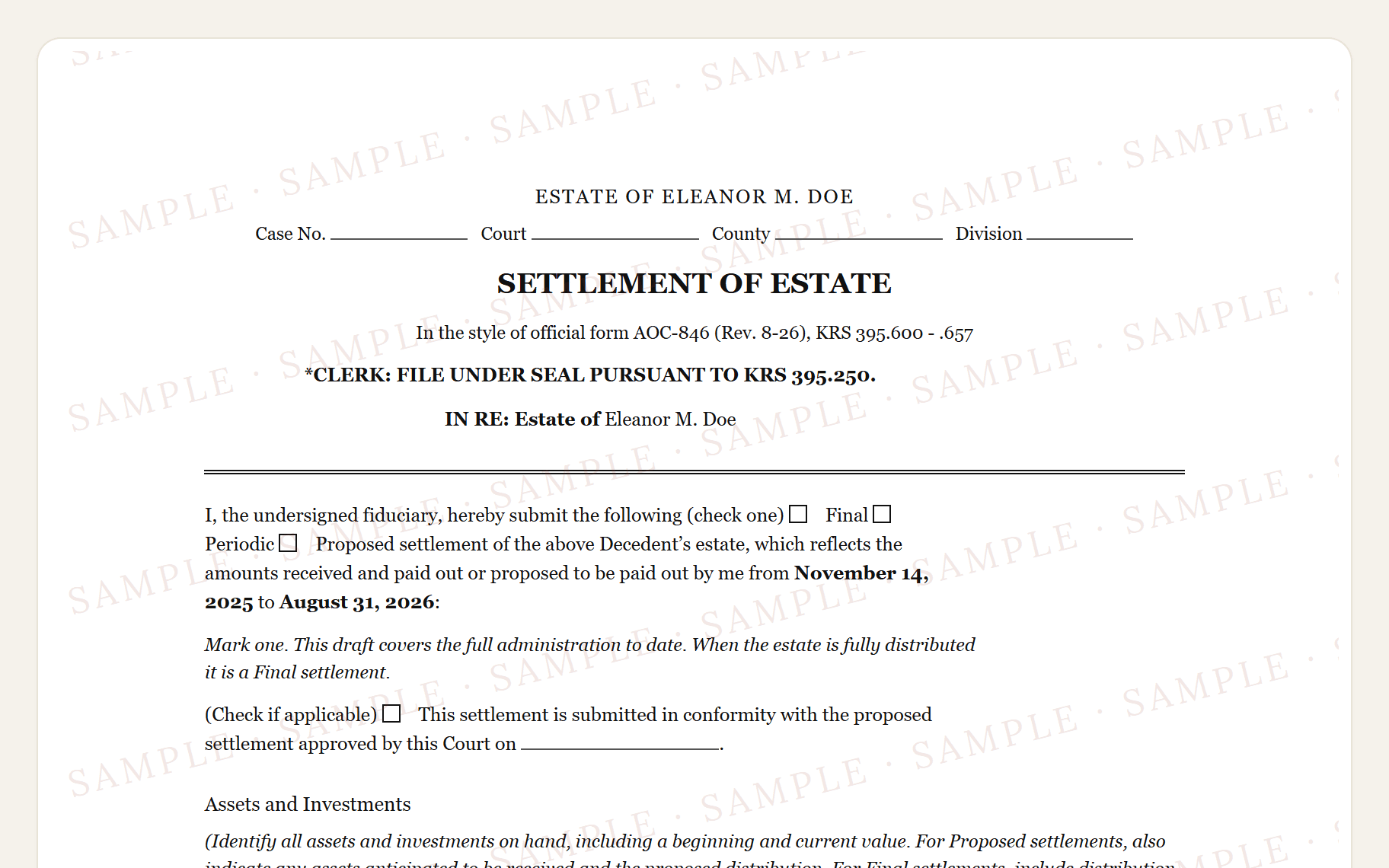
Recording is free for as long as the estate takes: every receipt and disbursement with date and payee, distributions per beneficiary, and a running balance that checks itself as you go. ExecutorLedger builds Kentucky court-style documents from those records, an inventory shaped like AOC-841 and a settlement shaped like AOC-846, ready to transcribe onto the official forms. They are not court forms, and the estate's attorney should read them first. Usually less than one attorney hour, and typically reimbursable by the estate.
Section 5 of 5.Questions about the Kentucky inventory
When is the Kentucky AOC-841 inventory due?
Generally no later than 90 days from the time you qualify as personal representative (KRS 395.250(1)(a), amended effective July 15, 2026). It is filed under seal, and the clerk sends a copy to the Department of Revenue. Guides saying 60 days quote the old statute.
What property is excluded from the AOC-841 inventory?
Property passing outside probate is generally excluded: survivorship joint property, payable-on-death and transfer-on-death accounts, and insurance or retirement money with living named beneficiaries. That is consistent with KRS 391.360 and 395.015(3)(b), though the inventory statute itself lists no exclusions. Ask your attorney when an item is a close call.
What are the five sections of the AOC-841?
The form has five numbered sections, in order: Real Property, Motor Vehicles, Personal Property, Cash and Cash Equivalents, Other. Each line carries a date-of-death value, and the form ends in one grand total, Total Estimated Value. There are no subtotals, no encumbrance column, and no oath or notary.
The inventory is the first filing, not the last. The full Kentucky guide covers the accounting that follows it, every deadline with its statute, what the executor is paid, and how estates close.
This page describes Kentucky practice as our verified references state it; formats drift and estates differ, and none of this is legal advice. ExecutorLedger produces court-style documents for transcription. They are not official court forms. What your estate must file is a question for its attorney.