Delaware's Form N.C. 600RW estate inventory, explained
Delaware requires an inventory, list and statement of the estate on Form N.C. 600RW (New Castle County) or an equivalent form, filed with the Register of Wills within three months after letters are granted. Here is what the form asks for, part by part, and how to have every number ready.
Section 1 of 5.What Form N.C. 600RW is, and who files it
Delaware administers estates under 12 Del. C. chapter 19, before the Register of Wills of the county where letters were granted. There is no separate probate court in Delaware. The Register of Wills administers as an arm of the Court of Chancery, and a routine filing carries a Register of Wills folio number, not a Court of Chancery civil action number.
Filing the inventory is required by law. 12 Del. C. § 1905(a) requires it within three months of the grant of letters, and section 1906 calls it by its full name, the inventory, list and statement. It is three things at once: an inventory of the decedent's goods and chattels, a list of debts and credits due or belonging to the decedent or the estate, and a statement describing every parcel of Delaware real estate the decedent owned, with the parcel identification number and the name and relationship of each person entitled to it. New Castle County's Register of Wills supplies Form N.C. 600RW for this. Kent County and Sussex County publish their own inventory forms.
Section 2 of 5.When the inventory is due
Under 12 Del. C. § 1905, an inventory and appraisal of the estate's assets generally must be filed with the county Register of Wills within 3 months after letters are granted, typically on the county's own inventory form (e.g., Form N.C. 600RW in New Castle County), and late filing can draw a $1-per-day personal penalty under § 1906; confirm the exact due date and any extension with your attorney.
A late inventory draws a personal penalty of $1.00 per day for each day delinquent, starting one month after the Register of Wills gives notice of the delinquency (12 Del. C. § 1906(a)). A later Court of Chancery order to file can add contempt (§ 1906(b)).
Property or debts discovered after the inventory is filed go on an additional inventory or list, filed with the Register. Delaware sets no deadline for it (12 Del. C. § 1910).
Section 3 of 5.What goes in it, part by part
The inventory's five schedules split into two groups. Schedule A, sole real estate, and Schedule B, jointly owned assets, are listed in full, each new owner named, and then walled off: they are non-probate and do not enter the estate's carried total. Schedules C, bank accounts and cash, D, stocks and bonds, and E, vehicles and miscellaneous property, are the probate schedules, and their sum is the figure the form calls Total Probate Assets, the one number that carries forward to the accounting.
Real estate is entered at its fair market value as of the date of death, without subtracting any mortgage or loan against it. Property owned jointly, including jointly owned real estate, goes on Schedule B, not on the schedule for solely held property. Three items never belong on the inventory at all: the family Bible, the decedent's clothes, and the family's stores laid in before the death (12 Del. C. § 1901(b)).
Hiring an appraiser is optional. A personal representative who does use one has to note the appraiser's name and address on the inventory beside the item appraised (12 Del. C. § 1904). If an executor owed the decedent money, becoming executor does not erase that debt: it still has to be listed among the debts due to the decedent (12 Del. C. § 1909).
Each personal representative swears to their own affidavit; where there is more than one, each affidavit is separate (12 Del. C. § 1905(b)). If a co-executor refuses or neglects to join in the inventory, the Court of Chancery removes them from office, unless they file their own inventory instead (12 Del. C. § 1907).
Section 4 of 5.From your records to Form N.C. 600RW
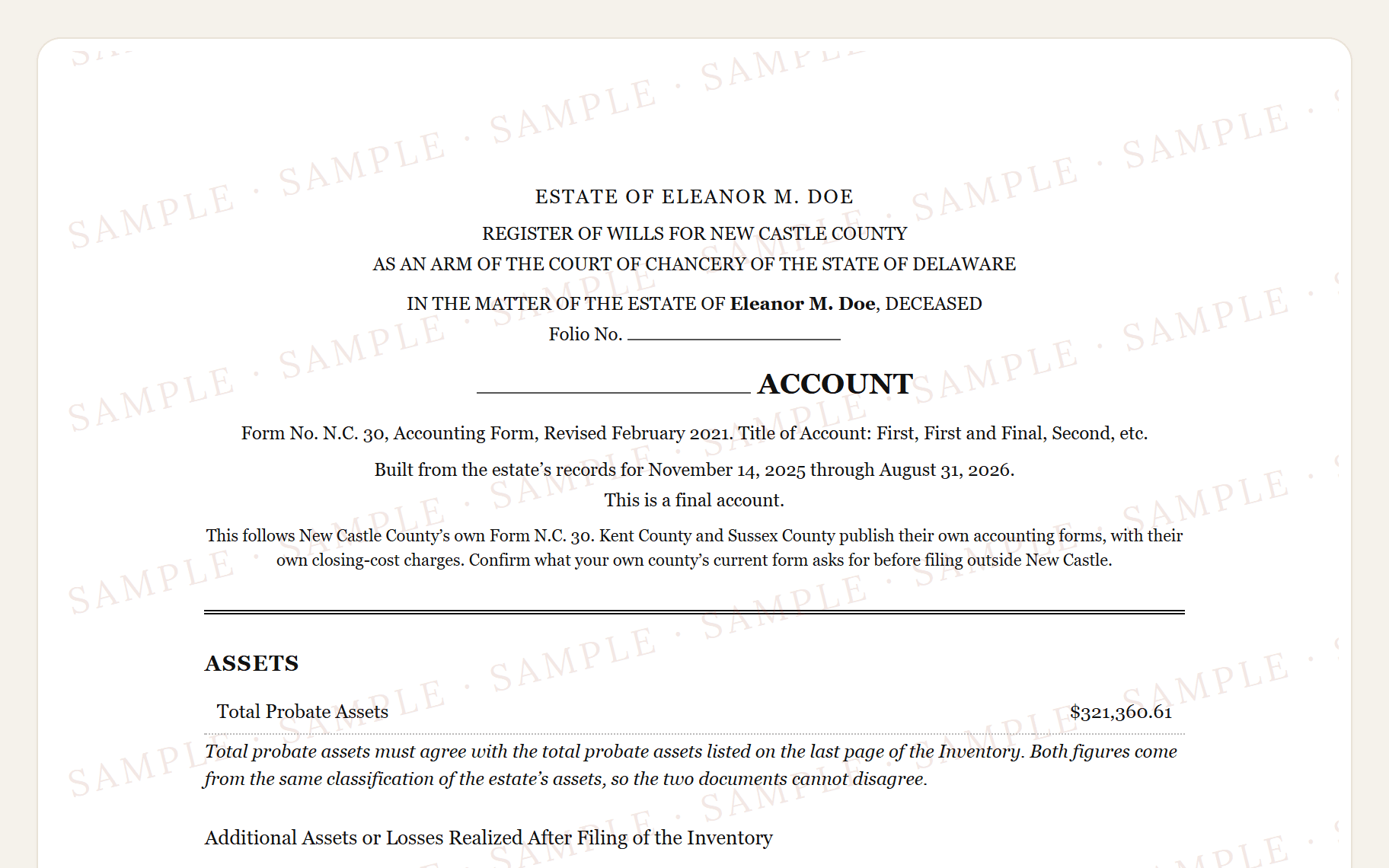
Recording is free for as long as the estate takes: every receipt and disbursement with its date and description, distributions per beneficiary, and a balance that checks itself as you go. ExecutorLedger builds Delaware-style documents from those records, an inventory laid out in New Castle's five lettered schedules and an accounting in New Castle's net worth reconciliation, ready to transcribe or attach when you file. Neither is a court form, and your attorney should review them before anything is signed or filed. Usually less than one attorney hour, and typically reimbursable by the estate.
Section 5 of 5.Questions about the Delaware inventory
When is the Delaware inventory due, and what happens if it is late?
Within three months after the grant of letters, with a copy filed in any other county where the decedent owned real estate (12 Del. C. § 1905(a)). A late inventory draws a personal penalty of $1.00 per day for each day delinquent, starting one month after the Register of Wills gives notice of the delinquency (§ 1906(a)).
Does real estate count toward the total on a Delaware inventory?
It is listed, in full, with the new owners named, but it does not count toward the total that carries to the accounting. Schedule A, sole real estate, and Schedule B, jointly owned assets, are non-probate; only Schedules C, D and E, bank accounts and cash, stocks and bonds, and vehicles and miscellaneous property, sum to Total Probate Assets.
Is an appraiser required for a Delaware inventory?
No. Hiring an appraiser is optional. A personal representative who does use one has to note the appraiser's name and address on the inventory beside the item appraised (12 Del. C. § 1904).
The inventory is the first filing, not the last. The full Delaware guide covers the accounting that follows it, every deadline with its statute, what the executor is paid, and how estates close.
This page describes Delaware practice as our verified references state it; formats drift and estates differ, and none of this is legal advice. ExecutorLedger produces court-style documents for transcription. They are not official court forms. What your estate must file is a question for its attorney.