Delaware Estate Accounting: A Representative's Guide
Delaware probate runs through the Register of Wills in each of the state's three counties, New Castle, Kent and Sussex, acting as an arm of the Court of Chancery rather than a separate probate court. Its fiduciary is the personal representative, the executor named in a will or the administrator appointed when there is none. New Castle County's own forms, Form N.C. 600RW for the inventory and Form N.C. 30 for the accounting, are what this guide follows; Kent and Sussex publish their own. Here is what Delaware law and New Castle's forms require, the deadlines behind them, and how a Delaware estate closes.
Section 1 of 7.The two documents: the Inventory and the Accounting
Delaware administers estates under 12 Del. C. chapter 19, the inventory, and chapter 23, subchapter I, the account, before the Register of Wills of the county where letters were granted. There is no separate probate court in Delaware. The Register of Wills administers as an arm of the Court of Chancery, and a routine filing carries a Register of Wills folio number, not a Court of Chancery civil action number.
The first document is the inventory. 12 Del. C. § 1905(a) requires it within three months of the grant of letters, and section 1906 calls it by its full name, "the inventory, list and statement." It is three things at once: an inventory of the decedent's goods and chattels, a list of debts and credits due or belonging to the decedent or the estate, and a statement describing every parcel of Delaware real estate the decedent owned, with the parcel identification number and the name and relationship of each person entitled to it. New Castle County's Register of Wills supplies Form N.C. 600RW for this. Kent County and Sussex County publish their own inventory forms.
The inventory's five schedules split into two groups. Schedule A, sole real estate, and Schedule B, jointly owned assets, are listed in full, each new owner named, and then walled off: they are non-probate and do not enter the estate's carried total. Schedules C, bank accounts and cash, D, stocks and bonds, and E, vehicles and miscellaneous property, are the probate schedules, and their sum is the figure the form calls "Total Probate Assets," the one number that carries forward to the accounting.
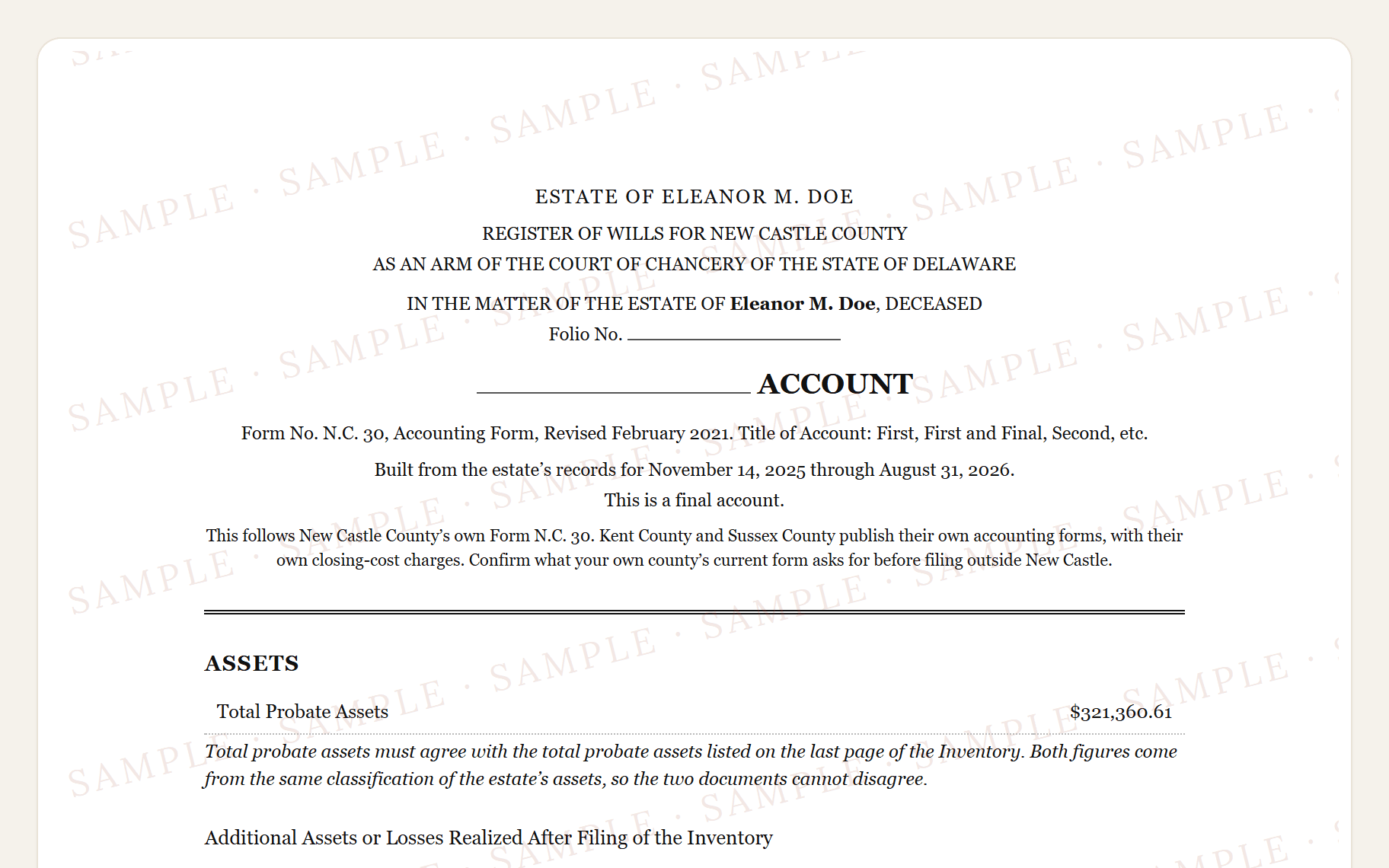
The second document is the accounting. 12 Del. C. § 2301(a) requires the personal representative to render an account of their administration to the Court of Chancery, in money, every year from the date of their letters until the estate is closed and a final account passed by the Court. New Castle's Form N.C. 30 is a net worth reconciliation in lump categories: it totals what the estate holds against what has been allowed and paid, with no dated ledger rows and no gain-or-loss column of its own. Kent and Sussex Registers publish their own accounting forms, with their own closing cost charges.
Section 2 of 7.Delaware's deadlines, with the statute behind each
- Day 90 (about 3 months)Inventory and appraisal due to Register of Wills
Why
Under 12 Del. C. § 1905, an inventory and appraisal of the estate's assets generally must be filed with the county Register of Wills within 3 months after letters are granted, typically on the county's own inventory form (e.g., Form N.C. 600RW in New Castle County), and late filing can draw a $1-per-day personal penalty under § 1906; confirm the exact due date and any extension with your attorney. - Day 365 (about 1 year)First (often final) accounting due to Register of Wills
Why
Under 12 Del. C. § 2301, an account of the administration generally must be filed with the Register of Wills within 1 year of letters and then every year until the estate is closed, though the Register may typically extend the time for accounting by up to 6 months; confirm each accounting due date with your attorney. - Day 390 (about 13 months)Pecuniary legacies start accruing 4% interest
Why
Under 12 Del. C. § 2312(c), pecuniary (fixed-dollar) legacies generally begin bearing interest at 4% per year, payable from the estate, starting 13 months after the first appointment of a personal representative unless the will indicates a contrary intent, so plan to pay cash bequests before this date where practical; confirm whether this applies and the exact timing with your attorney.
- Day 240 (about 8 months)Creditor claims bar (8 months after death)
Why
Under 12 Del. C. § 2102, creditor claims are generally barred unless presented within 8 months of the decedent's death, and this bar typically runs whether or not the Register of Wills' published notice went out, so calendar this date before paying claims or distributing; confirm the operative date with your attorney. - Day 270 (about 9 months)Federal estate tax return (Form 706), if required
Why
Under IRC §6075, Form 706 is due 9 months after death, but only if the gross estate exceeds the federal exemption or the estate elects portability, and a 6-month extension may be available; confirm applicability and timing with your attorney.
The inventory is due within three months after the grant of letters testamentary or of administration. A copy must also be filed with the Register of Wills of any other county where the decedent owned real estate (12 Del. C. § 1905(a)).
Read the full explanation
Missing that deadline carries a personal penalty: $1.00 per day for each day delinquent, and the penalty does not start until one month after the Register of Wills gives notice of the delinquency (12 Del. C. § 1906(a)). A later Court of Chancery order to file can add contempt (§ 1906(b)).
Property or debts discovered after the inventory is filed go on an additional inventory or list, filed with the Register. Delaware sets no deadline for it (12 Del. C. § 1910).
The accounting is due every year from the date of letters until the estate closes (12 Del. C. § 2301(a)). The Register of Wills may extend that for sufficient cause, up to six months, or dispense with an account entirely on the personal representative's own affidavit that there were no transactions to report that year (§ 2301(c)).
Once an account is filed, the Register mails notice to the beneficiaries, and the account stays open for exception for three months. Exceptions filed after that window are not considered (12 Del. C. § 2302(b), (d); Ct. Ch. R. 194(a)).
A federal estate tax return, Form 706, if the estate needs one, is due nine months after death (IRC § 6075), with a possible six-month extension. Confirm whether the estate needs one with your attorney.
Section 3 of 7.What Delaware pays a personal representative
There is no percentage schedule anywhere in Delaware law. 12 Del. C. § 2305(a) says only that commissions and attorneys' fees shall be allowed as provided by rule of the Court of Chancery, and Court of Chancery Rule 192(a) sets the standard: commissions and attorneys' fees shall be allowed in a reasonable amount.
Rule 192(b) lists what reasonableness turns on: the time spent, the risk and responsibility involved, the novelty and difficulty of the questions, the skill and experience brought to the estate, any provision the will makes for compensation, comparable rates for similar services in the locality, the character and value of the estate assets, the character and value of assets outside the probate estate that must still be valued and reported for tax purposes, the time constraints involved, the loss of other business the administration caused, and the benefit obtained for the estate. A fee based only on an hourly rate, or only on the estate's value, is not unreasonable for that reason alone.
Rule 192(d) presumes a claimed commission or fee reasonable unless a beneficiary files an exception to the account alleging otherwise, though the Court may still reduce either on its own. Section 2305(c) lets the Court reduce commissions and fees if the required accounts were not filed on time.
New Castle's accounting form separately lists closing costs paid to the Register of Wills, currently set as percentages of the net estate under its own schedule. Those are court costs, not the personal representative's pay. The commission is its own line on the form, set under Rule 192, never a percentage.
Section 4 of 7.How a Delaware estate closes
Before a final account can be presented to the Court for approval, a tax clearance form has to be on file with the Register from the Division of Revenue (Ct. Ch. R. 195(b)).
When the account is filed, the Register examines it, compares it against the cancelled checks and receipts backing every disbursement, verifies the calculations, and certifies that the accounting is correctly adjusted and settled (Ct. Ch. R. 194(c)(3)). Save every cancelled check and receipt as you go; it is what the Register checks the account against.
Every account has to be filed together with a statement of the beneficiaries entitled to share in the estate, their names and mailing addresses, plus the same for any guardian or trustee of a beneficiary under a legal incapacity (12 Del. C. § 2302(a)). New Castle's Register supplies that statement as Form N.C. 5. ExecutorLedger does not build Form N.C. 5; the accounting print names it and says it has to be filed alongside the account.
Court of Chancery approval of an account does not release the personal representative from liability for a loss or an injury to the estate caused by their own act, neglect, default, fraud, deception or concealment (Ct. Ch. R. 196).
The Delaware estate tax was repealed for deaths on or after January 1, 2018 (30 Del. C. ch. 15, repealed by 81 Del. Laws c. 52, § 1). New Castle's accounting form still asks whether a Delaware estate tax return is necessary, because it also covers two historical windows, deaths between January 1, 1999 and December 31, 2004, and deaths between July 1, 2009 and December 17, 2017, when an affidavit that no return was required had to be filed instead. A death after that falls outside both windows.
- Square away taxes first. The Register of Wills needs a tax clearance form from the Delaware Division of Revenue on file before your final account can be presented for approval (12 Del. C. § 2304; Ct. Ch. R. 195(b)).
- File the final accounting with the county Register of Wills on the county's accounting form, attaching a cancelled check or receipt for every expense you deducted. The Register compares the account against them line by line and certifies it as correctly adjusted and settled (12 Del. C. § 2301; Ct. Ch. R. 194(c)).
- Collect a signed waiver-and-consent from each beneficiary if you can (New Castle County's Form N.C. 2, or N.C. 3 for a legally incapacitated beneficiary); anyone who won't sign gets mailed notice and the account stays open to exceptions for 3 months before the Court of Chancery can approve it (12 Del. C. § 2302; Ct. Ch. R. 194-195).
- When you pay each legacy or share, collect a signed release or acquittance. Delaware lets you record an acknowledged release with the Court of Chancery, and you may require a refunding-style obligation with security before paying anyone (12 Del. C. §§ 2312(b), 2320).
- Close out with the Register of Wills: complete the remaining notice paperwork (Form N.C. 1 with stamped envelopes for any beneficiary who didn't waive, in New Castle County) and pay the percentage-based closing costs. New Castle charges 1.75% of the net estate, meaning total assets less total expenses, plus a 0.25% technology fee for deaths on or after 7/1/2018. Kent and Sussex publish their own accounting forms and their own charges, so check your county's current form.
Delaware has no separate probate court. The county Register of Wills administers estates as an arm of the Court of Chancery, and disputes (exceptions, surcharge) go up to Chancery. Court approval of the account does not itself release the personal representative from liability for loss caused by the personal representative's act, neglect, default, fraud, deception, or concealment (Ct. Ch. R. 196).
Section 5 of 7.The Inventory and the Accounting explained for a first-time personal representative
Each personal representative swears to their own affidavit; where there is more than one, each affidavit is separate (12 Del. C. § 1905(b)). The statute prescribes the wording: that due inquiry was made concerning the decedent's goods, chattels and money and the debts and credits due or belonging to them, that the inventory contains everything that has come to the deponent's knowledge, and that the statement of real estate and of transfers, powers of appointment, entireties and jointly owned property is true to the best of the deponent's knowledge and belief (§ 1905(c)). A notary or other qualified officer administers the oath.
Three items never belong on the inventory at all: the family Bible, the decedent's clothes, and the family's stores laid in before the death (12 Del. C. § 1901(b)).
Hiring an appraiser is optional. A personal representative who does use one has to note the appraiser's name and address on the inventory beside the item appraised (12 Del. C. § 1904).
Real estate is entered at its fair market value as of the date of death, without subtracting any mortgage or loan against it. Property owned jointly, including jointly owned real estate, goes on Schedule B, not on the schedule for solely held property.
If an executor owed the decedent money, becoming executor does not erase that debt: it still has to be listed among the debts due to the decedent (12 Del. C. § 1909).
If a co-executor refuses or neglects to join in the inventory, the Court of Chancery removes them from office, unless they file their own inventory instead (12 Del. C. § 1907).
Section 6 of 7.Where ExecutorLedger fits
Recording is free for as long as the estate takes: every receipt and disbursement with its date and description, distributions per beneficiary, and a balance that checks itself as you go. ExecutorLedger builds Delaware-style documents from those records, an inventory laid out in New Castle's five lettered schedules and an accounting in New Castle's net worth reconciliation, ready to transcribe or attach when you file. Neither is a court form, and your attorney should review them before anything is signed or filed.
Section 7 of 7.Questions Delaware executors ask
Is there a separate probate court in Delaware?
No. The Register of Wills in each of Delaware's three counties, New Castle, Kent and Sussex, administers estates as an arm of the Court of Chancery. A routine filing carries a Register of Wills folio number, not a Court of Chancery civil action number.
When is the Delaware inventory due, and what happens if it is late?
Within three months after the grant of letters, with a copy filed in any other county where the decedent owned real estate (12 Del. C. § 1905(a)). A late inventory draws a personal penalty of $1.00 per day for each day delinquent, starting one month after the Register of Wills gives notice of the delinquency (§ 1906(a)).
Does real estate count toward the total on a Delaware inventory?
It is listed, in full, with the new owners named, but it does not count toward the total that carries to the accounting. Schedule A, sole real estate, and Schedule B, jointly owned assets, are non-probate; only Schedules C, D and E, bank accounts and cash, stocks and bonds, and vehicles and miscellaneous property, sum to Total Probate Assets.
Does a Delaware estate have to file an accounting every year?
Yes. 12 Del. C. § 2301(a) requires an account every year from the date of letters until the estate closes. The Register of Wills may extend that for sufficient cause, up to six months, or dispense with an account entirely on the personal representative's own affidavit that there were no transactions that year (§ 2301(c)).
How is a Delaware personal representative paid?
There is no percentage schedule. Court of Chancery Rule 192(a) allows commissions and attorneys' fees in a reasonable amount, judged by factors including the time spent, the risk involved, and the character and value of the estate. Rule 192(d) presumes a claimed fee reasonable unless a beneficiary files an exception to the account.
Not sure which accounting your situation calls for? Which accounting do I need? covers the choice, and the accounting guide explains the structure every format shares.
This page describes Delaware practice as our verified references state it; formats drift and estates differ, and none of this is legal advice. ExecutorLedger produces court-style documents for transcription. They are not official court forms. The accounting your estate needs is a question for its attorney.