Arizona's PBIP46f estate inventory, explained
Arizona requires a personal representative to prepare an inventory on the Inventory and Appraisement (PBIP46f) within 90 days of appointment. Here is what the form asks for, part by part, and how to have every number ready.
Section 1 of 5.What Form PBIP46f is, and who files it
Arizona administers estates under the Uniform Probate Code as adopted in A.R.S. Title 14, chapter 3, before the Superior Court in each county. There is no separate probate court, surrogate, or register of wills. The fiduciary is the personal representative, the executor or administrator who settles the estate.
A.R.S. § 14-3706 requires the personal representative to prepare an inventory within 90 days of appointment showing each asset's fair market value as of the date of death, its nature as community or separate property, and any encumbrances. Arizona has adopted no statewide inventory form (Ariz. R. Prob. P. Rule 50(c); the Arizona Supreme Court's mandatory forms under Ariz. Code Jud. Admin. § 3-302 name none). What a personal representative files or sends is whichever self-service form the county publishes. This guide follows Maricopa County's Inventory and Appraisement (PBIP46f). Neither this nor Pima County's own inventory is a court form; each is what that county's self-help center publishes.
Section 2 of 5.When the inventory is due
Under A.R.S. § 14-3706, the personal representative generally must prepare an inventory within 90 days after appointment showing each asset's date-of-death fair market value, its nature as community or separate property, and any encumbrances, and then typically either file it with the court or mail copies to heirs or devisees; confirm the deadline and delivery method with your attorney.
A.R.S. § 14-3706(B) lets the personal representative choose: file the original with the court and send copies only to interested persons who ask for one, or skip filing and instead mail or deliver a copy to every heir or devisee and to any other interested person who requests it.
Section 3 of 5.What goes in it, part by part
Maricopa's Inventory and Appraisement opens with the personal representative's own statement, worded as "I am the Personal Representative for the decedent, the person who died," and three numbered items: a true-and-correct statement covering everything the person who died owned, the one total estimated value of the whole estate, and a description of each item's community or separate nature and any debt on it. Two schedules follow: Real Property, and Personal Property for everything else.
Each Real Property item prints as its own block: a street address, a space for the property description, boxes to check whether the property is community or separate, the estimated value, the amount owed on any encumbrance, and spaces for an appraiser's name and address. Each Personal Property item prints the same way. The form prints no subtotal on either schedule; the aggregate total is item 2's, the sum of every item's value. Some fields, such as encumbrance amounts, the community or separate classification, and appraisals, you will need to complete by hand.
Section 4 of 5.From your records to the inventory form
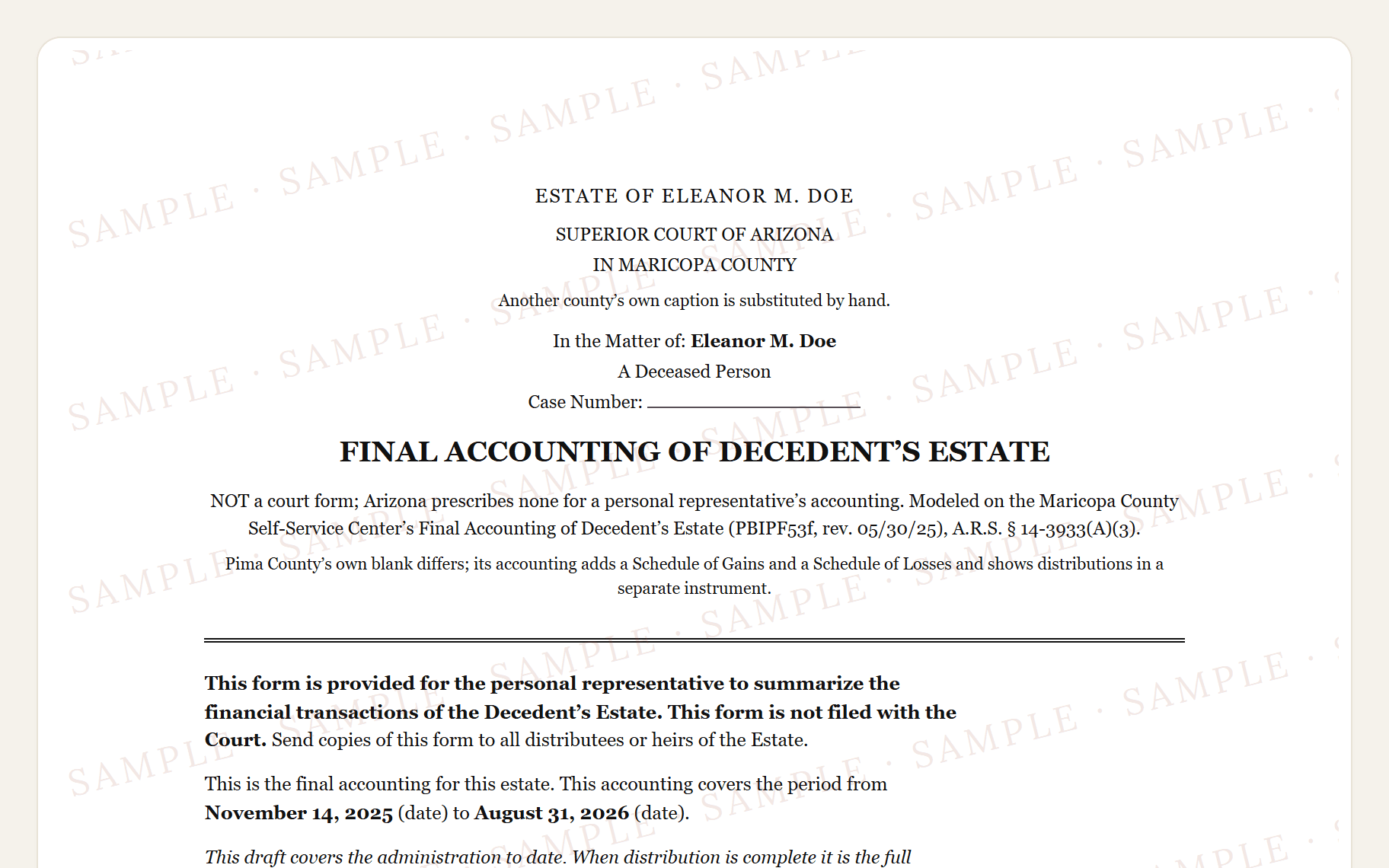
Recording is free for as long as the estate takes: every receipt and disbursement with its date and description, distributions per distributee or heir, and a balance that checks itself as you go. ExecutorLedger builds Arizona-style documents from those records, an inventory shaped like Maricopa's Inventory and Appraisement and an accounting shaped like Maricopa's Final Accounting of Decedent's Estate, ready to transcribe onto your own county's form if you end up sending one. Neither is a court form, and your attorney should review them before anything is signed or sent. Usually less than one attorney hour, and typically reimbursable by the estate.
Section 5 of 5.Questions about the Arizona inventory
Is there a court form for Arizona's inventory or accounting?
No. Arizona has adopted no statewide form for either document (Ariz. R. Prob. P. Rule 50(c); the Arizona Supreme Court's mandatory forms, Ariz. Code Jud. Admin. § 3-302, list none). What gets used is whatever self-service form the county publishes, such as Maricopa County's Inventory and Appraisement (PBIP46f) and Final Accounting of Decedent's Estate (PBIPF53f), or Pima County's own blanks.
When is the Arizona inventory due?
Within 90 days after appointment, valued at fair market value as of the date of death, with each item's community or separate nature and any encumbrance noted (A.R.S. § 14-3706). The personal representative either files it with the court or mails it to every heir or devisee.
The inventory is the first filing, not the last. The full Arizona guide covers the accounting that follows it, every deadline with its statute, what the executor is paid, and how estates close.
This page describes Arizona practice as our verified references state it; formats drift and estates differ, and none of this is legal advice. ExecutorLedger produces court-style documents for transcription. They are not official court forms. What your estate must file is a question for its attorney.