Arizona Estate Accounting: A Personal Representative's Guide
Arizona probate runs through the Superior Court of each county, and its fiduciary is the personal representative, the executor or administrator who settles the estate. Arizona has adopted no statewide inventory or accounting form for a personal representative, so this guide follows the Maricopa County Self-Service Center's own two forms, the Inventory and Appraisement (PBIP46f) and the Final Accounting of Decedent's Estate (PBIPF53f), and notes where Pima County's own blanks differ.
Section 1 of 7.The two documents: the Inventory and Appraisement and the Final Accounting
Arizona administers estates under the Uniform Probate Code as adopted in A.R.S. Title 14, chapter 3, before the Superior Court in each county. There is no separate probate court, surrogate, or register of wills. An estate can open informally, without a hearing, or formally, with one, and separately can be administered under court supervision or, far more often, without it. This guide covers the ordinary case, an unsupervised administration, which is how nearly every Arizona estate proceeds.
Ariz. R. Prob. P. Rule 50(c) says a personal representative's account need not be presented on the standard forms used for conservator accounts, and the Arizona Supreme Court's own statewide mandatory forms list, Forms 1 through 15 under Ariz. Code Jud. Admin. § 3-302, names no inventory or account for a personal representative at all. What a personal representative files or sends is whichever self-service form the county where the estate is pending hands out. This guide draws on the Maricopa County Self-Service Center's Inventory and Appraisement (PBIP46f, rev. 04/25/25) and Final Accounting of Decedent's Estate (PBIPF53f, rev. 05/30/25). Pima County publishes its own inventory, a single numbered table rather than Maricopa's per-item blocks, with its own printed subtotals, and its own accounting, six lists instead of four, with a separate Schedule of Gains and Schedule of Losses and distributions shown in a separate instrument rather than inside the accounting itself. Neither county's form is a court form, and neither is approved by any court; each is what that county's own self-help center publishes for a personal representative's convenience.
The inventory and the accounting travel different routes. Under A.R.S. § 14-3706(B), a personal representative preparing the inventory chooses: file the original with the court and send copies only to interested persons who ask for one, or skip filing and instead mail or deliver a copy to every heir or devisee and to any other interested person who requests it. The accounting works differently again. On the informal closing route, A.R.S. § 14-3933, the accounting is never filed with the court at all; Maricopa's own form says so directly, and it goes out only to distributees or heirs and to any unpaid, unbarred creditor. On the formal route, A.R.S. § 14-3931, a copy of the final account goes to the court as part of the settlement petition.
Section 2 of 7.Arizona deadlines, with the statute behind each
- Day 30 (about 1 month)Send information of appointment to heirs and devisees
Why
Under A.R.S. §14-3705, the personal representative generally must deliver or mail information of the appointment to the heirs and devisees not later than 30 days after appointment; confirm who must receive it and the exact date with your attorney. - Day 30 (about 1 month)Publish and mail notice to creditors
Why
Under A.R.S. §14-3801, upon appointment the personal representative generally must publish notice to creditors once a week for three successive weeks in the county and mail written notice to all known creditors; the statute sets no fixed day-count, so this reminder is calendared 30 days after appointment. Confirm the timing and method with your attorney. - Day 90 (about 3 months)Prepare inventory and appraisement
Why
Under A.R.S. §14-3706, the personal representative generally must prepare an inventory within 90 days after appointment showing each asset's date-of-death fair market value, its nature as community or separate property, and any encumbrances, and then typically either file it with the court or mail copies to heirs or devisees; confirm the deadline and delivery method with your attorney. - Day 120 (about 4 months) · earliest possibleEarliest date to file informal closing statement
Why
Under A.R.S. §14-3933, an informal closing statement generally may be filed no earlier than 4 months after the original appointment of a general personal representative (Arizona shortened the Uniform Probate Code's usual 6 months), and only once the claims period has run and the estate is fully administered; confirm readiness to close with your attorney. - Day 150 (about 5 months)Creditor claims bar date (estimated)
Why
Under A.R.S. §§14-3801, 14-3803, creditors generally must present claims within 4 months after the first publication of the creditor notice (or, for known creditors given mailed notice, 60 days after mailing if later); the true bar runs from publication, so this date is conservatively calendared about 5 months after appointment assuming prompt publication, and it should pass before you pay claims or distribute. Confirm the operative bar date with your attorney.
- Day 90 (about 3 months)Notify AHCCCS (Medicaid estate recovery), if decedent was 55+
Why
Under A.R.S. §36-2935, if the decedent was at least 55 and received AHCCCS (Arizona Medicaid) benefits, the personal representative generally must notify AHCCCS of the estate within 3 months after death unless AHCCCS has already filed a claim; confirm whether this applies with your attorney. - Day 270 (about 9 months)Federal estate tax return (Form 706), if required
Why
Under IRC §6075, Form 706 is due 9 months after death, but only if the gross estate exceeds the federal exemption or the estate elects portability, and a 6-month extension may be available; confirm applicability and timing with your attorney.
Heir and devisee notice is due within 30 days after appointment: deliver or mail the personal representative's name and address, whether a bond was filed, and the court where the file is kept, to every heir and devisee (A.R.S. § 14-3705).
Read the full explanation
Creditor notice is due at appointment: publish once a week for three successive weeks in a newspaper of general circulation in the county, and mail written notice to every known creditor (A.R.S. § 14-3801).
The inventory is due within 90 days after appointment, valued at fair market value as of the date of death, noting each item's nature as community or separate property and the type and amount of any encumbrance (A.R.S. § 14-3706).
If the person who died was 55 or older and received AHCCCS, Arizona's Medicaid program, notice to AHCCCS of the estate is due within three months after death, unless AHCCCS has already filed its own claim (A.R.S. § 36-2935(B)).
Creditor claims are barred two years after death, or, if sooner, on the deadlines set by the published and mailed notice under A.R.S. § 14-3801 (A.R.S. § 14-3803).
An informal closing statement cannot be filed earlier than four months after the original personal representative's appointment, Arizona's own shortened version of the Uniform Probate Code's usual six months, and only once the claims period has run and the estate is fully administered (A.R.S. § 14-3933).
A federal estate tax return, Form 706, if the estate needs one, is due nine months after death (IRC § 6075), with a possible six-month extension. Confirm whether the estate needs one with your attorney. Arizona itself has no estate tax; its old estate-tax statute was repealed.
Section 3 of 7.What Arizona pays a personal representative
A.R.S. § 14-3719 entitles a personal representative to reasonable compensation for services, with no statutory percentage schedule of any kind. If a will fixes the personal representative's compensation and there is no separate compensation contract with the person who died, the personal representative may renounce the will's provision before qualifying and take reasonable compensation instead, and may renounce the fee in whole or in part by a writing filed with the court.
A.R.S. § 14-3721 lets an interested person petition the court to review the reasonableness of a personal representative's self-determined compensation, and of any agent the personal representative employed, after notice to all interested persons; the court can order a refund of anything excessive. When the court reviews a fee, it applies the hourly-rate, totality-of-the-circumstances standard set out in Arizona Code of Judicial Administration § 3-303. There is no percentage schedule or percentage custom anywhere in Arizona's compensation statutes.
Section 4 of 7.How an Arizona estate closes
The informal route, A.R.S. § 14-3933, lets a personal representative close by filing a verified closing statement once at least four months have passed since the original appointment and the claims period has run. The statement certifies that the claims period has expired, that the estate is fully administered, with claims paid or otherwise accounted for and assets distributed, and that a copy went to every distributee and to any unpaid, unbarred creditor, along with a full written account of the administration furnished to the distributees whose interests are affected. No hearing is required. If no proceeding involving the personal representative is pending one year after the statement is filed, the appointment terminates automatically (A.R.S. § 14-3933(B)), and claims against the personal representative for breach of fiduciary duty are generally barred six months after the statement is filed, apart from claims of fraud, misrepresentation, or inadequate disclosure (A.R.S. § 14-3935).
The formal route, A.R.S. § 14-3931, lets the personal representative petition for an order of complete settlement at any time once the claims period has run; any other interested person may petition only after one year from the original appointment. Notice goes to all interested persons, and a copy of the final account goes to the affected distributees. After a hearing, the court can approve the settlement, direct or approve distribution, and discharge the personal representative from further claims by interested persons.
- Pay or resolve all presented claims, administration expenses, and taxes, then distribute the remaining assets to the people entitled to them. The estate must be fully administered before you can close.
- Close informally by filing a verified closing statement with the Superior Court (probate division) under A.R.S. §14-3933, a sworn statement that needs no hearing, available once at least 4 months have passed since your original appointment and the claims period has expired.
- Send a copy of the closing statement to every distributee and to any claimant whose claim is unpaid and not barred, and give each affected distributee a full written account of your administration.
- Collect signed receipts (and releases where you can) from beneficiaries as you distribute. This is good practice for your file, though Arizona requires no court-filed release or bond from them.
- If anyone disputes the administration or you want a court order protecting you, petition the Superior Court instead for an order of complete settlement and discharge under A.R.S. §14-3931 (the formal route).
Arizona follows the Uniform Probate Code: informal closing by sworn statement (the UPC §3-1003 pattern) is the norm, and your appointment terminates automatically one year after the closing statement is filed if no proceedings involving you are pending (A.R.S. §14-3933(B)). All probate is handled by the Superior Court in each county, and there is no separate surrogate, register of wills, or orphans' court.
Section 5 of 7.The Inventory and Appraisement and Final Accounting, explained for a first-time personal representative
Maricopa's Inventory and Appraisement carries a printed Confidential Document banner, quoting Rule 8, Arizona Rules of Probate Procedure, and pointing to a separate form, PB13h, for how to file a confidential document. It opens with the personal representative's own statement, worded on the form as "I am the Personal Representative for the decedent, the person who died," and three numbered items: a true-and-correct statement covering everything the person who died owned, the one total estimated value of the whole estate, and a description of each item's community or separate nature and any debt on it. Two schedules follow: Real Property, and Personal Property for everything else. Each Real Property item prints as its own block, a street address, a property description left blank, unchecked community or separate boxes, the estimated value, the amount owed left blank, and unchecked appraisal boxes with the appraiser's name and address left blank. Each Personal Property item prints the same way, plus a second, separate appraised-value field the form asks for but the ledger has no data to fill. ExecutorLedger's own registry tracks none of that: no liens, no community-or-separate classification, no appraisals, so those fields print as labeled blanks for you to complete by hand. The form prints no subtotal on either schedule; the one aggregate total is item 2's, and it is the sum of every item's value.
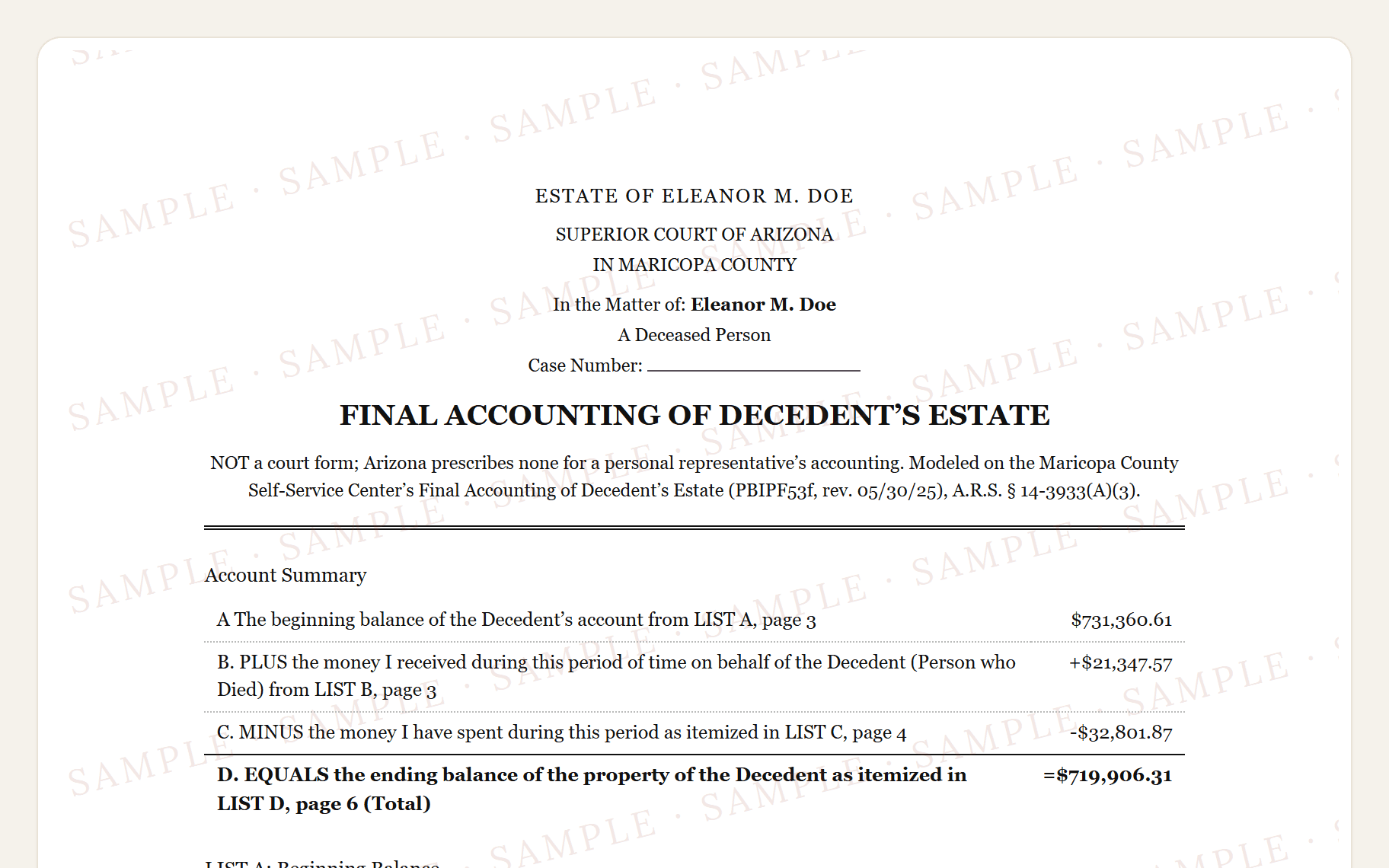
The Final Accounting of Decedent's Estate is signed but not notarized, unlike the inventory. Its own instruction says it plainly: it is not filed with the court, and copies go to every distributee or heir. Its Account Summary is one formula, A plus B minus C equals D: the beginning balance of the estate (List A), plus money received during the period (List B), minus money spent during the period (List C), equals the ending balance of the property (List D). Lists A and D sort assets by the form's own categories, checking, savings, and money market accounts; stocks, bonds, and mutual funds; life insurance received by the estate; and personal property broken into automobiles, household property, art or jewelry, and other, plus real property. Maricopa's form prints no gain or loss schedule anywhere. ExecutorLedger reads that silence the only way that lets the formula balance: a sale's gain over the value the asset was carried at posts to List B, and a loss posts to List C, so List D still equals what remains on hand. A preparer who instead enters a sale's full proceeds as a List B receipt has to also remove the sold item's own inventory value by hand, or the totals will not tie. Pima County's own accounting form takes the opposite, more explicit approach: it adds a Schedule of Gains and a Schedule of Losses as two of its own six lists, reconciling every sale against the asset's carried value directly, and shows distributions in a separate instrument rather than inside the accounting itself.
After List D, Maricopa's form has its own Distribution of Property table, naming every distributee or heir, the property distributed, and its value, cash at the amount distributed and property in kind at the value it was carried at. A Property Remaining in the Estate section follows, one dollar figure for whatever is left on hand, with room to describe how the personal representative intends to use it toward final costs like accounting fees or taxes. ExecutorLedger checks its own math the same way the form implies: List A plus List B minus List C should equal List D, and List D should equal the distributions plus what remains. If those numbers do not tie, the export shows the difference as a warning instead of hiding it.
Section 6 of 7.Where ExecutorLedger fits
Recording is free for as long as the estate takes: every receipt and disbursement with its date and description, distributions per distributee or heir, and a balance that checks itself as you go. ExecutorLedger builds Arizona-style documents from those records, an inventory shaped like Maricopa's Inventory and Appraisement and an accounting shaped like Maricopa's Final Accounting of Decedent's Estate, ready to transcribe onto your own county's form if you end up sending one. Neither is a court form, and your attorney should review them before anything is signed or sent. Every document previews free with your real numbers, and $149 (one-time payment) per estate lifts the watermark.
Section 7 of 7.Questions Arizona executors ask
Is there a court form for Arizona's inventory or accounting?
No. Arizona has adopted no statewide form for either document (Ariz. R. Prob. P. Rule 50(c); the Arizona Supreme Court's mandatory forms, Ariz. Code Jud. Admin. § 3-302, list none). What gets used is whatever self-service form the county publishes, such as Maricopa County's Inventory and Appraisement (PBIP46f) and Final Accounting of Decedent's Estate (PBIPF53f), or Pima County's own blanks.
When is the Arizona inventory due?
Within 90 days after appointment, valued at fair market value as of the date of death, with each item's community or separate nature and any encumbrance noted (A.R.S. § 14-3706). The personal representative either files it with the court or mails it to every heir or devisee.
How is an Arizona personal representative paid?
A.R.S. § 14-3719 sets reasonable compensation, with no statutory percentage schedule. A personal representative can renounce a will's own fee provision before qualifying and take reasonable compensation instead, and an interested person can ask the court to review the amount under A.R.S. § 14-3721, applying the hourly-rate standard in Arizona Code of Judicial Administration § 3-303.
How does an Arizona estate close?
Most close informally: a verified closing statement under A.R.S. § 14-3933, filed no earlier than four months after appointment, with a full written account sent to distributees. The appointment ends automatically a year later if nothing is pending (A.R.S. § 14-3933(B)). A personal representative or, after a year, any interested person can instead petition for formal complete settlement under A.R.S. § 14-3931.
How does ExecutorLedger handle a sale during administration?
Maricopa's own accounting form has no gain or loss schedule, so ExecutorLedger posts a sale's gain over its carried value to List B and a loss to List C, the reading that keeps the form's own A plus B minus C equals D formula true. Pima County's accounting form is more explicit: it reconciles every sale on its own Schedule of Gains and Schedule of Losses.
Not sure which accounting your situation calls for? Which accounting do I need? covers the choice, and the accounting guide explains the structure every format shares.
This page describes Arizona practice as our verified references state it; formats drift and estates differ, and none of this is legal advice. ExecutorLedger produces court-style documents for transcription. They are not official court forms. The accounting your estate needs is a question for its attorney.