Wyoming Estate Accounting: A Representative's Guide
Wyoming probate runs through the district court in the judicial district and county where the estate is opened, sitting in probate rather than as a separate probate court, and its fiduciary is the personal representative. The Wyoming Judicial Branch's self-help site carries exactly one probate tab, titled in the court's own words Probate Forms for Small Estates, holding only the affidavit series for distributing personal and real property in a small estate. A full administration has no inventory form, no appraisal form, no accounting form and no closing form anywhere. The statute is the whole specification. Here is what it requires, the deadlines behind it, and how a Wyoming estate closes.
Section 1 of 7.The two documents: the Inventory with its Report of Appraisal, and the Final Report and Accounting
Wyoming administers decedents' estates under Title 2, Chapter 7 of the Wyoming Statutes, through the district court for the county where the estate is opened. Every section behind this guide is written W.S. 2-7-xxx. There is no form number for any full-administration document, and none should ever be printed or claimed. The small-estate affidavits on the court's self-help page, the PPP series for personal property and the PRP series for real property, are a different, narrower procedure and are not what this guide covers.
The first document is the inventory, required by W.S. 2-7-403. It is one list of all the estate of the decedent, including the homestead if any, filed with the court upon the personal representative's own oath. Wyoming attaches something no other state in this product requires to that inventory: a second, separate sworn filing, the report of appraisal under W.S. 2-7-404, due 120 days after the inventory itself is filed. The inventory sets one 120-day clock running from appointment, and filing it starts a second 120-day clock for the appraisal. ExecutorLedger prints both as one document, the inventory followed by a clearly labeled Report of Appraisal section with its own oath block, because the two are prepared from the same asset list even though they are two filings with two deadlines.
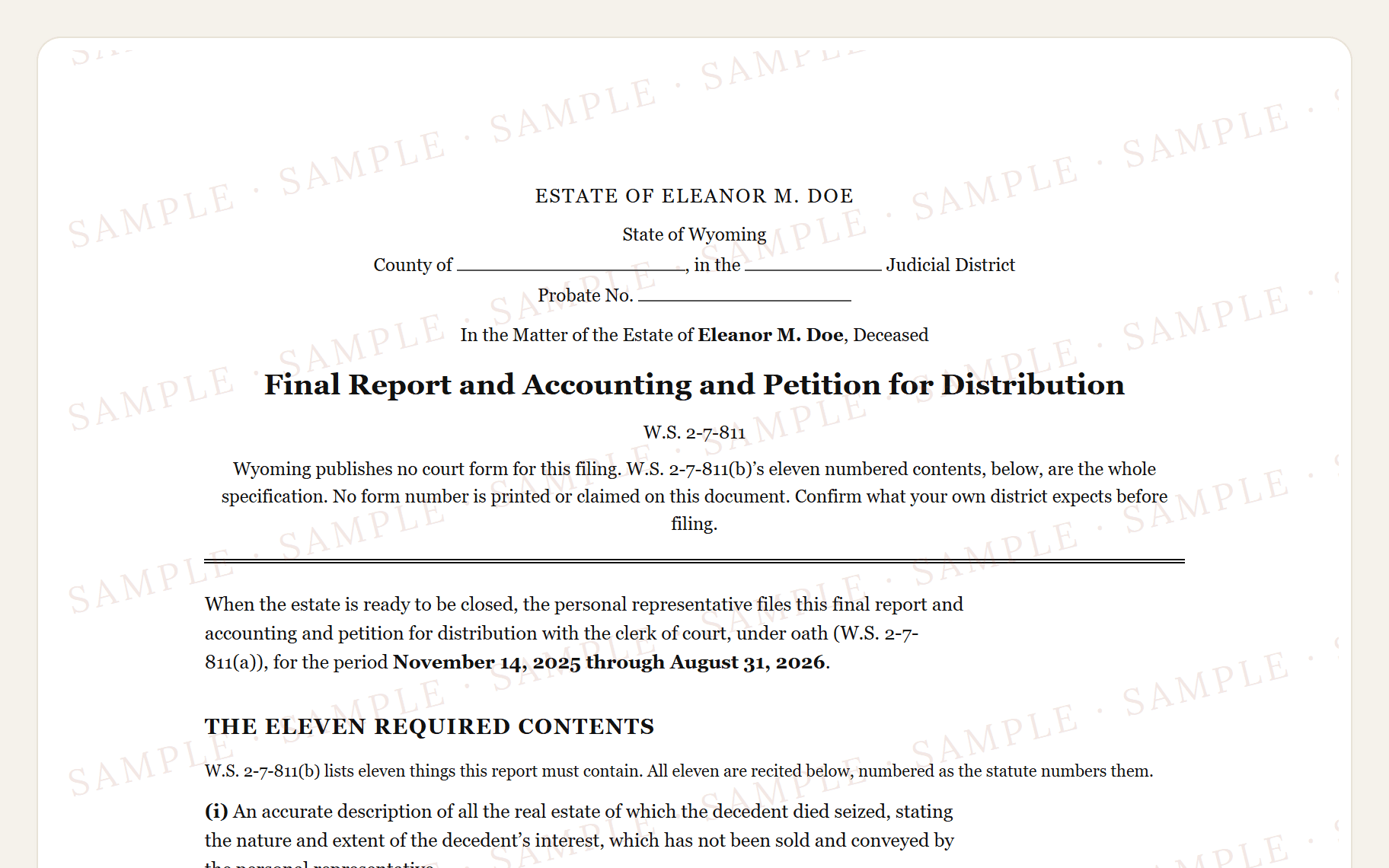
The second document is the final report and accounting and petition for distribution, required by W.S. 2-7-811 once the estate is ready to close. It carries eleven required contents in the statute's own numbered order, described below, and it is filed under oath.
Section 2 of 7.Wyoming's deadlines, with the statute behind each
- Day 7 (about 1 week)Mail notice to spouse, heirs, and beneficiaries
Why
Under Wyo. Stat. § 2-7-205(a)(i), the personal representative generally must mail a copy of the probate notice to the surviving spouse, heirs at law, and named beneficiaries within 1 week after the notice is first published in the newspaper; confirm the actual first-publication date and true mailing deadline with your attorney. - Day 60 (about 2 months)Mail notice to known creditors
Why
Under Wyo. Stat. § 2-7-205(a)(ii), the personal representative generally must mail notice to each creditor whose identity is reasonably ascertainable no later than 30 days before the 3-month claims-filing period (which runs from first publication of the notice) expires; confirm the actual first-publication date and true mailing deadline with your attorney. - Day 90 (about 3 months)Creditor claims bar date
Why
Under Wyo. Stat. §§ 2-7-201, 2-7-703(a), creditor claims are generally barred 3 months after the personal representative's notice to creditors is first published in the newspaper, except that a creditor who was mailed notice has until the later of that date or 30 days after the mailing, so don't pay unfiled claims or distribute assets before the bar passes; because publication follows your appointment by some additional days, the true bar date typically falls later than 90 days after letters. Confirm the actual first-publication date, the creditor mailing dates, and the true bar date with your attorney. - Day 120 (about 4 months)File the estate inventory
Why
Under Wyo. Stat. § 2-7-403(a), the personal representative generally must file a sworn inventory of the estate with the court within 120 days after appointment; confirm the exact due date (and whether the court has granted any extension) with your attorney. - Day 365 (about 1 year)Target date to complete administration
Why
Under Wyo. Stat. § 2-7-801(c), Wyoming generally expects estate administration to be completed within 1 year of your appointment, unless you file a verified report showing good cause and the court approves a continuance; confirm whether an extension applies with your attorney.
- Day 270 (about 9 months)Federal estate tax return (Form 706), if required
Why
Under IRC §6075, Form 706 is due 9 months after death, but only if the gross estate exceeds the federal exemption or the estate elects portability, and a 6-month extension may be available; confirm applicability and timing with your attorney.
The inventory is due within 120 days after the personal representative's appointment, made and returned to the court upon oath (W.S. 2-7-403(a)). Where W.S. 2-5-101's elective share applies, the inventory is instead due within 75 days after the will is admitted to probate (W.S. 2-7-403(b)). ExecutorLedger states that alternative rather than computing it, since the app has no way to know whether a spouse has elected against the will.
Read the full explanation
Missing the 120-day inventory deadline without good cause is contempt of court, and the court imposes a fine and whatever other enforcement it finds fit. The fine is paid into the corpus of the estate, so a late inventory costs the personal representative personally and the money lands back in the estate (W.S. 2-7-403(a)).
The report of appraisal is due within 120 days after the timely filing of the inventory, not within 120 days of appointment. The two 120-day windows run back to back (W.S. 2-7-404(a)).
Property discovered after the inventory is filed goes on its own appraisement, due within one month of the discovery, not merely listed (W.S. 2-7-410).
Missing either the inventory or the report of appraisal within the time allowed lets the court, on notice, revoke the personal representative's letters, and the personal representative stays liable on the bond for any resulting injury to the estate (W.S. 2-7-409). That reaches both filings, and it is a heavier consequence than any other state in this product carries for a late inventory.
If the final report is not filed within one year of appointment, a verified interim report and accounting is due at the one-year mark and annually after that, until the final report and accounting is filed (W.S. 2-7-806(b)).
The final report and petition for distribution may be filed once the estate is ready, but not less than three months after the first publication of the notice of opening the probate (W.S. 2-7-204(a)). After it is filed, anyone interested has ten days from the day named in the notice to file written objections, and settlement follows the day after that or as soon as the matter can be heard.
A federal estate tax return, Form 706, if the estate needs one, is due nine months after death (IRC section 6075), with a possible six-month extension. Confirm whether the estate needs one with your attorney.
Section 3 of 7.What Wyoming pays a personal representative and an attorney
Before any percentage matters, one rule comes first: W.S. 2-7-805(a) says no fees shall be paid to the personal representative or the attorney for the estate except upon order of the court. Either may apply at any time, by written verified application, for partial or total fees for ordinary or extraordinary services, with an itemization for expenses and, for extraordinary services, an itemization showing the kind, nature, extent and time spent. The court allows and authorizes payment only if satisfied it can be paid without detriment to the estate or to anyone interested in it. Fees allowed by an order entered ex parte stay open to timely objection at the hearing on the final report and accounting.
W.S. 2-7-803(a) sets the personal representative's schedule on the value of the probate estate accounted for: 10 percent of the first $1,000, 5 percent of the next $1,000 to $5,000, 3 percent of the next $5,000 to $20,000, and 2 percent above $20,000. The court may allow more for unusual circumstances, and further just and reasonable compensation is available for extraordinary services, expressly including tax matters and litigation (W.S. 2-7-803(b)).
W.S. 2-7-804 gives the estate's attorney the same four tiers on the same base, with the same extraordinary-services allowance, and the personal representative and the attorney may negotiate lower fees than the schedule allows (W.S. 2-7-804(d)).
The base both schedules use, under W.S. 2-7-803(c), is the property the personal representative is chargeable with at its inventory value, adjusted for any loss or increase shown by a reappraisal or an actual sale, plus accretions such as interest, dividends and profits on sales, minus property lost or destroyed without the personal representative's fault. Real estate sold by the personal representative during probate counts as personal property for this purpose.
ExecutorLedger never computes a Wyoming commission from these percentages. Where the estate's own ledger already shows a fee paid, the final report states plainly what the ledger recorded and that Wyoming requires a court order before any fee is paid to the personal representative or the attorney, and that a fee allowed ex parte can still be objected to at the final hearing. It never implies that a recorded figure has already been allowed.
Section 4 of 7.How a Wyoming estate closes
The final report and accounting and petition for distribution is set down for hearing, served under W.S. 2-7-204 and 2-7-205. Objections are filed in writing, in duplicate, with the clerk of court, and the personal representative carries the burden of proof on any issue of fact or law raised at the hearing (W.S. 2-7-811(c), (d), (e)).
W.S. 2-7-204(b) prescribes the wording of the notice that goes out once the final account is on file: a Notice of Final Settlement of Estate, naming the clerk of the district court, the judicial district, the county, the filing date, the last day to object, and the date settlement will follow if no one does. ExecutorLedger prints this notice, in the statute's own words, as a section of the final report.
No decree, discharge or release of bond comes before the taxes. W.S. 2-7-812 has the court satisfy itself, by receipts, canceled checks, certificates, closing letters or other proof, that every federal, state, county and municipal tax has been paid, or that none is chargeable.
Wyoming closes on a court decree, not a sworn closing statement. Once the court approves the final report and accounting and petition for distribution, with any changes it requires, it enters a final decree of distribution naming each person and the share of the estate they are entitled to (W.S. 2-7-813). The personal representative then distributes forthwith, and a distributee may demand, sue for and recover a share the decree awards.
Discharge follows on petition, after proof of payment or receipts (W.S. 2-7-814). The court may also close a pending estate on its own motion when no known assets remain, though that order does not exonerate the personal representative or the surety unless it says so (W.S. 2-7-815). A final settlement does not stop the estate from being reopened later for after-discovered property or to correct a property description (W.S. 2-8-101).
- Keep the one-year clock in mind: Wyoming expects administration to be finished within a year of your appointment, and you'll need a verified report showing good cause plus a court order if you need more time (Wyo. Stat. § 2-7-801(c)).
- When you're ready to close, file a sworn Final Report and Accounting and Petition for Distribution with the district court. It lists the heirs or beneficiaries, accounts for what you've handled (unless every interested party waives that in writing), and proposes how you'll distribute what's left (Wyo. Stat. § 2-7-811).
- Mail a copy of the report and the notice of hearing to the surviving spouse, heirs, and beneficiaries at least 10 days before the hearing unless they've waived notice in writing; anyone who objects can file objections and raise them at the hearing (Wyo. Stat. §§ 2-7-204, 2-7-205(b), 2-7-811).
- After the hearing, the court enters a Final Decree of Distribution. That's your authority to hand out what remains of the estate (Wyo. Stat. § 2-7-813).
- Once everything is paid and distributed as ordered, petition the court for your discharge and show proof you complied; the court then discharges you and your bond from further liability (Wyo. Stat. § 2-7-814).
Wyoming doesn't have an informal, UPC-style sworn closing statement. Every estate closes through this same court-supervised final-report-and-hearing process in the district court that handles probate.
Section 5 of 7.The Inventory, the Report of Appraisal and the Final Report explained for a first-time personal representative
W.S. 2-7-403 puts real property, including the homestead, on the same single inventory list as everything else, with no statutory classification scheme. Any label ExecutorLedger prints beside an item is this file's own plain word for it, never a class the statute names. A recorded date-of-death value prints as the figure on file; where none was recorded, the line prints blank rather than a silent zero, and it is counted separately rather than summed into the total.
The report of appraisal answers W.S. 2-7-404's two limbs. For an asset with a readily determinable market value, the statute asks for one disinterested person's written statement of that value as of the date of death. For everything else, it asks for disinterested persons to determine fair market value and attach a separate written report per asset showing the appraiser's basis. ExecutorLedger records neither an appraiser's name nor a per-asset basis, so this section prints as ruled lines for the preparer to complete, grouped by whether the item looks like it has a readily determinable value, with a note that the classification itself belongs to the preparer, not the app.
Property found after the inventory is filed is its own instrument under W.S. 2-7-410, an appraisement rather than a plain list, filed within one month of the discovery. It never joins the original inventory's total.
Two older rules ride along on the inventory. Naming a debtor as personal representative does not discharge what that person owes the estate; the debt goes on the inventory and the personal representative stays liable for it when it comes due (W.S. 2-7-407). A will that discharges or bequeaths a debt owed to the decedent is not valid against the estate's creditors; it is treated as a specific bequest of the debt, goes on the inventory, and can still be applied to pay debts if needed (W.S. 2-7-408).
The final report's eleven required contents, under W.S. 2-7-811(b), are the document's whole specification, and ExecutorLedger prints all eleven, numbered as the statute numbers them, with ruled blanks for anything the app has no data for: residences and relationships for each heir or devisee, any legal disability, and the name of a conservator or trustee and the court that issued their letters.
Two of the eleven work together and change what the account totals. Item (i) asks for an accurate description of real estate the decedent died owning that the personal representative has not sold and conveyed, describing the interest rather than valuing it. Item (ix) asks for an accounting of the monies and personal property that came into the personal representative's hands. Read together, unsold real estate is described under (i) and stays outside the account entirely; real estate the personal representative did sell is proceeds, and those proceeds enter the account like any other receipt, because W.S. 2-7-803(c) treats real estate sold during probate as personal property. So a Wyoming estate's account total will not match the figure the same sample estate produces in a charge-and-discharge state, because unsold real property is outside the account's scope by statute. That difference is correct, not an error to reconcile.
Item (ix)'s accounting may be waived entirely if all interested parties agree; the other ten contents of the final report may not be waived.
Section 6 of 7.Where ExecutorLedger fits
Recording is free for as long as the estate takes: every receipt and disbursement with its date and description, distributions per beneficiary, and a balance that checks itself as you go. ExecutorLedger builds Wyoming-style documents from those records, an inventory covering all the estate including the homestead with its own Report of Appraisal section and oath block, and a final report and accounting and petition for distribution carrying all eleven of W.S. 2-7-811(b)'s required contents, ready to transcribe or attach when you file. Neither is a court form, and your attorney should review them before anything is signed or filed. Every document previews free with your real numbers, and $149 (one-time payment) per estate lifts the watermark. Usually less than one attorney hour, and typically reimbursable by the estate.
Section 7 of 7.Questions Wyoming executors ask
Is there a court form for Wyoming's inventory or accounting?
No. The Wyoming Judicial Branch's self-help site carries one probate tab, Probate Forms for Small Estates, holding only the PPP and PRP affidavit series for a small estate. A full administration has no inventory form, no appraisal form, no accounting form and no closing form. W.S. 2-7-403, 2-7-404 and 2-7-811 say what a personal representative's inventory, report of appraisal and final report must contain, and that is the whole requirement.
When is the Wyoming inventory due?
Within 120 days after the personal representative's appointment, made and returned to the court upon oath, covering all the estate including the homestead (W.S. 2-7-403(a)). Where the elective share under W.S. 2-5-101 applies, it is due within 75 days after the will is admitted to probate instead (W.S. 2-7-403(b)). A late inventory without good cause is contempt of court, and any fine assessed is paid into the corpus of the estate.
Does Wyoming require an appraisal?
Yes, and it is mandatory, unlike every other state in this product. W.S. 2-7-404 requires a separate sworn report of appraisal, filed within 120 days after the inventory itself is filed, so two 120-day windows run back to back. Missing either the inventory or the report of appraisal lets the court revoke the personal representative's letters (W.S. 2-7-409).
Does real estate count in a Wyoming estate's final account?
Only if it was sold. W.S. 2-7-811(b)(i) has the final report describe real estate the decedent owned that the personal representative has not sold and conveyed, rather than valuing it. The account under (b)(ix) covers monies and personal property that came into the personal representative's hands, so unsold real estate stays outside the account's totals. Real estate the personal representative did sell is treated as personal property, and its proceeds enter the account.
How is a Wyoming personal representative or attorney paid?
No fee may be paid to either one except upon order of the court (W.S. 2-7-805(a)), and a fee allowed on an ex parte order stays open to objection at the hearing on the final report. W.S. 2-7-803 then sets the personal representative's schedule and W.S. 2-7-804 gives the attorney the same tiers: 10 percent of the first $1,000, 5 percent of the next $1,000 to $5,000, 3 percent of the next $5,000 to $20,000, and 2 percent above $20,000, with more available for extraordinary services.
How does a Wyoming estate close?
By a court decree, not a sworn closing statement. The final report and accounting and petition for distribution may be filed no less than three months after the first publication of the notice of opening the probate. Once it is on file, a statutory Notice of Final Settlement goes out, anyone interested has ten days to object, and if no one does, the court enters a final decree of distribution under W.S. 2-7-813 naming each person and share. No decree, discharge or release of bond comes before the estate's taxes are proved paid.
Not sure which accounting your situation calls for? Which accounting do I need? covers the choice, and the accounting guide explains the structure every format shares.
This page describes Wyoming practice as our verified references state it; formats drift and estates differ, and none of this is legal advice. ExecutorLedger produces court-style documents for transcription. They are not official court forms. The accounting your estate needs is a question for its attorney.