Utah Estate Accounting: A Personal Representative's Guide
Utah probate runs through the district court, in the judicial district and county where the estate is opened, and its fiduciary is the personal representative, the executor named in a will or the administrator appointed when there is none. Utah is a Uniform Probate Code state, and its statutes fix what an inventory and a closing statement must contain without fixing any printed form for either one. Here is what the statutes require, the deadlines behind them, and how a Utah estate closes.
Section 1 of 7.The two documents: the Inventory and the personal representative's statement
Utah administers decedents' estates under Title 75, Chapter 3 of the Utah Code, through the district court for the county where the estate is opened. A Utah probate caption names the judicial district, the county, and the case number, the way the Utah State Courts' own form 1002ES prints it. Utah's numbered probate forms, 1001ES through 1011ES, cover the case-opening application and its notices. None of them is an inventory or an account, and the Judicial Council's approved inventory and accounting forms under UCJA 6-501 apply only to guardians and conservators, not to a personal representative of a decedent. There is no form number for either document in this guide, and none should ever be printed on one.
The first document is the inventory, required by Utah Code 75-3-705. Within three months after appointment, the personal representative prepares one list of the property the decedent owned at death, with reasonable detail, each item's fair market value as of the date of death, and the type and amount of any encumbrance on it. A copy goes to any interested person who asks for one. Filing the original with the court is something the personal representative may do, not something the statute requires.
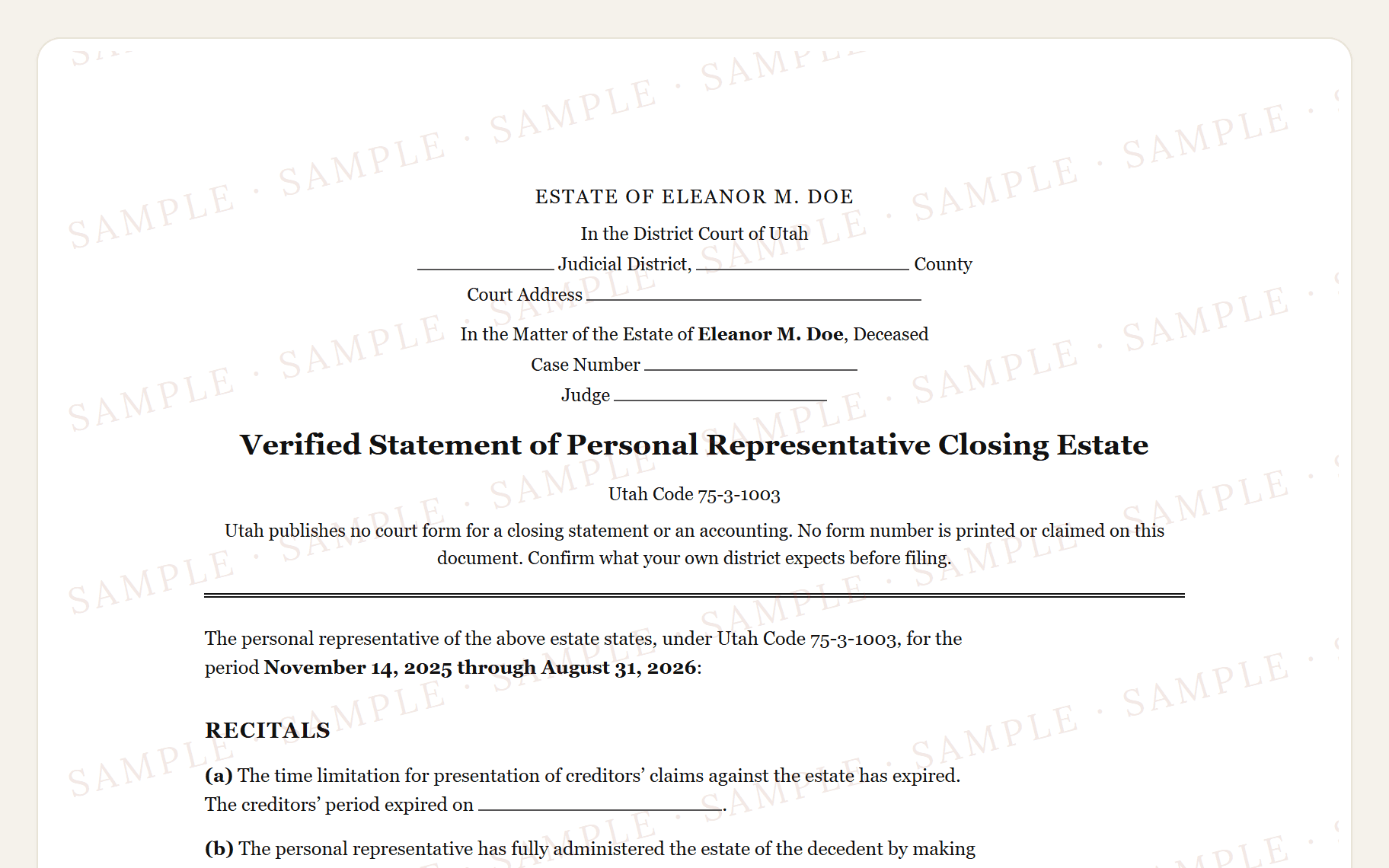
The second document is the closing statement under Utah Code 75-3-1003, a verified statement the personal representative may file once the estate is ready to close. It recites that the creditor claims period has run, that the estate has been fully administered, and that a copy of the statement, along with a full account in writing of the administration, has gone to every distributee and to every known creditor whose claim is neither paid nor barred. Utah's statute sets no content or format for that account. It only requires that one exists and reaches the distributees.
Section 2 of 7.Utah's deadlines, with the statute behind each
- Day 30 (about 1 month)Publish or mail notice to creditors
Why
Under Utah Code §75-3-801, publishing notice to creditors (once a week for three successive weeks, plus the §45-1-101 online notice) is generally optional in Utah, but doing so starts a shorter claims window: published notice bars claims 3 months after the first publication, and a creditor given mailed or delivered notice has until the later of 90 days from the published notice or 60 days from the mailing; the statute sets no deadline for publishing, so this 30-day target from appointment is only a reasonable prompt. Confirm whether and when to publish with your attorney. - Day 90 (about 3 months)Prepare the estate inventory
Why
Under Utah Code §75-3-705, the personal representative generally must prepare an inventory of the decedent's property within 3 months after appointment, listing each item with its fair market value at death and any encumbrances; filing with the court is optional (the statute only requires sending a copy to interested persons who request it), so confirm the timing and whether to file it in your case with your attorney. - Day 120 (about 4 months) · earliest possibleEarliest day to file the closing statement
Why
Under Utah Code §75-3-1003, a personal representative generally may not close the estate by verified closing statement any earlier than 4 months after the date of original appointment, so this date is when the informal closing path first becomes available, not a deadline; confirm that you are ready to close (claims period run, everything paid and distributed) with your attorney.
- Day 270 (about 9 months)Federal estate tax return (Form 706), if required
Why
Under IRC §6075, Form 706 is due 9 months after death, but only if the gross estate exceeds the federal exemption or the estate elects portability, and a 6-month extension may be available; confirm applicability and timing with your attorney. - Day 365 (about 1 year)Calendar the creditor claim cutoff date
Why
Under Utah Code §75-3-803, creditor claims that arose before death are generally barred at the earlier of 1 year after the decedent's death or the shorter notice-based window under §75-3-801, so this 1-year mark is the backstop that applies even if notice was never given; confirm the operative bar date for this estate with your attorney before paying claims or distributing assets.
The inventory is due within three months after the personal representative's appointment, not three months after death (Utah Code 75-3-705).
Read the full explanation
Property discovered afterward, or a value or description in the original inventory that turns out wrong, goes on a supplementary inventory under Utah Code 75-3-707. It is its own instrument, filed with the court only if the original inventory was filed.
The closing statement may be filed no earlier than four months after the date a general personal representative was originally appointed, not four months after death (Utah Code 75-3-1003(1)).
Creditor claims run on a published notice, once a week for three successive weeks, barred three months after the first publication, and on actual written notice, barred at the later of ninety days from the published notice or sixty days after the mailing (Utah Code 75-3-801, 75-3-803). An outer bar of one year after death sits over all of it, and the earliest applicable deadline controls. Utah Code 75-3-803 was amended in 2025, so confirm the current text with your attorney before relying on any of these periods.
Once the closing statement is filed, and if no proceeding involving the personal representative is pending in the court a year later, the appointment terminates on its own, with no order needed (Utah Code 75-3-1003(2)).
A federal estate tax return, Form 706, if the estate needs one, is due nine months after death (IRC section 6075), with a possible six-month extension. Confirm whether the estate needs one with your attorney.
Section 3 of 7.What Utah pays a personal representative
Utah sets no percentage schedule. Utah Code 75-3-718(1) entitles a personal representative and an attorney to reasonable compensation for their services. An amount becomes the reasonable amount without the court weighing it only where a petition seeking approval of it has been filed and no interested person objects, and 75-3-718(2) has the petitioner send that petition to every interested person at least ten days before the hearing.
So a Utah fee is a figure you support with the record of your work, not one you look up in a table. ExecutorLedger never computes a Utah commission from a percentage, since no Utah statute sets one. Where the estate's own records show compensation already paid, that figure is what the closing account reports.
Section 4 of 7.How a Utah estate closes
Utah gives a personal representative two routes to a close, and this guide covers the first in detail. The closing statement under Utah Code 75-3-1003 is a verified filing, not a petition: the personal representative files it once the creditor period has run and the estate is fully administered, after sending every distributee and every known, unpaid creditor a copy of the statement and a full written account. A supervised estate may use this route only if every distributee consents in writing.
The second route is a petition for an order of complete settlement under Utah Code 75-3-1001 and 75-3-1002. It asks the court to approve a final account, construe the will or determine the heirs, and adjudicate the final settlement and distribution. The personal representative may petition at any time once the creditor period has run; any other interested person has to wait a year from the original appointment. ExecutorLedger does not build that petition. It is the other way an estate closes, and worth asking your attorney about if the statement route does not fit.
Two clocks follow the closing statement. A year after it is filed, with no proceeding pending, the personal representative's appointment ends on its own (Utah Code 75-3-1003(2)). Six months after it is filed, claims against the personal representative for breach of fiduciary duty are barred, except claims for fraud, misrepresentation, or inadequate disclosure, which are never barred by that six-month clock (Utah Code 75-3-1005).
- Wait out the creditor claims period before making final distributions. Claims are generally barred at the earlier of 1 year after the decedent's death or the shorter window that runs from published or mailed notice under Utah Code §75-3-801 (see §75-3-803).
- Pay valid claims, administration expenses, and any taxes, then distribute what's left to the people entitled to it.
- Once at least 4 months have passed since your appointment, close informally under §75-3-1003: file a verified closing statement with the district court, send a copy of it to every distributee and to any known creditor whose claim is neither paid nor barred, and give each affected distributee a full written account of your administration (the accounting can be waived if every distributee consents in writing).
- If a distributee objects or you want court sign-off, petition for formal closing under §75-3-1001 (or §75-3-1002 to settle an informally probated will without adjudicating testacy). The court can settle your account, approve the distribution, and discharge you as personal representative.
- Consider collecting a signed receipt and release from each distributee. Utah prescribes no refunding-bond form, and distributees stay liable to unpaid creditors up to the value they received (§75-3-1004) and can be made to return improperly distributed property until the later of 3 years after death or 1 year after distribution (§75-3-1006).
All of this runs through Utah's district court. There is no separate probate, surrogate's, or orphans' court; the registrar (a court officer, typically the clerk or a judge's designee) handles informal filings. If no proceedings are pending 1 year after the closing statement is filed, the appointment terminates automatically (§75-3-1003(2)).
Section 5 of 7.The Inventory and the account explained for a first-time personal representative
Utah names no classes for the inventory, unlike states that sort property into lettered or numbered schedules. Real property sits on the same single list as everything else. Any label ExecutorLedger prints beside an item is this product's own description, never a category the statute asks for. The encumbrance the statute asks for, the type and amount of any lien or charge against an item, is its own datum, printed as a ruled line for you to fill in. It is never subtracted from the value, because Utah Code 75-3-705 asks for the item's value and its encumbrance separately, not a net figure.
Appraisers are optional under Utah Code 75-3-706. Where one is used, the appraiser's name and address go beside the items they appraised. ExecutorLedger records neither, so that stays a ruled blank rather than a claim that an appraisal happened. A supplementary inventory under Utah Code 75-3-707 is its own instrument with its own total, for property found later or a value that needs correcting. It never joins the original inventory's total.
Both documents are signed with the unsworn declaration Utah Code 78B-18a-106 prescribes, not sworn before a notary: "I declare under criminal penalty under the law of Utah that the foregoing is true and correct," with the date, the city or location, the printed name and the signature. Neither document carries a notary jurat.
Utah's statute says nothing about what the closing account has to contain, not a schedule, not a column, not a heading, and Utah Code 75-3-1003(3) lets every distributee waive the account entirely by written consent. The schedules ExecutorLedger prints are this product's own presentation of the estate's records in the standard fiduciary form, offered because a distributee receiving a full account in writing is most likely to recognize that shape. They are not a format Utah requires.
Utah's homestead and exempt property allowances are indexed to inflation every year under Utah Code 75-1-110, so no fixed dollar figure for either belongs on a document meant to stay accurate. If a spouse's elective share ever comes up, it is one third of the augmented estate under Utah Code 75-2-202, not one half.
Section 6 of 7.Where ExecutorLedger fits
Recording is free for as long as the estate takes: every receipt and disbursement with its date and description, distributions per beneficiary, and a balance that checks itself as you go. ExecutorLedger builds Utah-style documents from those records, an inventory in the statute's own single, undifferentiated list and a personal representative's statement with its full account, ready to transcribe or attach when you send a copy to an interested person or file with your court. Neither is a court form, and your attorney should review them before anything is signed or filed. Every document previews free with your real numbers, and $149 (one-time payment) per estate lifts the watermark. Usually less than one attorney hour, and typically reimbursable by the estate.
Section 7 of 7.Questions Utah executors ask
Is there a court form for Utah's inventory or accounting?
No. Utah's numbered probate forms, 1001ES through 1011ES, cover the case-opening application and its notices, not an inventory or an account. The Judicial Council's inventory and accounting forms under UCJA 6-501 apply only to guardians and conservators. Utah Code 75-3-705 and 75-3-1003 say what a personal representative's inventory and closing statement must contain, and that is the whole requirement.
When is the Utah inventory due, and do I have to file it?
Within three months after appointment (Utah Code 75-3-705). Filing the original with the court is optional. What the statute requires is sending a copy to any interested person who asks for one.
How is a Utah personal representative paid?
Utah Code 75-3-718(1) entitles a personal representative to reasonable compensation for their services. There is no percentage schedule. An amount becomes the reasonable amount without the court weighing it only where a petition seeking approval of it has been filed and no interested person objects, and 75-3-718(2) has the petitioner send that petition to every interested person at least ten days before the hearing.
How does a Utah estate close?
Most estates use the closing statement under Utah Code 75-3-1003, a verified filing made no earlier than four months after the personal representative's original appointment, once the creditor period has run and every distributee has received a copy and a full account. The other route is a petition for an order of complete settlement under Utah Code 75-3-1001 and 75-3-1002, which asks the court to approve the final account directly.
What happens after a Utah closing statement is filed?
Two clocks start. A year later, with no proceeding pending, the personal representative's appointment terminates on its own (Utah Code 75-3-1003(2)). Six months later, claims against the personal representative for breach of fiduciary duty are barred, except claims for fraud, misrepresentation, or inadequate disclosure, which stay open (Utah Code 75-3-1005).
Not sure which accounting your situation calls for? Which accounting do I need? covers the choice, and the accounting guide explains the structure every format shares.
This page describes Utah practice as our verified references state it; formats drift and estates differ, and none of this is legal advice. ExecutorLedger produces court-style documents for transcription. They are not official court forms. The accounting your estate needs is a question for its attorney.