Tennessee Estate Accounting: A Representative's Guide
Tennessee probate runs through the probate court or the chancery court in each county, not a single statewide court, and its fiduciary is the personal representative, the executor or administrator depending on whether there was a will. Tennessee has adopted no statewide form for the Estate Inventory or the Accounting. Here is what the county templates commonly cover, the deadlines behind them, and how a Tennessee estate closes.
Section 1 of 7.The two documents: the Estate Inventory and the Accounting
Tennessee administers decedents' estates under Title 30 of the Tennessee Code Annotated, through the probate court or the chancery court in each county, not a single statewide court. Most counties handle probate through Chancery Court, where the clerk and master serves the role a probate clerk plays elsewhere; a handful of counties, including Davidson (Nashville) and Shelby (Memphis), have a dedicated probate court instead. The statute calls the fiduciary the personal representative throughout, and this guide uses the same term.
Tennessee has adopted no statewide form for either document a personal representative files, the Estate Inventory or the Accounting. Each county clerk publishes its own template, and the four largest counties researched here, Davidson, Shelby, Knox and Hamilton, differ sharply. Davidson and Knox each publish a categorized Estate Inventory with a personal property schedule and a real property schedule; Shelby's and Hamilton's inventory forms are bare, uncategorized blanks instead. Only Shelby and Davidson publish a periodic or final Accounting schedule at all. Knox and Hamilton publish no Accounting blank of any kind, only a sworn statement in lieu once a detailed accounting is properly waived, so a personal representative there who has not qualified for that waiver route has to build a compliant accounting from scratch.
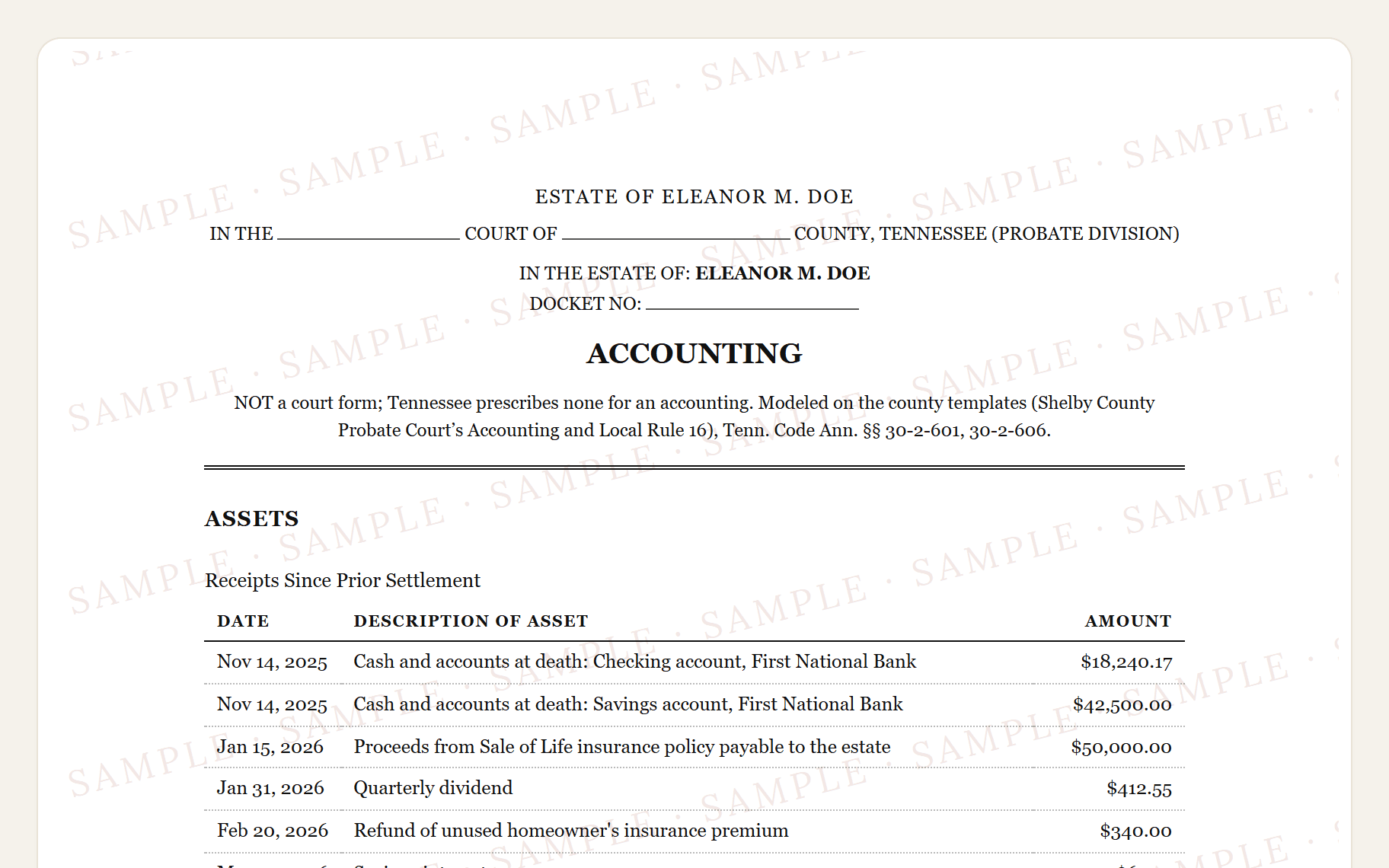
The Accounting itself follows what Tenn. Code Ann. § 30-2-606 calls a charge and credit: the clerk charges every accounting party with all sums of money received, or that could have been received with due diligence, and credits the accounting party with reasonable compensation and with disbursements supported by lawful vouchers. Shelby County's own Accounting form implements that model directly, in three pages: money charged in as assets, disbursements credited out, and a summary that ties the two together. This is a cash accounting, not one that measures a gain or loss against what an asset was worth at the decedent's death; nothing in the statute or in the county forms researched builds that comparison.
Section 2 of 7.The Tennessee deadlines, with the statute behind each
- Day 30 (about 1 month)Confirm notice to creditors was published
Why
Under Tenn. Code Ann. § 30-2-306, the court clerk (not the personal representative) typically must publish notice of the personal representative's qualification in a county newspaper for two consecutive weeks (or post it in three public places where no qualifying newspaper exists) within 30 days after letters issue, and the personal representative generally must also mail or deliver a copy of that notice to every creditor the representative actually knows of or can reasonably ascertain; confirm the publication ran and your known-creditor mailing list with your attorney. - Day 60 (about 2 months)File the estate inventory with the court
Why
Under Tenn. Code Ann. § 30-2-301, the personal representative typically must file a complete and accurate inventory of the probate estate with the court clerk within 60 days after entering on administration (i.e., after letters issue), verified by oath, unless the will excuses the inventory or all residuary legatees/distributees have waived it; confirm whether a waiver applies and the exact due date with your attorney. - Day 60 (about 2 months)Send will/letters copies to beneficiaries and heirs
Why
Under Tenn. Code Ann. § 30-2-301, within that same 60 days, the personal representative generally must send a complete copy of the will to beneficiaries sharing in the residue, a copy of the paragraph(s) containing their bequest to other legatees, and a copy of the letters of administration to residuary distributees of an intestate estate, then file an affidavit with the clerk confirming the copies were mailed or delivered; confirm exactly who must be notified with your attorney. - Day 60 (about 2 months)Notify TennCare (Medicaid) of the death
Why
Under Tenn. Code Ann. §§ 71-5-116(d), 30-2-301(b), the personal representative generally must notify the Bureau of TennCare of the death within 60 days after letters issue (§ 71-5-116(d)(1)(B) requires it for any decedent age 55 or older, and § 30-2-301(b) separately requires filing an affidavit with the clerk within the same 60 days confirming TennCare was notified), and the estate typically cannot be closed until TennCare issues a release, waiver, or no-amount-due statement under § 71-5-116(c)(2); confirm whether this applies with your attorney. - Day 450 (about 15 months)File the first accounting with the court
Why
Under Tenn. Code Ann. § 30-2-601, the personal representative typically must file the first accounting (or, where a detailed accounting was properly waived, the statement in lieu of accounting the statute allows) with the court clerk within 15 months of qualifying, and annually thereafter until the estate closes; confirm the exact schedule and whether a waiver applies with your attorney.
- Day 270 (about 9 months)Federal estate tax return (Form 706), if required
Why
Under IRC §6075, Form 706 is due 9 months after death, but only if the gross estate exceeds the federal exemption or the estate elects portability, and a 6-month extension may be available; confirm applicability and timing with your attorney. - Day 365 (about 1 year)Outer cutoff for creditor claims (12 months)
Why
Under Tenn. Code Ann. § 30-2-307, creditor claims are generally barred unless filed within the period stated in the published notice (4 months after first publication; a creditor who was mailed actual notice gets the later of that date or 60 days after its notice), and in all events the clerk typically must return any claim received more than 12 months after the date of death; calendar this outer date before making final distributions, and confirm the actual, likely-earlier bar date for this estate with your attorney.
Within 60 days after entering on the administration of the estate, meaning after letters issue, the personal representative files a complete and accurate Estate Inventory with the clerk of the court exercising probate jurisdiction in the county of the estate, verified by oath (Tenn. Code Ann. § 30-2-301(a)). A solvent estate's inventory can be waived if the will excuses it or every residuary distributee or legatee agrees, unless one of them later demands it.
Read the full explanation
Within that same 60 days, the personal representative sends a copy of the will, or a copy of the letters of administration for an intestate estate, to the residuary distributees or legatees, and files an affidavit confirming that was done, along with a separate affidavit that the Bureau of TennCare has been notified (Tenn. Code Ann. § 30-2-301(b)). Both the will-copy duty and its affidavit fall away entirely if the personal representative is the sole beneficiary or the will was admitted to probate in solemn form.
The clerk, not the personal representative, publishes notice to creditors within 30 days after letters issue, twice weekly for two consecutive weeks, or posts it in three public places where no county newspaper runs; the personal representative separately mails or delivers that same notice to every creditor known or reasonably ascertainable (Tenn. Code Ann. § 30-2-306).
Creditor claims are barred at the earlier of four months after the first publication or twelve months after the date of death, and the clerk must return any claim filed after that twelve-month outer date regardless (Tenn. Code Ann. §§ 30-2-307, 30-2-310).
The first accounting is due within fifteen months of qualification, and every accounting after that is due annually, counted from the date the first one was filed rather than from a calendar year (Tenn. Code Ann. § 30-2-601).
A federal estate tax return, Form 706, if the estate needs one, is due nine months after death (IRC § 6075), with a possible six-month extension. Confirm whether the estate needs one with your attorney.
Tennessee charges no inheritance or estate tax on any decedent who died in 2016 or later (Tenn. Code Ann. § 67-8-318); the exemption had already grown to $5,000,000 for 2015 deaths before the tax was repealed.
Section 3 of 7.What Tennessee pays a personal representative
Tenn. Code Ann. § 30-2-606 directs the clerk to credit the accounting party, ordinarily the personal representative, with reasonable compensation for services, as part of the same charge and credit tie-out that covers ordinary disbursements. There is no statutory percentage schedule of any kind; the clerk decides what is reasonable based on the estate and the work done.
Tenn. Code Ann. § 30-2-317(a)(1) makes that compensation a first-priority cost of administration, paid ahead of funeral expenses, taxes, and other claims against the estate. Shelby County sets the actual dollar figure in a separate document, the Order Confirming Accounting, issued at the same time the clerk settles the accounting, rather than as a line inside the accounting itself.
Section 4 of 7.How a Tennessee estate closes
A Tennessee estate closes by filing a final accounting, or, where a detailed accounting was properly waived, a sworn statement in lieu of one, with the clerk of the court exercising probate jurisdiction. Before the clerk takes the accounting, interested parties get at least five days' notice of the date fixed for taking it, unless that notice is waived in writing, and the clerk must publish notice in a newspaper if any interested party's address is unknown (Tenn. Code Ann. § 30-2-603).
Once the clerk states the accounting, any interested person has 30 days to except to it, then 30 more days to appeal the clerk's ruling on that exception. Tennessee calls this settling the accounting (Tenn. Code Ann. § 30-2-607).
A solvent estate can skip a detailed accounting altogether if the will waives it or every residuary distributee files a sworn waiver; a status report is filed instead, and once the creditor claims period runs, the personal representative and the distributees may each file a separate sworn statement in lieu of a detailed accounting (Tenn. Code Ann. § 30-2-601(b)).
The personal representative collects a signed receipt from each distributee when handing out that distributee's share (Tenn. Code Ann. § 30-2-707). An estate with $50,000 or less of personal property, and no real property at issue, can use the Small Estate Probate Act's limited-letters route instead of a full administration, after a 45-day wait from the date of death (Tenn. Code Ann. § 30-4-101 and following).
- File your final accounting with the clerk and master (or your county's probate clerk), an itemized report of everything the estate received, paid out, and has left to distribute (T.C.A. § 30-2-601). If the will or every residuary beneficiary properly waived a detailed accounting, you can file the simpler sworn statement in lieu of accounting the statute allows instead.
- Give interested parties the chance to except to (challenge) the accounting before the court confirms it. This is what Tennessee calls 'settling' the account.
- Collect a signed receipt and release from each beneficiary when you hand out their share.
- If the decedent was 55 or older or ever on TennCare (Medicaid), get TennCare's written release, waiver, or 'no amount due' letter before you ask the court to close the estate. T.C.A. § 71-5-116(c)(2) makes it a precondition to closing.
- Once the account is settled and distributions are done, petition the court for your formal discharge as personal representative.
Which court you file in varies by county: most Tennessee counties handle probate in Chancery Court through the Clerk and Master, but some counties (e.g., Davidson/Nashville, Shelby/Memphis) have a dedicated Probate Court, and a few vest it in General Sessions or Circuit Court by private act. Confirm your county's venue and local procedure with your attorney or the clerk's office.
Section 5 of 7.The Estate Inventory and the Accounting explained for a first-time personal representative
The Estate Inventory follows Davidson County's Estate Inventory, dated 9/1/22: a personal property schedule and a separate real property schedule, each with its own total. Every value column reads without deducting any encumbrances, so what prints is the gross value of the decedent's interest, never a figure netted against a mortgage or a lien. A real property schedule's lienholder column has no equivalent in this app's records, so it prints as a labeled blank for the personal representative to fill in by hand.
Davidson's form lists 31 numbered categories of personal property, from cash on hand through a catch-all for anything not already listed. ExecutorLedger's own registry does not track 31 separate categories, so it collapses them onto the handful its own asset categories can place, cash, bank accounts, brokerage holdings, vehicles, household goods, business interests, and everything else, each printed under the Davidson category line that fits. The inventory's own NONE and HUSBAND WIFE / JOINT columns stay blank for the personal representative to complete.
The Accounting follows Shelby County's three-page form: assets charged in on page one, expenditures and disbursements credited out on page two, and a summary that ties the two together on page three. Because the underlying model is a cash charge and credit rather than a carry-value comparison, a sale of estate property posts its full cash proceeds as a receipt, never a gain or loss measured against the asset's inventory value; no statute or county form read anywhere builds that comparison.
A cash distribution to a beneficiary posts as an ordinary disbursement, the same as any other expense. Tangible personal property still on hand at the end of the accounting period is listed separately from the monetary portion, with no dollar value required, matching Shelby County's own Local Rule 16.B.7.b. Real property stays off the Accounting entirely unless it was sold during the period, since it is not the kind of asset the charge and credit model tracks in cash.
Section 6 of 7.Where ExecutorLedger fits
Recording is free for as long as the estate takes: every receipt and disbursement with its date and description, distributions per beneficiary, and a balance that checks itself as you go. ExecutorLedger builds Tennessee-style documents from those records, an Estate Inventory shaped like Davidson County's and an Accounting shaped like Shelby County's, ready to transcribe onto your own county's form if you end up filing one. Neither is a court form, and your attorney should review them before anything is signed or filed. Every document previews free with your real numbers, and $149 (one-time payment) per estate lifts the watermark.
Section 7 of 7.Questions Tennessee executors ask
Is there a court form for Tennessee's inventory or accounting?
No. Tennessee has adopted no statewide form for either document. Each county clerk publishes its own, and Knox and Hamilton publish no accounting form at all, only a sworn statement in lieu once a detailed accounting is properly waived. This guide draws on Davidson County's and Shelby County's own templates (Tenn. Code Ann. §§ 30-2-301, 30-2-601).
When is the Tennessee Estate Inventory due?
Within 60 days after the personal representative enters on the administration of the estate, meaning after letters issue, verified by oath before the clerk (Tenn. Code Ann. § 30-2-301(a)). A solvent estate can skip it if the will excuses it or every residuary distributee or legatee agrees.
How is a Tennessee personal representative paid?
Tenn. Code Ann. § 30-2-606 directs the clerk to credit the accounting party with reasonable compensation, a first-priority cost of administration under § 30-2-317(a)(1). There is no statutory percentage schedule; Shelby County sets the actual figure in its own Order Confirming Accounting.
How does a Tennessee estate close?
By filing a final accounting with the clerk, giving interested parties 30 days to except to it once the clerk states it (Tenn. Code Ann. § 30-2-607), and collecting a signed receipt from each distributee (§ 30-2-707). A solvent estate can use the sworn statement in lieu of a detailed accounting instead, once the will or every residuary distributee waives it (§ 30-2-601(b)).
Does Tennessee charge an inheritance or estate tax?
Not for any decedent who died in 2016 or later. Tenn. Code Ann. § 67-8-318 repealed the tax as of that year, after the exemption had already grown to $5,000,000 for 2015 deaths.
Not sure which accounting your situation calls for? Which accounting do I need? covers the choice, and the accounting guide explains the structure every format shares.
This page describes Tennessee practice as our verified references state it; formats drift and estates differ, and none of this is legal advice. ExecutorLedger produces court-style documents for transcription. They are not official court forms. The accounting your estate needs is a question for its attorney.