Oregon Estate Accounting: A Personal Representative's Guide
Oregon probate runs through the circuit court in each county, and its fiduciary is the personal representative, the executor named in a will or the administrator appointed when there is none. Oregon splits its two documents down the middle. The inventory has no form at all, just a statute. The accounting has a real statewide form, published by the Oregon Judicial Department, which every judicial district must accept and some counties require. Here is what each document covers, the deadlines behind them, and how an Oregon estate closes.
Section 1 of 7.The two documents: the Inventory and the Accounting
Oregon administers decedents' estates under ORS chapters 111 through 118, through the circuit court in each county. A caption on any Oregon probate filing reads IN THE CIRCUIT COURT OF THE STATE OF OREGON FOR THE COUNTY OF ______, because Oregon's probate jurisdiction sits with the circuit courts rather than a separate probate court.
The first document is the inventory, required by ORS 113.165. No Oregon Judicial Department form exists for it. The statute is the whole specification, and no form number should ever be printed on it.
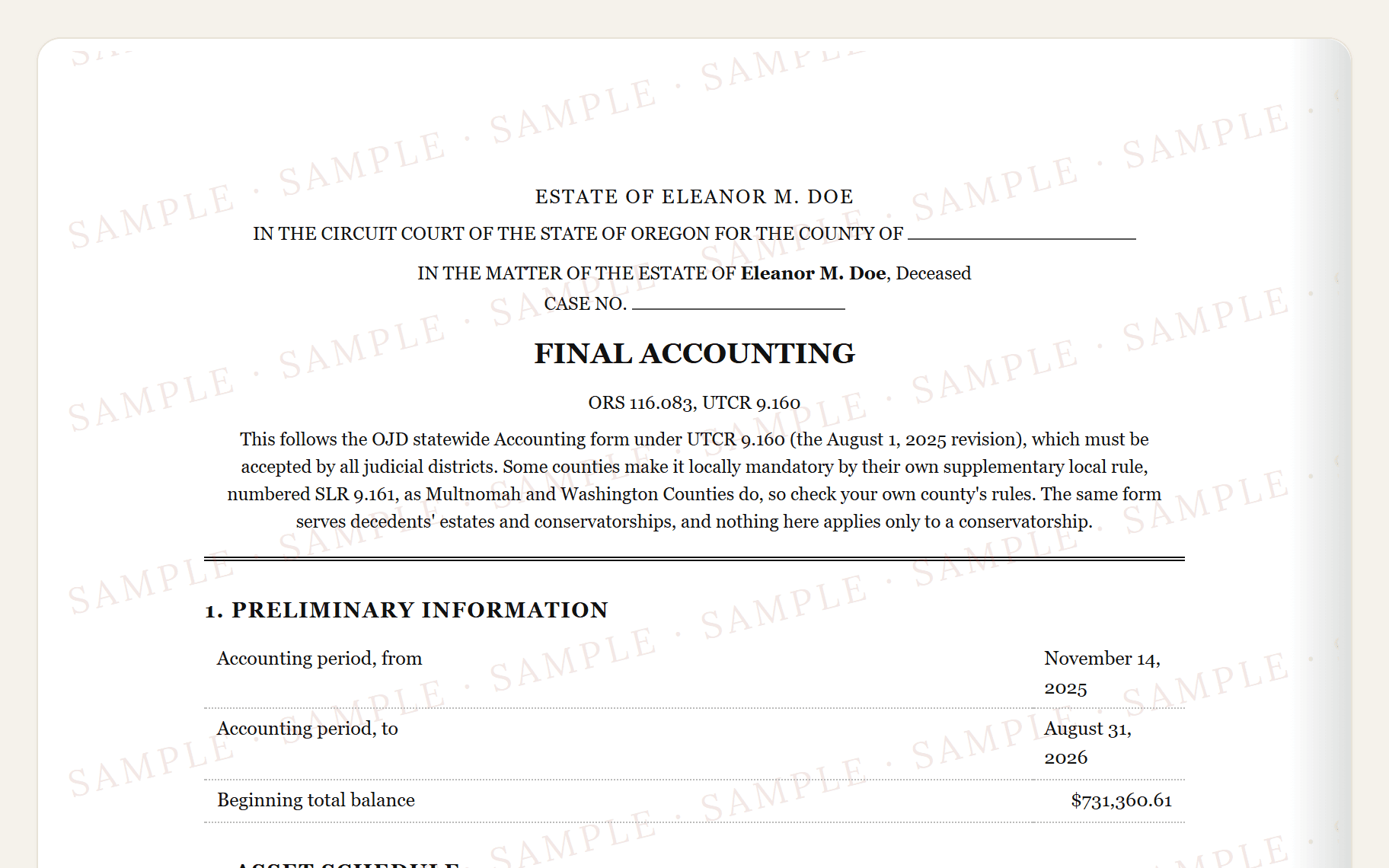
The second document is the accounting, whose duty comes from ORS 116.083 and whose format comes from UTCR 9.160, a uniform trial court rule. The Oregon Judicial Department publishes a statewide Accounting form, revised August 1, 2025, that must be accepted by all judicial districts. Some counties go further and make that same form locally mandatory by their own supplementary local rule, each numbered SLR 9.161, which is the number UTCR 9.160 reserves for it: Multnomah County and Washington County both do. Others may too, so check your own county's supplementary local rules. The same OJD form also serves conservatorship accountings, and this guide covers only the decedent's-estate use of it.
Section 2 of 7.Oregon's deadlines, with the statute behind each
- Day 30 (about 1 month)Notice to heirs, devisees, and DHS/OHA
Why
Under ORS 113.145, upon appointment the personal representative generally must deliver or mail an information notice to devisees, heirs, and other interested persons and file proof of that delivery or mailing (or a waiver) within 30 days after appointment, and in every estate must also send the same information plus a copy of the death record to the Department of Human Services and the Oregon Health Authority within 30 days after appointment (ORS 113.145(6)); confirm the full recipient list and mailing dates with your attorney. - Day 90 (about 3 months)File the estate inventory
Why
Under ORS 113.165, the personal representative generally must file an inventory of estate property, showing fair-market-value estimates as of the date of death, within 90 days after the date of appointment unless the court grants a longer time; confirm the operative deadline and whether an extension applies with your attorney. - Day 120 (about 4 months)Identify and notify known creditors
Why
Under ORS 115.003, the personal representative generally has 3 months after appointment (extendable by the court) to investigate the decedent's records for ascertainable claimants, then must deliver or mail notice to each known claimant no later than 30 days after that period ends (an outer bound of about 4 months after appointment), and later file proof of compliance; confirm the actual investigation-period end date and mailing deadline with your attorney. - Day 120 (about 4 months)Creditor claims bar date
Why
Under ORS 115.005, claims against the estate are generally barred unless presented by the later of 4 months after the date of publication of notice to interested persons, or (for creditors who were separately, directly notified under ORS 115.003) 45 days after that personal notice is delivered or mailed; publication is required 'upon appointment' (ORS 113.155), so this entry anchors conservatively to the appointment date rather than the true publication date. Confirm the actual publication date and whether any known-creditor notice extends the bar date with your attorney.
- Day 270 (about 9 months)Federal estate tax return (Form 706), if required
Why
Under IRC §6075, Form 706 is due 9 months after death, but only if the gross estate exceeds the federal exemption or the estate elects portability, and a 6-month extension may be available; confirm applicability and timing with your attorney. - Day 365 (about 1 year)Oregon estate transfer tax return (Form OR-706), if required
Why
Under ORS 118.100, for deaths on or after January 1, 2022, Oregon's estate transfer tax return and payment are generally due no later than 12 months after the date of death (a 6-month filing extension is available on request but does not extend the time to pay), and a return is generally required only if the gross estate is $1,000,000 or more (ORS 118.160); confirm whether a return is required and the exact due date with your attorney.
The inventory is due within 90 days after the date of appointment, unless the court grants a longer time (ORS 113.165). Ninety days, not sixty. A sixty-day figure circulates in some lower-quality sources and is wrong.
Read the full explanation
Property discovered after the inventory is filed gets a supplemental inventory, due within 30 days of the discovery, or it can be folded into the next accounting instead (ORS 113.175).
The accounting is due annually, within 60 days after the anniversary of the personal representative's appointment, unless the court orders otherwise. It is also due on the personal representative's resignation or removal, and again at final settlement (ORS 116.083). Distributees may consent in writing to a simplified statement in place of an annual accounting.
Creditor claims follow a four-month period running from the first publication of the notice to interested persons (ORS 115.005(2)(a)). A claimant who was given actual notice instead has a period running from that notice, and because its length depends on when the notice went out, confirm the date it applies from before relying on it
A federal estate tax return, Form 706, if the estate needs one, is due nine months after death (IRC section 6075), with a possible six-month extension. Confirm whether the estate needs one with your attorney.
Section 3 of 7.What Oregon pays a personal representative
ORS 116.173 sets a real bracketed schedule for property subject to the court's jurisdiction: 7 percent of any sum not exceeding $1,000, 4 percent of the amount above $1,000 and not exceeding $10,000, 3 percent of the amount above $10,000 and not exceeding $50,000, and 2 percent of the amount above $50,000. Those brackets are $1,000, $10,000 and $50,000, not $100,000 or $1,000,000. A further 1 percent applies to property not subject to the court's jurisdiction but reportable for Oregon or federal estate tax purposes, excluding life insurance proceeds.
The schedule's own base is wider than any single figure ExecutorLedger's ledger holds, since it takes in income received during administration and gains realized on the property as well as the property itself. So ExecutorLedger's Oregon accounting shows what the ledger recorded as compensation and cites ORS 116.173 beside it, and the fee itself is the preparer's to compute against the statute's own broader base.
Section 4 of 7.How an Oregon estate closes
A final accounting closes the estate, and it carries two statements the annual accountings do not. Both were added or restated by 2025 legislation, so older guidance found online may not mention them.
Chapter 463 of the 2025 Oregon Laws rewrote this part of ORS 116.083, and it is easy to read the new sentence backwards. The default is that evidence of disbursements accompanies the account: the vouchers are filed with it. Only where an order or rule of the court says otherwise, or where the personal representative is a trust company that has complied with ORS 709.030, is the evidence kept rather than filed, and the account must then say so, and say that interested persons may inspect and copy it at their own expense, at the personal representative's place of business during normal business hours, for at least one year after the order approving the final account is entered.
The final accounting also carries ORS 116.083's tax representation, in the statute's own words: a statement that all Oregon income taxes, estate taxes and personal property taxes that are due, if any, have been paid, or if not paid, that payment of those taxes has been secured by bond, deposit or otherwise.
The OJD form's own note is worth keeping in mind: annual accountings in a decedent's estate are generally not approved by the court until the final accounting is approved, so an annual accounting's approval usually waits.
A small estate can skip a full accounting altogether. Oregon's small-estate affidavit route, ORS 114.505 to 114.560, displaces a full accounting below a dollar threshold. Senate Bill 168 of the 2025 session changed that threshold, so a figure published before then may be out of date. Check the current threshold, or ask your attorney, before relying on the affidavit route.
- See if you can skip the full final account: if every distributee consents in writing (consent isn't needed from one who only received a cash gift or specific item already paid in full) and every creditor has been paid except administrative expenses awaiting court approval, file a verified statement in lieu of a final account (ORS 116.083(5)). No notice-of-objection period is required for that statement (ORS 116.083(6)).
- Otherwise, prepare a full final account in the statewide UTCR 9.160 format (an asset schedule cross-referenced to receipts-and-disbursements schedules) and mail copies, with notice of the objection deadline, to each distributee and each unpaid creditor at least 20 days before that deadline (ORS 116.093).
- File the account or statement together with a petition for a judgment of final distribution in the circuit court's probate department that opened the estate (or the county court in Gilliam, Grant, Harney, Malheur, Sherman, and Wheeler counties, ORS 111.055(2)).
- Once the court enters the general judgment of final distribution (ORS 116.113), distribute the estate as it directs, then file proof of distribution so the court can enter the supplemental judgment discharging you as personal representative (ORS 116.213).
- Tell distributees Oregon has no refunding bond to pre-sign; instead ORS 116.043 lets you petition the court to order a distributee to return distributed property (or pay its value) if claims, expenses, or taxes surface later. That's worth a plain-language mention on any receipt and release you send.
Oregon's probate code gives executors two closing routes, a consent-based verified statement or a full final account, but both end with a court judgment; Oregon never fully exits the court's involvement the way some pure-UPC states do.
Section 5 of 7.The Inventory and the Accounting form explained for a first-time personal representative
ORS 113.165 asks for the personal representative's own estimates of fair market value as of the date of death, not an appraisal. Where nothing has come into the personal representative's possession or knowledge, the filing itself is an inventory, a statement saying so, not a gap in the record. ORS 113.185 makes an appraisal available, at the estate's expense, for any item whose value is subject to reasonable doubt, by a qualified, disinterested appraiser, and the court can order one too, but nothing requires it. Oregon states no classification scheme for the inventory, so any grouping ExecutorLedger uses on the print is this product's own, not the statute's.
The OJD Accounting form's Preliminary Information section asks for the accounting period's from and to dates, the beginning total balance, and the bond or restriction status. The August 2025 revision tied the beginning balance down: a first annual accounting's beginning balance has to match the inventory total, and every later accounting's beginning balance has to match the prior accounting's ending balance. ExecutorLedger computes the first case, since it holds the inventory, and rules a blank for the second, since it holds no prior accounting.
The Asset Schedule has five columns: Description, Beginning Value, Value of Later-Acquired Asset, Value at Disposition, and Ending Value. It covers everything the estate owned at any point in the period, drawn from the inventory, any supplemental inventory, and the prior accounting. An asset disposed of during the period shows a Value at Disposition and an Ending Value of zero, which is the form's own guard against counting it twice.
The Receipts and Disbursements section wants a separate chronological schedule for each depository account, each one opening with that account's own beginning balance as its first receipts entry. ExecutorLedger's ledger does not record which depository account a transaction belongs to, so ExecutorLedger's print produces one combined schedule instead of one per account, and says so plainly. Splitting it into per-account schedules is the preparer's to do before filing.
Vouchers and Depository Statements, Narrative Description of Changes, and Fiduciary Disclosures under UTCR 9.170 are sections ExecutorLedger's ledger holds no data for: no voucher images, no narrative of a stock split or a change in living expenses, no record of a gift or a related-party transaction. Those sections print with ruled blanks, and the print says plainly that a fiduciary disclosure is the preparer's to make, not something the ledger can know. The form closes with a declaration under penalty of perjury, which is the personal representative's own to sign, not ExecutorLedger's to generate.
Section 6 of 7.Where ExecutorLedger fits
Recording is free for as long as the estate takes: every receipt and disbursement with its date and description, distributions per beneficiary, and a balance that checks itself as you go. ExecutorLedger builds an Oregon-style inventory under ORS 113.165 and an Oregon-style accounting shaped like the OJD Accounting form's own sections, ready to transcribe when you file the accounting or furnish the inventory. Neither is a court form, and your attorney should review them before anything is signed or filed. Every document previews free with your real numbers, and $149 (one-time payment) per estate lifts the watermark.
Section 7 of 7.Questions Oregon executors ask
Is there a court form for Oregon's inventory or accounting?
Split. The inventory under ORS 113.165 has no Oregon Judicial Department form; the statute is the whole specification. The accounting does have one, a statewide Accounting form under UTCR 9.160, revised August 1, 2025, that must be accepted in every judicial district. Accepted everywhere is not the same as required everywhere: a county requires it by adopting its own supplementary local rule, numbered SLR 9.161, as Multnomah and Washington Counties have.
When is the Oregon inventory due?
Within 90 days after the date of appointment, unless the court grants a longer time (ORS 113.165). Property discovered later gets a supplemental inventory within 30 days of the discovery, or it can be folded into the next accounting instead (ORS 113.175).
Does Oregon require an annual accounting?
Yes, within 60 days after the anniversary of the personal representative's appointment, unless the court orders otherwise, and again on resignation, removal, or final settlement (ORS 116.083). Distributees can consent in writing to a simplified statement instead. Since 2025 c.463, the evidence of disbursements accompanies the account unless an order or rule of the court says otherwise, or the personal representative is a trust company under ORS 709.030, and only then does the account state that the evidence is kept rather than filed.
How is an Oregon personal representative paid?
ORS 116.173 sets a bracketed schedule: 7 percent of the first $1,000, 4 percent of the amount above $1,000 up to $10,000, 3 percent of the amount above $10,000 up to $50,000, and 2 percent above $50,000, plus 1 percent of reportable property outside the court's jurisdiction, excluding life insurance proceeds. The schedule's base is wider than any single ledger figure, since it includes income and gains realized during administration.
Can a small Oregon estate skip the full accounting?
Oregon's small-estate affidavit route, ORS 114.505 to 114.560, displaces a full accounting below a dollar threshold. Senate Bill 168 of the 2025 session changed that threshold, and the current figure should be checked with the court or your attorney before relying on it.
Not sure which accounting your situation calls for? Which accounting do I need? covers the choice, and the accounting guide explains the structure every format shares.
This page describes Oregon practice as our verified references state it; formats drift and estates differ, and none of this is legal advice. ExecutorLedger produces court-style documents for transcription. They are not official court forms. The accounting your estate needs is a question for its attorney.