Oklahoma Estate Accounting: A Representative's Guide
Oklahoma probate runs through the district court of each county, and its fiduciary is the personal representative, the executor named in a will or the administrator appointed when there is none. Oklahoma publishes no statewide probate form. The statutes are the whole specification. Here is what they require of an inventory and of an account, the deadlines behind them, and how an Oklahoma estate closes.
Section 1 of 7.The two documents: the Inventory and the Account
Oklahoma administers decedents' estates in the district court, not a separate probate court, so a caption on any Oklahoma filing reads IN THE DISTRICT COURT OF ______ COUNTY, STATE OF OKLAHOMA. Oklahoma publishes no statewide probate form. Title 58 of the Oklahoma Statutes is the whole specification, and no form number should ever be printed or claimed.
Oklahoma has no unsupervised or independent administration, and no closing statement that lets an estate skip the court. Every Oklahoma estate's account is reviewed by the court, and the final account is allowed by the court's own decree.
The first document is the inventory, required by 58 O.S. 281. It names everything of the decedent's estate that came to the personal representative's possession or knowledge, designating the homestead and the exempt personal property as the law provides. It closes with the personal representative's sworn oath, under 58 O.S. 287, that it is a true statement of everything known to them.
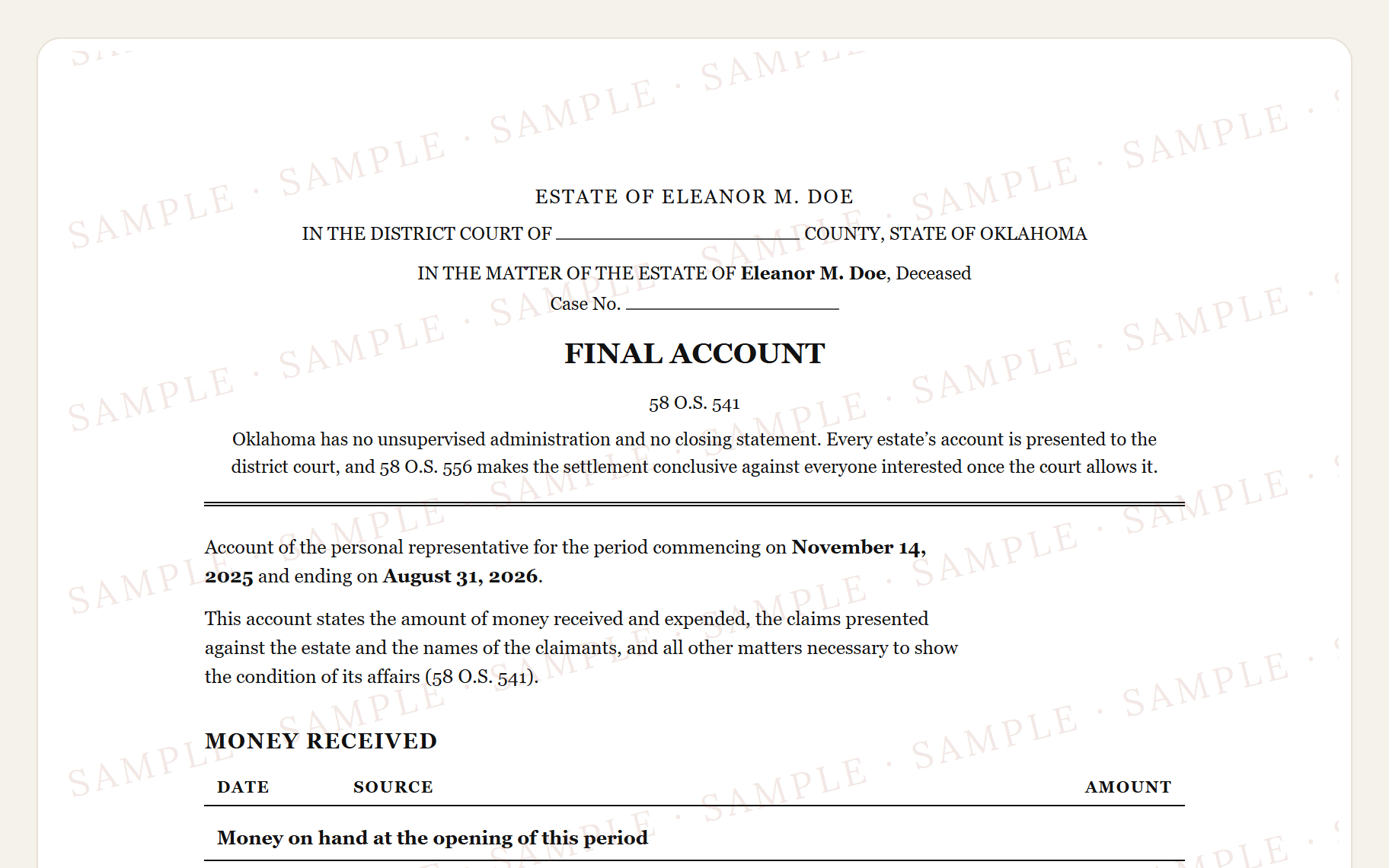
The second document is the account, required by 58 O.S. 541. It is an exhibit under oath showing the money received and expended, the claims presented against the estate and the names of the claimants, and the other matters needed to show the condition of the estate's affairs. Itemizing the account can be waived. Filing an account cannot: 58 O.S. 541 lets all persons entitled to distribution waive an itemized accounting in writing, or lets the personal representative skip it when they are the sole recipient, but even then the personal representative swears to what the estate's affairs were.
Section 2 of 7.Oklahoma's deadlines, with the statute behind each
- Day 60 (about 2 months)File the inventory (and appraisement) of the estate
Why
Under 58 O.S. §281, the personal representative generally must file an inventory, together with either a formal appraisement or the representative's own opinion of value, within 2 months after the order appointing them, though the court may extend this for good cause; confirm the exact filing deadline and any extension with your attorney. - Day 60 (about 2 months)File and publish notice to creditors
Why
Under 58 O.S. §331, the personal representative generally must file notice to creditors within 2 months after letters issue, then publish it once a week for two consecutive weeks and mail it to known creditors, stating a presentment date at least 2 months after the notice is filed; confirm the filing deadline and the presentment date you must state with your attorney. - Day 120 (about 4 months)Creditor claims bar date
Why
Under 58 O.S. §§331, 333, a creditor's claim not presented by the presentment date stated in the published notice is generally barred forever, and because that notice is due within 2 months of letters and must set a presentment date at least 2 months later, this bar date generally cannot fall earlier than about 4 months after letters issued; confirm the actual presentment date printed in your published notice with your attorney.
- Day 270 (about 9 months)Federal estate tax return (Form 706), if required
Why
Under IRC §6075, Form 706 is due 9 months after death, but only if the gross estate exceeds the federal exemption or the estate elects portability, and a 6-month extension may be available; confirm applicability and timing with your attorney.
The inventory is due within two months from the date of the order appointing the personal representative. The court may extend that time for good cause shown (58 O.S. 281(A)).
Read the full explanation
Property discovered after the inventory is filed goes on an additional inventory of its own, due within two months of the discovery (58 O.S. 289). That is a separate clock from the original inventory, and a separate document rather than a revision of it.
A formal appraisal, when one is ordered, follows a written demand from an interested person rather than a fixed date. The statute names no deadline for making that demand.
The final account and the petition for distribution are set for a hearing at a date the court fixes, not less than twenty days after the account is filed. Notice goes by mail at least ten days before the hearing, and by publication once a week for two consecutive weeks (58 O.S. 553).
Creditors present their claims within the period the notice to creditors sets, running from that notice (58 O.S. 331 and the sections that follow). Confirm the bar date from the notice issued in the case, since the statute ties it to the notice rather than to a single fixed number of days.
A federal estate tax return, Form 706, if the estate needs one, is due nine months after death (IRC 6075), with a possible six-month extension. Confirm whether the estate needs one with your attorney.
Section 3 of 7.What Oklahoma pays a personal representative
58 O.S. 527 sets a tiered schedule on the whole estate accounted for: five percent on the first one thousand dollars, four percent on the next five thousand dollars, and two and one-half percent on everything above six thousand dollars. Property that is not ranked as an asset of the estate is excluded from the base. The rates have not changed since a 1992 amendment.
The whole estate accounted for is a base the account itself settles, case by case, so ExecutorLedger states the schedule and prints what your own records show as compensation rather than computing a figure the record cannot settle on its own.
Section 4 of 7.How an Oklahoma estate closes
An Oklahoma estate closes when the court allows the final account. 58 O.S. 557 holds that the account cannot be allowed until it is first proved that notice was given as 58 O.S. 553 requires, and the decree allowing the account has to show that proof.
Once the court allows the account, 58 O.S. 556 makes the settlement conclusive against everyone interested in the estate, subject to a narrow right to reopen it for a person under a legal disability at the time.
Distribution is its own decree, under 58 O.S. 631 and the sections that follow, separate from the account and from the order allowing it.
A small family estate often uses 58 O.S. 541's waiver instead of an itemized account. All persons entitled to distribution sign a written waiver, or the personal representative is the sole recipient, and the personal representative swears instead that all income was properly received and the expenses lawfully made, that every allowed or approved claim was paid, that the funeral expenses, taxes and costs of administration were paid, and that the estate is ready for closing.
- Pay all allowed claims, funeral and last-illness expenses, taxes, and administration costs before you ask the court to close the estate. The court will not discharge you until your vouchers show everything due has been paid (58 O.S. §§635, 691).
- File a Final Account together with a Petition for Determination of Heirs, Distribution and Discharge on the district court's probate docket (58 O.S. §§553, 634). Oklahoma has no informal, UPC-style verified-statement shortcut, so this judicial filing is the standard closing route even for simple estates.
- Have the court set the hearing, then mail notice of it to every heir, devisee, and legatee whose address is known at least 10 days beforehand and publish it once a week for two consecutive weeks in a county newspaper (58 O.S. §553).
- Collect a signed receipt from each beneficiary for their distribution and file those receipts with the court as your vouchers.
- After the judge signs the Decree of Distribution, ask for an Order of Discharge (58 O.S. §691) releasing you from all further liability.
Smaller estates can shortcut this: if the estate is worth $300,000 or less, the decedent has been dead more than 5 years, or the decedent resided in another jurisdiction, you can petition for summary administration (58 O.S. §§245-247), which combines the creditor notice and the closing notices into a single 'Combined Notice', shortens the claims period to 30 days after the court admits the petition, and sets the final hearing no earlier than 45 days after that order.
Section 5 of 7.The Inventory and the Account explained for a first-time personal representative
58 O.S. 281 names no classification scheme. The inventory is one list, real property included, and any grouping on the page is ExecutorLedger's own choice, not a category the statute asks for. 58 O.S. 284 asks in addition for an account of all monies belonging to the decedent, drawn straight from the cash and bank items already on the list so a reader does not have to add the column themselves. 58 O.S. 285 and 286 add two sections the app keeps no data for: a debt the decedent held against the personal representative personally, and a debt the will forgave. Both print as their own ruled-blank sections rather than being left out.
An appraisal has not been mandatory since 1998. 58 O.S. 281(B) and (C), as amended that year, let the personal representative fulfill the appraisement requirement by stating their own opinion of the estate's value. A formal appraisal happens only when an interested person, an heir, a devisee, a legatee, a creditor who has filed a claim, a guardian, a conservator, a guardian ad litem, or another interested person, makes a written demand for one. Where that happens, the court appoints three disinterested appraisers, any two of whom may act, paid not more than seventy-five dollars a day except on the court's own order (58 O.S. 282). Nothing here should tell a reader an appraisal is required.
Oklahoma's inventory statute sets no valuation date of its own. 58 O.S. 283 has the appraisers value the property at whatever point the appraisal happens, an uncertain gap after death, and states no date-of-death standard in words. ExecutorLedger records values as of the date of death throughout, so the inventory print says plainly that the figures shown are the values recorded as of the date of death, and that Oklahoma's own statute fixes no valuation date, so the preparer should confirm what their own court expects.
58 O.S. 551, once cited as the final-account section, was repealed by Laws 1994, c. 234, s. 8, effective September 1, 1994, and carries no text today. Guidance written before then, or copied from something that was, may still point to it. The notice section for a non-final account is 58 O.S. 552, and for the final account it is 58 O.S. 553.
Section 6 of 7.Where ExecutorLedger fits
Recording is free for as long as the estate takes: every receipt and disbursement with its date and description, distributions per beneficiary, and a balance that checks itself as you go. ExecutorLedger builds Oklahoma-style documents from those records, an inventory shaped around 58 O.S. 281 and an account shaped around 58 O.S. 541, ready to transcribe when you file with the district court or hand them to your attorney. Neither is a court form, and your attorney should review them before anything is signed or filed. Every document previews free with your real numbers, and $149 (one-time payment) per estate lifts the watermark. Usually less than one attorney hour, and typically reimbursable by the estate.
Section 7 of 7.Questions Oklahoma executors ask
Is there a court form for Oklahoma's inventory or accounting?
No. Oklahoma publishes no statewide probate form. Title 58 of the Oklahoma Statutes says what the inventory and the account must contain, and that is the whole requirement. Any Oklahoma document you find online is someone's template, not an official form.
When is the Oklahoma inventory due?
Within two months from the date of the order appointing the personal representative, extendable by the court for good cause shown (58 O.S. 281(A)). Property discovered later goes on its own additional inventory, due within two months of the discovery (58 O.S. 289).
Does every Oklahoma estate have to file an account with the court?
Yes. Oklahoma has no unsupervised or independent administration and no closing statement that skips the court. Every estate's account is filed, noticed, and allowed by the court's own decree (58 O.S. 541, 553, 557). Itemizing the account can be waived in writing by everyone entitled to distribution, or skipped when the personal representative is the sole recipient, but the account itself is still filed.
Is an appraisal required for the Oklahoma inventory?
Not since 1998. The personal representative may state their own opinion of the estate's value (58 O.S. 281(B), (C)). A formal appraisal by three court-appointed appraisers happens only when an interested person makes a written demand for one (58 O.S. 282).
How is an Oklahoma personal representative paid?
58 O.S. 527 sets a tiered schedule on the whole estate accounted for: five percent on the first one thousand dollars, four percent on the next five thousand dollars, and two and one-half percent on everything above six thousand dollars. The rates have not changed since a 1992 amendment.
Not sure which accounting your situation calls for? Which accounting do I need? covers the choice, and the accounting guide explains the structure every format shares.
This page describes Oklahoma practice as our verified references state it; formats drift and estates differ, and none of this is legal advice. ExecutorLedger produces court-style documents for transcription. They are not official court forms. The accounting your estate needs is a question for its attorney.