New Jersey Estate Accounting: An Executor's Guide
New Jersey probate begins at the county Surrogate's Court, and its fiduciary is called the personal representative, whether an executor named in a will or an administrator appointed when there is none. New Jersey publishes no statewide form for either an inventory or an account, and no county publishes an inventory form for a decedent's estate at all. Here is what the county Surrogate's Informal Accounting and Refunding Bond and Release cover, the deadlines behind them, and how a New Jersey estate closes.
Section 1 of 7.The documents, and why New Jersey has no form
New Jersey probate begins at the county Surrogate's Court, which issues letters testamentary or of administration. Personal representative is the term Title 3B of the New Jersey Statutes uses throughout, covering both an executor named in a will and an administrator appointed when there is none. There is no separate probate court beyond the Surrogate; when a matter needs a full court's authority, it goes to the Superior Court, Chancery Division, Probate Part. No New Jersey statute or court rule prescribes a statewide printed form for either an inventory or an account of a decedent's estate, and the Judiciary publishes none.
Filing an inventory is not required in the ordinary case. N.J.S.A. 3B:16-2 lets a personal representative file one but does not require it, unless the court orders it or the exemption for the benefit of the decedent's family is claimed (N.J.S.A. 3B:16-5, 3B:16-7), in which case filing becomes mandatory and must happen within 3 months of letters. No county publishes an inventory form for a decedent's estate either; where a Surrogate wants information up front, it uses its own intake questionnaire, not an asset-value schedule.
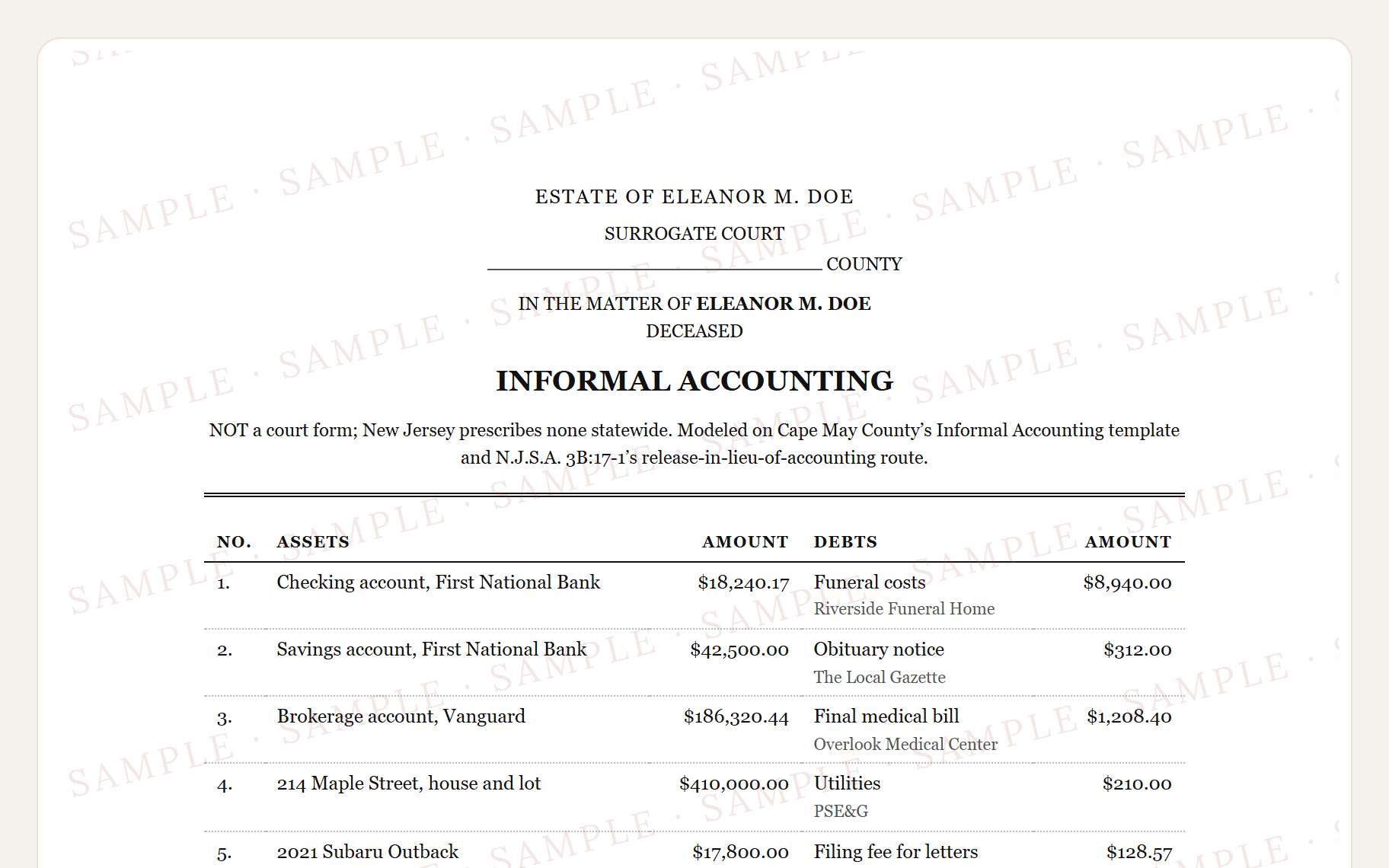
What nearly every New Jersey estate produces instead is the county Surrogate's own Informal Accounting, handed to the beneficiaries for their review, and a Refunding Bond and Release signed by each of them (N.J.S.A. 3B:23-24 through 3B:23-27), filed with the Surrogate before or at the same time as that beneficiary's distribution. Cape May County publishes a one-page Informal Accounting template in this shape, and Morris and Cumberland Counties publish close-to-identical Refunding Bond and Release templates. None of these carries a form number, a revision date, or a rule citation. This is county practice, not a statewide requirement, but it is what closes nearly every estate.
A formal court Account is the exception, used only for a complex or disputed estate, when a charity is a beneficiary, or when a beneficiary will not sign a release. It is filed as an action in the Superior Court, Chancery Division, Probate Part, and R. 4:87-3 governs its content, not its layout: it lets the accountant type or print the account in whatever shape suits the estate, so long as corpus and income are stated separately and six statements are annexed to it. Almost no New Jersey estate ever reaches this route.
Section 2 of 7.New Jersey deadlines, with the statute behind each
- Day 60 (about 2 months)Mail notice of probate to beneficiaries and next of kin
Why
New Jersey Court Rule 4:80-6 requires mailing written notice of probate to all will beneficiaries and to the decedent's spouse, heirs, and next of kin within 60 days after the date of probate, with proof of mailing filed with the Surrogate within 10 days after mailing - confirm the recipient list and timing with your attorney.
- Day 10 (about 1 week) · earliest possibleEarliest day to probate the will with the Surrogate
Why
Under N.J.S.A. 3B:3-22 a will cannot be admitted to probate until 10 days after death, so this is the earliest date to complete probate at the county Surrogate's Court, not a deadline; the papers may be filed sooner and probate is typically granted on day 11 - confirm the exact timing with your attorney. - Day 240 (about 8 months)NJ inheritance tax: pay within 8 months to avoid interest
Why
The New Jersey transfer inheritance tax is due at death under N.J.S.A. 54:35-1, and it is interest-free if paid within eight months of death (approximated here as 240 days); after that N.J.S.A. 54:35-3 charges 10% a year, or 6% where the estate could not be settled sooner for a reason outside the executor's control. The return is Form IT-R. Class A beneficiaries such as a spouse, children, parents, and grandchildren are exempt, and New Jersey's separate estate tax was repealed for deaths on or after January 1, 2018 - confirm with your attorney whether a return or tax waivers are needed. - Day 270 (about 9 months)Creditor claim window closes 9 months after death
Why
N.J.S.A. 3B:22-4 gives creditors nine months from the date of death (approximated here as 270 days) to present written claims; distributing before this window closes can expose you to personal liability, while the statute generally protects distributions made before a late claim is presented - confirm with your attorney before paying claims or distributing assets. - Day 270 (about 9 months)Federal estate tax Form 706 due, if estate is large
Why
Federal Form 706 is due nine months after death (approximated here as 270 days) under IRC section 6075(a), but only if the gross estate exceeds the federal exclusion amount or the surviving spouse wants a portability election - confirm whether a filing is needed with your attorney. - Day 270 (about 9 months)Get child support judgment search before paying anyone
Why
N.J.S.A. 2A:17-56.23b requires a certification from a private judgment search company showing whether each beneficiary is a child support judgment debtor before paying an inheritance of $2,000 or more; the statute sets no day count, so this date is only a pre-distribution reminder keyed to the close of the nine-month creditor window - confirm the timing with your attorney. - Day 300 (about 10 months)Collect refunding bonds and releases at distribution
Why
N.J.S.A. 3B:23-24 requires you to take a signed refunding bond from each beneficiary when paying their share and file it with the Surrogate's Court, and county Surrogates publish that bond combined with a release; the statute ties this to distribution rather than a day count, so this date approximates typical timing shortly after the creditor window closes - confirm with your attorney.
A will cannot be admitted to probate until 10 days after death (N.J.S.A. 3B:3-22). The papers can be filed sooner, but the Surrogate cannot grant probate before then.
Read the full explanation
Within 60 days after probate, the personal representative must mail written notice of probate to every will beneficiary and to the decedent's spouse, heirs, and next of kin, with proof of mailing filed with the Surrogate within 10 days after mailing (R. 4:80-6, R. 4:80-1(a)(3)).
The New Jersey transfer inheritance tax is due at death (N.J.S.A. 54:35-1), and it is interest-free if paid within eight months of death; after that, N.J.S.A. 54:35-3 charges 10% interest a year, or 6% where the delay was outside the executor's control. The return is Form IT-R. Class A beneficiaries, a spouse or domestic partner, and a parent, grandparent, child, or their issue, owe no tax at all. Class C beneficiaries, a sibling or a son's widow or daughter's widower, owe nothing on the first $25,000, then 11% up to $1,100,000, 13% up to $1,400,000, 14% up to $1,700,000, and 16% above that. Everyone else, Class D, owes 15% on the first $700,000 and 16% above it (N.J.S.A. 54:34-2). New Jersey's separate estate tax was repealed for deaths on or after January 1, 2018 (N.J.S.A. 54:38-1).
Creditors have nine months from the date of death to present a written claim (N.J.S.A. 3B:22-4). Distributing before that window closes can expose you to personal liability, though the statute generally protects distributions already made before a late claim is presented.
A federal estate tax return, Form 706, if the estate needs one, is due nine months after death (IRC section 6075), with a possible six-month extension. Confirm whether the estate needs one with your attorney.
Before paying anyone $2,000 or more, get a child support judgment search certification for each beneficiary (N.J.S.A. 2A:17-56.23b). The statute sets no day count of its own, so plan for it around the same time the creditor window closes.
Take a signed refunding bond and release from each beneficiary when you pay their share, and file it with the Surrogate (N.J.S.A. 3B:23-24 through 3B:23-27). The statute ties this to the act of distribution, not to a day count, so plan for it once the creditor window and the inheritance tax's interest-free period have both passed.
Section 3 of 7.What New Jersey pays an executor
Commissions are set by statute, not left to the court's discretion, unless someone objects. N.J.S.A. 3B:18-13 allows 6% on all income the fiduciary receives, taken without court allowance at all, including income withheld for tax purposes.
N.J.S.A. 3B:18-14 sets corpus commissions in marginal tiers: 5% on the first $200,000 of corpus received, 3.5% on the next $800,000, and 2% above $1,000,000, plus 1% of all corpus for each additional fiduciary beyond the first, capped so that no one fiduciary receives more than a sole fiduciary would have. A court can reduce corpus commissions, never increase them, and only on a beneficiary's own application with an affirmative showing that the service was materially deficient or substantially lighter than usual for an estate of comparable size. Income commissions carry no such review at all.
For an $800,000 corpus and $5,000 of income, that works out to a $300 income commission, 6% of $5,000, and a $31,000 corpus commission, 5% of the first $200,000 plus 3.5% of the next $600,000, for $31,300 total.
Section 4 of 7.How a New Jersey estate closes
Most New Jersey estates close without ever going to court. The personal representative shares an accounting, usually the county Surrogate's Informal Accounting, with every beneficiary. Each beneficiary then signs a Refunding Bond and Release, required by N.J.S.A. 3B:23-24 through 3B:23-27 for anyone who receives a devise or distributive share, obligating them to return their ratable part of it if a later debt needs it. Filing every bond with the Surrogate, paying the filing fee, making final distributions, and closing the estate bank account finishes the process.
N.J.S.A. 3B:17-1 is what makes this route work without a judge: filing a signed release from every beneficiary who is an adult and not incapacitated relieves the personal representative of ever having to settle an account in court, and N.J.S.A. 3B:17-13 makes that release binding on everyone with a future interest in the property, once every necessary party has signed. Absent special cause, no one can compel an accounting sooner than one year after appointment (N.J.S.A. 3B:17-2).
The formal route, an action to settle an account under R. 4:87 in the Superior Court, Chancery Division, Probate Part, is the exception, used when someone won't sign, when the estate is complex enough that the personal representative wants the court's protection, or when a charity beneficiary means the Attorney General may require it. A settled account is res judicata on everything that could have been raised, and discharges the personal representative except for assets still on hand, exceptions that were sustained, and ordinary relief from judgment (N.J.S.A. 3B:17-8).
- Share the accounting (usually informal) with every beneficiary.
- Collect a signed Refunding Bond and Release from each beneficiary. N.J.S.A. 3B:23-24 requires the refunding bond, and county Surrogates publish it combined with a release, so use the form your own county prints.
- File each refunding bond with the Surrogate and pay the filing fee.
- Make final distributions and close the estate bank account.
Formal judicial accounting is the exception in New Jersey, used when someone won't sign.
Section 5 of 7.The documents explained for a first-time executor
The Informal Accounting is a net-worth snapshot, not a running ledger. Cape May County's one-page template asks for two money columns: ASSETS, every bank account, stock, bond, vehicle, insurance policy, real estate parcel, and business interest the decedent owned at death, at its date-of-death value, and DEBTS, every administration expense, funeral cost, and tax paid. Property that comes in after death, a tax refund, a delayed payout, goes in its own rows in the ASSETS column too, labeled to show it arrived later, the same way the form's own instruction line lists refunds among what belongs there. Assets total minus debts total is the Net Estate Remaining for Distribution.
From there, the form has two more schedules. Specific Bequests (Under Will) is five blank numbered rows: the app has no field that tells a specific bequest apart from a residuary or intestate share, so it cannot guess which distribution belongs there, and prints the rows blank for you to fill in by hand. Balance to Residuary Legatees/Intestate Heirs carries every distribution the ledger recorded, cash at its amount and an in-kind item at the value it was carried at, each under the beneficiary's name. The form's own printed last line reads BALANCE $ -0-, proof that the residuary schedule leaves nothing of the net estate undistributed; if your own numbers do not land there, the export shows the real figure with a warning instead of printing a zero the math does not support.
Signing a Refunding Bond and Release does two things at once. It documents that a beneficiary received a specific dollar amount or piece of property, and it obligates them, under N.J.S.A. 3B:23-24 through 3B:23-27, to give back their ratable share if a debt turns up later that the estate has nothing else to pay it with. There is no court hearing built into this route. One is signed, notarized, and filed per beneficiary per distribution, not one document listing everyone.
If a formal account under R. 4:87-3 is ever filed, corpus and income have to be stated separately throughout, and six statements get attached to it: the asset list, showing both the inventory value and the value as of the day the account is drawn; a log of every change to the investments and assets since they were acquired, dated; a statement of what was apportioned between principal and income; a statement of how transfer inheritance or estate taxes were apportioned; an allocation statement if fees or commissions paid from corpus were allocated to income beneficiaries for tax purposes; and a statement showing how the corpus commission was computed. The rule leaves the layout to the accountant. It only fixes what has to be there.
Section 6 of 7.Where ExecutorLedger fits
Recording is free for as long as the estate takes: every receipt and disbursement with its date and description, distributions per beneficiary, and a balance that checks itself as you go. ExecutorLedger builds a New Jersey-style Informal Accounting and Refunding Bond and Release from those records, shaped like Cape May County's and Morris and Cumberland Counties' own templates, ready to transcribe if you end up handing a copy to the beneficiaries or filing one with your county Surrogate. Neither is a court form, and your attorney should review them before anything is signed or filed. Every document previews free with your real numbers, and $149 (one-time payment) per estate lifts the watermark.
Section 7 of 7.Questions New Jersey executors ask
Is there a form for New Jersey's inventory or accounting?
No. New Jersey publishes no statewide form for either one, and no county publishes an inventory form for a decedent's estate at all. What most estates use instead is the county Surrogate's own Informal Accounting, such as Cape May County's, and a Refunding Bond and Release signed by each beneficiary.
Do I have to file an inventory in New Jersey?
Not in the ordinary case. N.J.S.A. 3B:16-2 lets a personal representative file one but does not require it, unless the court orders it or the $5,000 exemption for the benefit of the decedent's family is claimed (N.J.S.A. 3B:16-5, 3B:16-7), in which case filing is mandatory within 3 months of letters.
How is a New Jersey executor paid?
N.J.S.A. 3B:18-13 sets 6% of income received, taken without court allowance. N.J.S.A. 3B:18-14 sets corpus commissions at 5% on the first $200,000, 3.5% on the next $800,000, and 2% above $1,000,000, plus 1% of corpus for each additional fiduciary. A court can reduce, never increase, the corpus figure, and only on a beneficiary's own motion.
How does a New Jersey estate close?
Most close without going to court: the personal representative shares an informal accounting with the beneficiaries, each signs a Refunding Bond and Release (N.J.S.A. 3B:23-24 through 3B:23-27), and the bonds are filed with the Surrogate before final distribution. A formal account under R. 4:87-3, filed in the Superior Court, Chancery Division, Probate Part, is the exception, used when someone won't sign.
Does New Jersey tax an inheritance?
Yes, by class, under N.J.S.A. 54:34-2. Class A, a spouse, domestic partner, parent, grandparent, child, or their issue, owes nothing. Class C, a sibling or a son's widow or daughter's widower, owes 11% to 16% above a $25,000 exemption. Everyone else, Class D, owes 15% to 16%. New Jersey's separate estate tax was repealed for deaths on or after January 1, 2018.
Not sure which accounting your situation calls for? Which accounting do I need? covers the choice, and the accounting guide explains the structure every format shares.
This page describes New Jersey practice as our verified references state it; formats drift and estates differ, and none of this is legal advice. ExecutorLedger produces court-style documents for transcription. They are not official court forms. The accounting your estate needs is a question for its attorney.