Nevada Estate Accounting: A Personal Representative's Guide
Nevada probate runs through the district court in each county, and its fiduciary is the personal representative, the executor named in a will or the administrator appointed when there is none. Nevada publishes no statewide probate form. Here is what the statutes require of the inventory and of the account, the deadlines behind them, and how a Nevada estate closes.
Section 1 of 7.The two documents: the Inventory and the Account
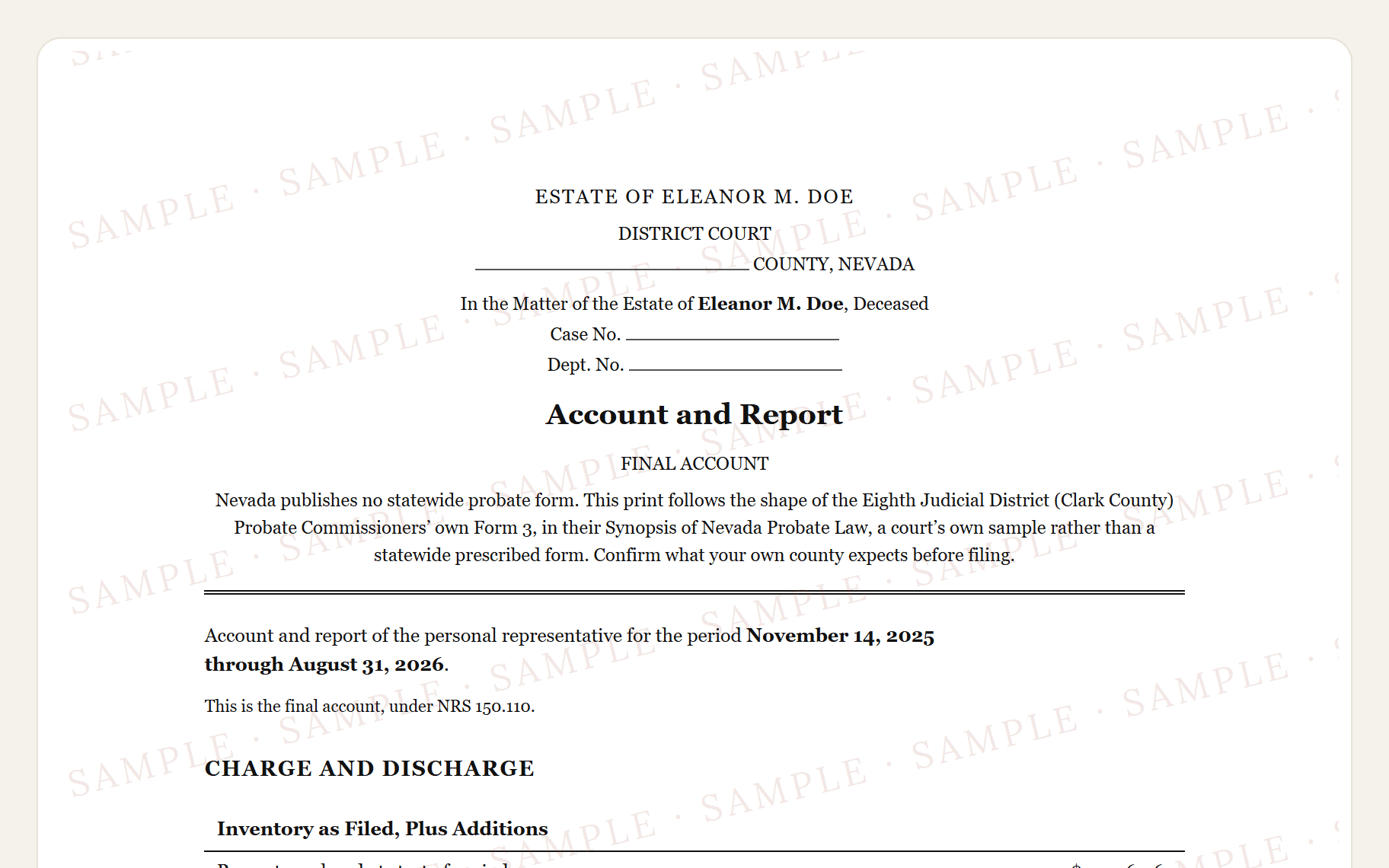
Nevada administers decedents' estates under Title 12 of the Nevada Revised Statutes, through the district court in each county. A caption on a Nevada probate filing reads DISTRICT COURT, then the county, and carries its own distinctive line for the department: Dept. No. Nevada publishes no statewide probate form. The only templates that exist are the Eighth Judicial District Court's own Probate Commissioners' samples, published in their Synopsis of Nevada Probate Law. Those are one court's own samples, not a statewide prescribed form, and Washoe County's guidelines describe a different shape. No form number should ever be printed or claimed.
The first document is the inventory, required by NRS 144.010. Unlike some states, filing it is not optional: every personal representative prepares and files a true inventory and appraisement, or record of value, of everything that has come to their possession or knowledge, unless every interested person waives it in writing. It covers all the decedent's estate wherever situated that is subject to the court's jurisdiction, real and personal together, and it shows what portion is community property and what portion is the decedent's separate property.
The second document is the account, required by NRS Chapter 150. It is a charge and discharge: the personal representative is accountable for the whole estate at the value the inventory set, plus the gains and the income the estate earns, less the losses the law allows. The Eighth Judicial District's own Form 3 lays that arithmetic out line for line, and real property sits inside its recapitulation along with everything else, not walled off in a schedule of its own.
Section 2 of 7.Nevada's deadlines, with the statute behind each
- Day 30 (about 1 month)Publish and mail notice to creditors
Why
Under NRS 155.020 & NRS 147.010, Nevada sets no fixed day count: the personal representative generally must publish the notice to creditors promptly and, 'as soon as practicable' after appointment, mail copies to creditors whose names and addresses are readily ascertainable, so this 30-day marker is only a practical prompt anchored to your appointment date, and acting sooner starts the claim clock sooner; confirm the timing and publication mechanics with your attorney. - Day 90 (about 3 months)Creditor claims bar date
Why
Under NRS 147.040, creditors generally must file claims within 90 days after the notice was mailed to them (for creditors entitled to mailed notice) or 90 days after the first publication of the notice to creditors (a later-discovered creditor mailed notice under NRS 155.020(5) gets the later of 30 days after that mailing or 90 days after first publication, and the period drops to 60 days in summary administration); this marker is anchored to the day letters issued, but the real clock runs from publication and mailing, so the actual bar is typically later. Confirm the operative date with your attorney before paying claims or distributing. - Day 120 (about 4 months)File inventory (or verified record of value)
Why
Under NRS 144.010, the inventory and appraisal (or verified record of value) of estate assets is generally due within 120 days after letters issue, though the court can extend the time for good cause and all interested persons can waive the filing by unanimous written consent; confirm the exact due date with your attorney. - Day 180 (about 6 months)First verified account due
Why
Under NRS 150.080, the first verified account showing money received and spent and the claims filed against the estate is generally due within 6 months after appointment (sooner if the court orders), with further accounts due annually under NRS 150.105 until the estate is closed; confirm whether the court expects an account at this mark with your attorney. - Day 180 (about 6 months)Close the estate or file status report
Why
Under NRS 143.035 & NRS 143.037, if the estate is not closed within 6 months after appointment (18 months where a federal estate tax return is required), the personal representative generally must file a report explaining why the estate has not been closed, and Nevada generally expects estates to close within 18 months of appointment absent pending litigation or tax matters; confirm which period applies to your estate with your attorney.
- Day 270 (about 9 months)Federal estate tax return (Form 706), if required
Why
Under IRC §6075, Form 706 is due 9 months after death, but only if the gross estate exceeds the federal exemption or the estate elects portability, and a 6-month extension may be available; confirm applicability and timing with your attorney.
The inventory is due within 120 days after the issuance of letters, not from the date of death, unless the court extends the time for good cause shown (NRS 144.010(1)).
Read the full explanation
A copy of the filed inventory goes to the interested heirs or devisees within 10 days after filing, with proof of the mailing filed in the case (NRS 144.010(3)).
Property discovered after the inventory is filed goes on a supplementary inventory of its own, due within 20 days after its discovery, prepared the same way as the original (NRS 144.090(1)).
The first account is due within 6 months after the personal representative's appointment, sooner if the court orders it (NRS 150.080). An account is then due every year until all remaining property is distributed (NRS 150.105), followed by a final account (NRS 150.110) and a supplementary account before or at the time of final distribution (NRS 150.115).
Creditor claims are generally due 90 days after the mailing required for known creditors, or 90 days after the first publication of notice, whichever applies. A creditor who receives a later mailed notice instead has 30 days after that mailing or 90 days after first publication, whichever is later. In a summary administration, the 90-day period shortens to 60 days (NRS 147.040). A claimant who never had notice of the administration may still file at any time before the final account is filed (NRS 147.040(3)).
A personal representative must close an estate within 18 months after appointment, subject to that section's own exceptions (NRS 143.037(1)), and files a report explaining why the estate is not yet closed within 6 months of appointment if no federal estate tax return is required, or within 18 months if one is (NRS 143.035(2)).
A federal estate tax return, Form 706, if the estate needs one, is due nine months after death (IRC 6075), with a possible six-month extension. Confirm whether the estate needs one with your attorney.
Section 3 of 7.What Nevada pays a personal representative
Where the will sets no compensation, or the personal representative renounces it, NRS 150.020(1) sets a schedule on the whole amount of the estate accounted for, less liens and encumbrances: 4 percent on the first $15,000, 3 percent on the next $85,000, and 2 percent on everything above $100,000. A will's own compensation clause is full payment unless the personal representative files a written renunciation of it within 60 days of appointment (NRS 150.010), and a contract for higher pay than the schedule allows is void (NRS 150.040).
An attorney who serves as personal representative may take compensation as one or the other, not both, unless the court approves a different method in advance (NRS 150.025). An attorney handling the estate has its own, larger ladder, available only on a written agreement the court approves: 4 percent of the first $100,000, 3 percent of the next $100,000, 2 percent of the next $800,000, 1 percent of the next $9,000,000, and lower rates above that, set by the court (NRS 150.060(4)).
Both schedules run on a base this app does not have: the personal representative's ladder is figured on the estate accounted for less liens and encumbrances, and the attorney's ladder is defined separately, expressly excluding encumbrances rather than deducting them. Nevada records no lien or encumbrance data in ExecutorLedger, so both figures are left to the preparer.
Section 4 of 7.How a Nevada estate closes
Nevada has four routes, and the 2025 legislative session raised every dollar threshold. Guides written earlier, and much of what is online, still show the old numbers.
General administration applies to a gross estate over $500,000. Both the inventory and the account apply in full.
Summary administration (NRS 145.040) applies where the gross value, after deducting encumbrances, is $500,000 or less, raised from $300,000 in 2025. NRS 145.010 dispenses with most of the usual proceedings but keeps the inventory and the notice of the final account and petition for distribution. The closing filing there is a combined Petition for Final Account and Distribution (NRS 145.075).
Set aside without administration (NRS 146.070) applies where the net value is $150,000 or less, raised from $100,000. There is no inventory and no account at all in this route.
The affidavit of entitlement (NRS 146.080) lets an heir collect at least 40 days after death with no court filing, up to $25,000, or $150,000 where the claimant is the surviving spouse, and no Nevada real property.
Once a final account is filed, the court sets it for hearing on the notice NRS 155.010 requires (NRS 150.160). With no timely objection and the account appearing correct, the court allows and confirms it (NRS 150.200), and that order becomes conclusive against every interested person, though a person under a legal disability may move to reopen it, or sue on the bond, before final distribution (NRS 150.210). A personal representative keeps the vouchers behind every payment rather than filing them, and only has to produce them for examination by the court or an interested person (NRS 150.150(1)).
- File your final account together with a petition for final distribution in the district court handling the probate (Nevada has no separate probate court; in Clark and Washoe counties a probate commissioner hears the calendar), and mail the 10-day notice of the hearing to everyone entitled to it (NRS 155.010).
- Attend the hearing and get the court's order settling the account and directing final distribution (NRS ch. 150 and 151).
- Distribute each asset exactly as the order says and collect a signed receipt from every distributee. The court requires satisfactory receipts before it will discharge you (NRS 151.230).
- File the receipts and ask for the order of discharge under NRS 151.230, which ends your authority and releases your sureties (the court can excuse a receipt you can't obtain after reasonable effort).
- If the estate can't close within Nevada's expected window (6 months after appointment, or 18 months when a Form 706 is required), file the status report explaining why (NRS 143.035) rather than letting the deadline pass.
Nevada is not a UPC state: there is no sworn closing-statement shortcut (no UPC §3-1003 analogue) and no informal-release-only route. Closing runs through the court: final account, order of final distribution, receipts from distributees, then a discharge order.
Section 5 of 7.The Inventory and the Account explained for a first-time personal representative
NRS 144.040 is Nevada's inventory statute, and it covers all the estate, real and personal, wherever situated, that is subject to the court's jurisdiction. It also asks, item by item, for the name of the debtor, the date, the sum originally payable and the collectible value of every receivable, bond, mortgage, note and other security for the payment of money the decedent held. ExecutorLedger's asset registry keeps none of that per-item detail, so that section prints as a ruled space for the preparer, the same way a mortgage of any kind on the estate's property prints as its own ruled section rather than a computed figure.
Nevada is a community property state, and NRS 123.250(1) makes an undivided one-half interest in community property the surviving spouse's own separate property, with only the remaining interest subject to probate. NRS 144.040(3)(a) asks the inventory to show, so far as it can be ascertained, what portion of the estate is community property and what portion is the decedent's separate property. That is a legal characterisation this app cannot make item by item, so it prints as a ruled column with the reason given.
NRS 144.040(3)(b) also asks for an account of all money belonging to the decedent that has come into the personal representative's possession. ExecutorLedger draws that schedule straight from the cash and bank rows already on the inventory, so the reader never has to add a column themselves. Each item over $500 is set down separately with its value in dollars and cents, as NRS 144.030(2) requires, which the inventory's own line-by-line format already does.
A personal representative is never obliged to engage an appraiser of their own accord. NRS 144.020(1) makes that a choice, and only where an asset's value is subject to reasonable doubt. What is required instead, where there is no reasonable doubt as to value, such as cash, bank deposits, bonds, life insurance or securities equal in value to cash, is a verified record of value in lieu of an appraisement (NRS 144.020(3)). Household furniture and furnishings reasonably believed worth less than $30,000 fall under the same rule, subject to a court-ordered appraisement on good cause shown (NRS 144.020(5)). NRS 144.010(4) lets a personal representative file a redacted inventory that omits account numbers, Social Security numbers, and values, making the full unredacted inventory available to the court or an interested person on request.
The inventory carries its own oath, sworn before a notary or the clerk, under NRS 144.070: that the inventory is a true statement of everything known to the personal representative, particularly all money belonging to the decedent, and of all just claims the decedent held against the personal representative. All three elements appear, with the officer's own block, on the printed inventory.
The account charges the personal representative with the inventory value, plus gains on sales and other receipts, less losses on sales (NRS 150.070(1) and (3)). Real property sits inside the recapitulation with the rest of the estate's assets, in the same six categories the Eighth Judicial District's own Form 3 uses: cash in banks, notes receivable, shares of stock, real property, vehicles, and other assets. A distribution in kind gets its own disclosure, naming the beneficiary and the item, because NRS 150.105's annual account asks what property has been disbursed and at what price, the same as a sale. The claims table NRS 150.080 asks for names each claimant, the nature of the claim, when it became or will become due, and whether it was allowed, rejected, or is not yet acted upon. ExecutorLedger keeps no claim register, so that table prints ruled for the preparer.
Section 6 of 7.Where ExecutorLedger fits
Recording is free for as long as the estate takes: every receipt and disbursement with its date and description, distributions per beneficiary, and a balance that checks itself as you go. ExecutorLedger builds Nevada-style documents from those records, an inventory shaped around NRS 144.040 and an account shaped around the Eighth Judicial District's own recapitulation, ready to transcribe when you file with the district court or hand them to your attorney. Neither is a court form, and your attorney should review them before anything is signed or filed. Every document previews free with your real numbers, and $149 (one-time payment) per estate lifts the watermark. Usually less than one attorney hour, and typically reimbursable by the estate.
Section 7 of 7.Questions Nevada executors ask
Is there a court form for Nevada's inventory or account?
No. Nevada publishes no statewide probate form. The Eighth Judicial District Court's Probate Commissioners publish their own samples in the Synopsis of Nevada Probate Law, and Washoe County's guidelines describe a different shape. NRS 144.040 and NRS Chapter 150 say what the documents must contain, and that is the whole requirement. Confirm what your own county expects before filing.
When is the Nevada inventory due, and can it be skipped?
Within 120 days after the issuance of letters, not the date of death, unless the court extends the time for good cause shown (NRS 144.010(1)). Filing it can be waived only by the unanimous written consent of all interested persons. Property discovered later goes on its own supplementary inventory, due within 20 days of discovery (NRS 144.090(1)).
Is an appraisal required for the Nevada inventory?
Not of your own accord. A personal representative may engage an appraiser only where an asset's value is subject to reasonable doubt (NRS 144.020(1)). Where there is no reasonable doubt, such as cash, bank deposits, bonds or securities equal to cash, a verified record of value is required in lieu of an appraisement (NRS 144.020(3)). One can still be ordered: for household furniture and furnishings put on a record of value, an interested person may ask the court to require an appraisement, and on a showing of good cause the court must order one (NRS 144.020(5)).
How is a Nevada personal representative paid?
Where the will sets no compensation, NRS 150.020(1) allows 4 percent on the first $15,000, 3 percent on the next $85,000, and 2 percent above $100,000, figured on the estate accounted for less liens and encumbrances. An attorney handling the estate has a separate, larger ladder under NRS 150.060(4), available only on a written agreement the court approves. ExecutorLedger records no lien or encumbrance data, so it computes neither figure.
What are Nevada's four probate routes, and which need these documents?
General administration, over $500,000, uses both documents in full. Summary administration (NRS 145.040), $500,000 or less after deducting encumbrances, keeps the inventory and the final account. Set aside without administration (NRS 146.070), $150,000 or less net value, has no inventory and no account at all. The affidavit of entitlement (NRS 146.080), up to $25,000, or $150,000 for a surviving spouse with no Nevada real property, files nothing with the court. All four thresholds were raised in the 2025 legislative session; older guides may still show the previous numbers.
Can a Nevada inventory leave out the value of an asset?
Yes, to protect the decedent, the estate or an interested person. NRS 144.010(4) lets a personal representative redact account numbers, Social Security numbers, and values on a filed inventory. The court or an interested person can still ask for the full, unredacted inventory, which the personal representative must then make available.
Not sure which accounting your situation calls for? Which accounting do I need? covers the choice, and the accounting guide explains the structure every format shares.
This page describes Nevada practice as our verified references state it; formats drift and estates differ, and none of this is legal advice. ExecutorLedger produces court-style documents for transcription. They are not official court forms. The accounting your estate needs is a question for its attorney.