Nebraska Estate Accounting: A Representative's Guide
Nebraska probate runs through the county court, which has exclusive original jurisdiction over decedents' estates, and its fiduciary is the personal representative, the executor named in a will or the administrator appointed when there is none. Nebraska is a Uniform Probate Code state, Neb. Rev. Stat. Chapter 30, article 24, and its statutes fix what an inventory and a closing statement must contain without fixing any printed form for either one. Here is what the statutes require, the deadlines behind them, and how a Nebraska estate closes.
Section 1 of 7.The two documents: the Inventory and the personal representative's statement
Nebraska administers decedents' estates under Chapter 30, article 24 of the Nebraska Revised Statutes, through the county court, which has exclusive original jurisdiction over probate proceedings (Neb. Rev. Stat. 30-2211). The later sections in this article carry a comma in their number, not a subsection mark: 30-24,117 is one section number, written exactly that way. Nebraska publishes no statewide probate form for a decedent's estate inventory or account. There is no form number for either document in this guide, and none should ever be printed on one.
The first document is the inventory, required by Neb. Rev. Stat. 30-2467. Within three months after appointment, a personal representative who is not a special administrator, and who has not taken over from an earlier representative who already did it, prepares one list of the property the decedent owned at death, with reasonable detail, each item's fair market value as of the date of death, and the type and amount of any encumbrance on it. Nebraska requires both steps the statute names: the original is filed with the court, and a copy goes to any interested person who requests it. Nebraska sits on the mandatory side of a split among Uniform Probate Code states. Utah, New Mexico, Idaho and Hawaii let a personal representative file an inventory or simply hold it; Nebraska's personal representative files it.
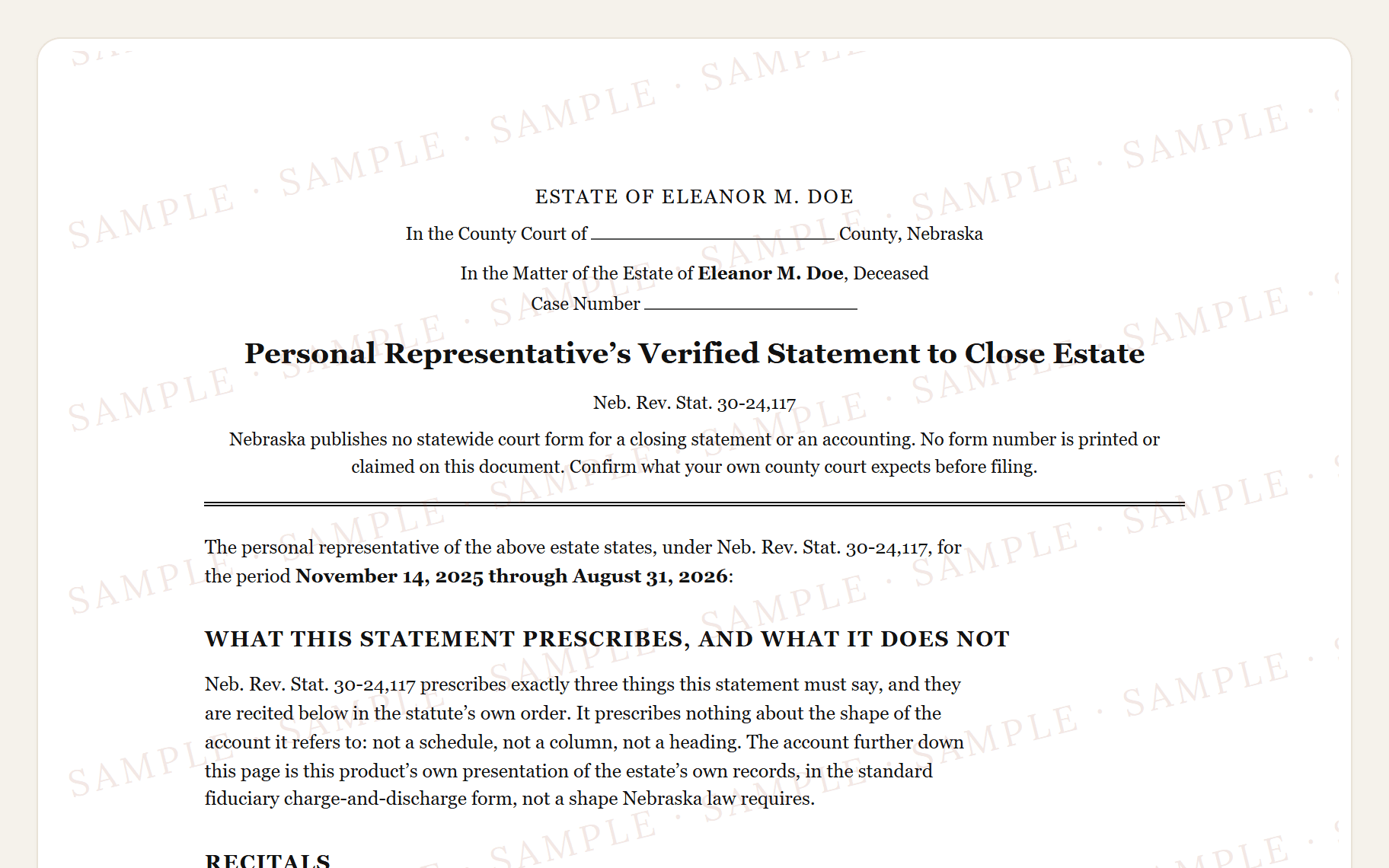
The second document is the closing statement under Neb. Rev. Stat. 30-24,117, a verified statement the personal representative may file once the estate is ready to close. It recites that notice to creditors was published and more than four months have passed since the first publication; that the estate has been fully administered and distributed, and, if any claim remains undischarged, either that it was distributed subject to possible liability with the agreement of the distributees or what other arrangements have been made to accommodate that claim; and that copies of the statement and a full written account have gone to the distributees and to every claimant whose claim is neither paid nor barred. Nebraska's statute sets no content or format for that account. It only requires that one exists and reaches the distributees.
Section 2 of 7.Nebraska's deadlines, with the statute behind each
- Day 5Medicaid estate-recovery notice to Nebraska DHHS
Why
Under Neb. Rev. Stat. §§30-2483 and 25-520.01, if the decedent was 55 or older or lived in a medical institution, a copy of the creditor notice with the decedent's Social Security number (and a predeceased spouse's name and number) generally must go to the Department of Health and Human Services within 5 days after the first publication of notice, in the delivery manner the department posts on its website, and a notice delivered the wrong way is void; the true trigger is first publication, so this entry is anchored conservatively to the appointment date; confirm the delivery method and operative date with your attorney. - Day 30 (about 1 month)Notice to creditors published (and mailed to interested persons)
Why
Under Neb. Rev. Stat. §§30-2483 and 25-520.01, the county court clerk generally publishes notice of the appointment once a week for three successive weeks, with the first publication due within 30 days after appointment, and the personal representative's side typically must mail the published notice to persons with a direct legal interest within 5 days after first publication under §25-520.01; confirm who handles publication and mailing in your county with your attorney. - Day 90 (about 3 months)Inventory and appraisal due
Why
Under Neb. Rev. Stat. §30-2467, the personal representative generally must prepare an inventory within 3 months after appointment, listing property with reasonable detail, date-of-death fair market values, and any encumbrances, filing the original with the county court and sending copies to interested persons who request it; confirm the exact due date with your attorney. - Day 92 (about 3 months)Creditor claims bar date
Why
Under Neb. Rev. Stat. §§30-2483 and 30-2485, creditors generally must present claims within 2 months after the first publication of notice or be forever barred; because first publication is typically due within 30 days after appointment, this entry calendars the latest date that 2-month bar can land (about 3 months after appointment), so confirm the actual bar date (2 months from the real first-publication date) with your attorney before paying claims or distributing. - Day 150 (about 5 months) · earliest possibleEarliest informal closing by verified statement
Why
Under Neb. Rev. Stat. §30-24,117, an informal closing by verified statement generally may be filed no earlier than 5 months after the original appointment of a general personal representative, and only if the first creditor-notice publication occurred more than 4 months before the statement; confirm whether the estate is ready to close and the earliest filing date with your attorney.
- Day 270 (about 9 months)Federal estate tax return (Form 706), if required
Why
Under IRC §6075, Form 706 is due 9 months after death, but only if the gross estate exceeds the federal exemption or the estate elects portability, and a 6-month extension may be available; confirm applicability and timing with your attorney. - Day 365 (about 1 year)Nebraska county inheritance tax due
Why
Under Neb. Rev. Stat. §77-2010, Nebraska's county inheritance tax is generally due 12 months after the date of death, with interest accruing on unpaid tax after that date and a penalty of 5% per month (up to 25%) if no proceeding to determine the tax is filed within 12 months, so the determination proceeding in county court typically needs to be underway well before this date; confirm whether this tax applies and the timing with your attorney.
The inventory is due within three months after the personal representative's appointment, not three months after death (Neb. Rev. Stat. 30-2467).
Read the full explanation
Property discovered afterward, or a value or description in the original inventory that turns out to be erroneous or misleading, goes on a supplementary inventory under Neb. Rev. Stat. 30-2469. It is its own instrument, filed with the court the same way the original is, and never folded into the original's total.
The closing statement may be filed no earlier than five months after the date of the personal representative's original appointment (Neb. Rev. Stat. 30-24,117).
Creditor claims are barred two months after the first publication of notice to creditors (Neb. Rev. Stat. 30-2483). That two-month bar is a separate clock from the closing statement's own timing: the statement cannot be filed until more than four months after that same first publication, and not before five months after appointment either. Three clocks, two of them measured from the same first-publication date, and none of them measured from death.
Once the closing statement is filed, and if no proceeding is pending in the court a year later, the personal representative's appointment terminates on its own (Neb. Rev. Stat. 30-24,117(b)).
A federal estate tax return, Form 706, if the estate needs one, is due nine months after death (IRC section 6075), with a possible six-month extension. Confirm whether the estate needs one with your attorney.
Section 3 of 7.What Nebraska pays a personal representative
Nebraska sets no percentage schedule. Neb. Rev. Stat. 30-2480 entitles a personal representative to reasonable compensation for their services, with no tiers and no rate named anywhere in the statute. Neb. Rev. Stat. 30-2482 lets the court review the reasonableness of that compensation, and of compensation paid to anyone the personal representative employed, on a filed motion.
So a Nebraska fee is a figure you support with the record of your work, not one you look up in a table. ExecutorLedger never computes a Nebraska commission from a percentage, since no Nebraska statute sets one. Where the estate's own records show compensation already paid, that figure is what the closing account reports, and nothing on the page claims a court has allowed or will allow it.
Section 4 of 7.How a Nebraska estate closes
The closing statement under Neb. Rev. Stat. 30-24,117 is a verified filing, made no earlier than five months after the personal representative's original appointment. It states three things, in the statute's own order: that notice to creditors was published and the first publication occurred more than four months before the date of the statement; that the personal representative has fully administered the estate, paying, settling or otherwise disposing of every claim that was presented, the expenses of administration and the death taxes, except anything the statement itself excepts, and distributing the assets to the persons entitled, saying for any claim that remains undischarged either that the estate was distributed subject to possible liability with the distributees' agreement or what other arrangements were made for it; and that copies went to the distributees and to any claimant whose claim is neither paid nor barred, along with a full account in writing of the administration.
Neb. Rev. Stat. 30-24,117(b) starts a one-year clock once the statement is filed. If no proceeding involving the personal representative is pending in the court when that year is up, the appointment terminates on its own, with no order needed.
- Get the county inheritance tax determined and paid first. File the determination proceeding in county court within 12 months of death, because interest and penalties run after that and the estate can't realistically wrap up until the tax is resolved.
- After the 2-month claims period runs, pay or otherwise resolve every presented claim, the administration expenses, and all death taxes.
- Send every distributee a full written account of your administration, and collect signed receipts as you hand out property.
- Close informally by filing a verified closing statement with the county court under §30-24,117. This is allowed no earlier than 5 months after your appointment and once first publication is more than 4 months old; if nothing is pending a year after filing, your appointment ends automatically.
- If you want an actual court order discharging you, or anyone disputes the accounting, petition the county court instead for an order of complete settlement under §30-24,115.
Nebraska county courts have exclusive original jurisdiction over decedents' estates (Neb. Rev. Stat. §24-517(1)). There is no separate surrogate, register of wills, or orphans' court. Nebraska follows the UPC informal-closing pattern (verified/sworn statement, UPC §3-1003 = §30-24,117).
Section 5 of 7.The Inventory and the account explained for a first-time personal representative
Nebraska names no classes for the inventory, unlike states that sort property into lettered or numbered schedules. Real property sits on the same single list as everything else. Any label ExecutorLedger prints beside an item is this product's own description, never a category the statute asks for. The encumbrance the statute asks for, the type and amount of any lien or charge against an item, is its own datum, printed as a ruled line for you to fill in. It is never netted against the value, because Neb. Rev. Stat. 30-2467 asks for the item's value and its encumbrance separately, not a combined figure.
Nebraska does publish one mandatory inventory form, CC 16:2.9, but it is a guardianship and conservatorship form, captioned for a ward or a protected person, not a decedent's estate. It does not apply here, and a personal representative who finds it online should not use it. Appraisers are optional under Neb. Rev. Stat. 30-2468. A supplementary inventory under Neb. Rev. Stat. 30-2469 is its own instrument with its own total, for property found later or a value that needs correcting. It never joins the original inventory's total.
Neb. Rev. Stat. 30-2219 deems every document filed with the county court under the probate code, including this inventory, to already include an oath, affirmation or statement that its representations are true so far as the person filing it knows or is informed. Willfully falsifying one is perjury under Neb. Rev. Stat. 28-915. Neither document carries a notary jurat, and Nebraska prescribes no sentence of the kind some other states require a signer to write out. The closing statement's own word, verified, is what that deemed oath supplies. Practice still varies by county, so confirm with your own county court whether it wants a notarized signature anyway; the statute does not forbid one.
Nebraska's statute says nothing about what the closing account has to contain, not a schedule, not a column, not a heading. The schedules ExecutorLedger prints are this product's own presentation of the estate's records, in the same charge-and-discharge shape it uses for Utah, Nevada, New Mexico and California, whose statutes are equally silent. They are not a format Nebraska requires, and the printed page says so.
Section 6 of 7.Where ExecutorLedger fits
Recording is free for as long as the estate takes: every receipt and disbursement with its date and description, distributions per beneficiary, and a balance that checks itself as you go. ExecutorLedger builds Nebraska-style documents from those records, an inventory in the statute's own single, undifferentiated list and a closing statement with its full account, ready to transcribe or attach when you send a copy to an interested person or file with your court. Neither is a court form, and your attorney should review them before anything is signed or filed. Every document previews free with your real numbers, and $149 (one-time payment) per estate lifts the watermark. Usually less than one attorney hour, and typically reimbursable by the estate.
Section 7 of 7.Questions Nebraska executors ask
Is there a court form for Nebraska's inventory or accounting?
No. Nebraska publishes no statewide form for a decedent's estate inventory or account. Nebraska does have a mandatory Inventory form, CC 16:2.9, but it is for guardianships and conservatorships, captioned for a ward or a protected person, and does not apply to a personal representative. Neb. Rev. Stat. 30-2467 and 30-24,117 say what a personal representative's inventory and closing statement must contain, and that is the whole requirement.
When is the Nebraska inventory due, and do I have to file it?
Within three months after appointment (Neb. Rev. Stat. 30-2467). Unlike some Uniform Probate Code states, Nebraska requires filing: the original goes to the court, and a copy goes to any interested person who requests one.
How is a Nebraska personal representative paid?
Neb. Rev. Stat. 30-2480 entitles a personal representative to reasonable compensation for their services. There is no percentage schedule. Neb. Rev. Stat. 30-2482 lets the court review the reasonableness of that compensation, and of compensation paid to anyone the personal representative employed, on a filed motion.
How does a Nebraska estate close?
By filing a verified closing statement under Neb. Rev. Stat. 30-24,117 no earlier than five months after the personal representative's original appointment, once the first publication of notice to creditors is more than four months old, the estate is fully administered, and every distributee and unpaid, unbarred claimant has received a copy of the statement and a full written account.
Does Nebraska's inventory need to be notarized?
No sworn oath is required by statute. Neb. Rev. Stat. 30-2219 deems every document filed with the county court under the probate code to already include an oath that its representations are true so far as the signer knows or is informed, and willfully falsifying one is perjury under Neb. Rev. Stat. 28-915. Practice varies by county, so confirm with your own county court whether it wants a notarized signature anyway.
Not sure which accounting your situation calls for? Which accounting do I need? covers the choice, and the accounting guide explains the structure every format shares.
This page describes Nebraska practice as our verified references state it; formats drift and estates differ, and none of this is legal advice. ExecutorLedger produces court-style documents for transcription. They are not official court forms. The accounting your estate needs is a question for its attorney.