Montana Estate Accounting: A Representative's Guide
Montana probate runs through the district court in each county. Montana has no separate probate court, so the caption on a Montana filing reads CAUSE NO., not Case No. Its fiduciary is the personal representative, the executor named in a will or the administrator appointed when there is none. Montana publishes no statewide form for the inventory or the account, and the statutes are the whole specification. Here is what the statutes require, the deadlines behind them, and how a Montana estate closes.
Section 1 of 7.The two documents: the Inventory and the Account
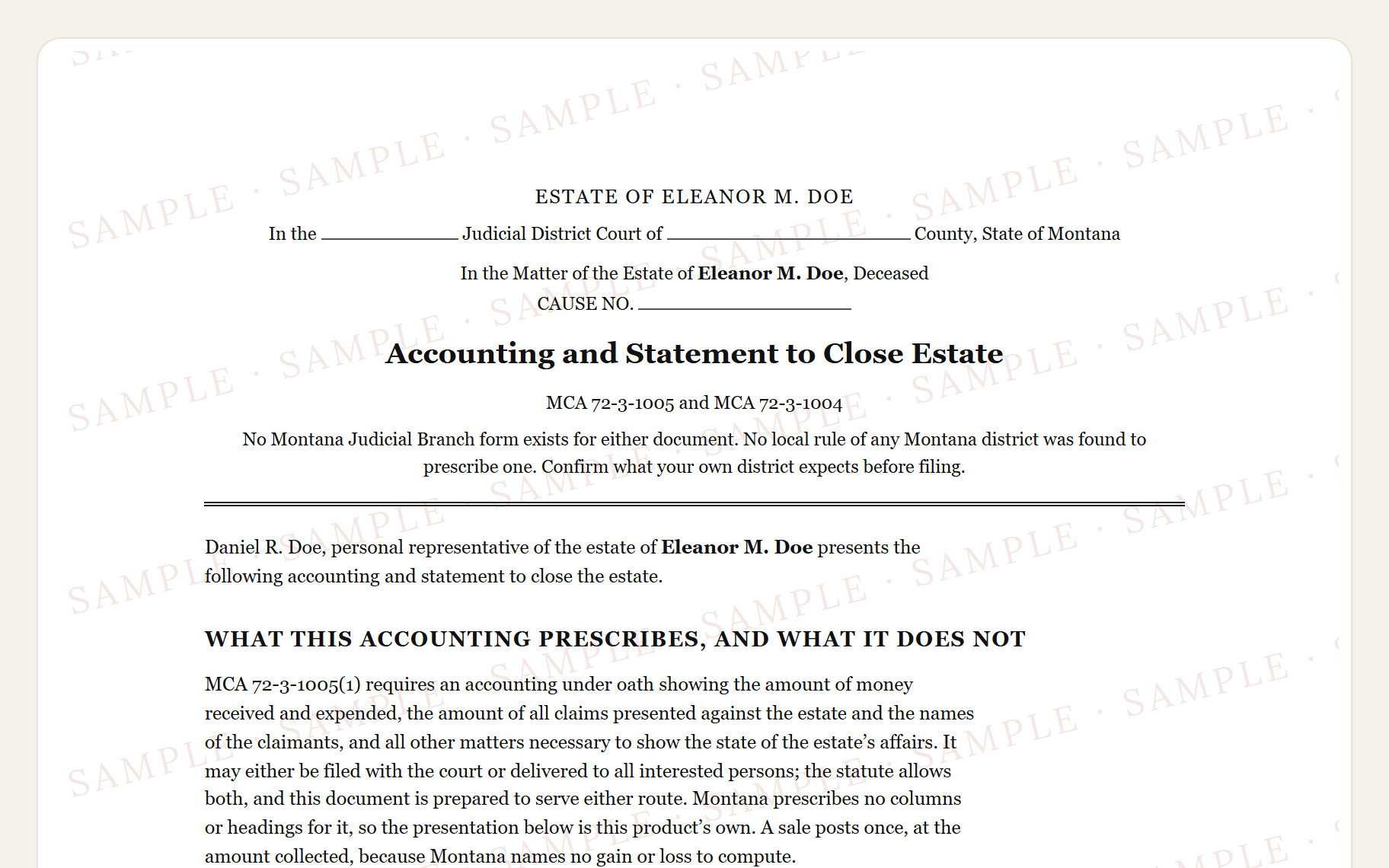
Montana administers decedents' estates under Title 72, Chapter 3 of the Montana Code Annotated, through the district court in the county where the estate is opened. A caption on a Montana probate filing reads In the ____ Judicial District Court of ______________ County, State of Montana, In the Matter of the Estate of: __________, Deceased, Cause No. ______________. Montana uses Cause No. where most other states use Case No.
The first document is the inventory, required by MCA 72-3-607. It is one flat list of the estate's property, real and personal together, with reasonable detail and the fair market value of each item as of the date of death. Montana names no lettered classes and no classification scheme, so ExecutorLedger's Montana inventory is a single schedule, the way the statute itself reads.
The second document is the account required by MCA 72-3-1005: a cash account of money received and money expended, with the amount of all claims presented against the estate and the names of the claimants. Montana names no columns for it, so ExecutorLedger builds a cash account, the same approach this product uses for other states whose statute names an account but no shape.
Both documents can go two ways. MCA 72-3-607(3) gives the personal representative a choice between sending copies to those who ask or filing the original with the court, and MCA 72-3-1005(1) lets the account either be filed with the court or delivered to all interested persons. Neither document is required to reach the court at all in every estate.
Section 2 of 7.Montana's deadlines, with the statute behind each
- Day 30 (about 1 month)Notice of appointment to heirs and devisees
Why
Under Mont. Code Ann. §72-3-603, the personal representative generally must give notice of the appointment to the heirs and devisees not later than 30 days after appointment, delivered or sent by ordinary mail to each one whose address is reasonably available; confirm who must receive this notice with your attorney. - Day 120 (about 4 months)Creditor claims bar (4 months after first publication)
Why
Under Mont. Code Ann. §§72-3-801, 72-3-803, creditors generally must present claims within 4 months after the first publication of the notice to creditors (which §72-3-801 requires promptly upon appointment, once a week for 3 successive weeks; a creditor given mailed notice gets 30 days from mailing if that is later), so calendar this bar date before paying or distributing; this date is anchored to your appointment date because the true trigger is the first publication, so confirm the operative date with your attorney. - Day 180 (about 6 months) · earliest possibleInformal closing by sworn statement first possible
Why
Under Mont. Code Ann. §72-3-1004, an unsupervised estate typically may first be closed by verified sworn statement no earlier than 6 months after the original appointment of a general personal representative, once the claims period has run and claims, expenses, and death taxes are handled; confirm whether the informal route applies to your estate with your attorney. - Day 270 (about 9 months)Inventory of probate property
Why
Under Mont. Code Ann. §72-3-607, the personal representative generally must prepare an inventory of probate property within 9 months after appointment, listing each item's date-of-death fair market value and any encumbrances, and then either send copies to heirs, devisees, and unpaid creditors who request one or file the original with the court; confirm the deadline and the delivery route with your attorney. - Day 730 (about 2 years)Estate to be closed within two years
Why
Under Mont. Code Ann. §72-3-1015, Montana estates generally must be closed within 2 years of the personal representative's appointment; the supreme court administrator reports estates open longer to the district judge, who after a show-cause hearing can order closure within 30 days and deny compensation to the personal representative and attorney absent good cause; confirm timing and any good-cause grounds with your attorney.
- Day 270 (about 9 months)Federal estate tax return (Form 706), if required
Why
Under IRC §6075, Form 706 is due 9 months after death, but only if the gross estate exceeds the federal exemption or the estate elects portability, and a 6-month extension may be available; confirm applicability and timing with your attorney. - Day 365 (about 1 year)One-year nonclaim bar from death
Why
Under Mont. Code Ann. §72-3-803(1)(a), claims that arose before death are generally barred 1 year after the decedent's death even as to creditors who never received notice, which typically sets the outer limit for safe distribution; confirm whether any exception (such as mortgages or insurance-covered claims) applies with your attorney.
The inventory is due within 9 months after appointment, not from the date of death (MCA 72-3-607(1)). That is longer than the three months most states use, so do not assume a shorter clock here.
Read the full explanation
A supplemental inventory covers property found later, or a value or description later found wrong or misleading. MCA 72-3-609 sets no deadline for it. It follows whichever route the original inventory took: filed with the court if the original was filed, or sent to the people interested in the new information if the original was not.
A surviving spouse with election rights can send a written demand for a list of the decedent's probate and nonprobate property. Once that demand is made, MCA 72-3-607(6) gives the personal representative 90 days to prepare it. This list is not the inventory, and a personal representative may also choose to prepare a similar, wider list on their own under MCA 72-3-607(5), covering probate and nonprobate property together.
A sworn statement to close the estate can be filed no earlier than 6 months after the personal representative's original appointment (MCA 72-3-1004). Montana's courts also describe furnishing interested persons a copy of an account, including fiduciary and attorney fees, within 2 years of appointment unless the interested person waives it. That two-year figure comes from courts.mt.gov's own probate guidance, not from a statute this guide could find, so confirm the current practice with your own district.
Creditors get notice by publication once a week for three successive weeks in a newspaper of general circulation in the county, with claims due within 4 months after the date of the first publication or forever barred (MCA 72-3-801(1)). A creditor given written notice has until 4 months from the published notice or 30 days from the written notice, whichever is later (MCA 72-3-801(2)). Written notice is something the personal representative may give, not something required, and MCA 72-3-801(3) removes liability either way.
A federal estate tax return, Form 706, if the estate needs one, is due nine months after death (IRC section 6075), with a possible six-month extension. Confirm whether the estate needs one with your attorney.
Section 3 of 7.What Montana pays a personal representative
There is no percentage schedule. MCA 72-3-631(1) allows a personal representative reasonable compensation for services, full stop. A former schedule, 3 percent of the first $40,000 plus 2 percent above that, was deleted from the statute in 2019, so a source that still quotes it is out of date.
A former cap tying an attorney's fee to 1.5 times the personal representative's own compensation was repealed the same year, so that figure should not be used either. MCA 72-3-634 works on a filed motion, and three people may file it: an interested person, the personal representative, or a person the personal representative employed. So a personal representative who wants their own fee settled by the court before distributing can ask for that themselves. Once the motion is filed and all interested persons have notice, the court must review and determine the propriety of employing anyone the personal representative hired, the reasonableness of that person's compensation, and the reasonableness of what the personal representative set for their own services.
ExecutorLedger computes no Montana commission from a percentage, since the statute sets none. The account shows the recorded amount, or a ruled blank, and nothing on the page claims a court has allowed or will allow it.
Section 4 of 7.How a Montana estate closes
MCA 72-3-1004 lets a personal representative close by filing a verified sworn statement no earlier than six months after the original appointment of a general personal representative. The statement recites that the time for presenting claims has expired, that the estate has been fully administered with claims, administration expenses and taxes paid or otherwise provided for and distribution made, or that arrangements for any undischarged claim are stated, and that a copy plus a full account in writing of the administration has gone to the distributees and to unpaid, unbarred creditors. If no proceeding involving the personal representative is pending one year after the statement is filed, the appointment terminates on its own.
MCA 72-3-1005 is a separate, cross-referencing section that also governs closing: before the estate can be finally closed and the personal representative relieved of duties, the personal representative files with the court or delivers to all interested persons a cash account under oath, showing money received and expended, the claims presented, the claimants' names, and anything else needed to show the state of the estate's affairs. No accounting at all is required if the personal representative is the estate's sole residual beneficiary. Any interested person may, for good cause, require further accountings at any time during administration.
No Montana Judicial Branch form covers an inventory, an account or a closing statement. courts.mt.gov's probate offerings are the Affidavit of Death, the small-estate collection-by-affidavit forms, and the Fiduciary Statement, which is an acceptance of the personal representative's own duty under MCA 72-3-109, not an inventory or an account. A document called Form 15.1 that circulates through commercial legal-form sites is not a Montana court form, whatever it says about itself.
- Once the claims period has run, pay the allowed claims, expenses, and any taxes, then prepare the final accounting under oath that Montana requires (Mont. Code Ann. §72-3-1005): money received, money spent, and every claim presented with the claimant's name. Either file it with the district court or deliver it to all interested persons (skippable only if you are the sole residual beneficiary).
- Distribute what is left and collect a signed receipt from each distributee for your records.
- Close informally with a verified closing statement under §72-3-1004 (Montana's version of UPC §3-1003): no earlier than 6 months after appointment, file the sworn statement with the district court saying claims, expenses, and death taxes are handled and assets distributed, and send a copy to every distributee and any unpaid claimant.
- If someone disputes the accounting or you want a court order behind you, petition the district court instead for formal settlement and an order of complete settlement under §72-3-1001.
- Keep your records handy afterward: if no proceedings are pending one year after the closing statement is filed, your appointment terminates automatically (§72-3-1004(2)).
Montana probate is handled by the state district court in the county of venue. There is no separate probate court, surrogate, or register of wills. Most Montana estates run unsupervised under the UPC and close by the informal sworn-statement route.
Section 5 of 7.The Inventory and the Account explained for a first-time personal representative
MCA 72-3-607(1) asks for reasonable detail, the fair market value of each item as of the date of death, and the type and amount of any encumbrance on that item. That is a gross value with the encumbrance shown separately, never netted against it. ExecutorLedger records no encumbrance data, so every row carries a ruled blank for it, with a note that the value and the encumbrance stay apart on the page. Real property goes on the same one list as everything else. Montana names no classification scheme, so there is no separate real-property schedule to keep straight from the rest.
MCA 72-3-607(2) requires the name and address of any appraiser to appear on the inventory beside the items that appraiser valued. Appraisal itself is optional, used only for an asset whose value may be subject to reasonable doubt. ExecutorLedger records no appraiser data, so this prints as a note for the preparer to complete by hand.
The choice in MCA 72-3-607(3) changes who gets a copy, not just whether the original is filed. Sending copies without filing reaches only heirs, devisees, and creditors with allowed claims that have not been satisfied, and only those who ask. Filing the original with the court instead means sending copies to interested persons generally, a wider group, again only to those who ask. This is neither a state where filing is only optional nor one where it is only required. It is a choice, and the choice decides who is entitled to a copy.
MCA 72-3-607(5) and (6) describe two documents that are not the inventory. Subsection (5) lets a personal representative voluntarily prepare a wider list of everything the decedent owned, probate and nonprobate property together, with each nonprobate transferee named. Subsection (6) requires a similar list, to the extent known or reasonably discoverable, within 90 days of a written demand from a surviving spouse with election rights. Neither replaces the inventory, and this guide keeps them separate from it.
The account's Receipts and Disbursements columns track money received and money expended, the words MCA 72-3-1005(1) itself uses. A sale posts once, at the amount collected, since the statute names no gain or loss to compute. The claims presented against the estate, and the names of the claimants, are a named requirement of MCA 72-3-1005(1) that ExecutorLedger has no data for, so this prints as a ruled schedule for the preparer rather than being left off the page. Any schedule of property the estate still holds is this product's own addition, offered under the statute's own catch-all for other matters necessary to show the state of the estate's affairs, and the page labels it that way rather than as something the statute requires.
Verification uses the sentence Montana's own currently published Fiduciary Statement form uses: I declare under penalty of perjury under the laws of the state of Montana that the foregoing is true and correct. MCA 1-6-105 offers two other exemplar sentences for an unsworn declaration, one for execution inside Montana and one outside it, and neither matches the form's own wording. MCA 72-3-1005(1) separately requires the account to be under oath, so a notarized affidavit remains available. Confirm which one your district wants.
Montana has no state estate or inheritance tax, and none is printed anywhere on ExecutorLedger's Montana documents.
Section 6 of 7.Where ExecutorLedger fits
Recording is free for as long as the estate takes: every receipt and disbursement with its date and description, distributions per beneficiary, and a balance that checks itself as you go. ExecutorLedger builds Montana-style documents from those records, an inventory laid out as MCA 72-3-607's single list and a cash account laid out the way MCA 72-3-1005 names it, ready to transcribe or attach when you file or furnish one. Neither is a court form, since Montana publishes none for either document, and your attorney should review them before anything is signed or filed. Every document previews free with your real numbers, and $149 (one-time payment) per estate lifts the watermark. Usually less than one attorney hour, and typically reimbursable by the estate.
Section 7 of 7.Questions Montana executors ask
Is there a court form for Montana's inventory or account?
No. courts.mt.gov's probate offerings are the Affidavit of Death, the small-estate collection-by-affidavit forms, and the Fiduciary Statement, which is an acceptance of duty under MCA 72-3-109, not an inventory or an account. A document called Form 15.1 circulating through commercial legal-form sites is not a Montana court form. MCA 72-3-607 and MCA 72-3-1005 say what the documents must contain, and that is the whole requirement.
Does the Montana inventory have to be filed with the court?
It is a choice. MCA 72-3-607(3) lets the personal representative either send copies to heirs, devisees, and creditors with allowed unsatisfied claims who ask, without filing, or file the original with the court and send copies to interested persons generally who ask, a wider group. The route chosen decides who is entitled to a copy.
When is the Montana inventory due?
Within 9 months after the personal representative's appointment, not from the date of death (MCA 72-3-607(1)). Property found later, or a value later found wrong, goes on a supplemental inventory with no fixed deadline, following whichever route the original inventory took (MCA 72-3-609).
Does a Montana estate have to file an accounting with the court?
Not always. MCA 72-3-1005(1) lets the account either be filed with the court or delivered to all interested persons, and MCA 72-3-1005(3) excuses it entirely if the personal representative is the estate's sole residual beneficiary. Any interested person may still require further accountings for good cause at any time during administration.
How is a Montana personal representative paid?
MCA 72-3-631(1) allows reasonable compensation for services, with no percentage and no schedule. A former 3-percent-plus-2-percent schedule, and a former cap on attorney fees at 1.5 times the personal representative's compensation, were both deleted from the statute in 2019. MCA 72-3-634 works on a filed motion, and an interested person, the personal representative, or a person the representative employed may file it. The court must then review and determine both the propriety of the employment and the reasonableness of the compensation.
Not sure which accounting your situation calls for? Which accounting do I need? covers the choice, and the accounting guide explains the structure every format shares.
This page describes Montana practice as our verified references state it; formats drift and estates differ, and none of this is legal advice. ExecutorLedger produces court-style documents for transcription. They are not official court forms. The accounting your estate needs is a question for its attorney.