Minnesota Estate Accounting: A Representative's Guide
Minnesota probate runs through the district court, probate division, in each county, under the Uniform Probate Code as Minnesota adopted it. Its fiduciary is the personal representative, and its two statewide forms are PRO912, the inventory, and PRO913, the final account. Here is what each covers, the deadlines behind each, and how a Minnesota estate closes.
Section 1 of 7.The two documents: the PRO912 inventory and the PRO913 final account
Minnesota administers estates under the Uniform Probate Code as enacted in Minn. Stat. chapter 524, article 3, before the district court, probate division, in each county. The statute and the court's own forms call the fiduciary the personal representative throughout, whether appointed under a will or without one, and this guide uses the same term (some call the role the executor or administrator instead).
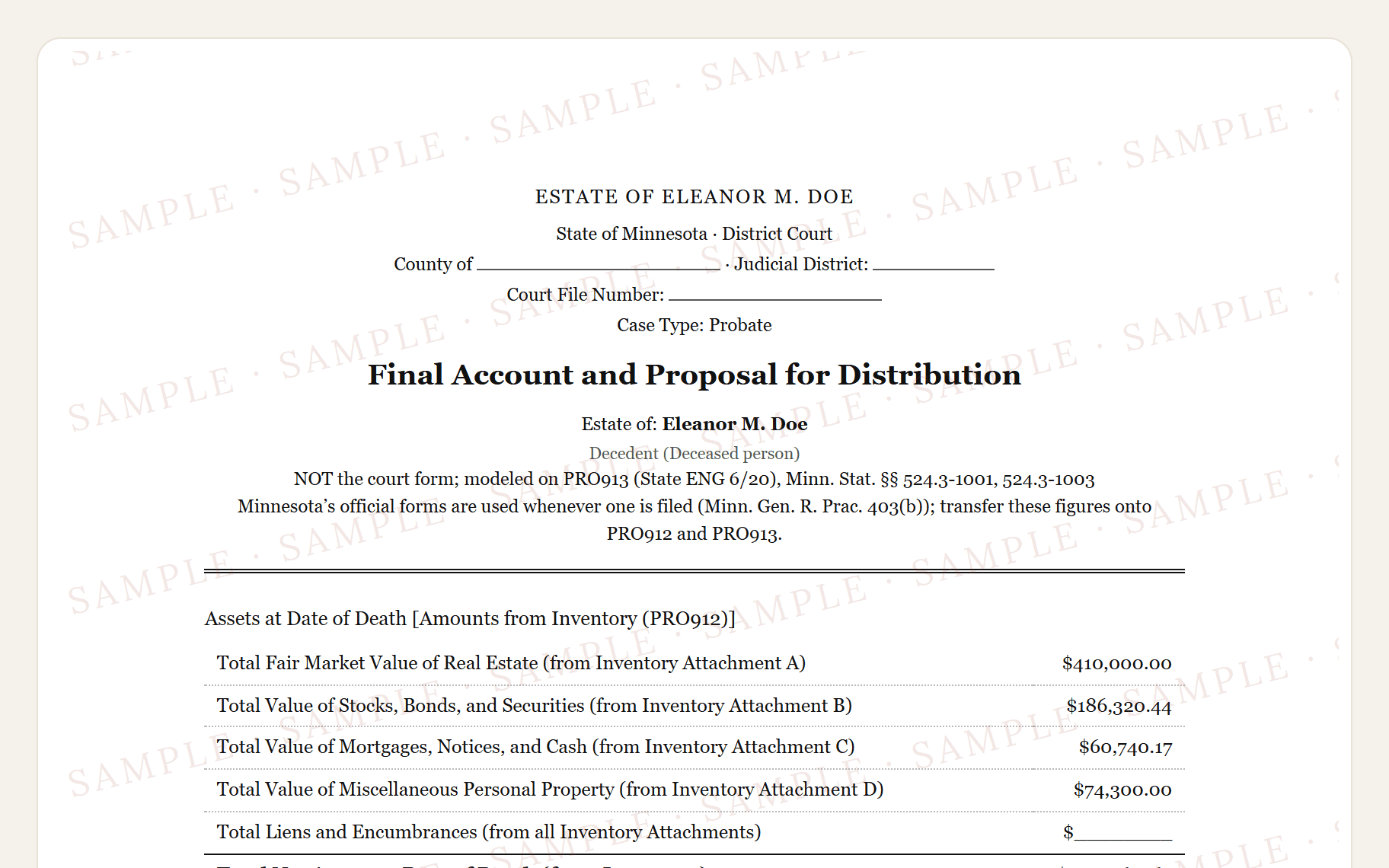
Minnesota's Judicial Branch publishes two statewide forms that carry a schedule shape: PRO912, Inventory and Attachments A-E, and PRO913, whose caption reads Final Account and Proposal for Distribution (its running header and footer call it Final Account and Attachments). Minn. Gen. R. Prac. 403(b) says the statewide forms shall be used whenever a form is filed, stronger wording than the 'available for convenience' phrasing some other Uniform Probate Code states use. There is no separate statewide interim or annual account form. PRO913 carries its own Original, Amended, and Supplemental checkboxes and gets refiled in the identical shape for a later filing rather than swapped for a different form.
Minnesota's own vocabulary crosses two pairs: informal versus formal proceedings, and supervised versus unsupervised administration. An informal proceeding is handled by the registrar, without notice or a hearing; a formal proceeding goes before a judge, with notice to interested persons and a hearing. There is no separate 'independent administration' track or term in Minnesota law. The same PRO912 and PRO913 forms serve every route unchanged, whether the case opened informally or formally, and whether administration ends up supervised or unsupervised.
Filing either document with the court is optional, described by the court's own instructions as good practice, in unsupervised administration (informal, or formal but unsupervised); filing is required in supervised administration. The Judicial Branch's own instruction sheets say so directly: PRO911 walks a personal representative through closing an informal case, and PRO1301 walks through closing a formal one, and both name the identical filing pattern for PRO912 and PRO913. Whether or not either document is ever filed with the court, the underlying duty to prepare the inventory, and to prepare and mail the final account, applies to every Minnesota personal representative.
Section 2 of 7.Minnesota deadlines, with the statute behind each
- Day 14 (about 2 weeks)Notice to DHS if decedent (or predeceased spouse) received Medical Assistance
Why
Under Minn. Stat. §524.3-801(d), if the decedent or a predeceased spouse received medical assistance or similar state assistance (§§246.53, 256B.15, 256D.16, 261.04), the personal representative generally must serve notice on the commissioner of human services 'as soon as practicable after the appointment of the personal representative,' and no estate property may typically be distributed until 70 days after that notice is served; the statute sets no fixed day count, so this is calendared 14 days from appointment as a conservative reminder. Confirm whether this applies and the service date with your attorney. - Day 90 (about 3 months)Serve the creditor notice on known and identified creditors
Why
Under Minn. Stat. §524.3-801(b), the published notice to creditors is generally arranged under the court administrator's direction when probate opens, and the personal representative must then typically serve a copy on each known and identified creditor within 3 months after the date of the first publication; because the true trigger is the publication date, this is calendared 90 days from appointment as a conservative stand-in. Confirm the actual first-publication date and service deadline with your attorney. - Day 120 (about 4 months) · earliest possibleEarliest informal closing by sworn statement
Why
Under Minn. Stat. §524.3-1003, in unsupervised administration the sworn closing statement generally may be filed no earlier than 4 months after the date of original appointment, and only if the creditor notice was first published more than 4 months before the filing; confirm the earliest filing date with your attorney. - Day 180 (about 6 months)Inventory of estate assets
Why
Under Minn. Stat. §524.3-706, the inventory is generally due within 6 months after appointment or 9 months after the decedent's death, whichever is later (calendared here at the 6-month mark, which is never later than the true date), and the statute typically lets the personal representative file it with the court or mail it, with a copy mailed or delivered to the surviving spouse, all residuary distributees, and interested persons or creditors who request one; confirm the operative date and who must receive it with your attorney.
- Day 270 (about 9 months)Minnesota estate tax return (Form M706), if required
Why
Under Minn. Stat. §§289A.10, subd. 1, and 289A.18, subd. 3, a Minnesota estate tax return is generally due 9 months after death, and is typically required if a federal return must be filed or if the federal gross estate plus federal adjusted taxable gifts made within three years of death exceeds $3,000,000 (deaths in 2020 or later), a far lower threshold than the federal exemption; confirm whether a Minnesota return is required and its due date with your attorney. - Day 270 (about 9 months)Federal estate tax return (Form 706), if required
Why
Under IRC §6075, Form 706 is due 9 months after death, but only if the gross estate exceeds the federal exemption or the estate elects portability, and a 6-month extension may be available; confirm applicability and timing with your attorney. - Day 365 (about 1 year)Outside bar date for creditor claims
Why
Under Minn. Stat. §524.3-803, creditor claims arising before death are generally barred one year after death even if no creditor notice was ever published, and noticed creditors are typically barred earlier (4 months after the published notice, or for a personally served creditor the later of 4 months after first publication or 1 month after service), but state assistance claims under §§246.53, 256B.15, and 256D.16 are not cut off by the one-year bar; confirm the operative bar dates before paying claims or distributing with your attorney.
The inventory is due within six months after appointment, or nine months after the decedent's death, whichever is later. The personal representative can file it with the court or mail it, at their own choice, but a copy must reach the surviving spouse and every residuary distributee regardless; any other interested person or creditor gets one only on request (Minn. Stat. § 524.3-706).
Read the full explanation
If the decedent, or a spouse who died before the decedent, received medical assistance or similar state assistance, notice goes to the Department of Human Services as soon as practicable after appointment, and no estate property may be distributed until 70 days after that notice is served (Minn. Stat. § 524.3-801(d)).
The creditor notice is published for two successive weeks under the court administrator's direction, and the personal representative must serve a copy on every known and identified creditor within three months after the date of first publication (Minn. Stat. § 524.3-801(a), (b)).
Creditor claims arising before death are barred one year after death, whether or not notice was ever published. A creditor who only gets the published notice is barred four months after its first publication; a creditor served individually is barred the later of four months after first publication or one month after service (Minn. Stat. § 524.3-803).
The unsupervised closing statement cannot be filed earlier than four months after the date of original appointment, and only once the creditor notice was first published more than four months before filing (Minn. Stat. § 524.3-1003).
The court's own instructions put the final account on a one-year clock: PRO911 says it must be completed and mailed within one year after appointment, absent extraordinary circumstances, and that filing it with the court is good practice but not required in unsupervised administration.
If the federal gross estate plus taxable gifts made in the three years before death exceeds $3,000,000, a Minnesota estate tax return (Form M706) is due nine months after death, the same trigger that applies whenever a federal return is required (Minn. Stat. §§ 289A.18, 289A.10).
A federal estate tax return, Form 706, if the estate needs one, is due nine months after death (IRC section 6075), with a possible six-month extension. Confirm whether the estate needs one with your attorney.
Section 3 of 7.What Minnesota pays a personal representative
Minn. Stat. § 524.3-719 entitles the personal representative to reasonable compensation for services, with no statutory percentage, tier, or schedule of any kind. The statute names three factors for judging what is reasonable: the time and labor required, the complexity and novelty of the problems involved, and the extent of the responsibilities assumed and the results obtained.
If a will fixes the personal representative's compensation and there is no separate contract with the decedent about it, the personal representative can renounce that provision before qualifying and take reasonable compensation instead, or renounce all or part of any fee in a writing filed with the court.
On an interested person's petition, or on the court's own motion in supervised administration, the district court can review the reasonableness of the personal representative's own fee, or of any attorney's or other agent's fee, and order a refund of anything excessive (Minn. Stat. § 524.3-721).
Whatever fee is charged has to show up on PRO913: its Attorney's Fees and Expenses and Personal Representative's Fees and Expenses sub-tables both carry an hourly rate and a number of hours feeding the amount, not a percentage of the estate.
Section 4 of 7.How a Minnesota estate closes
Most unsupervised estates close informally, by sworn statement. No earlier than four months after the date of original appointment, and only once the creditor notice was first published more than four months before filing, the personal representative can file the sworn closing statement under Minn. Stat. § 524.3-1003. Before filing it, the personal representative has to have already sent a full written account, the final account, to every distributee and to any creditor or other known claimant whose claim is still unpaid and not barred. This route is not available in supervised administration.
The personal representative's appointment ends automatically one year after the closing statement is filed, as long as no proceeding involving the personal representative is then pending.
The formal route is a petition for complete settlement of the estate under Minn. Stat. § 524.3-1001, filed with the district court, probate division. The personal representative can petition at any time; any other interested person can petition once a year has passed since the original appointment. It takes notice to every interested person and a hearing, unless every heir or distributee waives the hearing in writing in a solvent estate. This route is required for supervised administration and for an insolvent estate.
PRO913's own Proposal for Distribution table gives every devisee and heir a 30-day window to object in writing once the proposal is mailed or delivered to them. Missing that window ends the right to object to the proposed distribution.
- Wait out the creditor period. You can close informally once 4 months have passed since your appointment and more than 4 months since the creditor notice was first published (Minn. Stat. §524.3-1003).
- Share the numbers and get signatures: send the final account (court form PRO913 fits) to the people receiving assets, and collect a signed Receipt for Assets by Distributee (form PRO916) from each of them as you distribute.
- File the Unsupervised Personal Representative's Statement to Close Estate (form PRO914), the sworn closing statement under §524.3-1003, and send a copy to all distributees and to creditors or claimants whose claims are neither paid nor barred.
- If someone won't cooperate or you want court-ordered finality, petition the district court's probate division for an order of complete settlement of the estate under §524.3-1001 instead.
- Keep the estate records at least a year after filing. Your appointment ends automatically one year after the closing statement is filed if no proceedings involving you are pending (§524.3-1003).
Minnesota is a Uniform Probate Code state. Probate runs through the district court (probate division; a registrar handles informal filings), most estates are unsupervised, and the informal sworn-statement route under Minn. Stat. §524.3-1003 is the norm. No judicial accounting is required unless administration is supervised or someone petitions for formal settlement.
Section 5 of 7.The documents explained for a first-time personal representative
PRO912 opens with a Summary of Assets table that adds up four attachments: Attachment A, Real Estate; Attachment B, Stocks, Bonds, and Other Securities; Attachment C, Bank Accounts, Cash, and Money Owed to the Estate; and Attachment D, Other Personal Property. Each attachment lists everything at its fair market value on the date of death, and item numbers start over at 1 on each attachment. Add the four together and the form calls the result the subtotal.
Attachment E, Mortgages, Liens, and Money the Estate Owes to Others, is a fifth attachment, and it works differently: it subtracts once, at the bottom of the page, from the subtotal to reach the true total. A ledger that never records liens has nothing to fill that attachment with, so the Attachment E line and the total below it print blank rather than a false zero, for the personal representative to complete by hand once any mortgages, liens, or debts to others are known.
PRO913, the final account, opens by carrying PRO912's own attachment totals forward, unchanged, into Block 1, Assets at Date of Death. Block 2 adds everything that increased the estate since then: interest, dividends, refunds, a gain on selling something for more than its inventory value, and so on. Block 3 subtracts everything that decreased it: a loss on a sale, funeral expenses, taxes, fees, and every interim distribution already made to a devisee or heir, which the form lists under its own Interim Distributions to Devisees and Heirs line, alongside the ordinary expense lines rather than in a schedule of its own.
A sale never posts its full price. Only the gain or loss against the asset's inventory value, its value on the date of death, goes on the account: a gain adds to Block 2, a loss subtracts in Block 3. Fees are documented the same way throughout, by the hourly rate and the number of hours worked, not a percentage of the estate.
Block 4, Assets on Hand for Distribution, lists what is left, personal property and real estate separately, backed by Attachment C's own itemized schedule. The Proposal for Distribution table names who gets what in plain language, a second, narrative view of the same remaining property that Attachment C already itemized in dollars.
Everything rolls up into the Final Summary, a two-column box that has to balance: the date-of-death total plus every increase on the left, every decrease plus everything still on hand for distribution on the right. If the two sides do not match, the form itself says to go back through the earlier sections and attachments for the error.
Section 6 of 7.Where ExecutorLedger fits
Recording is free for as long as the estate takes: every receipt and disbursement with its date and description, distributions per beneficiary, and a balance that checks itself as you go. ExecutorLedger builds Minnesota-style documents from those records, an inventory shaped like PRO912 and an account shaped like PRO913, ready to transcribe onto the statewide forms if you end up filing them, sending copies to distributees, or handing them to your attorney. Neither is a court form, and your attorney should review them before anything is signed or filed. Every document previews free with your real numbers, and $149 (one-time payment) per estate lifts the watermark.
Section 7 of 7.Questions Minnesota executors ask
Does Minnesota require the PRO912 inventory and PRO913 final account?
Only when one is filed with the court, and Minn. Gen. R. Prac. 403(b) then requires the statewide form. Filing both is required in supervised administration; in unsupervised administration, informal or formal but unsupervised, filing either is good practice, not mandatory, though preparing the inventory and preparing and mailing the final account are mandatory regardless (Minn. Stat. § 524.3-706; the court's own PRO911 and PRO1301 instructions).
When is the Minnesota inventory due?
Within six months after appointment, or nine months after the decedent's death, whichever is later. A copy must reach the surviving spouse and every residuary distributee; anyone else gets one only on request (Minn. Stat. § 524.3-706).
How is a Minnesota personal representative paid?
Minn. Stat. § 524.3-719 allows reasonable compensation, judged by the time and labor required, the complexity of the problems involved, and the responsibilities assumed and the results obtained, with no statutory percentage. The district court can review the fee's reasonableness and order a refund of any excess on an interested person's petition (Minn. Stat. § 524.3-721).
How does a Minnesota estate close?
Most unsupervised estates close informally: no earlier than four months after appointment, and only once the creditor notice was published more than four months before filing, by a sworn closing statement under Minn. Stat. § 524.3-1003. Supervised estates, and any estate that needs a court order, close instead by a petition for complete settlement under Minn. Stat. § 524.3-1001, with notice and a hearing unless waived.
What if the decedent received medical assistance from the state?
Notice to the Department of Human Services goes out as soon as practicable after appointment, and no estate property may be distributed until 70 days after that notice is served (Minn. Stat. § 524.3-801(d)). Confirm whether this applies, and the service date, with your attorney.
Not sure which accounting your situation calls for? Which accounting do I need? covers the choice, and the accounting guide explains the structure every format shares.
This page describes Minnesota practice as our verified references state it; formats drift and estates differ, and none of this is legal advice. ExecutorLedger produces court-style documents for transcription. They are not official court forms. The accounting your estate needs is a question for its attorney.