Idaho Estate Accounting: A Personal Representative's Guide
Idaho probate is assigned to the magistrate division of the district court, and its fiduciary is the personal representative, the executor named in a will or the administrator appointed when there is none. Idaho is a Uniform Probate Code state, Idaho Code Title 15, and its statutes fix what an inventory and a closing statement must contain without fixing any printed form for either one. Here is what the statutes require, the deadlines behind them, and how an Idaho estate closes.
Section 1 of 7.The two documents: the Inventory and the verified statement
Idaho administers decedents' estates under Title 15 of the Idaho Code, and probate is assigned to the magistrate division of the district court (Idaho Code 1-2208(2)). A caption still names the district court, the judicial district and the county rather than the word division: that is how a currently live Idaho Court Assistance Office form for a related probate matter captions itself, and this guide follows the same convention. The Court Assistance Office publishes no form for a decedent's estate inventory, account or closing statement. Its forms catalogue covers guardianships and conservatorships, not decedents' estates, and a personal representative who finds one of those forms online should not use it. A form number sometimes described online as Form CAO Pb 01 cannot be found on the Court Assistance Office's own site and should not be relied on. The IUPC form series, including a document sometimes labeled IUPC041, traces to an old Idaho State Bar probate-forms volume reproduced today only by commercial vendors. It is not a court form, and no form number prints on any document this guide describes.
The first document is the inventory, required by Idaho Code 15-3-706. Within three months after appointment, not three months after death, a personal representative who is not a special administrator, and who has not taken over from an earlier representative who already did it, prepares one list of the property the decedent owned at death, with reasonable detail, each item's fair market value as of the date of death, and the type and amount of any encumbrance on it. Idaho sits on the permissive side of a split among Uniform Probate Code states. Sending a copy to an interested person who requests one is required. Filing the original with the court is the personal representative's own option. A reader who has read about a neighboring state's mandatory filing rule should not assume Idaho works the same way. It does not.
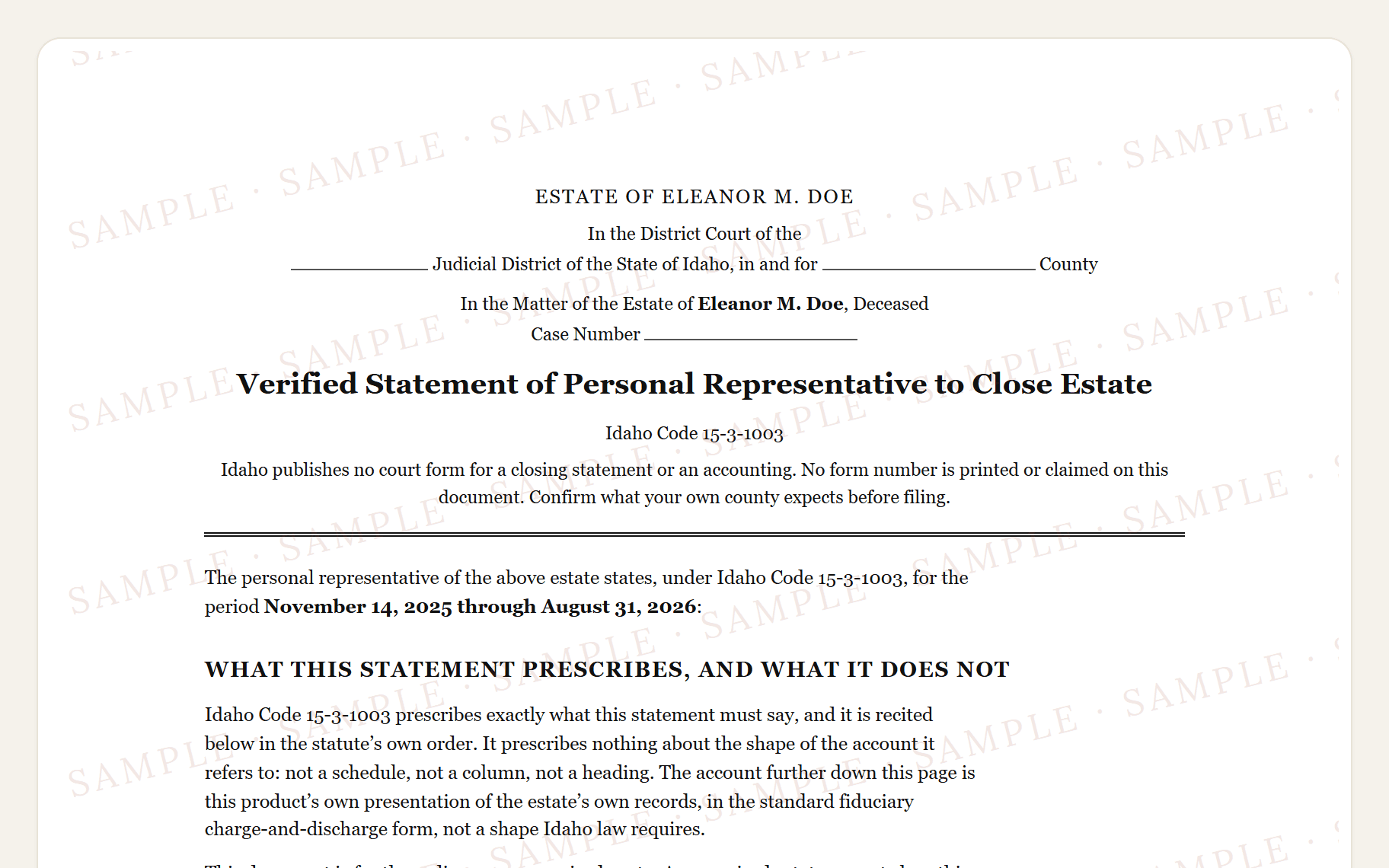
The second document is the verified statement to close the estate under Idaho Code 15-3-1003, filed once the estate is ready to close. It recites that the creditors' claim deadline has expired; that the estate has been fully administered, meaning every claim that was presented has been handled along with the expenses of administration and estate, and inheritance and other death taxes, with the assets distributed to the people entitled, and, for any claim that remains undischarged, either that the estate was distributed subject to possible liability with the distributees' consent or what other arrangements were made; and that copies of the statement went to the distributees and to any known creditor or claimant whose claim remains unpaid or unbarred, along with a full written account of the administration furnished to the distributees. Idaho's statute sets no content or format for that account. It only requires that one exists and reaches the distributees, and it is furnished to them rather than filed with the court; only the verified statement itself is filed.
Section 2 of 7.Idaho's deadlines, with the statute behind each
- Day 30 (about 1 month)Information to heirs and devisees
Why
Under Idaho Code §15-3-705, the personal representative generally must deliver or mail notice of the appointment (your name and address, whether bond was filed, and the court where estate papers are on file) to all heirs and devisees within 30 days after appointment; confirm the recipient list and timing with your attorney. - Day 30 (about 1 month)Publish and mail notice to creditors
Why
Under Idaho Code §15-3-801, publishing notice to creditors (once a week for 3 successive weeks) is technically optional in Idaho, but publication typically starts the 4-month claims bar, so executors generally publish promptly after appointment and also mail notice to known creditors (whose bar is the later of the 4 months or 60 days after mailing); confirm whether and when to publish with your attorney. - Day 30 (about 1 month)Medicaid estate-recovery notice to Idaho Dept. of Health and Welfare
Why
Under Idaho Code §56-218(5) and §15-3-801(d), if the decedent received medical assistance (Medicaid) at age 55 or older, the personal representative generally must give the director of the Idaho Department of Health and Welfare written notice of the appointment within 30 days of appointment, and the department then pursues its recovery claim through the ordinary creditor-claim process; confirm whether this applies with your attorney. - Day 90 (about 3 months)Prepare estate inventory and appraisement
Why
Under Idaho Code §15-3-706, within 3 months after appointment the personal representative generally must prepare an inventory listing each asset in reasonable detail with its date-of-death fair market value and any encumbrances; filing it with the court is optional, but copies typically must be sent to interested persons who request one; confirm the exact due date and recipients with your attorney. - Day 150 (about 5 months)Creditor claims bar date
Why
Under Idaho Code §15-3-801 and §15-3-803, creditor claims are generally barred 4 months after first publication of notice (or, for a creditor given mailed notice, 60 days after mailing if later), with an outer bar of 3 years after death if no notice is given; this date is anchored to your appointment assuming publication within about a month, but the true clock runs from publication or mailing, so calendar it before paying or distributing and confirm the operative bar date with your attorney. - Day 180 (about 6 months) · earliest possibleEarliest date to file informal closing statement
Why
Under Idaho Code §15-3-1003, an estate generally may be closed informally by sworn statement no earlier than 6 months after the original appointment of a general personal representative, and only after the creditor claim period has run; confirm the earliest filing date with your attorney.
- Day 270 (about 9 months)Federal estate tax return (Form 706), if required
Why
Under IRC §6075, Form 706 is due 9 months after death, but only if the gross estate exceeds the federal exemption or the estate elects portability, and a 6-month extension may be available; confirm applicability and timing with your attorney.
The inventory is due within three months after the personal representative's appointment, not three months after death (Idaho Code 15-3-706).
Read the full explanation
Property discovered afterward, or a value or description in the original inventory that turns out to be erroneous or misleading, goes on a supplementary inventory under Idaho Code 15-3-708. It is its own instrument, never folded into the original's total, and the statute sets no deadline of its own for filing it.
The verified statement to close the estate may be filed no earlier than six months after the date of the original appointment of a general personal representative, not six months after death and not six months after a later successor's own appointment (Idaho Code 15-3-1003).
Once the verified statement is filed, and if no proceeding involving the personal representative is pending in the court a year later, the personal representative's appointment terminates on its own (Idaho Code 15-3-1003(b)).
A federal estate tax return, Form 706, if the estate needs one, is due nine months after death (IRC section 6075), with a possible six-month extension. Confirm whether the estate needs one with your attorney.
Section 3 of 7.What Idaho pays a personal representative
Idaho sets no percentage schedule. Idaho Code 15-3-719 entitles a personal representative to reasonable compensation for their services, with no tiers and no rate named anywhere in the statute. Idaho Code 15-3-721 covers compensation paid to anyone the personal representative employed, including counsel, and their own compensation as well. The court may review it after notice to all interested persons, on the petition of an interested person, or on an appropriate motion where the administration is supervised.
So an Idaho fee is a figure you support with the record of your work, not one you look up in a table. ExecutorLedger never computes an Idaho commission from a percentage, since no Idaho statute sets one. Where the estate's own records show compensation already paid, that figure is what the closing account reports, and nothing on the page claims a court has allowed or will allow it.
Section 4 of 7.How an Idaho estate closes
The verified statement to close the estate under Idaho Code 15-3-1003 is filed no earlier than six months after the original appointment of a general personal representative. It recites three things, in the statute's own order: that the creditors' claim presentation deadline has expired; that the estate has been fully administered, handling every claim that was presented, the expenses of administration and estate, and inheritance and other death taxes, and distributing the assets to the people entitled, with a place to describe anything excepted, and stating for any claim that remains undischarged either that the estate was distributed subject to possible liability with the distributees' consent or what other arrangements were made; and that copies of the statement went to every distributee and to known creditors or claimants whose claims remain unpaid or unbarred, along with a full account in writing of the administration furnished to the distributees whose interests are affected by it.
This is the ordinary, unsupervised route. A supervised estate closes the formal way instead, under Idaho Code 15-3-1001 and 15-3-1002, and cannot use the verified statement under 15-3-1003 at all. A small estate closed through the summary procedure under Idaho Code 15-3-1203 files a different closing statement of its own, under Idaho Code 15-3-1204. Neither of those routes is what this guide or ExecutorLedger's Idaho documents cover.
Idaho Code 15-3-1003(b) starts a one-year clock once the statement is filed. If no proceeding involving the personal representative is pending in the court when that year is up, the appointment terminates on its own, with no order needed.
- Wait out the creditor claim period and at least 6 months from your appointment. Idaho Code §15-3-1003 does not allow an informal closing any sooner.
- Pay the allowed claims, expenses, and taxes, then distribute what remains to the people entitled to it.
- Send every distributee and every known claimant a full written accounting of your administration. The closing statement must swear you did this.
- File a sworn (verified) closing statement under Idaho Code §15-3-1003 with the magistrate division of the district court. This is the informal route most Idaho estates use; your appointment then ends automatically one year after filing if no proceedings are pending.
- If there are disputes or you want a binding court order approving the accounting and distribution, petition instead for formal settlement under Idaho Code §15-3-1001.
Idaho probate, including closing, is handled by magistrates in the magistrate division of the county district court (Idaho Code §1-2208). There is no separate probate, surrogate's, or orphans' court.
Section 5 of 7.The Inventory and the account explained for a first-time personal representative
Idaho Code 15-3-706 names no classes for the inventory, unlike states that sort property into lettered or numbered schedules. Real property sits on the same single list as everything else, at its full value, with its own subtotal shown as a subtotal of that same list rather than a second schedule that could be counted twice. Any label ExecutorLedger prints beside an item is this product's own description, never a category the statute asks for. The encumbrance the statute asks for, the type and amount of any lien or charge against an item, is its own datum, printed as a ruled line for you to fill in. It is never netted against the value, because Idaho Code 15-3-706 asks for the item's fair market value and its encumbrance separately, a gross figure plus a separate line, not a combined net-of-lien figure the way some other states ask for it.
Idaho is a community property state, but Idaho Code 15-3-706's own text carries no community-or-separate column, unlike some other community property states. ExecutorLedger prints none, and does not say the statute requires one.
Employing an appraiser is optional under Idaho Code 15-3-707, for any asset whose value may be subject to reasonable doubt, and different appraisers may be used for different kinds of asset. Once an appraiser is used, the statute makes the disclosure mandatory: the appraiser's name and address must be shown on the inventory beside the item or items that appraiser valued. A supplementary inventory under Idaho Code 15-3-708 is its own instrument with its own total, for property found later or a value or description that needs correcting, with no deadline of its own. What happens to it depends on whether the original inventory was filed with the court. If it was, the supplementary inventory is filed with the court too. If it was not, copies go to the state tax commission and to every interested person who was sent a copy of the original. Idaho no longer imposes an inheritance or estate tax, so the tax commission copy may be a dead letter, and a personal representative should confirm with the state tax commission whether it still wants a copy.
Idaho Code 15-1-310 deems every document filed with the court under the probate code, including this inventory, to already include an oath, affirmation or statement that its representations are true so far as the person filing it knows or is informed, with penalties for perjury possibly following deliberate falsification. Neither document carries a notary jurat, and Idaho prescribes no sentence of the kind some other states require a signer to write out. Because the verified statement to close the estate calls itself verified, practice still varies by county, so confirm with your own county whether it wants a notarized signature anyway; the statute does not forbid one.
Idaho's statute says nothing about what the closing account has to contain, not a schedule, not a column, not a heading. The schedules ExecutorLedger prints are this product's own presentation of the estate's records, in the same charge-and-discharge shape it uses for Utah, Nevada, New Mexico, Nebraska and California, whose statutes are equally silent. They are not a format Idaho requires, and the printed page says so.
Section 6 of 7.Where ExecutorLedger fits
Recording is free for as long as the estate takes: every receipt and disbursement with its date and description, distributions per beneficiary, and a balance that checks itself as you go. ExecutorLedger builds Idaho-style documents from those records, an inventory in the statute's own single, undifferentiated list and a verified statement to close with its full account, ready to transcribe or attach when you send a copy to an interested person or furnish an account to a distributee. Neither is a court form, and your attorney should review them before anything is signed or filed. Every document previews free with your real numbers, and $149 (one-time payment) per estate lifts the watermark. Usually less than one attorney hour, and typically reimbursable by the estate.
Section 7 of 7.Questions Idaho executors ask
Is there a court form for Idaho's inventory or accounting?
No. Idaho publishes no statewide form for a decedent's estate inventory or account. The Court Assistance Office's forms catalogue covers guardianships and conservatorships, not decedents' estates. Idaho Code 15-3-706 and 15-3-1003 say what a personal representative's inventory and verified closing statement must contain, and that is the whole requirement.
When is the Idaho inventory due, and do I have to file it?
Within three months after appointment, not three months after death (Idaho Code 15-3-706). Filing the original with the court is the personal representative's own option. Sending a copy to an interested person who requests one is required.
How is an Idaho personal representative paid?
Idaho Code 15-3-719 entitles a personal representative to reasonable compensation for their services. There is no percentage schedule. Idaho Code 15-3-721 covers compensation paid to anyone the personal representative employed, including counsel, and their own compensation as well. The court may review it after notice to all interested persons, on the petition of an interested person, or on an appropriate motion where the administration is supervised.
How does an Idaho estate close?
By filing a verified statement to close the estate under Idaho Code 15-3-1003 no earlier than six months after the original appointment of a general personal representative, once the creditors' claim deadline has expired, the estate is fully administered, and every distributee and unpaid, unbarred creditor or claimant has received a copy of the statement, with a full written account furnished to the distributees. A supervised estate closes the formal way instead, under Idaho Code 15-3-1001 and 15-3-1002, and a small estate uses the summary closing statement under Idaho Code 15-3-1204.
Does Idaho's inventory need to be notarized?
No sworn oath is required by statute. Idaho Code 15-1-310 deems every document filed with the court under the probate code to already include an oath that its representations are true so far as the signer knows or is informed, with penalties for perjury possibly following deliberate falsification. Practice varies by county, so confirm with your own county whether it wants a notarized signature anyway.
Not sure which accounting your situation calls for? Which accounting do I need? covers the choice, and the accounting guide explains the structure every format shares.
This page describes Idaho practice as our verified references state it; formats drift and estates differ, and none of this is legal advice. ExecutorLedger produces court-style documents for transcription. They are not official court forms. The accounting your estate needs is a question for its attorney.