Hawaii Estate Accounting: A Personal Representative's Guide
Hawaii probate runs through the circuit court, which has a probate division rather than a separate probate court, and its fiduciary is the personal representative, the executor named in a will or the administrator appointed when there is none. Hawaii is a Uniform Probate Code state, Hawaii Revised Statutes chapter 560, and its own Hawaii Probate Rules add requirements the statutes leave open, most of all for the account. Here is what the statutes and the rules require of an inventory and an account, the deadlines behind them, and how a Hawaii estate closes.
Section 1 of 7.The two documents: the Inventory and the Account
Hawaii administers decedents' estates under HRS chapter 560, the Hawaii Uniform Probate Code, through the circuit court of the circuit where the estate is opened. Probate is a division of the circuit court, not a separate court, so a Hawaii probate caption names the circuit court and its probate division rather than a probate court of its own. Hawaii publishes no statewide printed inventory form and no printed account form. The statutes and the Hawaii Probate Rules set what each document must contain, and for the account the rules go further than most states in this guide do.
HRS 560:3-706 gives the inventory three separate duties, and they should not be flattened into one. First, the personal representative shall prepare an inventory within three months after appointment, listing the decedent's property with reasonable detail, its fair market value as of the date of death, and the type and amount of any encumbrance on it. Second, the personal representative shall file it with the court or mail it, one or the other, and that choice is still a duty, not an option to skip. Third, the personal representative shall send a copy to any interested person who requests one, and may also file the original with the court. That third clause is the one that reads as optional. The first two do not.
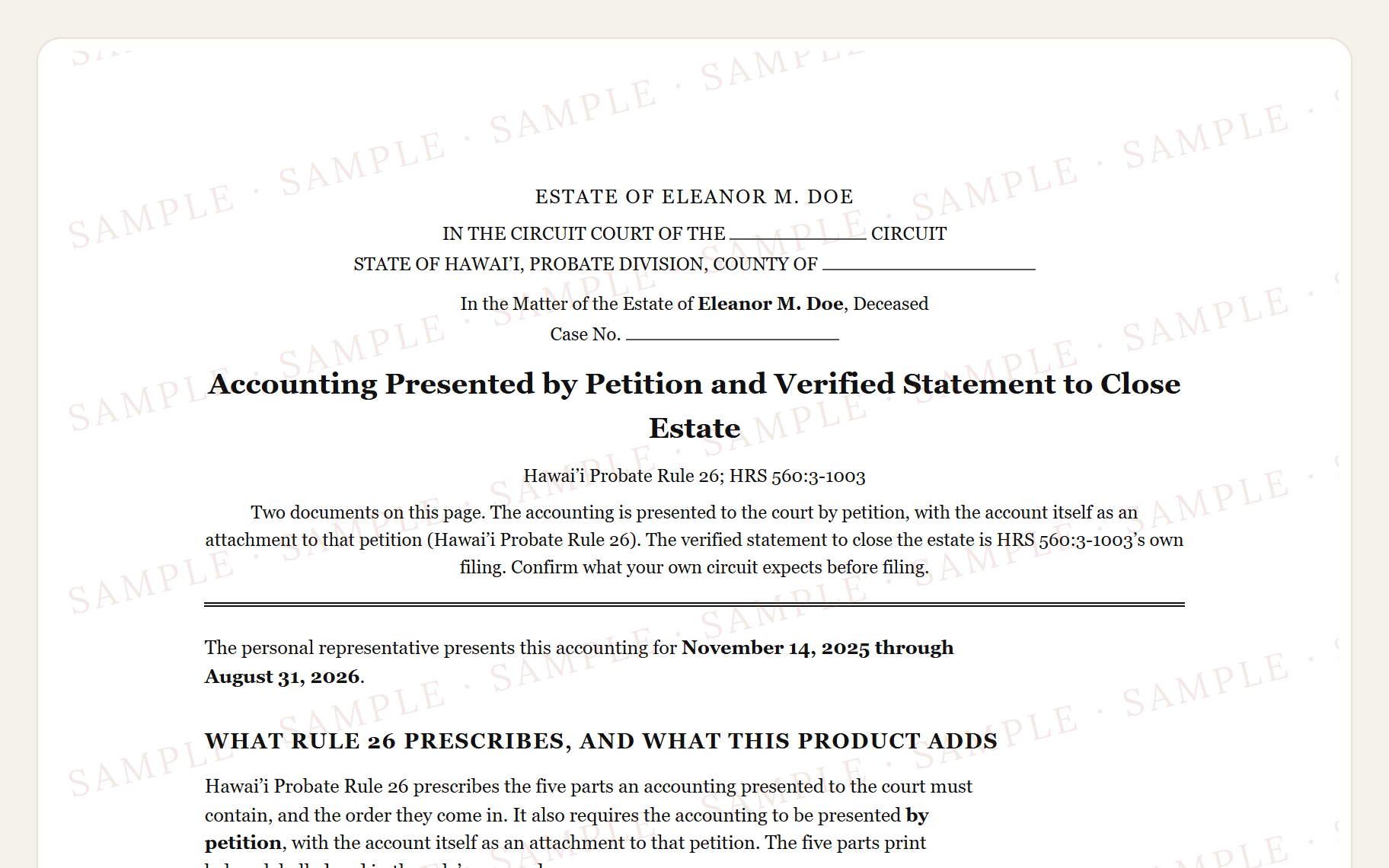
The account is a different story. HRS 560:3-1003 says what a closing statement must recite, but nothing about what an account presented to the court must contain. Hawaii Probate Rule 26 fills that gap. It is titled Format and Content, and it prescribes five parts, in order, for every accounting presented to the court. A later section of this guide lists them.
Section 2 of 7.Hawaii's deadlines, with the statute behind each
- Day 30 (about 1 month)Send notice of your appointment to heirs and devisees
Why
Under HRS §560:3-705, within 30 days after appointment you generally must deliver or mail information of your appointment to all heirs and devisees whose addresses are reasonably available, including your name and address, whether bond was filed, the court where papers are on file, and a statement that the estate is being administered without court supervision; confirm the recipient list and contents with your attorney. - Day 30 (about 1 month)Publish and mail notice to creditors (optional, but it starts the claim clock)
Why
Under HRS §560:3-801, publishing notice to creditors is optional in Hawaii and typically handled by the petitioner when the probate petition is filed, and after appointment you generally may mail written notice to known creditors to start a 60-day cutoff for each of them (you must make a reasonable review of the decedent's records to identify creditors); the statute sets no deadline for giving notice, so this date is only a prompt anchored to your appointment. Confirm whether and when to give notice with your attorney. - Day 90 (about 3 months)Prepare the estate inventory (file it or send it out)
Why
Under HRS §560:3-706, within 3 months after appointment you generally must prepare an inventory of the decedent's property showing date-of-death values and any encumbrances, then file it with the court or mail it, sending copies to interested persons who request it (court filing is optional, and a filed inventory must meet Haw. Prob. R. 60's first-page requirements); confirm the exact date and whether to file with your attorney. - Day 180 (about 6 months) · earliest possibleEarliest day to file the informal closing statement
Why
Under HRS §560:3-1003, an unsupervised estate generally may be closed by filing a verified closing statement no earlier than 6 months after the original appointment, and only after the claims period has run and claims, taxes, and distributions are handled, so this is the first day closing becomes possible rather than a deadline (your appointment then terminates automatically one year after filing if nothing is pending); confirm readiness and timing with your attorney.
- Day 270 (about 9 months)Hawaii estate tax return (Form M-6), if required
Why
Under HRS §236E-9, the Hawaii estate tax return (Form M-6) is generally due 9 months after death, but only if the taxable estate exceeds Hawaii's $5,490,000 exclusion (frozen at the 2017 federal level and decoupled from the current federal exemption, so an estate can owe Hawaii tax without owing federal tax) or the estate elects Hawaii portability for a surviving spouse, and a 6-month filing extension is available by attaching the IRS-approved federal Form 4768 while payment stays due at 9 months; confirm whether a return is required and the timing with your attorney. - Day 270 (about 9 months)Federal estate tax return (Form 706), if required
Why
Under IRC §6075, Form 706 is due 9 months after death, but only if the gross estate exceeds the federal exemption or the estate elects portability, and a 6-month extension may be available; confirm applicability and timing with your attorney. - Day 540 (about 18 months)Absolute cutoff for creditor claims (18-month backstop)
Why
Under HRS §560:3-803, pre-death claims are generally barred at the later of 4 months after first publication of notice or 60 days after written notice was delivered to that creditor, and if notice was never published or served, all such claims are barred 18 months after death. This date is that no-notice backstop and the bar typically falls earlier for noticed creditors, so calendar it before paying or distributing; confirm the operative date with your attorney.
The inventory is due within three months after appointment, not three months after death (HRS 560:3-706).
Read the full explanation
Property found later, or a value or description in the original inventory that turns out to be erroneous or misleading, goes on a supplementary inventory under HRS 560:3-708. That section sets no deadline of its own for filing it.
Creditor claims are generally barred four months after the first publication of notice to creditors, or sixty days after a creditor is served written notice, whichever of those two periods expires LATER (HRS 560:3-801, 560:3-803). Later, not first: a creditor served late still has sixty days from that service, even though the four months from publication have already run. If notice was never published or served, a claim is barred eighteen months after the decedent's death instead.
This route is not open to every estate: 72-3-1004 applies unless the court has ordered otherwise, and it is not available at all for an estate being administered in supervised administration. Otherwise the closing statement may be filed no earlier than six months after the date of the personal representative's original appointment (HRS 560:3-1003). That clock runs from the original appointment of a general personal representative, not from a successor's appointment and not from death.
A federal estate tax return, Form 706, if the estate needs one, is due nine months after death (IRC section 6075), with a possible six-month extension. Confirm whether the estate needs one with your attorney.
Section 3 of 7.What Hawaii pays a personal representative
HRS 560:3-719 entitles a personal representative to reasonable compensation for their services, with no rate and no schedule named in the statute. If a will provides for the personal representative's compensation, the personal representative may renounce that provision before qualifying and take reasonable compensation instead, and a personal representative may also renounce all or part of any compensation by a written renunciation filed with the court.
HRS 607-18 does carry a percentage schedule, and it is titled compensation of trustees. Whether it also reaches a decedent's estate personal representative, as opposed to a trustee or a guardian, is not something this guide can confirm. Confirm it with your own attorney before treating any percentage in Hawaii law as applying to a personal representative's fee. What is clear is that HRS 560:3-719, the section that governs a personal representative, sets no percentage at all.
Hawaii Probate Rule 26 adds its own requirement on top of HRS 560:3-719: an accounting to the court must explain the amount and the basis of any fiduciary fee taken or charged, not just the amount. ExecutorLedger prints the amount the estate's own records show as recorded compensation, or a ruled blank if none is recorded, plus a ruled blank for the basis, since the basis is the preparer's to state. Nothing on the page claims a court has allowed or will allow the amount.
Section 4 of 7.How a Hawaii estate closes
A personal representative may close an estate by filing with the court, no earlier than six months after the date of original appointment of a general personal representative, a verified closing statement under HRS 560:3-1003. The statement recites that the time limited for presentation of creditors' claims has expired, that the personal representative has fully administered the estate by paying, settling or otherwise disposing of all claims that were presented, the expenses of administration, and estate, inheritance and other death taxes, except as the statement specifies, and that the assets have been distributed to the persons entitled. If a claim remains undischarged, the statement says either that the estate was distributed subject to possible liability with the distributees' agreement, or states in detail the other arrangements made to accommodate it. Both branches exist in the statute, and only one will apply to a given estate.
The closing statement itself is what gets filed with the court. The full written account is a different document: the personal representative sends a copy of the statement, and a full account in writing of the administration, to every distributee and to every creditor or claimant the personal representative knows of whose claim is neither paid nor barred. HRS 560:3-1003 has that account reach the distributees and claimants, not the court file.
Hawaii Probate Rule 26 governs a different situation: an accounting presented to the court itself, by petition, which is what happens when a personal representative petitions the court to settle an account, or an interested person asks the court to compel one. If you are furnishing the closing account to distributees under HRS 560:3-1003, Rule 26 does not reach that document. If you or someone else brings the account before the court, Rule 26's five parts are the specification for it.
Once the closing statement is filed, and if no proceeding involving the personal representative is pending in the court a year later, the appointment terminates on its own, with no further order needed (HRS 560:3-1003(b)).
- Wait out the creditor claims period, then close informally if you can: once 6 months have passed since your appointment, file a verified closing statement with the circuit court under HRS §560:3-1003 swearing that claims, expenses, and taxes are handled and the assets distributed.
- Before or with that filing, send a full written account of your administration to every distributee whose interests it affects, and send the closing statement itself to all distributees and to any creditor whose claim is neither paid nor barred.
- If you want a court order, or someone objects, petition the circuit court sitting in probate for complete settlement under HRS §560:3-1001 instead, serving the petition and final accounts on beneficiaries and unpaid creditors per Probate Rule 54.
- On the formal route, after the court approves the final accounting, distribute the assets, collect signed receipts from the distributees, and file those final receipts. Under Probate Rule 84 that filing discharges you without any further court order.
- On the informal route, your appointment ends automatically one year after the closing statement is filed if no proceedings are pending (HRS §560:3-1003(b)).
Probate is handled by Hawaii's circuit courts (HRS §603-21.6); there is no separate surrogate, register of wills, or orphans' court. Most administrations are unsupervised under the UPC pattern, and the informal sworn-statement route is the norm.
Section 5 of 7.The Inventory and the Account explained for a first-time personal representative
HRS 560:3-706 names no classes and no schedule for the inventory. It is one flat list, and real property sits on it with everything else, since the statute covers property owned by the decedent at the time of death with no carve-out. Any label ExecutorLedger prints beside an item is this product's own word for it, never a category the statute asks for.
Per item, the statute asks for three things kept separate: reasonable detail, the fair market value as of the date of death, and the type and amount of any encumbrance. ExecutorLedger records no lien data, so every row prints the value you recorded and a ruled blank for the encumbrance, with a note that Hawaii's statute keeps the value and the encumbrance in two columns rather than netting one against the other. This is a gross value plus a separate encumbrance figure, not a value already reduced by a lien.
Appraisal is optional under HRS 560:3-707. The personal representative may employ a qualified and disinterested appraiser for any asset whose value is open to reasonable doubt, and different appraisers may value different kinds of assets. When an appraiser is used, the statute makes the appraiser's name and address a required disclosure: it must appear on the inventory beside the item or items that appraiser valued. ExecutorLedger's inventory print carries a ruled line for that name and address wherever an appraiser was used, since the statute requires it only in that case.
Property found after the original inventory, or a value or description that turns out to be erroneous or misleading, goes on a supplementary inventory under HRS 560:3-708, never folded into the original total. HRS 560:3-708 carries two branches for where it goes: if the original inventory was filed with the court, the supplementary inventory is filed with the court too. If the original was not filed, the personal representative instead furnishes the supplementary inventory, or the information in it, to the interested persons who request it or who requested a copy of the original.
Hawaii Probate Rule 26 prescribes five parts for an accounting presented to the court, in this order, and that is unlike most states in this guide, where nothing governs the account's shape. First, a brief summary at the beginning of the account summarizing receipts and disbursements. Second, a list of the assets on hand at the end of the accounting period, at their inventory value, since Rule 26 asks for the inventory value for a probate accounting and a different figure, current fair market value, only for other kinds of accountings. Third, a summary explaining both the amount and the basis of any fiduciary fee taken or charged. Fourth, a detailed accounting of the period's transactions. Fifth, a copy of any auditor's report and management letter, if an audit was done; most estates have none, and the print says so rather than showing an empty section. Rule 26 also says an accounting to the court is presented by petition, so the account itself is an attachment to that petition, not a standalone filing.
Verification uses Hawaii Probate Rule 5's own words, not the familiar penalty-of-perjury phrase. Rule 5 gives a declaration reading: "I, (name of person), do declare under penalty of law that the foregoing is true and correct." Hawaii's rule says penalty of law, not penalty of perjury, and that wording should be printed as the rule gives it, without smoothing it into the familiar phrase. Rule 5 also gives petitions, including an accounting presented by petition under Rule 26, a statement at the end and before the signature. It has three parts, not one: that the representations are true as far as the person executing or filing it knows or is informed; that the document is not being presented for an improper purpose, such as to harass or to cause unnecessary delay or needless increase in the cost of litigation; and that penalties for perjury may follow deliberate falsification. Rule 5 says such a statement is accepted in place of an affidavit as to the facts stated in the document, and it adds that the signature of an applicant in informal proceedings shall be notarized. HRS 560:1-310 separately deems every document filed under the probate code to already include an oath to that same effect, except as a rule otherwise specifically provides, and Rule 5 is that kind of rule. So Hawaii's documents carry Rule 5's own wording rather than a notary jurat, and no Hawaii probate filing in this guide needs one.
Section 6 of 7.Where ExecutorLedger fits
Recording is free for as long as the estate takes: every receipt and disbursement with its date and description, distributions per beneficiary, and a balance that checks itself as you go. ExecutorLedger builds Hawaii-style documents from those records, an inventory in HRS 560:3-706's own single list and an account in Hawaii Probate Rule 26's five prescribed parts, ready to transcribe or attach when you file, mail or present one. Neither is a court form, and your attorney should review them before anything is signed or filed. Every document previews free with your real numbers, and $149 (one-time payment) per estate lifts the watermark. Usually less than one attorney hour, and typically reimbursable by the estate.
Section 7 of 7.Questions Hawaii executors ask
Is there a court form for Hawaii's inventory or account?
No printed form for either. HRS 560:3-706 says what the inventory must contain, and Hawaii Probate Rule 26 prescribes the five parts and their order for an accounting presented to the court, but neither is a fill-in-the-blank form.
When is the Hawaii inventory due, and do I have to file it?
Within three months after appointment, not after death (HRS 560:3-706). The personal representative must prepare it, and must file it with the court or mail it, one or the other. Filing the original with the court beyond that is optional; sending a copy to anyone who requests one is not.
What makes Hawaii's account different from most states in this guide?
Hawaii Probate Rule 26 prescribes the account's content. Most states leave the account's shape to the preparer, but Rule 26 requires five parts in order: a summary of receipts and disbursements first, the assets on hand at inventory value, the amount and basis of any fiduciary fee, the detailed transactions, and any auditor's report. It also requires an accounting to the court to be presented by petition.
How is a Hawaii personal representative paid?
HRS 560:3-719 entitles a personal representative to reasonable compensation, with no percentage schedule. HRS 607-18 does set percentages, under a heading about trustees' commissions; whether it reaches a personal representative's fee is unconfirmed, so confirm it with your own attorney. Rule 26 requires an accounting to the court to explain both the amount and the basis of any fee.
Does Hawaii's inventory need a notary?
No. Hawaii Probate Rule 5 supplies its own declaration wording, under penalty of law rather than penalty of perjury, and HRS 560:1-310 separately deems a filed document to include an oath except where a rule specifically provides otherwise, which Rule 5 does. Neither calls for a notary jurat.
Not sure which accounting your situation calls for? Which accounting do I need? covers the choice, and the accounting guide explains the structure every format shares.
This page describes Hawaii practice as our verified references state it; formats drift and estates differ, and none of this is legal advice. ExecutorLedger produces court-style documents for transcription. They are not official court forms. The accounting your estate needs is a question for its attorney.