Georgia Estate Accounting: A Personal Representative's Guide
Georgia probate runs through each county's own probate court, not a single statewide court, and its fiduciary is the personal representative, the executor named in a will or the administrator appointed when there is none. Georgia has adopted no statewide form for a decedent's estate inventory or for an annual or final return. Here is what each county template commonly covers, the deadlines behind them, and how a Georgia estate closes.
Section 1 of 7.The two documents: the inventory and the return
Georgia probate runs through each county's own probate court. The personal representative is called that throughout the Revised Probate Code of 1998, O.C.G.A. Title 53. O.C.G.A. § 15-9-90 lets the Supreme Court of Georgia adopt standard forms for the probate courts, and Uniform Probate Court Rule 5.9 makes a standard form mandatory once one is adopted for a given procedure. The Council of Probate Court Judges of Georgia has adopted no such form, called a GPCSF, for a decedent's estate inventory or for an annual or final return, so Rule 5.9's mandate never reaches either filing.
What gets filed is whatever inventory and return template the estate's own probate court hands out. This guide draws on two county templates: Cobb County's Estate Inventory and Return of Personal Representative, dated February 2025, and Fulton County's Inventory and Annual Return. Other counties, including Gwinnett, publish their own. Check your own county probate court's website or clerk's office for its current template before filing.
Both filings can be relieved. A testator can dispense with the inventory, the annual returns, or both, by will, as long as doing so does not injure creditors or anyone besides the beneficiaries (§ 53-7-33 for the inventory, § 53-7-69 for the return). Separately, the heirs or beneficiaries can give unanimous written consent authorizing the probate court to relieve the personal representative of inventory and returns (§§ 53-7-32(b), 53-7-68(c)); the court has no power to relieve either filing on its own. An individual beneficiary or heir can also waive their own copy of either document in a signed writing, revocable at any time (§§ 53-7-32(a), 53-7-68(b)).
Section 2 of 7.Georgia deadlines, with the statute behind each
- Day 60 (about 2 months)Publish notice to creditors
Why
Under O.C.G.A. § 53-7-41, the personal representative generally must begin publishing a notice to the estate's creditors within 60 days after qualification, and the notice typically runs once a week for four weeks in the official legal-organ newspaper of the county of qualification; confirm the publication schedule and correct newspaper with your attorney. - Day 175 (about 6 months)Creditor claim period ends (estimated)
Why
Under O.C.G.A. § 53-7-41, creditors generally have 3 months from the last date of publication of the creditor notice to present their claims, and a late creditor typically loses equal-priority rights as to distributions already properly made; this entry is estimated from your appointment date because the statute's true trigger is the last publication date, so confirm the operative bar date with your attorney. - Day 180 (about 6 months)File inventory and mail copies to beneficiaries
Why
Under O.C.G.A. § 53-7-30, unless the will or the probate court relieves the requirement, the executor generally must file a verified inventory of all estate property with the probate court and mail a copy to each beneficiary (or heir, if intestate) within 6 months after qualification, with extensions available for good cause; confirm whether your estate is relieved of this filing and the exact date with your attorney. - Day 180 (about 6 months) · earliest possibleSix-month standstill ends and debts become payable
Why
Under O.C.G.A. § 53-7-42, the executor generally cannot be required to pay estate debts, and no action to recover a debt of the decedent may typically be commenced against the personal representative, until 6 months after the first personal representative qualified, so executors generally use this window to ascertain the estate before paying claims or distributing; confirm the timing with your attorney. - Day 425 (about 14 months)First annual return due (recurs every year until discharge)
Why
Under O.C.G.A. § 53-7-67, unless relieved by the will (§ 53-7-69), the beneficiaries (§ 53-7-68), or the probate court, the executor generally must file a verified annual return of the year's receipts and expenditures, with an updated inventory of estate assets and vouchers (or a vouchers-compared affidavit), within 60 days after each anniversary of qualification, and missing a return typically forfeits that year's commissions under O.C.G.A. § 53-6-60(f); confirm whether returns are required for your estate with your attorney.
- Day 30 (about 1 month)Notify Georgia Medicaid estate recovery (DCH), if decedent received Medicaid
Why
Under Ga. Comp. R. & Regs. 111-3-8-.05, if the decedent received Medicaid, the personal representative generally must give the Department of Community Health's Estate Recovery Program written notice of the death at least 30 days before disbursing any estate assets and typically must obtain a release from the Department before distributing (a representative who distributes without one can be personally liable); the rule's real trigger is disbursement rather than the death date, so this entry uses 30 days after death only as a conservative early reminder. Confirm whether estate recovery applies and the safe timing with your attorney. - Day 270 (about 9 months)Federal estate tax return (Form 706), if required
Why
Under IRC §6075, Form 706 is due 9 months after death, but only if the gross estate exceeds the federal exemption or the estate elects portability, and a 6-month extension may be available; confirm applicability and timing with your attorney.
Notice to creditors is due within 60 days after qualification, published once a week for four weeks in the official newspaper of the county of qualification (O.C.G.A. § 53-7-41).
Read the full explanation
The inventory is due within six months after qualification, filed with the probate court and mailed first class to every beneficiary or heir entitled to receive it, extendable by the court for good cause (§ 53-7-30).
Creditor claims are barred three months after the date of the personal representative's last, fourth, publication. A creditor who misses it loses equal-priority rights as to distributions already made before the claim is brought (§ 53-7-41).
The personal representative need not pay the estate's debts, and no action to recover a debt of the decedent may be brought, until six months after the first personal representative qualified (§ 53-7-42).
Each annual return is due within 60 days after the anniversary of qualification, every year, unless relieved (§ 53-7-67(a)).
Once a return is filed and mailed, anyone with an objection has 30 days to file it. Without an objection, the probate court records the return as prima facie evidence of the personal representative's correctness (§ 53-7-70).
A federal estate tax return, Form 706, if the estate needs one, is due nine months after death (IRC § 6075), with a possible six-month extension. Confirm whether the estate needs one with your attorney.
Section 3 of 7.What Georgia pays a personal representative
Absent a will or a written agreement, O.C.G.A. § 53-6-60(b) sets the default: two and one-half percent commission on all sums of money the personal representative receives for the estate, except money the personal representative personally loaned to the estate and got back, and two and one-half percent commission on all sums paid out, for debts, legacies, or distributive shares.
For property delivered over in kind, the probate court may separately allow reasonable compensation, up to 3 percent of its appraised value, or, if there was no appraisal, up to 3 percent of the fair value the judge finds (§ 53-6-60(b)(3)).
If the personal representative lends the estate's own money out in that capacity during administration, and includes the interest earned on the return so it becomes chargeable as part of the estate's corpus, the personal representative earns a 10 percent commission on that interest (§ 53-6-60(b)(2)). The probate court can also allow up to 10 percent of the annual income of any land the personal representative manages for the estate (§ 53-6-60(b)(4)).
A personal representative who fails to make a required annual return forfeits that year's commissions, unless the probate court relieves the forfeiture on cause shown (§ 53-6-60(f)). A personal representative may also renounce all or part of the compensation (§ 53-6-60(g)).
Section 4 of 7.How a Georgia estate closes
Georgia has no separate final-return filing named in the statute. What closes out the record is the last annual return, filed with a zero balance on hand once distribution is complete, alongside the petition for discharge.
The personal representative closes the estate by filing a petition for discharge under O.C.G.A. § 53-7-50 with the probate court that granted letters, on the state's own standard form, GPCSF 33. The petition states that the estate is fully administered, names every known heir or beneficiary, addresses any unpaid claims, and states that all necessary inventory and returns were filed, or that relief from filing them was granted by the testator, the heirs or beneficiaries, or the probate court.
Citation issues to every heir or beneficiary, with one published notice at least ten days before the objection deadline. Anyone who already relieved the personal representative of liability need not be separately notified. If no objection is filed, the probate court enters the discharge order without a hearing.
Discharge releases the personal representative from liability, but it does not bar a minor heir, beneficiary, or creditor who lacked a guardian; they get two years after reaching majority to sue despite the discharge (§ 53-7-50(c)). Outside the ordinary discharge route, an heir or beneficiary, or the probate court on its own initiative, can also cite the personal representative to a formal settlement of accounts, at any time after six months from the grant of letters (§ 53-7-62(a)); a successor personal representative can petition for the same kind of accounting after a prior representative resigns, is removed, or dies (§ 53-7-61). Either produces an enforceable settlement but is not itself a closing filing.
- Wait out the six-month creditor standstill (O.C.G.A. § 53-7-42), pay the valid claims, then distribute what's left and collect a signed receipt and release from each beneficiary.
- Get your paperwork current before you ask to be discharged: inventory filed and every annual return in, or written proof that the will, the beneficiaries, or the court relieved you of those filings.
- File a Petition for Discharge of Personal Representative (standard form GPCSF 33) under O.C.G.A. § 53-7-50 in the same probate court that appointed you; beneficiaries can sign acknowledgments consenting to the discharge, which avoids citation and speeds things up.
- If everyone consents or no one objects after notice, the court enters an order discharging you from office and from all liability. In Georgia, that court order is what cuts off your exposure, not the beneficiary releases.
Georgia closing runs through the probate court of the county of appointment. Some executors skip formal discharge and just hold the signed releases, but only a § 53-7-50 discharge order ends liability. Even that order does not bar a minor heir, beneficiary, or creditor who lacked a guardian; they get two years after majority to sue.
Section 5 of 7.The documents explained for a first-time personal representative
The inventory follows Cobb County's four sections: real property; financial assets, split into bank, credit union and liquid assets and then other financial accounts such as brokerage holdings; other personal property, split into vehicles, boats, campers and trailers and then miscellaneous personal property and effects; and other, for a business interest, claim, or asset not listed elsewhere. Cobb's ownership-interest percentage, mortgage balance, and last-four-digits columns have no source in this app's records and print as labeled blanks.
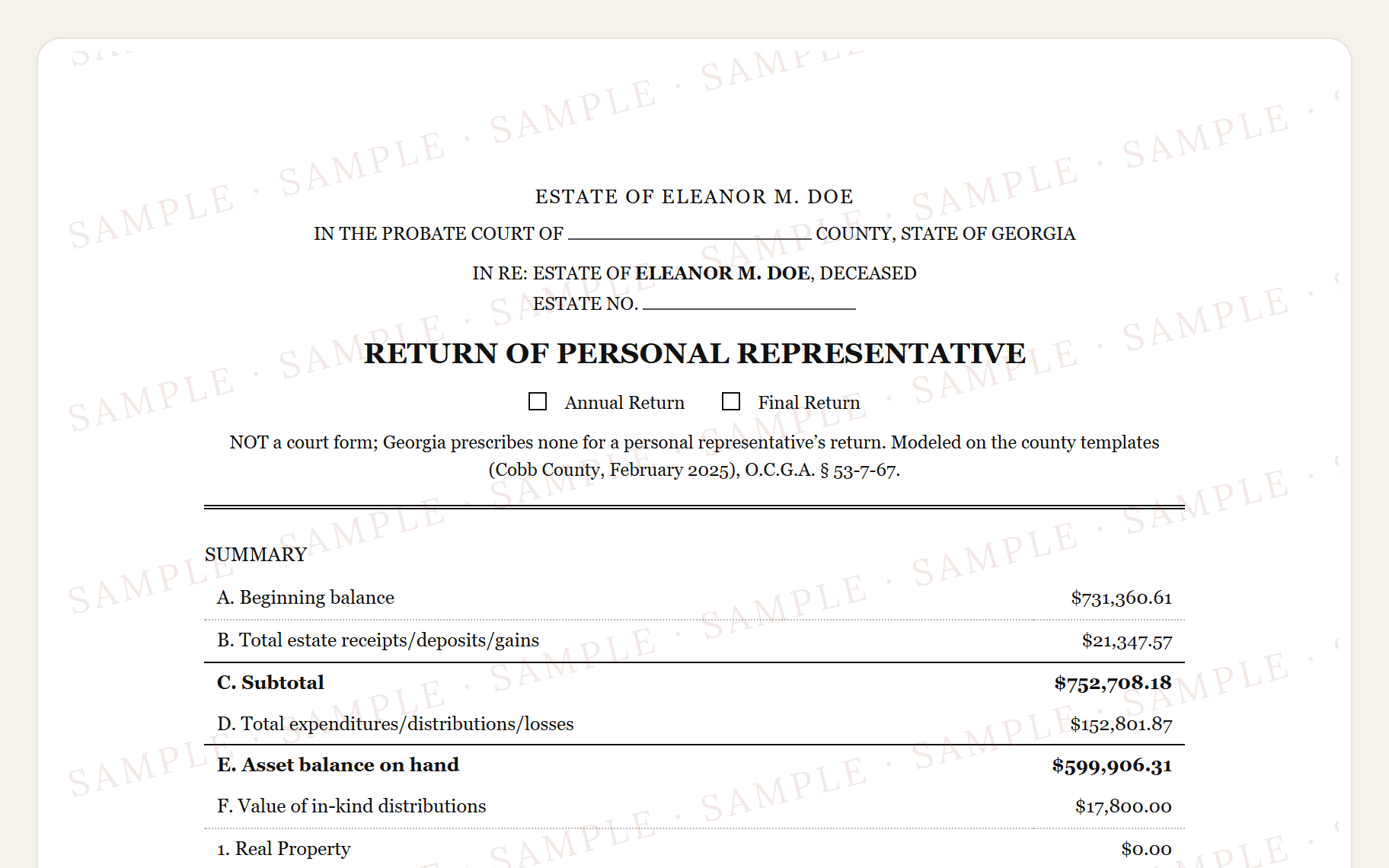
The return follows Cobb's eight-line summary: a beginning balance, total receipts and gains, a subtotal, total expenditures and losses, the asset balance on hand, the value of any in-kind distributions, the undistributed assets remaining, and the current bond amount. The asset balance on hand, minus what was distributed in kind, should equal the total of what is still undistributed at the end of the period. If it does not, the export flags the difference as a warning rather than hiding it.
A sale posts as a gain or a loss against the value the asset was carried at, the way Cobb's own Receipts/Deposits/Gains and Expenditures/Distributions/Losses labels describe. Not every Georgia county's blank works this way: Fulton's own return shows a sale's full proceeds as a plain receipt instead, with no gain or loss line at all. Check your own county's template before transcribing.
Property distributed in kind gets its own line, with the date, a description, the recipient, and the value at which it was carried. The personal representative's commission is one itemized disbursement, with its own calculation attached. Either the original vouchers or an affidavit that they were compared to each item on the return accompanies the filing (§ 53-7-67(a)).
Once filed, a copy of the return, not the vouchers, goes to every heir or beneficiary by first-class mail, and the personal representative files a verified statement that the mailing was made (§ 53-7-68(a)). The 30-day window to object runs from that filing and mailing (§ 53-7-70).
Section 6 of 7.Where ExecutorLedger fits
Recording is free for as long as the estate takes: every receipt and disbursement with its date and description, distributions per heir or beneficiary, and a balance that checks itself as you go. ExecutorLedger builds Georgia-style documents from those records, an inventory shaped like Cobb County's Estate Inventory template and a return laid out the way Cobb's Return of Personal Representative is, ready to transcribe onto your own county's template if you end up filing one. Neither is a court form, and your attorney should review them before anything is signed or filed. Every document previews free with your real numbers, and $149 (one-time payment) per estate lifts the watermark.
Section 7 of 7.Questions Georgia executors ask
Is there a court form for Georgia's inventory or return?
No. Georgia has adopted no statewide standard form for either a decedent's estate inventory or an annual or final return (O.C.G.A. § 15-9-90, Uniform Probate Court Rule 5.9). What gets filed is whatever template the estate's own county probate court hands out, such as Cobb County's or Fulton County's.
When is the Georgia inventory due?
Within six months after qualification, filed with the probate court and mailed first class to every beneficiary or heir entitled to receive it, extendable by the court for good cause (O.C.G.A. § 53-7-30).
When is the Georgia annual return due?
Within 60 days after each anniversary of qualification, every year, unless the personal representative is relieved of the filing (O.C.G.A. § 53-7-67(a)). Once filed and mailed, anyone with an objection has 30 days to file it (§ 53-7-70).
How is a Georgia personal representative paid?
Absent a will or written agreement, O.C.G.A. § 53-6-60(b) sets 2.5 percent of sums received and 2.5 percent of sums paid out, plus up to 3 percent for property delivered in kind and a 10 percent commission on interest earned when the representative lends the estate's own money out. A missed annual return forfeits that year's commission unless the court relieves the forfeiture (§ 53-6-60(f)).
How does a Georgia estate close?
The personal representative files a petition for discharge under O.C.G.A. § 53-7-50, on the state's own standard form, GPCSF 33, stating that the estate is fully administered and that all necessary inventory and returns were filed or relief from filing them was granted. If no one objects after notice, the probate court enters the discharge order.
Not sure which accounting your situation calls for? Which accounting do I need? covers the choice, and the accounting guide explains the structure every format shares.
This page describes Georgia practice as our verified references state it; formats drift and estates differ, and none of this is legal advice. ExecutorLedger produces court-style documents for transcription. They are not official court forms. The accounting your estate needs is a question for its attorney.