DC Estate Accounting: A Representative's Guide
DC probate runs through the Probate Division of the Superior Court of the District of Columbia, one citywide Register of Wills office with no county-by-county variation. Its fiduciary is called the personal representative throughout the statute and the court's own forms (the executor or administrator, in everyday terms). The Register of Wills' Inventory and Account forms, or a substantially similar format, are required for anything filed with the Probate Division. Here is what each covers, the deadlines behind each, and how a DC estate closes.
Section 1 of 7.The two documents: the Inventory and the Account
DC probate estates run through the Probate Division of the Superior Court of the District of Columbia, case type prefix ADM, under D.C. Code Title 20 and the Superior Court Rules of the Probate Division (SCR-PD). There is no county-by-county variation: one citywide Register of Wills office handles every estate. The statute and the court's own forms call the fiduciary the personal representative throughout, whether appointed under a will or without one. D.C. Code § 20-401 splits every estate into one of two tracks: supervised administration, where the Court keeps continuing authority over the estate, or unsupervised administration, where it does not unless a party specifically asks the Court to supervise it. Estates of people who died before July 1, 1995 are supervised by default; on or after that date, administration is unsupervised unless someone requests supervision.
The Register of Wills maintains an Inventory form, Inventory Summary and Inventory Schedule (ADM), 118.10.v2, and an Account form, Account and Order (ADM), also called the Statement of Account, 143.10.v1. One Account form covers both an interim account and a final account, checked on its first sheet. SCR-PD Rule 104(c) says only a form the rules or the Register of Wills prescribe, or one substantially similar in content and format, gets accepted for filing; Rules 112(b)(1)(A) and 113(b)(1)(A) repeat the same requirement specifically for a filed inventory and a filed account. Filing with the Court is mandatory only in supervised administration (§20-711(b) for the inventory, §20-721 for the account). An unsupervised personal representative who never files may instead use a format that clearly sets out what the rule requires, the information itself for an inventory (Rule 112(b)(1)(B)), or the assets, receipts, disbursements, and distributions for an account (Rule 113(b)(1)(B)), rather than the Register's own layout.
The Inventory's Summary table lists seven lettered schedules and totals their Appraised Value: A, Real property in the District of Columbia; B, Tangible personal; C, Corporate Stocks; D, Bonds, notes, mortgages, debts due to the decedent; E, Bank accounts, building association shares, savings and loan accounts, cash; F, Debts owed to the decedent by the personal representative; G, All other interests. Every item is valued at its fair market value on the date of death (§20-711(a)), across the same seven categories the statute itself lists. A separate schedule sheet gets filed for each lettered category used, with an item number, description, and value for every asset.
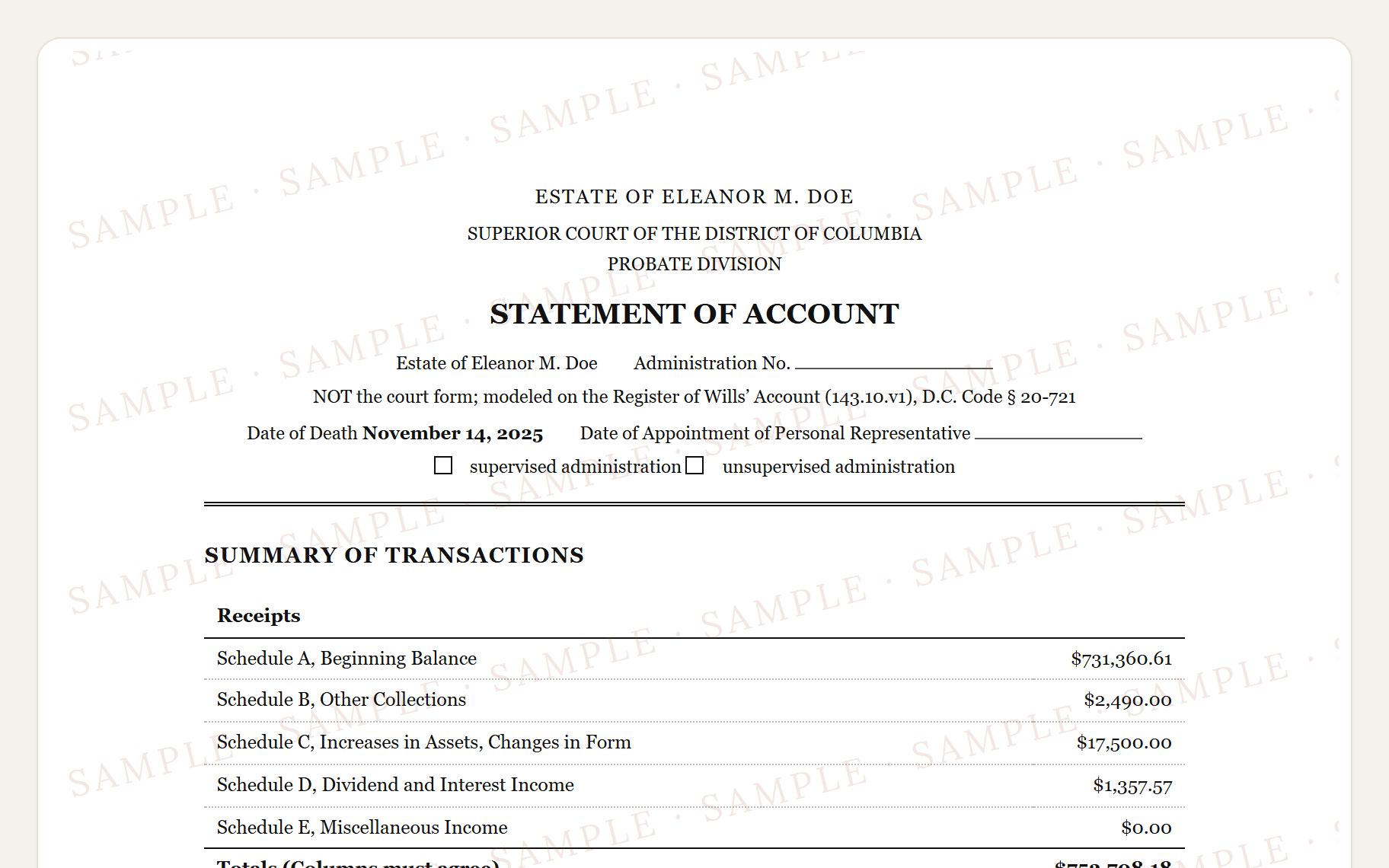
The Account's Summary of Transactions is a two-column receipts-and-disbursements ledger, pulling one total from each of eleven lettered schedules, A through K, plus a twelfth, K1, and closing with the form's own instruction: Totals (Columns must agree). Schedule C is the one schedule with two columns of its own, for a sale's net gain in one and its net loss in the other, rather than the sale's gross proceeds. ExecutorLedger builds an Inventory shaped like the Register's 118.10.v2 form and an Account shaped like its 143.10.v1 form, mapping the app's own asset categories onto the Inventory's seven schedules and the app's own transactions onto the Account's eleven.
Section 2 of 7.DC deadlines, with the statute behind each
- Day 20 (about 3 weeks)Publish notice of appointment to creditors
Why
Under D.C. Code §20-704(a), within 20 days after appointment the personal representative generally must begin publishing notice of the appointment (once a week for 2 successive weeks) in a legal periodical or newspaper of general circulation in the District, telling creditors to present their claims; confirm the publication arrangements and exact timing with your attorney. - Day 20 (about 3 weeks)Mail notice of appointment to heirs, legatees, and known creditors
Why
Under D.C. Code §20-704, within 20 days after appointment the personal representative generally must mail notice of the appointment to all heirs, legatees, and known or reasonably ascertainable creditors, and must certify to the Register of Wills within 90 days that the notices were given; confirm the recipient list and timing with your attorney. - Day 90 (about 3 months)Inventory of estate property
Why
Under D.C. Code §§20-711, 20-713.01, the personal representative generally must prepare a verified inventory within 3 months after appointment, filing it with the Court in a supervised administration or delivering/mailing it to each interested person in an unsupervised one; confirm which track applies and the exact due date with your attorney. - Day 203 (about 7 months)Creditor claims bar date
Why
Under D.C. Code §20-903, creditor claims are generally barred 6 months after the first publication of the notice of appointment, so calendar this bar date before making final distributions; because the true trigger is publication (which must begin within 20 days after appointment), this date is estimated conservatively from your appointment date at 6 months plus 20 days. Confirm the actual first-publication date and operative bar date with your attorney. - Day 1095 (about 3 years)Close the estate or extend your appointment (3-year automatic termination)
Why
Under D.C. Code §20-1301, in an unsupervised administration the personal representative's appointment generally terminates automatically 3 years after appointment unless a Certificate of Completion has been filed or the Court grants a 12-month extension on the personal representative's written request; confirm your closing or extension plan with your attorney.
- Day 270 (about 9 months)Federal estate tax return (Form 706), if required
Why
Under IRC §6075, Form 706 is due 9 months after death, but only if the gross estate exceeds the federal exemption or the estate elects portability, and a 6-month extension may be available; confirm applicability and timing with your attorney. - Day 300 (about 10 months)DC estate tax return (Form D-76), if required
Why
Under D.C. Code §47-3705, a DC estate tax return (Form D-76), with payment, is generally due within 10 months after death, but only if the gross estate exceeds DC's inflation-indexed zero-bracket amount ($4,988,400 for 2026 deaths); confirm whether this applies and the exact due date with your attorney.
Within 20 days after appointment, the personal representative publishes notice of the appointment once a week for 2 successive weeks in a periodical or newspaper of general circulation in the District (§20-704(a)), and separately mails the same notice, plus a court-developed general information statement, to heirs, legatees, and every creditor whose identity is known or reasonably ascertainable (§20-704(b)). The personal representative then certifies to the Register, within 90 days after appointment, that both notices went out (§20-704(b-2)).
Read the full explanation
The Inventory is due within 90 days after appointment, three months on the statute's own terms (§20-711(a), §20-713.01(a), Rule 112(c)(1)). A supervised personal representative files it with the Court, with a certificate that a copy went to every interested person within the previous 15 days; an unsupervised one delivers or mails it to each interested person within the same 90 days and may, but does not have to, file the verified original with the Court too.
In supervised administration, the first account is due within 1 year and 1 day after the first publication of the notice of appointment, and every account after that within 9 months of the one before it, until the final account or the end of the personal representative's appointment (§20-724(a)). An unsupervised personal representative accounts to interested persons at reasonable intervals or on their reasonable demand instead of on this filing schedule (§20-734), though the court's own After Death guide tells unsupervised personal representatives to use the same 1-year-1-day, then 9-month cadence as a non-binding guideline.
Creditor claims against the estate are barred 6 months after the first publication of the notice of appointment (§20-903(a)(1)). ExecutorLedger estimates this date conservatively, 6 months plus 20 days from your appointment date, since the true trigger is the publication date itself, which has to start within 20 days of appointment; confirm the actual first-publication date and bar date with your attorney.
A federal estate tax return, Form 706, if the estate needs one, is due 9 months after death (IRC §6075), with a possible 6-month extension. A DC estate tax return, Form D-76, is due 10 months after death if the gross estate exceeds the District's inflation-indexed zero-bracket amount, $4,988,400 for 2026 deaths (D.C. Code §47-3705). Confirm whether either return applies with your attorney.
Section 3 of 7.What DC pays a personal representative
D.C. Code §20-751 entitles a personal representative to reasonable compensation for services, with no statutory percentage schedule. If a will sets compensation and there is no separate contract with the person who died, the personal representative may renounce the will's provision, before or after qualifying, and take reasonable compensation instead, and may renounce all or part of the compensation by a written filing with the Court.
SCR-PD Rule 220(a) states plainly that compensation is payable without court approval: whether administration is supervised or unsupervised, the personal representative may pay reasonable compensation to the personal representative, an attorney, and any other provider of services, without asking the Court first. Review happens only afterward, on an interested person's petition or objection (Rule 220(b)-(c)), weighed against the five factors §20-753(b) sets out: the reasonable relationship of the compensation to the work performed; any compensation estimate given to the personal representative beforehand; the reasonableness of the time spent, including the hours worked and the usual hourly rate; the nature and complexity of the matter and the results achieved; and whether the relevant deadlines were met.
Compensation shows up as a dollar line inside the Account's Schedule F, Principal Administration Expenses, or Schedule H if the will creates a trust; there is no separate fee schedule to fill out. The Account's own Certificate also has the personal representative check one box describing the compensation's legal posture: approved by a Court order, requested in a petition now pending before the Court, requested in the petition filed with this account, or provided for in the will. All four are disclosure only. None of them is a precondition to paying compensation under Rule 220(a).
Section 4 of 7.How a DC estate closes
In supervised administration, the Court's approval of the final account automatically closes the estate. It ends the personal representative's appointment too, but only if the final account itself asks for that and the Court grants it (§20-1301(a)); if the appointment survives the final account, the personal representative can petition separately, later, for an order ending it.
In unsupervised administration, the personal representative closes the estate by filing a verified Certificate of Completion with the Court, and not before the creditor-claims period has expired (§20-735). The Certificate states that the claims period has run, that every interested person received a copy of the account and 60 days' notice of the right to object to it, that distribution matches what the account says, that known claims are satisfied or explains what has been arranged for any that are not, and that every administration expense has been paid.
Filing the Certificate always closes the estate. It ends the personal representative's appointment only if the personal representative elects termination in the Certificate itself (§20-1301(b)(A)). Without that election, the appointment instead runs out automatically 3 years after appointment, extendable by unlimited 12-month increments on written request (§20-1301(c)); watch that clock even after the estate itself is closed.
A unanimous written waiver by every heir and legatee converts a supervised account's full Court audit into a cursory review instead (§20-732); an heir or legatee who waived it can still demand a full audit within 20 days of the final account's approval.
- Wait out the 6-month creditor claims period that runs from first publication of your appointment notice, and pay or resolve every valid claim and administration expense before final distributions (D.C. Code §20-903).
- Send each heir, legatee, and other interested person an account of everything you received, spent, and distributed. Unsupervised estates don't file accounts with the court, but D.C. Code §20-734 still requires you to account to the people involved.
- Collect a signed receipt (and ideally a release) from each beneficiary as you make final distributions. This is informal in DC, but it's your proof that distributions landed.
- File a verified Certificate of Completion, on the court's prescribed form, with the Probate Division (D.C. Code §20-735). That closes an unsupervised estate, and ends your appointment only if you elect termination in the Certificate (D.C. Code §20-1301(b)). It cannot be filed until the creditor claims period has expired.
- If your administration is supervised, close by filing a final account for court approval instead. The first account is due 1 year and 1 day after first publication, then every 9 months until the final account (D.C. Code §20-724).
Probate in the District is handled by the Probate Division of the Superior Court of the District of Columbia; filings go through the Register of Wills, the division's clerk. Watch the 3-year automatic termination of an unsupervised appointment (D.C. Code §20-1301): file the Certificate of Completion or request a 12-month extension (unlimited extensions available) before it hits.
Section 5 of 7.The documents explained for a first-time personal representative
The Inventory's Summary table totals every recorded schedule value to one figure; a schedule with nothing in it prints blank, and Schedule F, debts the personal representative owes the estate, always prints blank, since ExecutorLedger has no way to track a debt like that. Each schedule sheet used lists an item number, a description, and a value. The value column is always the gross fair market value at death, never reduced by what is owed against it; the form's own instruction is direct about this, include a description of the type and amount of any encumbrance but do not deduct it from the value column, so a lien or mortgage only ever shows up as a note in the description.
The Account's Schedule C is the one place a sale shows up at less than its full proceeds. Only the net gain or loss, the sale price minus the value the asset was carried at, rolls into the Summary of Transactions, the way the form's own worked example does it: shares sold for $3,000, carried at $2,500, a net gain of $500. A sale for the same price as its carried value still prints as its own line, at zero, so it is clear the sale happened even though it did not move the total.
Schedule I, Distribution of Principal, lists every distribution grouped under the beneficiary who received it, dated, and tied to the specific clause of the will that authorizes it; cash and property distributed in kind are each shown at their own value, subtotaled per beneficiary. Schedule H, income administration expenses, and Schedule J, income distributions, apply only when the will creates a trust; a plain decedent's estate with no trust prints them with that note rather than a bare zero.
Schedule K, Undistributed Assets, lists whatever the personal representative still holds at the end of a period that is not final, each item described and valued at what it is carried at. Schedule K1 asks for one of six court-specified reasons the estate is still open for each Schedule K asset: DC real property being transferred, DC real property being sold, real property outside DC, unclaimed property, litigation or an appeal on the docket, or everything else, each with its own backup documentation.
A full Court audit of a filed account needs copies of bank, brokerage, and other institutional statements; receipts or settlement statements showing income or assets received; documents showing the sale or other disposition of any asset; checks or vouchers for cash transactions; and tax filings, or a statement that none is required (Rule 113(e)(1)). None of that is something a ledger generates on its own; attach it separately when you file.
Section 6 of 7.Where ExecutorLedger fits
Recording is free for as long as the estate takes: every receipt and disbursement with its date and description, distributions per beneficiary, and a balance that checks itself as you go. ExecutorLedger builds DC-style documents from those records, an inventory shaped like the Register's 118.10.v2 form and an account shaped like its 143.10.v1 form, ready to transcribe onto the court's own forms if you end up filing them, sending copies to interested persons, or handing them to your attorney. Neither is the court form, and your attorney should review them before anything is signed or filed. Every document previews free with your real numbers, and $149 (one-time payment) per estate lifts the watermark.
Section 7 of 7.Questions District of Columbia executors ask
Does DC require the Register of Wills' Inventory and Account forms?
Only when you file with the Court. SCR-PD Rule 104(c) accepts only the Register of Wills' own form, or one substantially similar, for anything filed. Filing is mandatory in supervised administration (§20-711(b) for the inventory, §20-721 for the account); an unsupervised personal representative who never files may instead use any format that covers the same information (Rules 112(b)(1)(B), 113(b)(1)(B)).
When is the DC inventory due?
Within 90 days after appointment, at fair market value as of the date of death, with the type and amount of any lien noted (§20-711(a), §20-713.01(a), Rule 112(c)(1)). A supervised personal representative files it with the Court; an unsupervised one delivers or mails it to each interested person.
How is a DC personal representative paid?
D.C. Code §20-751 entitles the personal representative to reasonable compensation, with no statutory percentage schedule. SCR-PD Rule 220(a) lets the personal representative pay it without asking the Court first, in either supervised or unsupervised administration; the Court reviews it only afterward, on petition or objection, against the five factors of §20-753(b).
How does a DC estate close?
A supervised estate closes when the Court approves the final account (§20-1301(a)). An unsupervised estate closes when the personal representative files a verified Certificate of Completion, once the creditor-claims period has run (§20-735); that always closes the estate, but ends the personal representative's appointment only if termination is elected in the Certificate itself (§20-1301(b)(A)).
How does the DC Account show a sale?
Never at its full proceeds. Only the net gain or loss, the sale price minus the value the asset was carried at, goes on Schedule C and rolls into the Summary of Transactions. A sale for the same price as its carried value still prints its own line, at zero.
Not sure which accounting your situation calls for? Which accounting do I need? covers the choice, and the accounting guide explains the structure every format shares.
This page describes District of Columbia practice as our verified references state it; formats drift and estates differ, and none of this is legal advice. ExecutorLedger produces court-style documents for transcription. They are not official court forms. The accounting your estate needs is a question for its attorney.