Alabama Estate Accounting: A Personal Representative's Guide
Alabama probate runs through the probate court of each county, a court of its own rather than a division of the circuit court, and its fiduciary is the personal representative, the executor named in a will or the administrator appointed when there is none. Alabama publishes no statewide form for either the inventory or the settlement; each county probate court supplies its own packet. Here is what the statutes require of an inventory and of a settlement, the deadlines behind them, and how an Alabama estate closes.
Section 1 of 7.The two documents: the Inventory and the Settlement
Alabama administers decedents' estates under Title 43, Chapter 2 of the Code of Alabama, through the probate court of the county where the estate is opened. A caption on any Alabama probate filing reads IN THE PROBATE COURT OF ______ COUNTY, ALABAMA, because the probate court is its own court, not a division of the circuit court the way it is in some other states. The Administrative Office of Courts publishes a form set that is mostly for circuit court matters. Each county probate court supplies its own inventory and settlement packets instead, confirmed here for Jefferson, Mobile, Madison and Montgomery Counties. There is no statewide form number for either document, and none should ever be printed or claimed.
The first document is the inventory, required by Ala. Code 43-2-835(a). It is one list covering all of the decedent's property, real and personal together, with reasonable detail and the fair market value of each item as of the date of death. Alabama names no numbered classes and no classification scheme for the inventory. ExecutorLedger groups real property and personal property under their own subheadings on the print, and only because the settlement that follows excludes the lands, not because Alabama's statute asks for separate schedules.
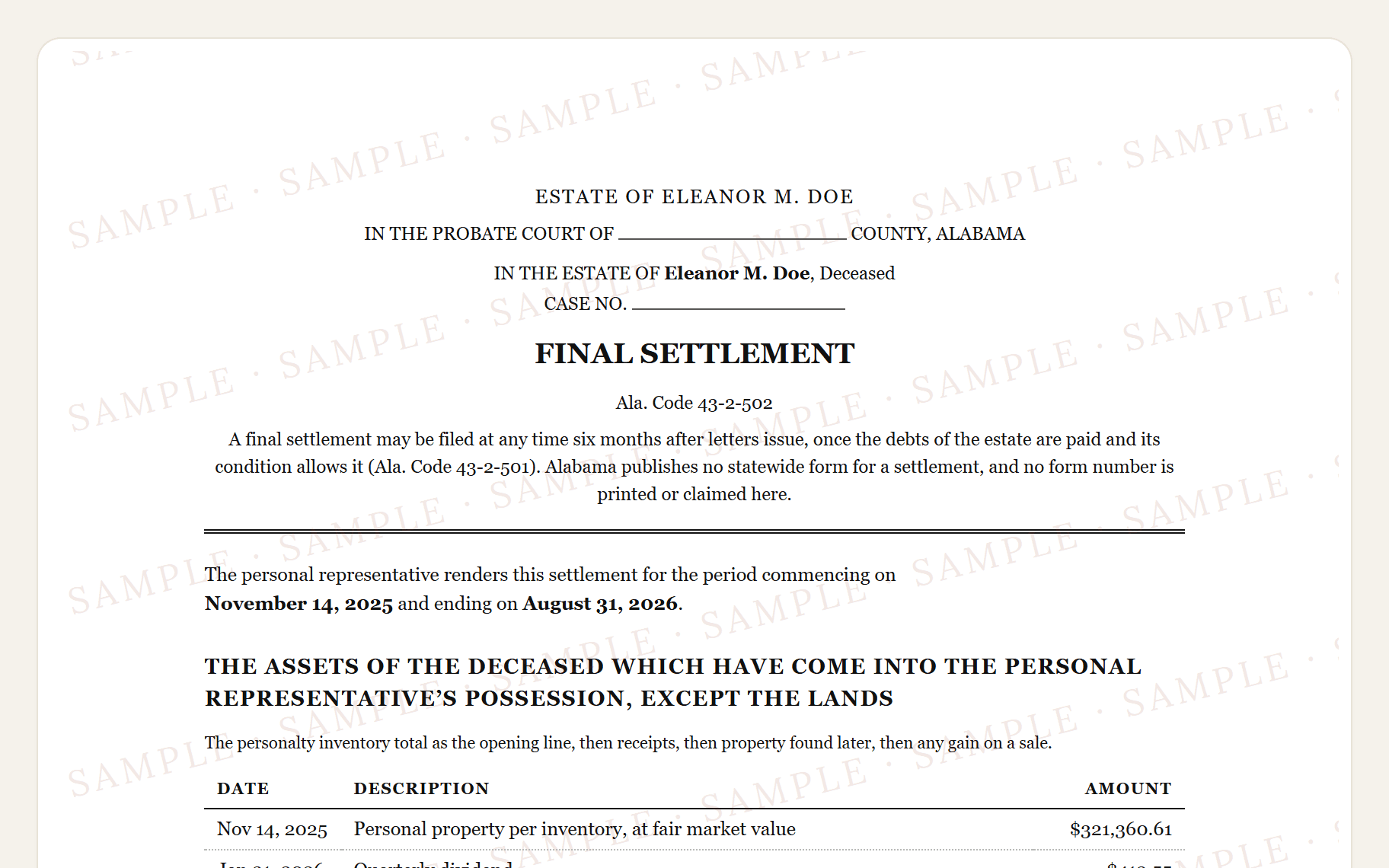
The second document is the settlement, required by Ala. Code 43-2-502. The personal representative charges themselves with all of the decedent's assets that came into their possession, except the lands, and credits themselves with what the law allows, verified by oath. Alabama gives a personal representative two ways to close a settlement: a noticed settlement under Ala. Code 43-2-505, set for a hearing with published or posted notice, and a consent settlement under Ala. Code 43-2-506, filed with every legatee and distributee's written consent and no notice at all. They are two different filings, not two versions of the same one.
Section 2 of 7.Alabama's deadlines, with the statute behind each
- Day 30 (about 1 month)Publish notice of appointment and mail notice to known creditors
Why
Under Ala. Code §§ 43-2-60, 43-2-61, notice of the appointment generally must be given by publication within 30 days after letters are granted, running once a week for three successive weeks in a newspaper of general circulation in the county where letters were granted, and known or reasonably ascertainable creditors typically must also get first-class-mail (or equivalent actual) notice within six months after letters; confirm the publication arrangements and your creditor mailing list with your attorney. - Day 30 (about 1 month)Certified-mail notice to Alabama Medicaid Agency (estate recovery)
Why
Under Ala. Code § 43-2-697, the personal representative generally must send notice of the appointment to the Alabama Medicaid Agency by certified mail (return receipt addressed to the probate court where the estate was filed) and immediately file an affidavit of that mailing with the court; the statute sets no exact day count for sending, so this 30-days-after-letters entry is a conservative prompt, and no distributions typically may be made until proof of notice is filed and 30 days have passed after the Agency receives it (the Agency's claim is waived if it does not respond within those 30 days); confirm whether this applies and the timing with your attorney. - Day 60 (about 2 months)File inventory of estate property
Why
Under Ala. Code § 43-2-835, the personal representative generally must file an inventory of the decedent's property with date-of-death fair market values within 2 months after appointment, but Alabama wills very commonly waive this filing (Ala. Code § 43-2-311); confirm whether your will waives the inventory and the exact due date with your attorney. - Day 180 (about 6 months)Creditor claims bar date
Why
Under Ala. Code § 43-2-350, creditors generally must present claims within 6 months after the grant of letters or 5 months after first publication of notice, whichever is later (and a creditor who got mailed notice always has at least 30 days after that notice), so calendar this bar date before paying claims or distributing; confirm the operative date with your attorney. - Day 180 (about 6 months) · earliest possibleEarliest date for final settlement
Why
Under Ala. Code § 43-2-501, a final settlement generally may be made at any time after 6 months from the grant of letters, once the debts are all paid and the estate is otherwise ready to close, so this is typically the earliest the estate can wrap up rather than a deadline; confirm the timing with your attorney.
- Day 270 (about 9 months)Federal estate tax return (Form 706), if required
Why
Under IRC §6075, Form 706 is due 9 months after death, but only if the gross estate exceeds the federal exemption or the estate elects portability, and a 6-month extension may be available; confirm applicability and timing with your attorney.
The inventory is due within two months after appointment (Ala. Code 43-2-835(a)).
Read the full explanation
Property discovered later, or a value that needs correcting, goes on a supplementary inventory under Ala. Code 43-2-836. That section sets no clock of its own, so there is no thirty-day or two-month deadline to meet for it.
Annual settlements are mandatory every year the estate stays open (Ala. Code 43-2-500). A final settlement may be filed any time six months after letters issue, once debts are paid and the estate's condition allows it (Ala. Code 43-2-501).
A noticed settlement needs three weeks' notice by newspaper publication or courthouse posting before the hearing. If the settlement is final, it also needs ten days' individual notice to every adult resident distributee and to every surety on the bond (Ala. Code 43-2-505).
Creditor claims are generally due within six months after the grant of letters, or five months after the first publication of notice, whichever is later. A creditor who was mailed notice always has at least thirty days after that notice, even if the other two deadlines have already passed (Ala. Code 43-2-350).
A federal estate tax return, Form 706, if the estate needs one, is due nine months after death (IRC 6075), with a possible six-month extension. Confirm whether the estate needs one with your attorney.
Section 3 of 7.What Alabama pays a personal representative
Ala. Code 43-2-848(a) sets a ceiling, not a percentage schedule with brackets: compensation shall not exceed two and one-half percent of the value of all property received and under the personal representative's possession and control, plus two and one-half percent of all disbursements. There are no tiers and no graduated rates behind those two figures.
Ala. Code 43-2-848(b) allows additional reasonable compensation for extraordinary services, on top of the ceiling in (a). Subsections (c) and (d) let a personal representative renounce a will's own compensation clause, and let the decedent or all of the affected beneficiaries fix compensation by a written agreement, which binds unless it turns out to be unconscionable.
ExecutorLedger computes no Alabama commission. The print shows the two and one-half percent ceiling as a note for the court, and leaves the actual figure to the personal representative and the probate judge.
Section 4 of 7.How an Alabama estate closes
A noticed settlement under Ala. Code 43-2-505 is the older route. The probate judge sets a day for the settlement and gives the notice. It runs for three successive weeks by publication in a newspaper published in the county, or, if no newspaper is published there, by posting at the courthouse and three other public places in the county. Publication may be waived where every heir at law is of age and consents in writing. When the settlement is a final one, the probate judge also gives ten days' individual notice to every adult resident distributee and to every surety on the bond.
A consent settlement under Ala. Code 43-2-506 is available where every legatee and distributee is of age and every legal charge against the estate is proven paid in full. The personal representative petitions with a written consent signed by every legatee and distributee, and the probate court may approve the settlement with no notice, no publication and no posting at all.
Annual settlements keep the estate current with the court while it stays open (Ala. Code 43-2-500). A final settlement becomes available any time six months after letters issue, once debts are paid and the estate's condition allows it (Ala. Code 43-2-501), through whichever of the two routes fits the estate.
Filing itself follows the packet the estate's own county probate court supplies. Jefferson, Mobile, Madison and Montgomery Counties each publish their own inventory and settlement packets; a different county publishes its own as well, and none of them shares a form number with another county's.
- Wait out the six-month claims window and resolve every claim filed with the probate court. Final settlement can't happen until six months after letters and the debts are handled (Ala. Code §§ 43-2-350, 43-2-501).
- If every heir or beneficiary will sign, collect a written waiver and consent to final settlement from each of them. With all consents filed, the probate court can usually close the estate without a formal hearing or a fully audited accounting.
- If anyone won't sign, file a petition for final settlement with a verified account in the probate court. Charge yourself with all assets received, backed by vouchers or affidavits for each credit, plus a sworn list of heirs and legatees flagging minors and anyone of unsound mind (Ala. Code § 43-2-502). The court then sets a hearing day, publishes notice, and audits the account.
- After the court's decree on final settlement, distribute the remaining assets, get signed receipts from each recipient, and keep the decree. It's what discharges you.
Alabama estates close in the probate court (judge of probate) of the county that granted letters, unless a party has removed the administration to circuit court under Ala. Code § 12-11-41, in which case the circuit court handles the settlement. Alabama did not adopt the UPC informal sworn-closing-statement pattern; closing is by consent-based or contested final settlement.
Section 5 of 7.The Inventory and the Settlement explained for a first-time personal representative
The inventory is one list, not a set of numbered classes. Ala. Code 43-2-835(a) asks for reasonable detail, the fair market value of each item as of the date of death, and the type and amount of any encumbrance beside that item. That is a gross value with the encumbrance broken out next to it, the opposite of a rule that nets the encumbrance out of the value first. ExecutorLedger records no encumbrance data, so that column prints a ruled blank for the preparer to fill in.
Ala. Code 43-2-312 adds a second part to the inventory: debts and demands owed to the decedent, with when each was due, the amount, how it was evidenced, and the debtor's name. ExecutorLedger keeps no debtor register, so this section prints with ruled blanks rather than being left off the document.
The inventory closes with the oath Ala. Code 43-2-313 asks for, that the inventory is full and complete as to the property that has come to the personal representative's knowledge or possession. It is filed with the probate court unless the will exempts the personal representative from filing (Ala. Code 43-2-311, 43-2-835(b)). Even when the will exempts it, a copy still goes to any interested person who asks for one.
The settlement's charge side never includes the lands. Ala. Code 43-2-502 charges the personal representative with all of the decedent's assets except the lands, so real property stays on the inventory and off the settlement entirely, its totals, and any balance the settlement strikes. That is Alabama's own wording, and it runs the other way from a state where real property sits inside the account.
Four things file with the settlement: written evidence supporting every credit, whether a voucher or an affidavit; a sworn statement naming every heir and legatee, flagging anyone under nineteen or of unsound mind, which Ala. Code 43-2-503 makes the personal representative and the sureties liable for damages if it is left out; a sworn statement of any estate funds the personal representative personally used, with the time and the profit from that use, or an express denial of using any; and reasonable reimbursement of the bond premium, allowed as a credit.
A distribution in kind is a credit like any other on the settlement. Handing over an item discharges the charge the personal representative carries for it, and the print gives that item its own row at its carried value, naming what it was.
Section 6 of 7.Where ExecutorLedger fits
Recording is free for as long as the estate takes: every receipt and disbursement with its date and description, distributions per heir or legatee, and a balance that checks itself as you go. ExecutorLedger builds Alabama-style documents from those records, an inventory listing everything the decedent owned and a settlement charging the personal property received against what the law allows as credits, ready to transcribe onto your own county probate court's packet when you file one. Neither is a court form, and your attorney should review them before anything is signed or filed. Every document previews free with your real numbers, and $149 (one-time payment) per estate lifts the watermark. Usually less than one attorney hour, and typically reimbursable by the estate.
Section 7 of 7.Questions Alabama executors ask
Is there a court form for Alabama's inventory or settlement?
No. Alabama publishes no statewide form for either document. Each county probate court supplies its own packet, confirmed here for Jefferson, Mobile, Madison and Montgomery Counties. Never print or claim a form number for an Alabama filing.
When is the Alabama inventory due?
Within two months after appointment (Ala. Code 43-2-835(a)). Property found later, or a value that needs correcting, goes on a supplementary inventory under Ala. Code 43-2-836, which sets no deadline of its own.
Does real property go on the Alabama settlement?
No. Ala. Code 43-2-502 charges the personal representative with all of the decedent's assets except the lands. Real property is listed on the inventory and stays off the settlement entirely, its totals, and any balance it strikes.
How is an Alabama personal representative paid?
Ala. Code 43-2-848(a) sets a ceiling of two and one-half percent of the property received and under the personal representative's control, plus two and one-half percent of the disbursements. It is a cap on reasonable compensation, not a schedule with brackets, and (b) allows more for extraordinary services.
How does an Alabama estate close?
Through one of two routes. A noticed settlement under Ala. Code 43-2-505 needs three weeks' published or posted notice, and ten more days' individual notice to distributees and sureties when it is final. A consent settlement under Ala. Code 43-2-506 needs no notice at all, where every legatee and distributee is of age and every charge is proven paid.
Not sure which accounting your situation calls for? Which accounting do I need? covers the choice, and the accounting guide explains the structure every format shares.
This page describes Alabama practice as our verified references state it; formats drift and estates differ, and none of this is legal advice. ExecutorLedger produces court-style documents for transcription. They are not official court forms. The accounting your estate needs is a question for its attorney.